Electronics ribbed winter beanies Bulk Order Planning looks straightforward on paper: pick a knit cap, add a logo, order enough units for the team or the season. The trouble starts after the mockup. Ribbed knit is not flat fabric, and it does not behave like one. Stretch changes logo width, cuff depth changes visible space, and a small change in stitch density can make the same design read crisp on one sample and distorted on the next.
That is why the cheapest quote is rarely the cleanest purchase. Buyers usually get into trouble in the same few places: they approve artwork before measuring the decoration zone, they skip a real sample, or they compare prices without comparing what is actually included. A low unit price means very little if the cuff is too shallow for the logo, the yarn color shifts under indoor lighting, or the packing plan creates wrinkled inventory before the order leaves the carton.
For electronics teams, the goal is usually practical rather than flashy. Staff need warmth. Field crews need a cap that stays presentable after repeated wear. Retail bundles need something that looks consistent across a shelf or a gift box. All three depend on the same thing: a clear spec sheet before the quote. Once the order starts, the factory follows the brief exactly. If the brief is vague, the result usually is too.
If you are building a buying program across uniforms, giveaways, and seasonal bundles, the first step is not branding. It is fit, decoration space, and the way the beanie will be handled after production. A beanie is closer to packaging than many buyers realize. Fold it, bag it, stack it, ship it, and the product changes shape before it ever reaches a wearer.
Electronics Ribbed Winter Beanies Bulk Order Planning: Start With Fit
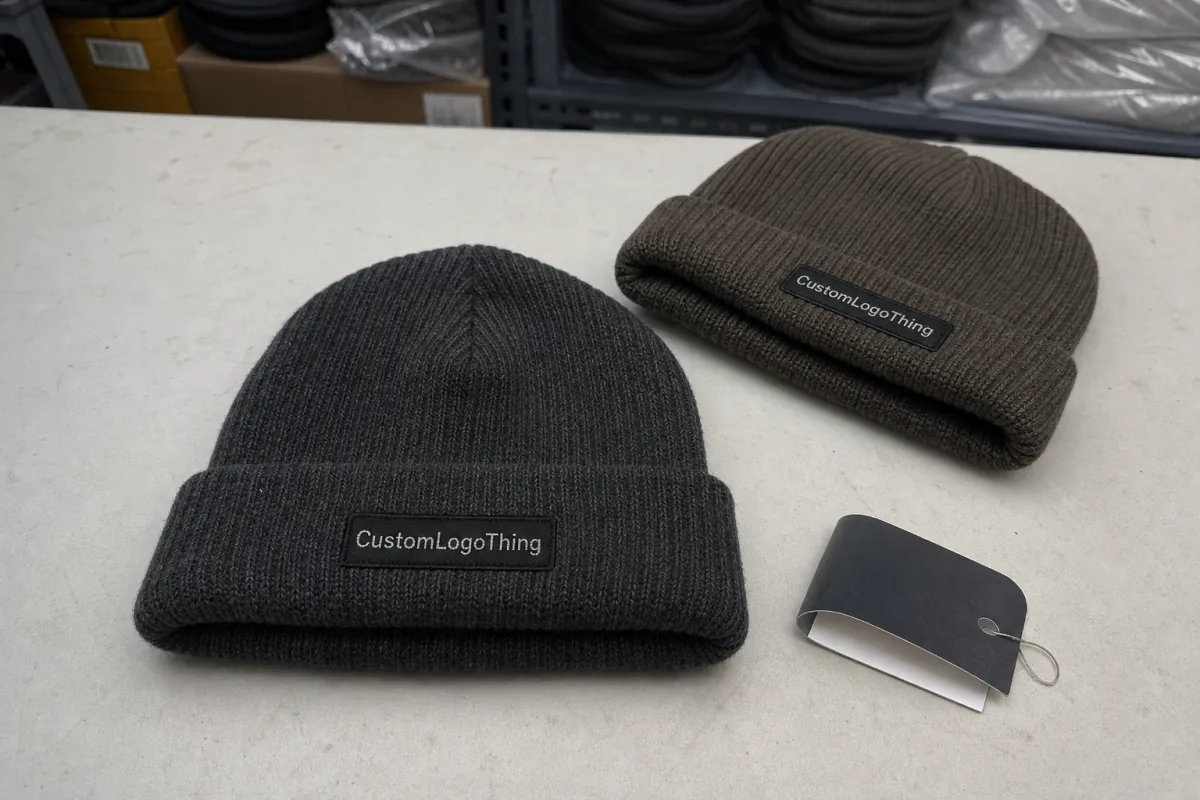
The decoration zone should be decided before anyone starts asking for a quote. On a ribbed knit, fit controls how the logo reads in the real world. The fabric stretches horizontally and vertically. That sounds minor until a logo that looked centered on a screen shifts across the knit once the beanie is worn. A tidy render can turn into an awkward, compressed mark in production if the surface was never measured.
Cuffed beanies are usually the safest choice because the cuff creates a flatter, more stable front panel. Think of it as a temporary billboard on a moving surface. The cuff gives the logo a place to sit. Uncuffed styles can look cleaner and more modern, but they leave less room for decoration and more room for distortion. A small logo on a tight rib can disappear into the texture. A large logo can stretch into a shape that looks fine in a digital proof and too wide on the actual garment.
For most electronics buyers, the use case decides the fit. Staff uniforms need enough front space for a clear mark. Trade show giveaways need a compact design that will not look oversized on different head shapes. Retail bundles need a knit that keeps its structure after packing and unpacking. Service teams usually care more about comfort and warmth than about a bold decoration method, which is a hint that the logo should stay simple.
- Staff uniforms: choose a cuffed rib with enough front space for a simple, high-contrast logo.
- Trade show giveaways: keep the decoration compact so the beanie looks balanced on different head sizes.
- Retail bundles: prioritize shape retention after repeated wear, folding, and repacking.
- Service teams: favor warmth, comfort, and low-profile branding that does not interfere with daily wear.
The biggest mistake is approving a quote before checking whether the cuff height, crown shape, and stretch range actually support the artwork. Once production begins, those details are not negotiable without extra time and money. The factory is not guessing what your team intended. It is building exactly what was ordered.
That is where repeat buyers save money. A tighter spec reduces rework, avoids surprise sampling rounds, and keeps launch dates intact. It also prevents the common after-the-fact realization that the order is technically complete but practically unusable because the branding zone was too small or the fit was too loose for the intended audience.
Ribbed Beanie Features Buyers Should Lock Before Quoting
Construction comes first. A cuffed ribbed beanie gives the cleanest branding area for most logo types because the cuff acts like a stable panel. Uncuffed styles can work, but the design has less control over placement, and a small shift in stretch can change the whole look. For buyers who need consistent output across a large run, cuffed construction usually lowers risk.
Decoration method is the next decision. Embroidery, woven labels, patches, and side tabs all react differently on rib knit. Fine printed detail is usually a poor match for the texture because the knit interrupts the linework. Simple shapes hold better. Bold text holds better. Thin script and tiny iconography are the first things to lose clarity when the fabric stretches.
For electronics brands, color often matters more than people expect. Black, charcoal, navy, and heather gray are still the safest choices because they read cleanly and hide wear. They also tend to make logos easier to recognize in warehouses, service vehicles, and indoor event lighting, where bright colors can look more cheerful but less controlled. A dark beanie with a restrained logo often feels more credible than a bright novelty piece, especially for technical or field-facing teams.
Sampling should reflect wear, not just a flat proof. A design that measures well on paper can look oversized once it sits on a head, or too small once the cuff folds. That is one reason the sample stage matters so much. It is the closest thing to reality before production locks in quantity. In practice, a sample is less about perfection than about revealing where the first assumption was wrong.
Most buyers are ordering one of four versions: staff uniforms, retail bundles, trade show giveaways, or winter service kits. Those uses should drive the decoration choice. Woven labels usually make sense for retail because they are subtle and consistent. Embroidery is often best for staff gear because it reads clearly and feels durable. A patch can add surface area for detailed logos, but it also adds structure and weight, which may not suit a lighter knit.
Packaging deserves the same attention. If the order needs branded inserts, ask whether the paper stock has to meet a sourcing standard such as FSC. If the cartons must survive longer freight routes or stacked warehouse storage, the packing plan should reflect testing methods such as those published by ISTA. The beanie itself may be soft, but the supply chain around it is not.
Specs That Prevent Rework in Production
Material choice is where budget and hand feel start to separate. Acrylic remains the default because it is affordable, warm enough for promotional and uniform use, and easy to source in volume. Acrylic-wool blends usually feel better and drape more naturally, though they push the price up. Recycled yarn can support a sustainability story, but buyers should expect more variation in color match and texture from supplier to supplier. The recycled label does not remove the need for testing.
Buyers should ask for more than “one size fits most.” That phrase is too soft for a production order. Confirm actual measurement ranges, especially if the beanies are intended for larger adult heads or mixed teams. Ask about rib gauge, cuff height, crown shape, stitch density, and stretch recovery. If those details are missing, the order can drift quickly. A small change in knit density can make the same cap feel shallow, loose, or tight.
A useful spec sheet usually includes the following:
- PMS references or clear color references for yarn and decoration.
- Logo placement with exact distance from the cuff edge and centerline.
- Label type such as woven label, patch, side tab, or embroidery.
- Sample match for knit weight, color, and hand feel.
- Packaging plan including polybag count, carton packing, and insert cards.
Packaging is not a side note. Too much compression can flatten the cuff and warp the logo before the box is opened. Too little packing consistency wastes receiving time and makes rework more likely. If the cartons are built for one route but shipped on another, the contents may arrive technically complete and visually tired. That is a poor trade.
Color control also needs realism. Yarn dye lots can shift slightly, especially across replenishment runs or if a supplier is mixing fiber sources. A good buyer asks how the supplier handles lot matching and whether the sample is a true production sample or only a pre-production reference. Those are not the same thing. One can look correct and still leave a mismatch after the full run begins.
The most useful quality-control checks are not glamorous. They are measurement checks, color checks, stitch consistency checks, and a simple review of logo alignment on a worn sample. If the logo stays centered when the knit stretches, the order is in better shape than most buyers realize. If it does not, the rest of the quote is noise.
Cost, Pricing, and MOQ Breakpoints
Unit price usually drops as quantity rises, but only while the order stays simple. Add custom yarn colors, complex decoration, special labels, or retail packaging and the discount curve bends fast. For electronics Ribbed Winter Beanies Bulk Order planning, landed cost matters more than the headline quote. Freight, samples, setup fees, and remake risk belong in the same conversation as the unit price.
MOQ breakpoints vary by decoration method and factory capacity. Blank stock may start around 50 to 100 pieces. Embroidered cuff orders often sit around 100 to 300 pieces. Woven labels, patches, and custom retail packaging can push minimums higher, often 300 to 500 pieces or more. That is not arbitrary. Setup time, thread changes, label prep, and packing labor all shape the floor.
| Option | Typical MOQ | Unit Price Range | Lead Time | Best For |
|---|---|---|---|---|
| Blank stock ribbed beanie | 50-100 | $2.90-$4.40 | 5-10 business days | Fast fills, emergency needs, simple giveaways |
| Single-color embroidery on cuff | 100-300 | $4.80-$7.20 | 10-15 business days | Staff kits, service crews, clean brand placement |
| Woven label or side tab | 300-500 | $5.60-$8.60 | 12-18 business days | Retail bundles, subtle branding, repeat orders |
| Patch plus custom polybag | 500+ | $6.90-$10.80 | 15-22 business days | Retail-ready packaging and higher perceived value |
Those ranges are useful, but they are not guarantees. Special yarn colors can add cost. Rush timelines can add cost. Sample rounds can add cost. Shipping can add more cost than the decoration itself if the order is small or the destination is far from the production point. A quote that looks lean on paper can become expensive once the missing line items appear.
Ask for three pricing tiers every time: a low run, a mid run, and a target quantity. That exposes the breakpoint instead of hiding it in a single number. If the supplier only gives one price and refuses to show the quantity steps, the savings are probably coming from assumptions that will not survive approval. A buyer should know where the break occurs before the budget is set.
A practical comparison also includes sample cost, packing, freight assumptions, and remake policy. That matters because two quotes with the same unit price can produce very different final totals. One may include packing and a clear sample path. Another may leave those out and quietly recover the difference later. The invoice is where the truth usually arrives.
Process, Timeline, and Production Steps From Mockup to Delivery
A clean workflow is usually the fastest one: brief, mockup, sample, approvals, production, quality control, packing, and shipping. Skip a step and the order slows later. The most common delay is not manufacturing. It is decision drift. One team wants the logo smaller, another wants the color darker, and a third wants the packing changed after the sample is already approved.
A realistic schedule often looks like this:
- Brief and quote: 1-3 business days if artwork and quantity are clear.
- Mockup and revisions: 2-4 business days, longer if placement is still being debated.
- Sampling: 7-12 business days, more if custom colors or label approvals are involved.
- Production: 12-20 business days after approval, depending on order size and decoration method.
- Shipping: 3-7 business days domestic, longer for consolidated freight or peak season.
Those windows can stretch. Winter orders often run into crowded freight schedules, slower approvals, and end-of-year backlog. A buyer planning a staff rollout or a seasonal retail launch should work backward from the needed date, not forward from the first promise. If the beanies are needed before a cold-weather event, build buffer time. Weather does not care that the order is still in sample review.
Delays usually cluster in the same places. A final logo file is missing. A department signs off late. Someone notices the cuff looks too shallow only after the proof is approved. Procurement asks for a price recheck after the sample is already underway. None of that is rare. It is the predictable cost of letting decisions arrive out of sequence.
Good suppliers will usually ask sharper questions about packing and transit. If they reference ISTA methods, ask how the cartons are expected to perform under stacking, moisture, and handling pressure. That question matters more than it sounds. The beanie may be a soft item, but the order spends most of its life in boxes, not on heads.
Responsibility also needs to be assigned early. Marketing should approve the look. Procurement should approve the price. Operations should approve the timing and receiving plan. If those lanes are blurry, the order slows no matter how strong the production side is. Clear ownership is often the difference between a tidy shipment and a week of last-minute changes.
What Makes a Supplier Worth Keeping on Repeat Orders
Repeat ordering becomes easier when the supplier keeps records properly. Artwork files, measurement notes, color references, prior approvals, and packing instructions should survive the first order and carry into the second. For electronics ribbed winter beanies Bulk Order Planning, consistency is the point. If the next run feels different from the first, the relationship starts to cost attention, and attention is usually the first thing buyers do not have enough of.
The best suppliers are also honest about what rib knit can and cannot support. They do not pretend every decoration method works on every cuff depth. They explain why a fine-line logo will blur, why a patch may sit awkwardly on a shallow front, or why a heavy label can drag on a lighter knit. That kind of answer is more useful than enthusiastic agreement. A supplier who says yes to everything is usually saving the real answer for later.
Transparent tolerances matter. So do real sample photos. Buyers should know what is included in the quote: setup, sample cost, packing, label attachment, and whether freight is separate. If those items are left fuzzy, the order will often grow more expensive after approval. Hidden charges do not improve with time. They just become harder to challenge.
For repeat programs, the best outcome is not the lowest first-run number. It is a second and third order that match the first without fresh firefighting. That means the beanie looks the same, feels the same, and lands on time with the same label placement. Small savings on the front end disappear fast if the team has to re-approve the product every season.
What to Send for a Fast, Accurate Bulk Quote
The fastest quotes come from the clearest briefs. Quantity, delivery deadline, color choice, logo file, decoration method, and packaging needs are the base inputs. If any of those are missing, the quote is probably a guess. Buyers often ask for a price first and send the details later, but the reverse usually saves time and avoids revision loops.
Be specific about the version you need. Blank stock, custom labeling, and retail-ready packaging all sit in different price bands. A plain beanie is not the same product as a bagged, labeled piece with an insert card and shelf-ready presentation. They may share the same yarn, but they do not share the same labor or packing cost.
Ask for tiered pricing, sample timing, and shipping assumptions in the same message. Confirm the delivery address. Confirm whether the quote includes freight, duties, and packing, or only the factory price. If that is unclear, the final number can move farther than expected. Some suppliers quote FOB only. Some include packing but not export fees. Some spell it out cleanly. Others leave the buyer to discover the missing pieces later.
A practical quote request usually includes:
- Quantity: target run and backup tier.
- Color: exact shade or closest-match request.
- Artwork: vector file, text treatment, and placement notes.
- Decoration: embroidery, woven label, patch, or side tab.
- Packing: individual polybag, insert card, carton count, and any retail requirements.
- Timing: sample date, ship date, and delivery deadline.
That level of detail cuts the guessing out of the process. It also makes it easier to compare quotes on equal footing. If one supplier prices a full retail-ready pack and another prices a bare beanie, the numbers are not competing. They are talking about different products.
For buyers sorting through multiple programs, the goal is not to make the order complicated. It is to make the variables visible before anyone commits. That is the difference between a controlled bulk buy and a sequence of avoidable revisions.
FAQ
How do I choose the right MOQ for electronics ribbed winter beanies?
Match the MOQ to the actual use case: staff rollout, event giveaway, or retail sell-through. Ask for tiered quotes at 100, 300, and 500 units so the breakpoints are visible. Do not chase the lowest MOQ if sample, setup, and freight costs erase the savings.
Which decoration method works best on ribbed winter beanies for electronics brands?
Embroidery, woven labels, and patches usually hold up better than tiny printed details. Keep the artwork simple because rib stretch can distort fine text and thin lines. A cuff placement often gives the cleanest branding area and the most reliable repeat result.
What lead time should I plan for a bulk beanie order?
Plan for sample approval first, then production, then shipping; each stage can move separately. Simple orders move faster, while custom colors, labels, and winter peak season add delays. Build buffer time before a launch date so the shipment is not arriving after the campaign.
What drives unit cost most in a bulk ribbed beanie quote?
Quantity, decoration complexity, and packaging usually move the price more than buyers expect. Custom yarn colors, rush jobs, and extra labeling can increase the landed cost quickly. Ask for pricing with and without add-ons so you can see where the margin goes.
Can I mix colors or logos in one bulk beanie order?
Color mixes are sometimes possible, but each extra color can change the MOQ or pricing tier. Multiple logos usually mean extra setup or approval time, even if the base beanie stays the same. If you need variety, decide that before quoting so the factory does not rebuild the order later.