Buyer Fit Snapshot
| Best fit | Embossed Rigid Boxes Manufacturer projects where brand print, material claims, artwork control, MOQ, and repeat-order consistency need to be specified before quoting. |
|---|---|
| Quote inputs | Share finished size, material target, print colors, finish, packing count, annual reorder estimate, ship-to region, and any compliance wording. |
| Proofing check | Approve dieline scale, logo placement, barcode or warning zones, color tolerance, closure strength, and carton packing before bulk production. |
| Main risk | Vague material claims, crowded artwork, missing packing details, or unclear freight terms can make a low unit price expensive after revisions. |
Fast answer: Embossed Rigid Boxes Manufacturer: Board, Finish, Dieline, and Unit Cost should be specified like a repeatable production item. The safest quote records material, print method, finish, artwork proof, packing count, and reorder notes in one written spec.
Production checks before approval
Compare the actual filled-product size with the drawing, then confirm tolerance on folds, seals, hang holes, label areas, and retail display edges. Reserve space for logos, QR codes, warning copy, and material claims before decorative graphics fill the panel.
Quote comparison points
Review material grade, print process, finish, sampling route, tooling charges, carton quantity, and freight assumptions side by side. A quote is only useful when the supplier can repeat the same color, closure quality, and packing count on the next order.
Two boxes can hold the same serum kit, the same watch, or the same candle set. One lands and gets forgotten. The other has a little swagger. That gap usually comes down to the Embossed Rigid Boxes manufacturer behind it. Get the structure, pressure, and surface treatment right, and the box feels more valuable before the lid even opens. That is the job. Not decoration for decoration's sake. Control.
For brands comparing premium packaging options, the difference between a flat printed carton and an embossed rigid box is obvious the second you touch it. A serious Embossed Rigid Boxes manufacturer is thinking about board thickness, wrap paper, tooling depth, foil registration, and fit all at once. Those details matter because luxury is usually precision wearing a nice jacket. If you want to compare other custom packaging formats, Custom Packaging Products is a practical place to look at rigid boxes, mailers, and presentation-focused options. About Custom Logo Things explains how the team handles custom packaging support.
A raised logo is not the finish. It is the result of board, paper, die pressure, and artwork discipline lining up at the same time. If one piece is off, the box looks expensive for a second and ordinary after that.
That is why the best projects are never treated like surface decoration alone. A good embossed rigid boxes manufacturer balances visual impact with structural discipline, so the box protects the product, holds up in retail, and delivers a consistent unboxing experience from the first sample to the last carton in the run. I have seen beautiful concepts fall apart because the board was too soft or the wrap was too slick. Pretty on screen. A mess in hand. Happens all the time.
What an embossed rigid boxes manufacturer actually does
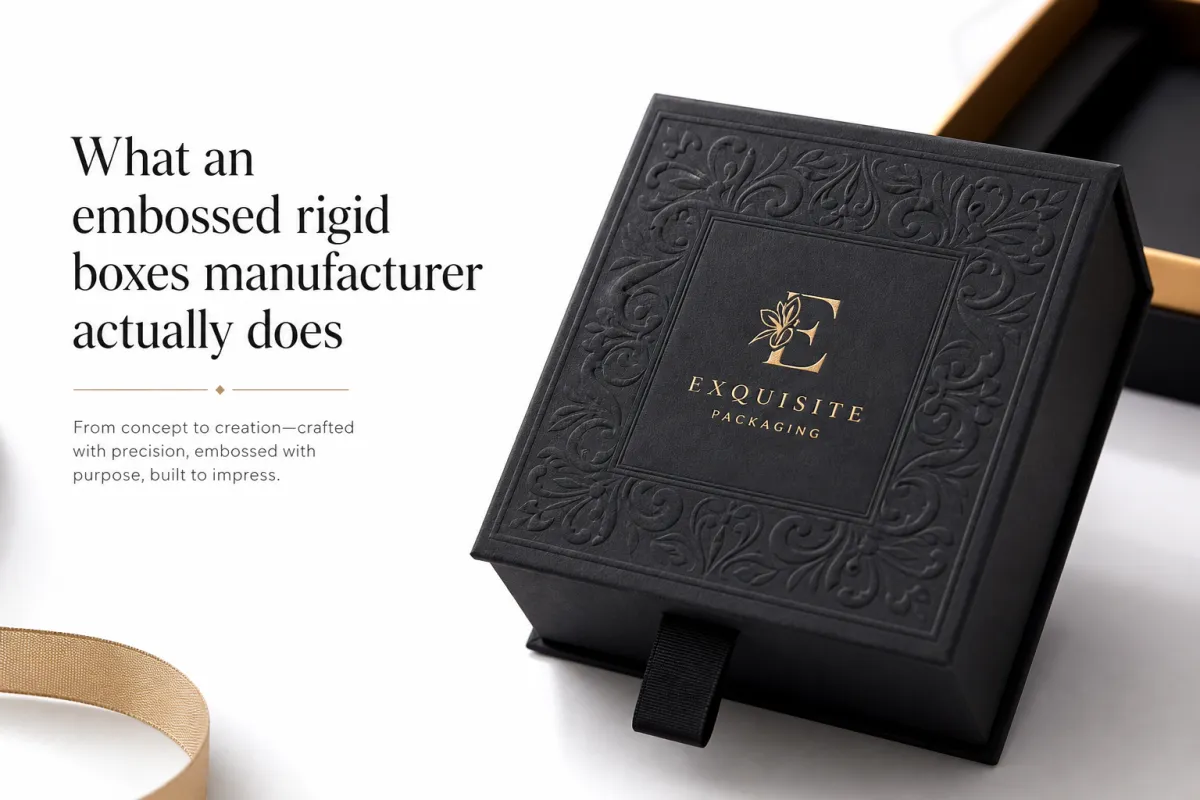
Picture two products with nearly identical contents. Same formula. Same ingredients. Same internal cost. One arrives in a plain folding carton, the other in a rigid box with a raised logo, a tight lid fit, and a wrap that catches light in a controlled way. Buyers often decide within seconds which one feels more premium. That is where an embossed rigid boxes manufacturer earns its keep.
Embossing means pressing artwork into the surface so it rises above the paper wrap. It is not the same as printing, which lays ink on top of the surface. It is also different from debossing, which pushes the design inward, and from foil stamping, which adds reflective metallic film. A skilled embossed rigid boxes manufacturer may combine all four, but each effect has a different job. Printing delivers color. Foil adds brightness. Embossing creates tactile emphasis. Debossing can create a quieter mark. Used well, the box feels intentional instead of crowded.
The rigid board matters just as much as the decoration. Folding cartons are built to fold flat, so they flex more and usually cannot hold a deep embossed detail with the same crispness. A rigid box uses dense board, often around 1.5 mm to 3 mm depending on the format, so the surface stays firm under pressure. That firmness helps the embossed area stay sharp. Weak board can flatten the effect or leave uneven edges, and the premium look disappears fast.
In practice, an embossed rigid boxes manufacturer works best for products that need presence as much as protection. Luxury cosmetics, gift sets, premium apparel, jewelry, electronics accessories, subscription kits, and limited-edition launches all fit the profile. So do high-end food items, especially when the box is part of gifting or seasonal merchandising. The packaging does not need to shout. It just needs to signal value in a controlled way.
There is another layer here that buyers miss. A serious embossed rigid boxes manufacturer is not only decorating a box; it is managing consistency across a production run. That includes lid tension, wrap alignment, emboss depth, corner wrap quality, and the way the board behaves under humidity changes. Premium packaging lives or dies on repeatability. A beautiful one-off sample is nice. A hundred matching boxes are better. A thousand matching boxes are what brands actually need.
From a buyer's point of view, that is the core difference. A vendor can print a logo. A real embossed rigid boxes manufacturer understands how the logo should feel, how much pressure the die can take, how the paper will stretch, and which coating will preserve clarity. That mix of structure and finishing control is what turns a box into a sales tool.
Embossed rigid boxes manufacturer process and timeline
The production flow usually starts long before the press or embossing station is involved. A good embossed rigid boxes manufacturer begins with a brief: product dimensions, desired opening style, target quantity, finish preferences, and the level of protection needed. If the box must hold a fragile item, a tray or insert may be built into the design. If the goal is shelf presence, the lid, side panel, or inside reveal may carry the visual weight instead.
After the brief comes structural design. This is where the dieline is created or adjusted, and where the box proportions are tuned so the product fits without rattling or binding. Then the artwork team prepares the layout for print, foil, and embossing. A embossed rigid boxes manufacturer needs clean registration here, because the raised area must land precisely where the design expects it. If the logo drifts even a little, the result can look sloppy. In luxury packaging, small alignment errors are not small.
Tool creation is the next step. The embossing die is usually made from metal, and its depth and edge definition determine how crisp the final result will be. Fine text and narrow strokes need more care than large shapes. A manufacturer with weak tooling can make a logo look swollen or soft instead of clean. That is why sample approval matters. The sample is not just a checkbox. It is the point where the brand confirms that the visual idea survives real pressure and real materials.
Typical timelines depend on complexity, but a realistic schedule often looks like this:
- Brief and quote: 1-3 business days
- Dieline or structural mockup: 2-5 business days
- Sample production and approval: 5-10 business days
- Bulk production after approval: 12-15 business days for simpler runs, longer for layered finishes
- Packing and freight planning: 2-7 business days, depending on destination and volume
The more decoration layers you add, the more time you should expect. A simple embossed logo on a standard rigid box can move fairly quickly. Add magnetic closures, multiple foil colors, internal print, custom inserts, and a specialty wrap paper, and the schedule stretches. That is normal. The press run itself is rarely the real bottleneck. Revision cycles, sample sign-off, and shipping coordination usually take more time than the actual manufacturing phase.
Registration accuracy matters especially when embossing overlaps with print or foil. Even a slight shift changes the feel of the design. A strong embossed rigid boxes manufacturer will talk openly about tolerance limits and explain whether your artwork should be simplified. That kind of honesty is useful. Tiny text, hairline borders, and dense pattern work may look elegant on screen, but not every detail survives a raised finish. If a supplier says every detail is fine, they are probably being polite instead of useful.
If a project is straightforward, the total lead time from approved artwork to packed boxes is often around three to four weeks. More complex jobs can run longer. Not because anyone is dragging their feet, but because premium packaging needs checkpoints. A good partner would rather adjust a tool than push a flawed run into production. That is the boring answer. It is also the correct one.
Cost and pricing factors when working with an embossed rigid boxes manufacturer
Pricing is where many buyers get surprised, and not always in a bad way. A well-quoted project can make sense quickly if you understand what drives the numbers. The biggest cost factors are board thickness, wrap paper grade, emboss depth, foil stamping coverage, insert design, magnet closures, and any specialty coating such as soft-touch or matte lamination. A top-tier embossed rigid boxes manufacturer will usually break those items out clearly so you can see where the money is going.
Setup costs tend to be higher on embossed work than on standard printed cartons because tooling and sampling are more involved. There is more preparation, more handwork, and more opportunity for rejection if the detail does not register correctly. The upside is that those setup costs spread out better on larger runs. That is why minimum order quantity matters. Small runs often carry a higher per-unit price even when the design is simple. The fixed labor does not disappear just because the run is short.
Here is a practical pricing comparison for typical Custom Rigid Box work. The exact numbers change by market, size, and finish coverage, but the pattern is consistent.
| Option | Typical MOQ | Approx. unit price | What usually changes the cost |
|---|---|---|---|
| Basic embossed rigid box | 300-500 pieces | $2.10-$3.80 | Single-color print, light emboss, standard wrap paper |
| Mid-tier presentation box | 500-1,000 pieces | $1.60-$2.95 | Foil logo, deeper emboss, custom insert, better paper stock |
| Premium gift or luxury box | 1,000-5,000 pieces | $0.95-$1.85 | Multi-stage finishing, magnets, tight tolerances, refined interior work |
Those ranges are useful because they show an important truth: lower-priced boxes usually simplify the finishing. Higher-end boxes do not just cost more because of brand markup. They cost more because the workflow becomes more demanding. The board has to be more stable. The wrap has to land cleaner. The emboss has to hold sharper edges. The box fit has to be tighter. The boring parts drive the price. Not the logo photo.
Another trap is hidden bundling. Some quotes fold structure, decoration, inserts, and packing into one line. That sounds tidy until you try to compare vendors. Ask for separated pricing so you can see the real cost of each component. A careful embossed rigid boxes manufacturer should be able to price the shell, the print, the embossing tool, the insert, and the outer shipper independently. That makes negotiation easier and keeps one feature from masking another.
Material choice matters more than many people expect. A smoother wrap paper can improve emboss clarity, but it can also raise the price. Soft-touch finishes feel expensive in the hand, yet they may show scuffing if the box is handled roughly. FSC-certified paper can be a strong selling point for sustainability claims, especially when a buyer wants a credible sourcing story. If that matters to your brand, look for documentation rather than marketing language alone. The FSC site is a good reference point for certification basics.
For transport testing, packaging teams often reference the ISTA family of test methods, especially when a rigid box will travel by parcel or mixed distribution. A premium finish is only useful if it arrives intact. That sounds obvious, but many first-time buyers forget to ask how the box performs under compression, vibration, and drop conditions. A sturdy structure should look good and survive the lane.
If you are comparing quotations from an embossed rigid boxes manufacturer, focus on the total package: tooling, sampling, structure, decoration, and logistics. A quote that looks lower by ten percent can become higher once you add revisions, freight, and replacements for damaged samples. The cheapest option is not always the least expensive. It just looks that way early.
Key factors to evaluate before choosing an embossed rigid boxes manufacturer
Not every supplier that says it makes premium boxes can actually deliver crisp embossing. That is the first thing to test. Ask for close-up samples, especially on fine text, small icons, and geometric patterns. These are the areas where tooling quality shows itself fast. A weak embossed rigid boxes manufacturer may produce a good-looking hero sample and still struggle with detail across a full run. That gap matters.
Next, look at process control. Does the manufacturer handle structure, print, foil, embossing, and final assembly in-house, or are those steps handed to outside vendors? Outsourcing is not automatically bad, but it adds risk. More handoffs mean more chances for delay or miscommunication. A manufacturer with more control over the chain can usually protect color consistency and registration more effectively. That does not mean every step must be internal. It does mean the team should know exactly who owns each stage.
Board selection is another quiet but important factor. A smooth, stable board supports a cleaner embossed surface. Cheap board can crush at the edges, show wavy wraps, or reduce the tactile impact of the design. If the material has too much give, the embossed area looks shallow. A seasoned embossed rigid boxes manufacturer will talk about caliper, stiffness, wrap paper, adhesive behavior, and scuff resistance, not just the pretty finish.
Repeatability is where many vendors separate themselves. One beautiful sample is useful, but only if the next fifty boxes match it. Ask for evidence from repeat orders or long-run consistency. Are the corners still tight? Does the lid fit the same way? Does the emboss depth hold from the first carton to the last? Premium packaging is not supposed to drift. If a vendor shrugs at that question, keep looking.
Sustainability deserves a careful, unsentimental look. Ask what the wrap paper is made from, whether the board is recyclable, what adhesives are used, and whether the paper comes from certified sources. A box can be designed with fewer mixed materials, which usually helps recovery at end of life. At the same time, some luxury features make recycling harder. That tradeoff is real, so it should be discussed openly. If a supplier cannot explain the material stack clearly, that is a warning sign.
Communication speed matters more than people admit. A responsive embossed rigid boxes manufacturer should translate design goals into production language without hiding behind vague promises. If you ask about emboss depth, they should answer with a range. If you ask about lead time, they should name the variables. If you ask about registration tolerance, they should not bluff. That clarity saves money because it reduces revision loops.
From a buyer's standpoint, a strong supplier should also help you compare finish choices in plain language. Sometimes the best result is not the most decorated one. A raised logo on a clean matte wrap can outperform a box covered in competing effects. The goal is not to do everything. The goal is to do the right few things well.
Step-by-step: How to order embossed rigid boxes
The cleanest projects usually start with a tight brief. Before contacting an embossed rigid boxes manufacturer, define the product dimensions, target quantity, budget ceiling, expected shelf role, and the kind of unboxing you want. Are you trying to protect a delicate product? Create a giftable moment? Improve retail display? The answer changes the box structure, the insert design, and the finish level.
Once the brief is set, ask for a dieline or structural mockup early. This avoids the common mistake of building artwork first and trying to force it onto a box shape later. Packaging should not be an afterthought layered onto the product. It should be designed around the product from the beginning. That is especially true with a embossed rigid boxes manufacturer, because emboss positioning depends on the available flat areas, lid geometry, and wrap margins.
After that, approve material and finish samples before full production. This sounds basic, but it saves a lot of trouble. Emboss depth, paper texture, and foil reflection change when you see them in hand. A screen cannot tell you how the surface catches light across a shelf or how it feels after three seconds of handling. A sample can. If the sample is not right, adjust before the full run. Do not wing it. Packaging is too expensive for guesswork.
A good timeline usually includes clear checkpoints:
- Confirm box size, insert type, and finish stack.
- Approve the dieline and artwork placement.
- Review a physical sample or prototype.
- Lock the production spec sheet.
- Start bulk production only after written approval.
- Inspect packing method and ship-date window before dispatch.
That last step matters more than many teams realize. A box can leave the factory looking perfect and still arrive damaged if the outer packing is weak. Ask about carton strength, palletization, and whether the boxes are wrapped to prevent rub marks. A diligent embossed rigid boxes manufacturer should have answers for all of that.
It also helps to create a simple comparison sheet Before You Buy. Track tooling cost, sample speed, finish options, unit pricing, and lead-time promises side by side. This is where the vendor list becomes usable. If one supplier can do more in-house, another offers better paper quality, and a third has a sharper foil result, you will see the tradeoffs clearly instead of relying on instinct alone.
For brands with tighter budgets, one smart tactic is to put the finish on the panel that gets photographed most often. The lid or front face usually matters more than the inside tray. If the interior is only seen during the first reveal, you can keep that area simpler and spend more on the visible exterior. A good embossed rigid boxes manufacturer will not push decoration everywhere just because it can be done. Better to spend where the customer actually looks.
Finally, keep freight in the discussion from the beginning. Rigid boxes take volume. They are not flat-packed in the same way folding cartons are. Shipping cost can surprise first-time buyers, especially on overseas moves. If the quote does not include packing assumptions, ask for them. A realistic order plan is built on more than unit price.
When the process is managed well, ordering from an embossed rigid boxes manufacturer is straightforward. The hard part is not placing the order. The hard part is defining the spec tightly enough that the finished box matches the brand's intent without repeated guesswork.
Common mistakes that weaken embossed rigid box results
The first mistake is over-embossing the artwork. Dense illustrations, crowded patterns, and too many raised elements can make the surface feel busy instead of premium. Embossing works best when it has room to breathe. If every millimeter of the panel is occupied, the visual message gets muddy. A disciplined embossed rigid boxes manufacturer will usually recommend simplifying the art rather than forcing detail into a space that cannot support it.
The second mistake is ignoring registration limits. Thin lines, tiny fonts, and delicate icons often fail to emboss cleanly. They can blur, crack, or disappear under pressure. That is why a file that looks elegant on a monitor may need to be adjusted for production. The box is not a poster. It is a physical object with tolerances, paper grain, and pressure behavior. The best suppliers explain those limits early, not after the sample is already off-spec.
The third mistake is treating finishes as if they all work together automatically. They do not. A glossy foil can fight with a deeply textured paper. A heavy emboss can compete with an already busy print layout. Soft-touch lamination can enhance the feel of the box, but it may mute some visual contrast if everything else is already dark. The right finish stack depends on the design goal. One of the most useful habits is to ask how the raised logo will read at arm's length, under retail lighting, and in a phone photo. Those are different tests.
Deadline planning is another weak point. Buyers often underestimate how long sample changes take. A single tooling adjustment can move the schedule by days, and a structural revision can move it by more. If the launch date is fixed, back-plan from the delivery window rather than from the desired ship date. A careful embossed rigid boxes manufacturer will build in time for approval, packing, and transit, but only if the buyer gives enough lead time to work with.
There is also a common assumption that any rigid box automatically feels premium. Not true. A rigid box can still feel cheap if the lid fit is loose, the wrap corners are sloppy, the surface scratches easily, or the emboss sits off-center. Premium is a composite effect. It comes from structure, finish, and consistency. One strong feature cannot rescue the rest.
Another mistake is forgetting the inside. People focus so much on the lid that they leave the reveal moment underdesigned. The insert, the tray color, and the opening sequence all affect the customer experience. If the outer face is quiet but the reveal is rich, the packaging feels more thoughtful. If the outside is dramatic and the inside is generic, the emotional payoff drops.
The fix is usually not complicated. Use fewer competing effects. Check fine detail at production scale. Confirm the box fits the product without forcing it. And work with an embossed rigid boxes manufacturer that is willing to say "no" when an idea will not survive production. That kind of pushback saves projects. It also saves reputations, which brands tend to care about once the cartons are already in transit.
Expert tips and next steps for a better embossed box program
Use contrast deliberately. A raised logo reads best against a quiet background, not a crowded one. If the surface already has strong pattern, bright foil, and multiple colors, the emboss loses its authority. A better tactic is to let the embossed area own the moment. That simple design discipline is one reason a strong embossed rigid boxes manufacturer can make a box feel more expensive without making it louder.
Prioritize the touchpoint that matters most. For some brands, that is the lid reveal. For others, it is the front panel on shelf. For gifting products, the inside of the lid may be the most memorable location. Not every surface deserves the same amount of effort. The point is to direct attention, not scatter it.
If budget is tight, spend on the panel people actually see in photos or in retail display. That often means the top lid or the front face. You can keep the other sides simpler and still achieve a high-end result. This is one of the most practical ways to work with an embossed rigid boxes manufacturer without overbuilding the box.
It also helps to compare suppliers on more than price. A simple scorecard can keep the process objective:
- Tooling quality and emboss crispness
- Sample turnaround time
- Material options and paper quality
- Lead-time reliability
- Clarity of communication
- Consistency on repeat orders
Use that list to shortlist one or two serious vendors, not ten. Too many options can slow a packaging decision down until the launch date starts driving the conversation. A focused review works better. Then request samples, compare finish quality in hand, and confirm the production schedule before placing the order. That is the most reliable path when you want a custom box that feels designed, not assembled from a catalog of effects.
One more practical note: if you are selling into channels that care about sustainability claims, ask your embossed rigid boxes manufacturer for a material declaration. Recyclability depends on the full structure, not just the paper wrap. A box with magnets, mixed films, and certain adhesives may not behave the same as a paper-only solution. The details are worth understanding before the marketing team writes the final claim.
For brands building a premium line, the best next step is simple. Shortlist one embossed rigid boxes manufacturer, request samples, compare the depth and sharpness of the emboss, review the structural fit, and lock the timeline before the project drifts. Then document the approved spec in one place so the second run matches the first. That is how you keep the box looking intentional instead of lucky.
Frequently asked questions
What should I ask an embossed rigid boxes manufacturer before requesting a quote?
Ask about minimum order quantity, tooling costs, sample charges, and whether structure and finishing are handled in-house. Share product dimensions, target quantity, finish preferences, and any artwork constraints so the quote reflects the real job. A good embossed rigid boxes manufacturer should be able to tell you where the main cost drivers are before anything goes to sample.
How does an embossed rigid boxes manufacturer price small vs. large runs?
Small runs usually cost more per unit because setup, tooling, and sampling are spread over fewer boxes. Larger runs lower the unit price, but only if the design stays consistent and does not require extra revisions. If the artwork is likely to change, make that clear early, because a embossed rigid boxes manufacturer can only hold pricing steady when the specification stays stable.
How long does the embossed rigid box production process usually take?
Simple projects can move faster, but custom tooling, sample approval, and complex finishes add time. The most reliable schedule comes from locking artwork, structure, and finish details before bulk production starts. In many cases, a full project runs about three to four weeks from approval to packing, though a more layered job can take longer with a good embossed rigid boxes manufacturer.
Can embossed rigid boxes work for products beyond luxury retail?
Yes; they also work well for subscription sets, corporate gifts, launch kits, candles, tech accessories, and premium food items. The key is matching the box structure and finish level to the product's price point and customer expectations. A practical embossed rigid boxes manufacturer will adjust the design so the box supports the product instead of overpowering it.
What files should I prepare before contacting an embossed rigid boxes manufacturer?
Prepare product dimensions, logo files, artwork direction, quantity targets, finish ideas, and any reference boxes you like. If possible, include a dieline request and a short spec sheet so the manufacturer can quote and sample faster. The more specific the brief, the easier it is for an embossed rigid boxes manufacturer to price accurately and avoid unnecessary revisions.
If you want the short version, here it is: the right embossed rigid boxes manufacturer gives you more than a decorated shell. It gives you repeatable structure, accurate embossing, predictable lead times, and a better chance that the first sample and the final shipment feel the same in the hand. Start with a tight spec, approve a physical sample, and lock the production details before the run begins. That is the cleanest path to premium packaging that actually behaves like premium packaging.