Buyer Fit Snapshot
| Best fit | Embossed Rigid Boxes Wholesale for Premium Shipping projects where brand print, material claims, artwork control, MOQ, and repeat-order consistency need to be specified before quoting. |
|---|---|
| Quote inputs | Share finished size, material target, print colors, finish, packing count, annual reorder estimate, ship-to region, and any compliance wording. |
| Proofing check | Approve dieline scale, logo placement, barcode or warning zones, color tolerance, closure strength, and carton packing before bulk production. |
| Main risk | Vague material claims, crowded artwork, missing packing details, or unclear freight terms can make a low unit price expensive after revisions. |
Fast answer: Embossed Rigid Boxes Wholesale for Premium Shipping should be specified like a repeatable production item. The safest quote records material, print method, finish, artwork proof, packing count, and reorder notes in one written spec.
Production checks before approval
Compare the actual filled-product size with the drawing, then confirm tolerance on folds, seals, hang holes, label areas, and retail display edges. Reserve space for logos, QR codes, warning copy, and material claims before decorative graphics fill the panel.
Quote comparison points
Review material grade, print process, finish, sampling route, tooling charges, carton quantity, and freight assumptions side by side. A quote is only useful when the supplier can repeat the same color, closure quality, and packing count on the next order.
Embossed Rigid Boxes Wholesale for Premium Shipping
Premium products can arrive intact and still feel cheap. The item survives. The box does its job. The brand gets a shrug. That gap is exactly why Embossed Rigid Boxes wholesale matters. It protects the product, keeps the presentation sharp, and gives the shipment a finished look without turning the pack-out into a circus.
Why embossed rigid boxes wholesale win in premium shipping
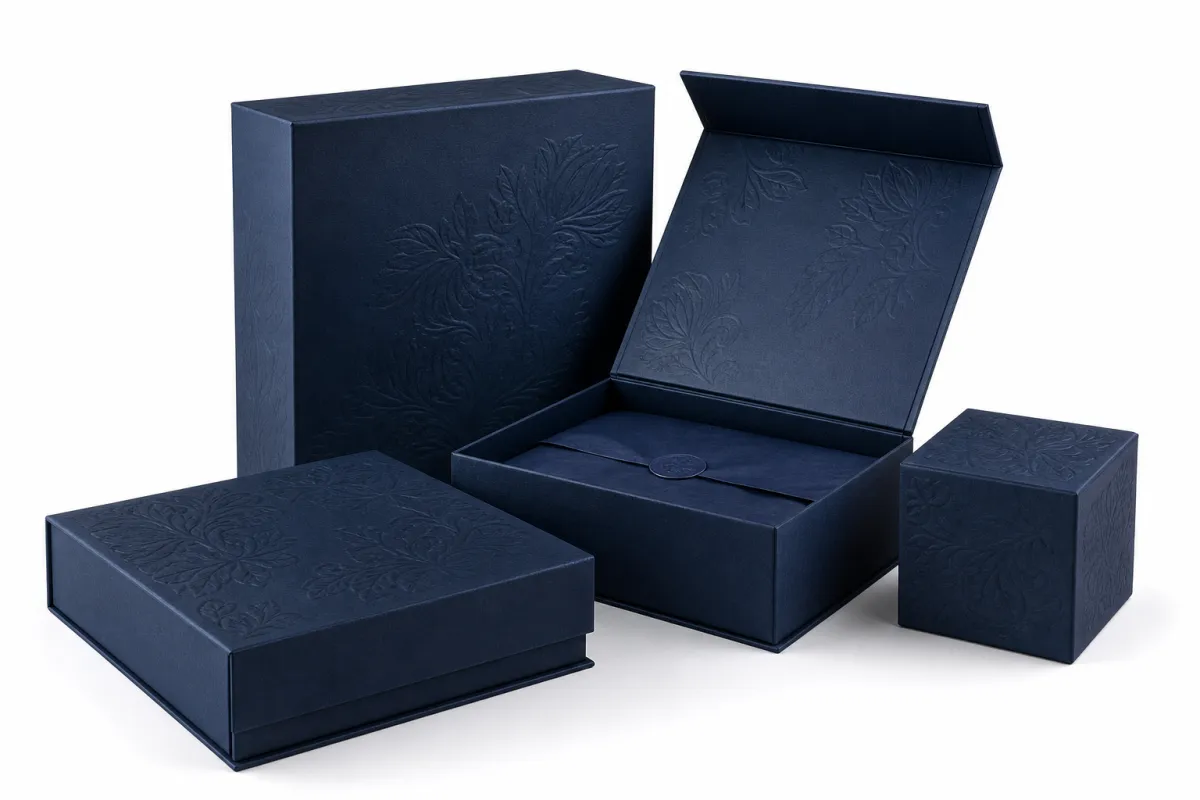
Embossed Rigid Boxes wholesale solves a packaging problem that shows up everywhere: the product gets there safely, but the packaging forgets to make the sale. Brands notice it even when customers do not say it out loud. A customer opening a fragrance set, skincare kit, luxury accessory, or corporate gift is already deciding whether the purchase feels worth the money. A folding carton can protect the item. A rigid box can protect it better. Embossed rigid boxes wholesale does both, then adds a tactile cue that says somebody paid attention.
Rigid construction helps in transit. The board wall resists compression better than lightweight cartons, so corners stay cleaner and lids keep their shape through sorting, stacking, and last-mile handling. That matters for subscription kits, luxury samples, and e-commerce orders that may get touched by half a dozen people before they reach the doorstep. I have seen boxes look perfect on a sample table and then come back from shipping with crushed edges because the structure was too soft for the route. Cheap packaging always finds a way to make itself known.
Embossing adds another layer. A raised logo or pattern gives the customer something to feel immediately. That often does more for perceived quality than another pass of full-color printing. Fancy ink is nice. Texture is what people remember. And yes, that little bump on the lid can change how a box feels in hand fast.
Buyers compare embossed rigid boxes wholesale with lower-cost mailers and ask whether the upgrade is really necessary. The better question is what the box has to do. If it only needs basic containment, a mailer may be enough. If the packaging has to support premium positioning, reduce extra gift wrap, and keep the brand presentation consistent across replenishment orders, rigid usually earns its keep. A sleeve, tissue wrap, or insert card can still help. They just do not have to carry the whole show.
That is why this format shows up again and again in products where unboxing affects repeat purchase or reseller confidence:
- premium cosmetics and skincare
- fragrance and personal care sets
- electronics accessories and branded tech gifts
- corporate gifting and employee welcome kits
- subscription launches and limited-edition samples
- luxury retail replenishment orders
In business terms, embossed rigid boxes wholesale improves three things at once: perceived value, shipping consistency, and the odds that the package gets photographed, shared, or remembered. That is not fluff. It is merchandising living inside a logistics decision.
There is one more reason the format keeps getting approved by serious teams: it reduces arguments downstream. Fewer dents. Fewer repacks. Fewer “why does this look cheaper than the product inside?” complaints from sales or customer service. That alone is worth the trouble on higher-value orders.
Embossed rigid boxes wholesale: materials, finishes, and structure
The build matters as much as the decoration. A good embossed rigid boxes wholesale order starts with the board, because the board controls how the box holds its corners, how clean the emboss reads, and how much stress the structure can take in shipping. Most buyers work from greyboard or chipboard in the 1.5 mm to 3 mm range, with 2 mm common for premium presentation boxes and 3 mm used more often where the box needs extra heft or has to protect heavier contents. The outer wrap is usually a printed or specialty paper stock around 157 gsm to 200 gsm, though heavier wraps show up on larger panels or where stronger visual coverage matters.
Embossing is not a single setting. It can be minimal, or it can be sharply controlled. Blind emboss is the cleanest choice for logos and patterns because the raised shape does all the work. Registered emboss lines up with printed artwork, which helps when the logo outline needs to sit exactly on a printed mark. Deep emboss gives stronger relief, but it needs careful setup so the wrap does not crack or distort. In embossed rigid boxes wholesale, moderate emboss depth is often the best commercial choice. It gives texture without inviting production drama.
Finish choices change how the emboss reads. Matte lamination keeps reflections down and makes the raised logo easier to see and feel. Soft-touch film adds a velvet-like hand-feel, though it can scuff if warehouse handling is rough. Uncoated wraps bring a more natural look and suit craft-driven brands, but they are less forgiving when the shipment gets handled more than once. Foil can work well beside embossing, but restraint helps. A full foil field can fight the tactile detail and turn the box into a loud little argument.
Common structure options include:
- Two-piece lid-and-base for classic presentation and easier packing
- Book-style rigid boxes for premium reveals and controlled opening
- Magnetic closure boxes for higher-end gifting and retail sets
- Drawer styles for accessories, samples, and multi-piece kits
- Shoulder-neck boxes for a more layered, luxury opening experience
Insert selection affects both transit stability and the feeling inside the box. EVA is common when the product needs precise retention. Molded pulp fits brands looking for a more recyclable interior. Foam still has a place for fragile items, though many buyers now prefer paperboard dividers or custom cavities when the shape allows it. For embossed rigid boxes wholesale, the insert should do more than look tidy. It should stop movement during parcel handling and keep the product in the same position every time it arrives.
For buyers comparing transit performance and certified material supply, the industry guidance from ISTA and fiber sourcing standards from FSC are worth keeping nearby. Those references help separate packaging that looks premium on a sample table from packaging that is actually ready for shipping. They also help procurement teams ask better questions, which is half the battle.
One practical detail gets overlooked all the time: the emboss has to work with the wrap, not against it. A tight corner, a deep relief, and a glossy laminated sheet can fight each other. The result is usually a tiny crease that nobody wanted. Not fun. Not mysterious either.
Specifications buyers should lock in before quoting
The quickest way to get a useful quote for embossed rigid boxes wholesale is to remove ambiguity early. Start with product size. Not “about this size.” Not “roughly fits.” Exact dimensions matter because rigid packaging is built around fit, clearance, and insert depth. A product that is 148 mm long, 92 mm wide, and 38 mm tall needs a very different cavity than one that is 150 mm by 100 mm by 45 mm. Even a few millimeters can change the insert, the lid height, and the shipping carton plan.
Artwork details need the same treatment. Buyers should specify logo size, emboss location, line thickness, Pantone targets, and whether the box needs foil or spot UV in addition to the emboss. Thin lines often disappear in production if the relief is too shallow or the artwork is too dense. Fine features need breathing room. Bold marks behave better. A clean logo on the lid is usually safer than a crowded decorative field, especially on first-time embossed rigid boxes wholesale orders.
Surface requirements matter too. The quote should say whether the interior must be printed, whether the edges need color wrapping, whether the finish should be matte or soft-touch, and whether the box has to resist scuffing during warehouse handling. A brand shipping direct-to-consumer every week has different needs from one using the Boxes for Retail display only. If cartons will be picked, packed, and relabeled many times, the surface needs more durability than a one-time gift presentation.
Logistics specs get skipped all the time, and that is where budgets drift. Good embossed rigid boxes wholesale planning includes pack-out count, master carton size, pallet configuration, and dimensional weight expectations. A compact box may look cheaper on paper but cost more in freight if the outer shipper is oversized. A slightly larger nested pack-out can sometimes reduce damage and lower the landed cost because it improves pallet efficiency. Those tradeoffs should be priced, not guessed.
A solid sample checklist usually includes:
- physical prototype or white sample
- pre-production proof with final artwork placement
- fit test with the actual product or a dimensionally equivalent dummy
- closure test to confirm lid strength and opening tension
- transit check using the planned outer carton or master pack
For brands that want to align with recognized transit testing, ISTA protocols such as 3A are often used for parcel shipments, while other programs fit heavier or more complex freight paths. The point is not to over-engineer. The point is to verify that the box does the job before the full run starts.
A decent brief also answers a few boring questions that save everyone time: Do you need assembled boxes or flat-packed components? Will the order ship to one warehouse or several? Does the product need room for seasonal labels or region-specific inserts? The answer changes price more than people expect.
Embossed rigid boxes wholesale pricing and MOQ
Pricing for embossed rigid boxes wholesale comes down to a few variables that stack fast: box size, board grade, wrap material, emboss complexity, insert type, foil coverage, and how many setup steps the build requires. A simple two-piece rigid box with blind emboss and a standard paper wrap usually lands lower than a magnetic closure box with multiple inserts, deep emboss, and foil registration. That sounds obvious. Still, people underestimate how much each extra process adds. One more finishing pass can change labor time and yield in a hurry.
MOQ works the same way. Lower volumes usually carry higher unit prices because tooling, setup, color checking, and assembly effort get spread across fewer boxes. In embossed rigid boxes wholesale, a small run makes sense for launches, seasonal gift sets, or test markets. Once quantities rise, the economics improve quickly because the setup cost gets diluted. Bigger runs also tend to improve freight efficiency and reduce production interruptions, provided the design stays stable.
For planning, these ranges are common in the market, though the final quote depends on exact specs:
| Build type | Typical MOQ | Planning range per unit | Best use case | Notes |
|---|---|---|---|---|
| Two-piece rigid box, blind emboss | 500-1,000 units | $1.20-$2.10 | Premium samples, gifts, starter launches | Lower decoration cost, simpler assembly |
| Matte or soft-touch rigid box with foil | 1,000-3,000 units | $1.75-$3.20 | Retail replenishment and DTC shipping | Foil and finish choice affect waste and setup time |
| Magnetic closure with insert | 2,000-5,000 units | $2.40-$4.80 | Corporate gifting and luxury kits | More labor, stronger presentation, higher assembly control |
| Drawer or shoulder-neck style | 3,000+ units | $3.00-$6.50 | High-end launches and premium set packaging | Layered structure increases build time and pack complexity |
Hidden costs deserve a seat at the table. Special color matching, multiple sample revisions, custom inserts for each SKU, and split shipments to several warehouses all change the final number. A brand can get a low unit price and lose the savings in freight, rework, or extra handling. That is why embossed rigid boxes wholesale should be judged on landed cost, not just factory price.
There are cleaner ways to hold the budget without flattening the presentation. Standardize insert sizes across related products. Keep the dieline consistent across SKUs. Use one finish pass instead of two when the design allows it. Simplify the interior if the exterior already carries the brand message. Those choices usually save more than chasing a tiny discount on paper stock. Also, do not keep changing the art every time the sample comes back. That is how schedules go sideways.
For buyers comparing packaging categories directly, the Wholesale Programs page is a useful starting point, and the broader Custom Packaging Products catalog can help determine whether a rigid box fits the job or whether another structure will ship more efficiently.
Process and timeline for embossed rigid boxes wholesale orders
The order path for embossed rigid boxes wholesale is simple if the brief is clean. It usually starts with inquiry intake, then specification review, quote, artwork confirmation, prototype, approval, production, packing, and freight booking. Time in each stage depends on how fast the buyer responds and how complex the box is. A clean two-piece box with a simple blind emboss moves faster than a magnetic closure box with printed interiors, foil, and a molded insert.
Most delays come from avoidable mistakes. The biggest one is incomplete specifications. If the product dimensions change after the quote, the insert has to change too. If artwork changes after proof approval, the emboss plate or die may need adjustment. If a buyer requests a new color match after sampling, the sample cycle often starts again. For embossed rigid boxes wholesale, each revision has a real schedule impact because rigid packaging is not assembled like a folding carton. It takes more handwork. More handwork means more ways to lose time.
A realistic timeline usually looks like this:
- Quote stage: 1-3 business days for a complete brief
- Sample or prototype: 5-10 business days depending on complexity
- Artwork and proof approval: 2-5 business days if feedback is decisive
- Production: often 12-18 business days after approval for standard runs
- Freight booking and dispatch: additional time based on route, season, and destination
That schedule can stretch during peak packaging periods or if the order includes several custom elements. It can also tighten when the build is simple and the buyer approves quickly. The main move is to plan backward from the shipment date instead of forward from the quote date. That keeps surprises down and protects print quality.
Shipping logistics belong in the schedule, not in a separate bucket. Master carton planning, palletization, export documentation where required, and route booking all affect arrival time. If the order crosses borders, customs timing should be built in early. If it goes to multiple warehouses, split delivery instructions should be agreed before production starts. Embossed rigid boxes wholesale designed with freight in mind usually reaches the buyer with fewer handling issues and less receiving-side rework.
Progress updates should be specific. Buyers should expect proof status, sample photos, QC checkpoints, and a clear shipment window. Vague status notes do not help anybody in packaging procurement. A good supplier should be able to say what stage the order is in, what has been approved, and what still needs to happen before loading. If they cannot explain that clearly, that is a warning sign, not a personality quirk.
One small rule saves a lot of pain: freeze the structural specs before you obsess over the last 5% of decoration. The structure is the part that breaks, rattles, or shifts. The foil is just the pretty shirt.
Why choose us for embossed rigid boxes wholesale
Custom Logo Things is built for buyers who need packaging that looks premium and ships like somebody actually planned the supply chain. Embossed rigid boxes wholesale is not only decoration. It is repeatable execution. That means consistent emboss depth, controlled board compression, clean corner wrap, and a closure that still feels solid after handling and freight. When those details are right, the box supports the product instead of distracting from it.
Most buyers do not want mystery. They want clarity. They want to know whether the board will hold up, whether the emboss will read sharply, whether the insert will keep the item centered, and whether the shipper can pack the order in a way that saves cost without creating damage. That is the practical difference between a generic packaging quote and a well-scoped embossed rigid boxes wholesale order.
A buyer does not pay for embossing alone. The value is in the combination: better presentation, cleaner transit performance, and fewer surprises at receiving.
There is also a supply-chain benefit to working with a specialist. Material guidance is more accurate. Sampling is easier to compare. Production risks are easier to spot before full run approval. If the order needs to support multiple SKUs, the structure can often be standardized so the brand gets scale without losing appearance. That matters for teams managing retail replenishment and direct-to-consumer shipments under the same packaging program.
If your sourcing team needs more than a pretty render, ask for clear specs: board thickness, wrap stock, emboss style, insert material, pack-out count, and freight assumptions. That is the level of detail that makes embossed rigid boxes wholesale usable in real operations. It also keeps comparison shopping honest, because every quote can be judged on the same basis.
For brands that value fast answers, transparent lead times, and practical recommendations instead of vague premium language, Custom Logo Things is set up to help with both quote development and production planning. The goal is not to oversell. The goal is to get the box right the first time.
We also try to be honest about trade-offs. A deep emboss looks great, but it is not always the smartest option for a thin wrap or a fragile surface. A lower-cost insert may work fine for one SKU and fail completely for another. Real packaging work is mostly decision-making, not magic.
Next steps for embossed rigid boxes wholesale buyers
If you are preparing an order for embossed rigid boxes wholesale, the fastest path is to gather the inputs that affect price and production most. Start with product dimensions, target quantity, artwork files, preferred finish, insert requirement, and delivery address. If the product has fragile points, note them. If the box has to fit inside an outer shipper, include that measurement too. The more complete the brief, the more accurate the quote.
Then compare suppliers on the same variables. A strong quote should show unit price, sample cost, MOQ, lead time, carton packing assumptions, freight basis, and revision policy. If one quote is much lower, check whether it excludes inserts, proofing, or shipping coordination. In embossed rigid boxes wholesale, a low number only matters if it covers the whole job.
The fastest approval process usually follows a simple sequence: request a sample, verify fit and emboss quality, confirm the dieline, and approve artwork before production begins. That order keeps the project from bouncing backward. It also helps the buyer catch issues early, which matters because rigid packaging is hard to adjust after the run is underway.
A practical rule helps here. If the box will ship often, prioritize structure and pack efficiency first. Then refine the finish and decoration. A beautiful box that cracks in transit is a poor decision. A slightly simpler box that holds its shape, displays the logo cleanly, and lands safely is better business. That is why embossed rigid boxes wholesale keeps earning space in premium shipping programs: it balances presentation with real-world performance.
Send the specs, ask for a sample plan, and request a timeline in one message. That single step usually saves the most time. If the brief is complete, the next quote for embossed rigid boxes wholesale can move from estimate to production plan quickly, with fewer revisions and a cleaner path to shipment. If you want the order to land well, that is the move. No drama, no guesswork.
The takeaway is simple: lock the dimensions, pick the structure that fits the product weight and route, and confirm the emboss depth before you chase finishes. Do that, and the box will do its job without making procurement miserable.
What is the typical MOQ for embossed rigid boxes wholesale?
MOQ depends on size, structure, and finishing complexity. Simpler builds can usually start lower than highly decorated formats, while deeper embossing and custom inserts often require larger runs because setup and tooling costs need to be spread across the order.
How long does embossed rigid boxes wholesale production take after approval?
After artwork and sample approval, production timing usually depends on order size, finish count, and whether custom inserts are included. Add extra time for freight booking, peak-season capacity, and any revisions that happen after the proof stage.
Which products ship best in embossed rigid boxes wholesale packaging?
The strongest fit is premium merchandise that needs both protection and presentation, such as cosmetics, fragrance, gifts, electronics accessories, and PR kits. The format works especially well when the unboxing moment influences repeat purchase or reseller perception.
How much do embossed rigid boxes wholesale orders cost per unit?
Unit cost is driven by box size, board thickness, emboss depth, print coverage, inserts, and total quantity. Pricing usually improves as volume rises, but extra finishes and multiple production steps can offset some of the savings.
Can embossed rigid boxes wholesale survive e-commerce shipping?
Yes, when the structure, insert, and master carton are designed for transit rather than display alone. For parcel shipping, confirm drop protection, corner strength, and pack-out efficiency before placing a full order.


