For event merch teams, OPP Header Bags are attractive because they are light, clear, and easy to stack. The warning label is usually the part that decides whether the pack is usable or gets held for revision. A glossy proof can hide a weak label; a strong label survives handling, lighting, and the quick glance a floor manager gives it before distribution.
Clear packaging creates a false sense of simplicity. OPP, or oriented polypropylene, looks straightforward because the film is transparent and the header panel is easy to brand. The catch is that the warning label carries more weight than the bag itself. If the copy is too small, too faint, or placed across a fold, the order can fail even when the packaging looks polished on screen.
That is the practical reality behind the event merch teams OPP Header Bags Warning Label guide search. Buyers are not only choosing a bag size. They are trying to protect a distribution plan, a compliance review, and a very short production window. One weak decision in the artwork stage can undo the whole order later.
Why warning labels matter more than the bag itself
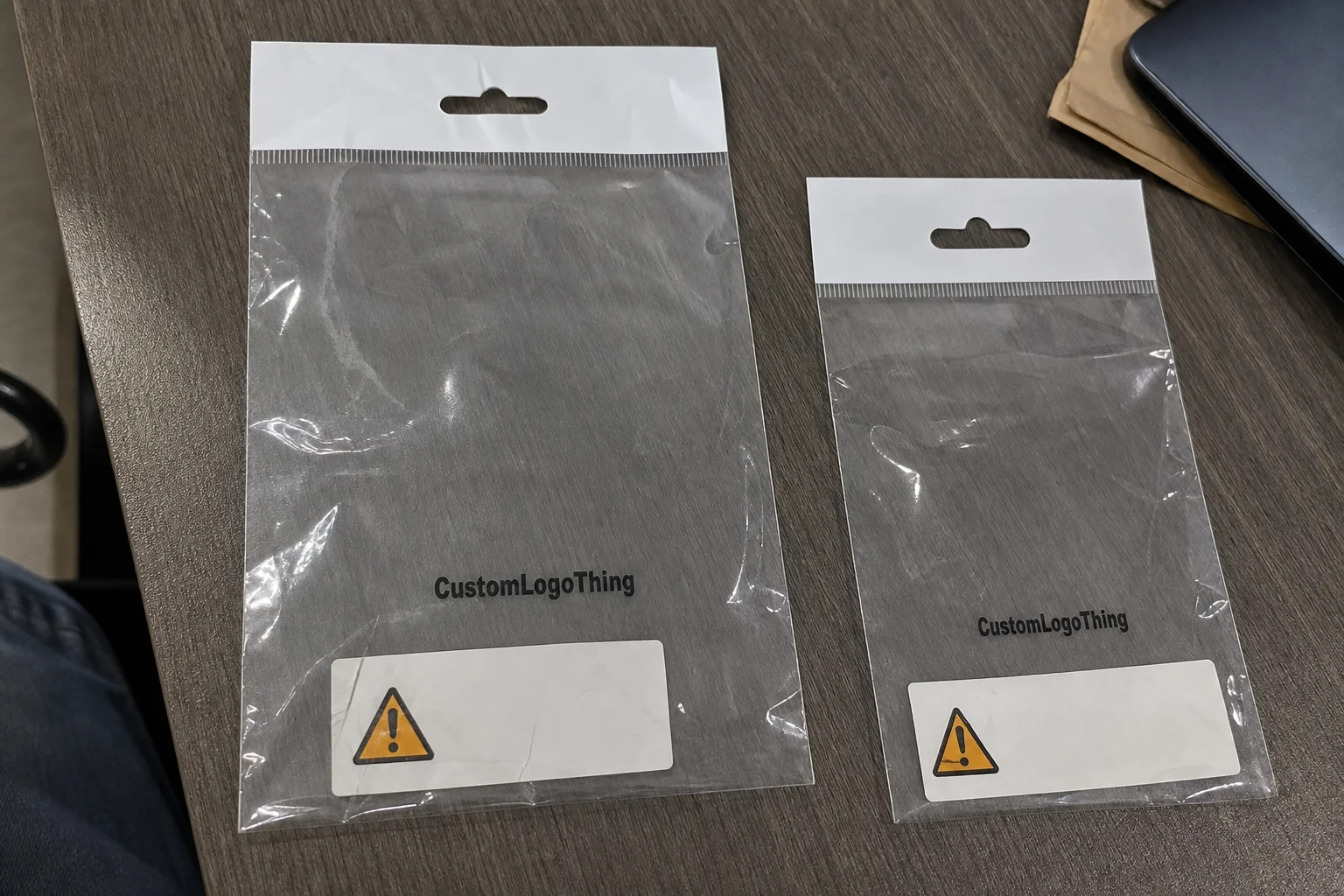
OPP header bags are popular in event merchandising because they present well, resist the wrinkled look that some softer films develop, and make the product inside visible without extra effort. The top header gives the pack structure, a place for hanging or stacking, and a clean surface for branding. That is the visible part.
The less visible part is the label. If the warning copy is required by product category, venue rules, or internal safety review, the bag cannot do its job until that text is correct. Buyers often approve the film, dimensions, and print quality first, then discover that the label needs more room than expected. By then, the artwork is already crowded. Every correction costs time.
It helps to think of the warning label as a structural element rather than a decorative one. It must survive sealing, shipping, unpacking, and the rougher handling that happens at registration tables and merchandise counters. The label also has to be read under mixed lighting, from an arm's length or less, by people who are moving quickly. That is a higher bar than a clean-looking proof.
A bag can look finished and still be wrong. If the warning text cannot be read without effort, the pack is not really finished.
For event programs, the strongest pack is usually the one that balances presentation with a label that can be verified quickly. If the label is carrying the compliance burden, keep the rest of the bag spec simple enough to leave room for it. That is one reason buyers often pair the header bag with Custom Labels & Tags instead of trying to squeeze every detail into a single printed panel.
Event merch teams OPP header bags warning label guide essentials
The first decision is the label format. The warning can be printed directly on the header, applied as a separate adhesive label, integrated into a hang-tag style insert, or built into a pre-printed panel. Each option changes the workflow. Direct printing is efficient for repeatable runs. Separate labels add flexibility. Hang-tag hybrids improve visibility but add assembly steps. Pre-printed panels make sense only when the copy is stable enough to justify the setup.
The next decision is placement. The top header is usually the safest zone because it remains visible after packing and sealing. A label on the body may look tidy in the proof and still disappear once the pack is stacked, folded, or taped into cartons. A label that crosses a crimp or seal band is riskier still. Even a slight distortion can reduce legibility enough to cause a revision.
Material choice matters too. OPP has excellent clarity, but the surface finish of the label stock can work against it. High-gloss labels may reflect venue lighting. Thin translucent stocks can reduce contrast. A simple matte or satin label often reads better than a more decorative finish, especially when the text is small. If the label must stay readable in humid or refrigerated environments, adhesive strength should be checked early rather than assumed.
There is also the question of film thickness. Event-grade OPP header bags commonly sit in a practical range around 30 to 40 microns, though the exact spec depends on the product weight and how aggressively the bags will be handled. Thinner film can lower cost, but it tends to feel less forgiving on crowded loading tables. Slightly heavier film usually costs more and can improve presentation. Neither choice fixes a bad label.
One detail buyers miss: warning copy is not only about compliance. It also helps warehouse staff and event crews sort product faster. Clear labeling reduces mis-picks, helps separate SKUs, and keeps mixed kits moving through packing tables. In a live event environment, that operational value is real. A label that reads well is easier to distribute, easier to audit, and easier to defend if questions arise later.
For teams that need broader context on packaging standards and material handling, the Association for Packaging and Processing Technologies is a useful industry reference. If sustainability claims need to be substantiated, the Forest Stewardship Council remains one of the clearer starting points for paper and board sourcing, though it does not replace product-specific verification.
Compliance factors that shape the final spec
The final spec is usually determined by five variables: product category, warning language, label size, placement, and contrast. If any one of those is vague, the proof may look acceptable while the finished pack still misses the requirement. That is why experienced buyers do not start with artwork. They start with the rule set.
The rule set is not always obvious. Sometimes it comes from consumer safety guidance. Sometimes it comes from venue policy, partner standards, or internal legal review. A merch pack for apparel inserts does not carry the same risk as a kit that includes cosmetics, batteries, or another item that triggers caution text. Different products create different expectations, and a template from last month may not be valid this month.
Language also matters. Dense copy should be avoided where possible, but it cannot be oversimplified to the point that it becomes unclear. Type size, line breaks, and spacing often decide whether the label reads cleanly at actual size. A phrase that looks reasonable in a PDF may shrink into a blur once it is placed on a small header panel. Black text on a clear or lightly tinted field remains the safest default in most cases because it holds contrast better than gray, metallic, or reversed-out text.
If a program runs across different regions, review the label early for language variations and any local formatting expectations. Multilingual copy can quickly consume space, and the temptation to compress it too far usually creates a worse result. In practice, a cleaner hierarchy beats a crowded block of text. Title, warning line, and supporting note should be visually distinct, not merged into one paragraph of equal weight.
One useful check is physical, not digital. Print the warning text at true size, place it on a sample bag or mock-up, and read it from the distance staff will actually use. If the copy only works under perfect light and close inspection, it is too fragile. If it is still legible when the bag is slightly bent or held at an angle, the spec is probably sound.
That same check should include the seal line. Many delays come from labels that overlap the fold or seal edge by just enough to distort the lettering. On a monitor, that overlap looks harmless. In production, it creates exactly the sort of problem that gets flagged after the order is already moving.
Process and timeline: from proof to production
A workable process starts with a complete brief. The bag dimensions, film thickness, warning copy, and label placement need to be locked before proofing begins. If the briefing is incomplete, the proof cycle expands. Someone adds a note, someone else notices a compliance gap, and the project drifts into another round of revisions.
The cleanest sequence is simple: finalize the copy, place it on the dieline, approve the digital proof, review a sample if the pack is sensitive, and release production. A physical sample is not always required, but it becomes more valuable when the label is small, the run is large, or the event is high-traffic and timing is tight. The sample reveals the things a PDF cannot, such as glare, stiffness, and how the label behaves after sealing.
Most delays happen upstream. Late legal review can hold a proof that was otherwise ready. A missing ingredient list or caution line can stop the job before production begins. Changes after sample approval can trigger a second approval loop. The printer is often blamed because the order is visible there, but the real problem usually starts earlier.
Lead time depends on the specification, but a typical custom run for standard labeled header bags often lands around 12 to 15 business days after proof approval. Smaller jobs can move faster if the artwork is already final and the label format is straightforward. Larger quantities, special inks, extra finishing, or separate label application can add time. Rush work is possible in some cases, but rush work and frequent copy changes do not mix well.
If the warning label is changing across locations or event dates, build that variability into the schedule rather than trying to absorb it later. A separate adhesive label can be a good choice for that reason, even if the unit cost is slightly higher. The extra flexibility often protects the timeline more effectively than the cheapest fixed print option.
Version control deserves more attention than it usually gets. A lot of rework comes from someone reviewing an outdated proof, not from the art itself. Keep one master file, one approval trail, and one clear signoff point. That discipline sounds basic because it is basic. It also saves days.
Cost, pricing, and MOQ drivers buyers should watch
Pricing for labeled OPP header bags is driven by a small group of variables: size, film thickness, print coverage, label count, assembly method, and total quantity. The wider the header panel, the more room there is for branding and warnings, but the greater the setup complexity. Thicker film usually costs more. More print coverage costs more. A hand-applied label costs more than an in-line print if labor is involved.
MOQ matters because the fixed costs are spread across the run. A small order carries more proofing, setup, and coordination cost per unit. A larger order usually lowers the unit price, sometimes sharply. That said, the cheapest per-piece quote is not always the best buy if the event count is uncertain or the warning language may change before the next run.
| Option | Typical use | Cost profile | Operational tradeoff |
|---|---|---|---|
| Printed warning on header | Repeat events with stable copy | Lower handling cost and better efficiency at scale | Harder to change once the artwork is locked |
| Separate adhesive label | Variable campaigns and mixed SKUs | Often higher unit cost, especially in small runs | More flexible, but it adds application time |
| Hang-tag hybrid | Premium presentation or extra information | Higher material and assembly cost | Good visibility, more labor involved |
| Pre-printed header panel | High-volume recurring orders | Best unit economics once the design is stable | Least flexible if warnings change |
For rough budgeting, many buyers see custom labeled event packs land somewhere around the low cents to low double-digit cents per unit at scale, with small runs and more complicated label systems moving higher. That range is wide for a reason. One extra color, a specialty adhesive, or a manual label application step can change the quote more than the bag film itself.
Hidden costs are usually the real problem. Artwork changes after proof approval, emergency reprints, and added review cycles are more expensive than a slightly better initial spec. So are jobs that require the supplier to sort out a vague label hierarchy after the order has already been scheduled. If the brief is unclear, the quote may look attractive while the total project cost creeps up later.
Buyers comparing vendors should keep the input set identical across quotes. Same dimensions, same film thickness, same warning text, same label format, same quantity, same deadline. Otherwise the numbers are not directly comparable. A lower quote on a different job spec is not evidence of better pricing. It is evidence of a different job.
Common mistakes that trigger reprints or delays
The most common mistake is treating the warning label as a final-minute add-on. That nearly always creates friction. The design gets approved visually, and then compliance enters the conversation once the layout is already crowded. At that point, every change is expensive because the pack has become a near-final object instead of a flexible draft.
Low contrast is another recurring issue. A label can look fine on a bright monitor and still disappear under venue lighting or on the glossy surface of a clear bag. Fine type, thin weights, and pale colors are the usual culprits. A second problem is the label placed over a seam or fold line. That seems minor until the bag is stacked, compressed, and handled several times before distribution begins.
Teams also approve mockups without testing them at true size. A header bag is small enough that margins matter. What feels spacious in a PDF can become cramped in the hand. If the warning copy is long, it should be simplified before it is squeezed smaller. Shrinking type is not the same as improving the layout.
Another avoidable error is reusing a past spec without checking whether the current product still matches it. Event merch programs change quickly. A kit that used to hold one item might now hold three. A label that once fit comfortably may no longer cover the current content. Copying an old file without confirming the current SKU is one of the fastest ways to generate revision notes.
And then there is the issue of mixed approvals. If marketing, legal, operations, and a venue partner all review the same proof through different channels, the version count can get out of control. One person signs off on one file, another comments on a different one, and the final print file ends up being a compromise no one actually approved. That is not a production problem. It is an internal process problem.
Strong buyer discipline usually fixes most of this. Lock the text early. Check it at actual size. Verify the placement against the true seal line. Confirm that the label stock suits the finish of the bag. Those steps are less dramatic than a rush reprint, but they are the reason the order leaves on time.
Next steps for event merch teams ordering OPP header bags
Start with the product category and warning language. Those two items determine the rest of the spec. Once they are settled, choose the label format that fits the event rhythm. Stable copy favors a printed header. Variable copy favors a separate label. If the kit is premium or needs extra information, a hang-tag hybrid may be justified, but only if the added assembly time is acceptable.
Ask for a digital proof first. Then request a physical sample if the label is small, the text is dense, or the pack will be handled in a high-traffic environment. Sample checks are especially useful for first-time programs because they reveal fit, glare, and handling issues that are easy to miss in artwork review. A good proof can still produce a bad real-world result if the scale is wrong.
For repeat orders, build a reusable template and keep the warning copy version-controlled. That reduces reapproval time and makes pricing easier to compare across events. It also prevents the kind of drift that happens when each location edits the same layout separately.
The most useful way to use this event merch teams OPP Header Bags Warning Label guide is as a comparison tool. Treat each quote as a spec, not a price line. Compare the same bag, the same label method, the same warning text, and the same quantity. Only then does the unit cost tell you anything real.
Good labeled packaging does not draw attention to itself. It moves the product cleanly, survives the event floor, and avoids unnecessary review. That is usually enough.
What should event merch teams check in an OPP header bags warning label guide?
Check the warning language, label size, placement, contrast, and final bag dimensions before requesting quotes. The label should be evaluated against the actual product category, not against a previous order that may no longer match.
Do warning labels go on the header or the bag body?
Most teams place the warning on the header panel or another clearly visible zone so it remains readable after sealing and handling. The body can work in some cases, but it is easier to lose visibility once the pack is stacked or distributed quickly.
How does MOQ affect pricing for OPP header bags with warning labels?
Smaller MOQs usually raise the unit price because setup, proofing, and review costs are spread across fewer pieces. Larger runs usually lower the price per bag, but only if the artwork and warning copy are already final.
What causes delays in the production timeline for labeled header bags?
Late legal review, missing warning copy, and artwork changes after proof approval are the most common causes. Rush orders still need approval, so speed depends more on final decision-making than on the print run itself.
Can a single label template work for repeated event merch orders?
Yes, if the product category, warning text, and bag dimensions stay consistent. A reusable template shortens approval time and usually improves cost predictability across recurring events.
For event merch teams, the practical lesson is simple: lock the copy early, verify the label at actual size, and compare quotes on the same spec. That is the difference between a pack that looks right in a proof and one that actually works on the table, in the carton, and at the event.


