Flat Bill Snapbacks material guide decisions look straightforward until the first sample lands with a soft crown, a bill that starts to curl, or embroidery that pulls the front panel out of square. The fabric matters, but so does the structure wrapped around it: visor board, front support, stitch density, closure hardware, and even the carton it rides in during transit.
Material Choices That Change Shape, Feel, and Finish
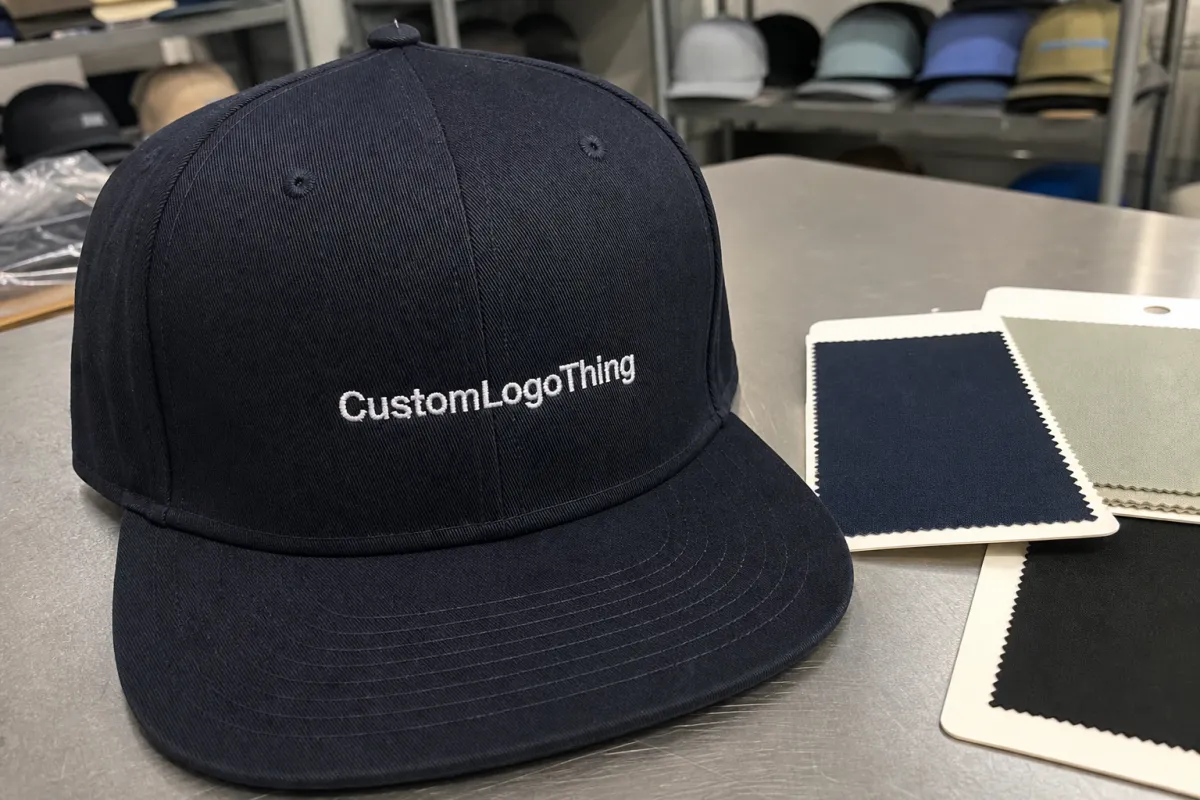
A flat bill can look sharp on a spec sheet and still lose its edge after a few days in a packed warehouse, a humid event tent, or a carton that was stacked too high. That is why a Flat Bill Snapbacks material guide has to do more than list fabrics. It needs to show how the cap will hold its profile, how it will take decoration, and how much value it signals before anyone tries it on.
The material choice starts with use case. A streetwear drop can tolerate a heavier hand and a firmer crown because the buyer often reads structure as quality. A team or event program may need better comfort, cleaner color consistency, and a price that stays controlled across a larger run. A premium retail cap usually has to do both: hold shape and look refined under bright store lighting.
That is why snapbacks should be treated as small engineered products, not just fabric goods. The front panels, visor board, seam construction, and closure all depend on the base material behaving in a predictable way. If the fabric is too soft, the crown collapses. If it is too rigid, the hat can feel boxy or hot. Either way, the silhouette starts to work against the logo.
For most buyers, the useful comparison is not “which fabric sounds best,” but which one balances three things:
- Structure - does the crown stay upright after packing and wear?
- Surface - does the fabric support embroidery, patches, or print without distortion?
- Perceived value - does the cap look right for the target price and channel?
Cotton twill is familiar and comfortable, but it can absorb moisture and show wear sooner. Polyester twill usually holds color better, resists wrinkling, and gives a cleaner surface for repeat use. Cotton-poly blends sit in the middle and are often the safest default when the cap needs broad appeal. Wool or acrylic blends tend to feel more premium and can help a cap keep a stronger, more dimensional silhouette.
Fabric weight matters as much as fiber content. A midweight twill in the 240-300 gsm range often lands in a useful zone for structured snapbacks. Go lighter and the cap may breathe better, but the front can telegraph every weakness in the build. Go heavier and the hand feels richer, though the inside can turn stiff or warm if the rest of the construction is overbuilt.
Finish changes the read too. A matte surface usually feels more casual and can hide small irregularities. A smoother or slightly brushed finish often reads cleaner at retail, especially on darker colors where surface quality becomes obvious fast. The right answer depends on the audience, not on a universal rule.
How the Crown, Brim, and Closure Depend on Fabric
The crown is the first place a weak material shows itself. Front panels that are too soft will sag, lose height, and flatten out after packing. Front panels that are too stiff can create a square look that seems forced rather than premium. The sweet spot comes from the combination of fabric, interfacing, and how the panels are sewn together.
Most structured Flat Bill Snapbacks rely on some form of buckram, fusible interfacing, or reinforced front panel construction. One weak part can undo the rest. A good face fabric with a weak visor board can still arrive with a bill that curves under pressure. A strong visor with underbuilt front panels can leave the logo sitting on a crown that caves in around it.
The brim does more than stay flat. It controls the visual line of the hat. If the board inside the visor is too thin, the bill can flex during shipping and settle into a bend the buyer never asked for. If it is too heavy, the cap may feel stiff in hand and awkward in wear. In practice, the bill is the difference between a crisp profile and one that looks tired before it has sold.
A flat bill is a shape problem before it is a style choice. Once the crown softens, the logo shrinks visually and the cap reads less finished.
The closure matters as well. Plastic snap closures are common because they are light, adjustable, and inexpensive, but they still need to match the rest of the build. Too rigid, and the fit range narrows. Too loose, and the rear of the cap sits strangely against the head. Metal buckles and strap systems can feel more premium, but they may change both cost and production time.
Decoration sits inside the same system. Dense embroidery pulls on light fabric. Woven patches hold up better on a stable front panel than on a soft one. Heat transfers need a smooth, consistent surface or they start to wrinkle and lift. In other words, the fabric is only part of the decision. The full build has to support the decoration you actually plan to sell.
What to Compare Before You Request Samples
Comparing fabrics by name alone is a fast route to a bad sample round. Cotton is not automatically better because it feels familiar. Polyester is not automatically better because it sounds technical. The better approach is to compare weight, finish, color behavior, and decoration compatibility before you ask a factory to cut anything.
Start with the wear profile. If the cap will be used outdoors, moisture handling and colorfastness matter more than a soft hand feel. If it will be worn for long stretches, breathability becomes more important. If the end use includes repeated packing and shipping, wrinkle resistance and recovery move up the list. Those details sound small until the first return shipment comes back with crushed front panels.
Decoration compatibility is often underestimated. A thick embroidery file on a thin cotton face can pucker around the stitch line. A smooth polyester surface can carry that same logo much more cleanly. Patches, chenille, appliques, and print each stress the fabric in a different way. A surface that looks ideal for one method can fail under another.
Color matters in a way buyers often discover too late. Strong brand colors can drift after heat exposure, sunlight, or a wash cycle. A black cap with a slight sheen can look premium in one lighting setup and artificial in another. Ask for physical swatches, not just digital approvals, and check them in both indoor and daylight conditions.
There is also a practical budget question. A cap that is intended for a short promotional run can usually live with a simpler fabric and more basic interior trim. A retail piece has to justify its shelf price from the moment it is handled. The difference between “acceptable” and “worth paying for” often comes down to surface quality and how well the crown holds its line.
Use a simple comparison table to narrow the field before sampling:
| Fabric family | Typical feel | Shape retention | Best fit | Cost effect |
|---|---|---|---|---|
| Cotton twill | Soft, familiar, casual | Moderate | Lifestyle merch, everyday wear | Usually mid-range |
| Polyester twill | Smoother, more technical | Strong | Uniforms, events, repeated use | Often efficient at scale |
| Cotton-poly blend | Balanced, versatile | Good | Mixed use, broad audience | Usually stable |
| Wool or acrylic blend | Heavier, more premium | Strong | Retail drops, elevated branding | Higher, but often justified |
That table only helps if you connect it to the decoration and the audience. A fabric can win on paper and still disappoint in hand. The sample stage is there to prove or disprove the assumption.
Production Steps and Timeline
A clean tech pack saves time. The factory needs fabric content, fabric weight, panel count, crown height, visor shape, closure type, logo placement, and packing instructions before the first sample is cut. If any of those items are vague, the sample round turns into a guessing game, and guessing is expensive.
The usual workflow is straightforward: brief, fabric sourcing, pattern confirmation, sample construction, revisions, and bulk approval. The problem is that one late change can touch every other part of the process. A custom dye lot adds time. A different closure adds sourcing work. A logo treatment that is not already in the factory’s standard library may need a fresh setup or an extra revision round.
Sampling time depends on what the cap is made from. Stock-material samples are often quicker because the components are already on hand. Custom fabric, special labeling, or a new front treatment usually lengthen the schedule. For planning, 7-14 business days is a common window for stock builds, while custom builds often run longer if color approval or decoration needs another pass.
Most delays come from the same places. Artwork approval drags because someone is waiting on a final file. Color references are incomplete, so the factory has to interpret the shade. The spec changes halfway through, which means the sample no longer reflects the order. By the time everyone is tired of waiting, the risk of approving the wrong material rises.
Packaging can change the outcome more than many buyers expect. If caps are shipped in loose bags inside a weak carton, the crown can pick up dents before it reaches the customer. For retail programs, ask about corrugated cardboard strength, whether the factory uses kraft paper dividers, and how the caps are supported inside the master carton. If lower-impact packaging matters, ask whether the supplier offers recycled materials, FSC certified cartons, post-consumer waste content, or biodegradable packaging for the outer packout.
For transit testing, the method library at ISTA is useful because it gives buyers a way to talk about shipment stress in concrete terms. For packaging claims, FSC helps separate verified paper sourcing from loose marketing language.
Do not approve a material based on one attractive sample if the structure raises questions. A second round is slower, but it is cheaper than discovering in bulk that the bill is too soft or the crown loses its shape after packing.
Cost and Pricing: What Moves the Quote
Snapback pricing is not driven by fabric alone. Fabric type, front panel structure, decoration complexity, closure selection, and whether the order uses stock or custom components all shape the quote. If two bids look close but one is meaningfully lower, read the spec line by line. There is almost always a reason.
MOQ changes the math quickly. A 300-piece order spreads setup costs across fewer units than a 3,000-piece order, so the unit price rises. Larger runs often unlock better fabric rates and more finishing options. The cap is the same silhouette, but the commercial reality is not.
For planning, a simple structured snapback may land around $2.25-$4.50 per unit at moderate quantities, excluding freight and some packaging upgrades. More premium builds with heavier fabric, cleaner embroidery, special labeling, or upgraded inner trim can move higher. Region, labor rates, and component sourcing all affect the final number, so the range should be treated as a guide rather than a promise.
Hidden costs are where bad comparisons happen. Sample fees, color matching, woven labels, interior taping, freight, and individual packaging can add up fast. One supplier may show a low base price and then charge separately for every detail. Another may bundle more into the quote. Ask for a line-item breakdown so you can compare landed cost, not just headline price.
Here is a useful way to read the quote:
| Decision point | Lower-cost choice | Higher-cost choice | What usually changes |
|---|---|---|---|
| Fabric | Stock cotton or poly blend | Wool blend or custom-dyed fabric | Hand feel, color control, lead time |
| Structure | Standard front support | Heavier buckram and visor board | Shape retention, shipping resilience |
| Decoration | Simple embroidery | Multi-layer patches, complex stitching | Setup time, labor, finish quality |
| Packaging | Basic polybag and master carton | Retail insert, custom sleeve, upgraded carton | Presentation, protection, cost |
The better question is not “What is the cheapest cap?” It is “What spec gives the fewest compromises at the target price?” That is the point where a buyer starts saving time, because the quote starts matching the product the team actually wants.
Common Material Mistakes That Make Caps Look Cheap
The first mistake is choosing fabric from a photo. Photos hide density, sheen, and hand feel. A glossy poly face can look premium in a rendering and artificial in daylight. A matte twill can look rich online and arrive flat if the weave is too loose. Swatches and pre-production samples are the only reliable check.
The second mistake is pairing a premium logo treatment with an underbuilt base. A clean embroidery file can still look unstable if the front panels collapse around it. A patch can be technically correct and still sit awkwardly if the bill cannot hold its line. Buyers often blame the decoration. The problem started earlier.
The third mistake is skipping wear tests. If you do not check sweat staining, pilling, crown collapse, and color shift after a few wears, you are approving appearance only. That might be enough for a short event run. It is not enough for a cap that needs to survive a retail season or a uniform program.
The fourth mistake is ignoring packaging. A hat can leave the factory looking crisp and still arrive crushed if it is packed too loosely. For shipments that need shelf-ready presentation, the carton spec matters almost as much as the cap spec. A strong outer shipper, properly sized corrugated cardboard, and a modest layer of kraft paper can protect the crown better than branding that adds no support.
Finally, do not confuse “eco” language with proof. If a supplier says the packaging uses recycled materials, ask how much. If they say FSC certified, ask for the paperwork. If they promise biodegradable packaging, ask how it behaves during humidity, storage, and transit. A green claim that cannot survive shipping is just copy.
The cheapest-looking snapback is rarely cheap because of one flaw. It usually happens when several small choices all move toward minimum effort.
How to Write a Better Supplier Brief
If you want fewer revisions and faster approvals, write the brief like a production person. Ask for the exact fabric content, fabric weight, front structure, visor board type, closure style, decoration method, and packaging spec. One page of clarity can remove a surprising amount of ambiguity.
A practical approval checklist helps keep the conversation tight:
- Fabric - content, weight, finish, and color tolerance
- Structure - front support, crown height, and bill stiffness
- Decoration - embroidery, patch type, print method, and placement
- Fit - closure type, adjustment range, and target head sizes
- Packaging - inner pack, carton spec, and retail presentation needs
Ask for at least two fabric weights side by side. A 240 gsm option and a 280 gsm option can look similar on screen and feel very different in hand. That comparison often reveals whether the cap should lean lighter for breathability or heavier for structure and shelf presence.
Document the non-negotiables. If the logo must stay centered, say so. If the bill must stay flat through shipping, say so. If the crown cannot vary beyond a small tolerance, write that down. Suppliers can work around a lot, but they cannot protect a requirement they never saw.
Separate sample fees, unit cost, and freight in every quote. That makes it easier to see whether a low price reflects efficient sourcing or a weaker spec. It also keeps the conversation on the real outcome: a cap that looks right, holds shape, and arrives ready to sell.
Used well, this flat bill snapbacks material guide turns a vague styling decision into a production brief. That is usually where the quality jump happens. Not in a fancier logo, but in a cleaner material choice and a spec that the factory can actually build without improvising.
What materials work best for flat bill snapbacks?
Cotton feels familiar and breathable, while polyester usually holds color and shape better over time. Blends are often the safest middle ground if the cap needs both comfort and a cleaner silhouette. If the goal is a more premium read, ask about wool or acrylic blends and confirm how they behave with embroidery.
How do I choose between cotton and polyester for a flat bill snapback?
Choose cotton when softness and a casual feel matter more than long-term shape retention. Choose polyester when you need stronger color consistency, quicker dry time, and better resistance to wear. For uniforms, events, or repeated use, a blend is often the more practical choice.
What drives flat bill snapbacks unit cost the most?
Fabric selection, front panel structure, and decoration complexity usually move the price most. MOQ changes the quote because setup and sourcing costs get spread across more or fewer hats. Packaging, custom labels, and freight can also add meaningful cost even when the base cap price looks low.
How long does sampling usually take for custom snapbacks?
Stock-material samples are often faster because the factory can build from existing components. Custom fabric, special dyeing, or complex logo work can add extra rounds and stretch the timeline. A good supplier should give a realistic sample and production schedule before you approve the final spec.
What should I ask a supplier before ordering flat bill snapbacks?
Ask for the exact fabric content, weight, and structure so you know what you are approving. Confirm color tolerance, shrink behavior, lead time, and whether the sample materials match bulk production. Request a Quote that separates sample fees, unit cost, and freight so you can compare offers accurately.


