For a buyer launching clean, retail-ready packaging without locking cash into inventory, frosted zipper bags Low MOQ Custom Order is a practical move, not a niche one. The logic is simple: a frosted pouch looks more deliberate than a generic clear bag, and a lower MOQ keeps risk contained while you test demand, artwork, and fit. I have watched brands spend more on storage and rework than on the packaging itself, and that usually starts with ordering too much, too early.
That combination matters across a wide range of packaging programs. Seasonal SKUs, sample kits, subscription inserts, travel items, cosmetics, apparel accessories, and small food launches all need presentation before volume. The costly mistake is usually not the bag itself. It is ordering too many units, choosing the wrong size, approving weak closure hardware, or discovering too late that the logo vanishes once it hits the film. A well-planned frosted zipper bags Low MOQ Custom Order avoids those problems before they turn into expensive inventory.
There is also a quieter benefit that gets overlooked: a low-MOQ run gives teams room to learn from real use. A mockup can tell you if the art file looks nice. It cannot tell you whether a zipper opens cleanly after repeated use, whether the product settles in the pouch the way you expected, or whether the frosted surface softens the print a little more than the PDF suggested. That feedback is kinda the whole point.
Why frosted zipper bags low MOQ custom order beats overbuying
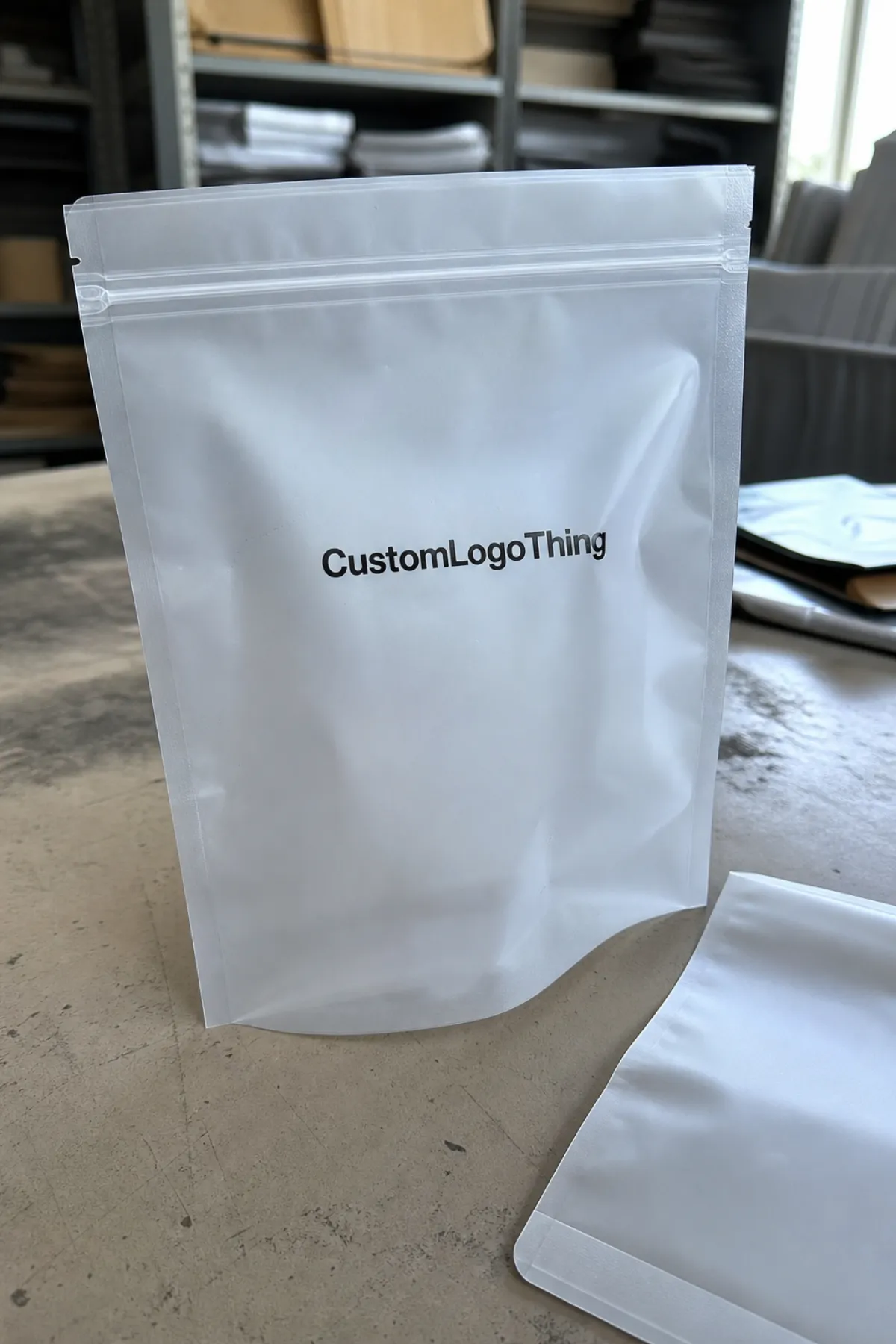
Most packaging failures begin with forecasting, not design. A brand sees momentum, assumes the next step is scale, and places a larger order to lower the unit price. Then the channel shifts, the launch slows, or the SKU changes shape. The boxes are gone from the spreadsheet, but the bags are still on a shelf, quietly turning a discount into dead stock.
Frosted Zipper Bags low MOQ custom order works better than chasing the lowest sticker price because the real cost of packaging is broader than the factory quote. Lower run sizes may raise the per-unit price, but they reduce warehouse pressure, preserve working capital, and leave room for product revisions after launch. Freight, storage, and write-offs change the arithmetic fast. A cheap bag can become the most expensive decision in the room.
The frosted finish adds another advantage. It delivers a cleaner retail look without relying on heavy print coverage. Contents appear softened rather than hidden, which gives the package a more intentional feel. Logos read well against the muted background, and the overall presentation feels closer to branded packaging than to a generic pouch pulled from stock.
That matters in a few common situations:
- Seasonal products that sell in a short window and should not be overproduced.
- Test-market SKUs that need proof before anyone commits to bulk production.
- Subscription inserts that change often and need flexible packaging design.
- Sample kits that must look polished without a high MOQ.
- Early ecommerce lines that need package branding to support conversion without overbuying.
In practice, the buyer is not ordering a bag. The buyer is buying time to learn. A lower MOQ lets you confirm whether the size works, whether the zipper closes cleanly, whether the pouch stands or lays as expected, and whether the logo survives real lighting instead of studio lighting. That is better than filling a warehouse with packaging that looked right on a screen and wrong in hand.
"The smartest packaging order is usually the one that keeps the next decision open."
Compared with custom printed boxes, flexible pouches are faster to launch, lighter to ship, and easier to adjust after the first run. Boxes bring structure. Bags bring speed. For pilot runs and short production windows, frosted zipper bags often win on discipline alone.
Product details: frosted finish, zipper styles, and print options
The word "frosted" matters. A frosted bag is semi-opaque: not clear, not solid, somewhere in between. That middle ground changes how a product is perceived. The contents remain partly visible, but the package feels softer, cleaner, and less busy. Logos stand out against the muted background, and labels, batch codes, and barcodes can be placed with more intention.
For buyers comparing options, the finish is one of the fastest ways to move from ordinary product packaging to something that feels custom. Even a modest run can look planned when the surface has the right amount of opacity. That is one reason frosted zipper Bags Low MOQ Custom Order keeps showing up in launches where first impressions matter more than sheer volume.
The zipper style matters just as much as the finish. Buyers usually compare a few practical options:
- Standard press-to-close zipper for routine resealability.
- Double-track zipper for a firmer close and better repeat use.
- Tear notch for easier opening on shelf or during fulfillment.
- Hang hole for retail display or peg hooks.
- Flat or stand-up formats depending on how the bag will be displayed.
Print options should follow the product, not the mood board. Low-MOQ work tends to perform best with one-color logos, restrained two-color layouts, or graphics that do not depend on tiny lines. A frosted surface softens contrast slightly, so thin fonts can disappear faster than they would on a white substrate. If the brand mark depends on fine detail, ask for a proof on the actual film instead of trusting the PDF.
Food, cosmetics, and personal care usually push the conversation toward barrier and presentation. Apparel accessories and promotional kits care more about visibility and tactile feel. Good packaging starts with the contents, not the art file. The bag has to function as storage, presentation, and transport at the same time if the use case demands it.
Useful buyer checklist:
- What product is going inside, and what is its real finished size?
- Do you want more opacity, or do you need content visibility?
- Should the bag feel soft, matte, or slightly structured?
- Is the closure for one-time retail use or repeated opening?
- Will the bag be used for storage, shipping inserts, or shelf display?
For teams managing broader package branding, consistency matters. If the line already uses cartons, labels, or inserts, the frosted bag should support that system instead of fighting it. The strongest packaging programs rarely shout. They repeat a visual language until it feels intentional.
One more practical point: if the bag will carry heavier or sharper items, ask about film strength and seal integrity before you discuss print. A pouch that splits during packing is not premium packaging. It is a labor problem with a nice surface.
Specifications that determine fit, barrier, and shelf life
Specifications decide whether the package works. A sample can look excellent on a desk and still fail in a warehouse. Maybe the opening is too narrow. Maybe the product compresses the zipper. Maybe the film is too thin for the weight inside. A quote that starts with a picture and ends with a guess usually wastes money.
The core specs are simple, but each one changes cost and performance:
- Width and height determine actual fit.
- Gusset depth affects how much the bag can hold and whether it stands.
- Film thickness influences feel, puncture resistance, and presentation.
- Seal strength affects durability during fulfillment and transit.
- Zipper profile determines how easily the bag opens and closes.
Appearance specs and performance specs are not the same thing. A bag can look right on a mockup and still fail in real use because the contents create pressure, the opening is too tight, or the film flexes more than expected. A low MOQ order gives you room to catch that early before the mistake spreads across a larger run.
Barrier questions deserve direct answers. Ask about moisture resistance, odor resistance, puncture resistance, and whether the construction suits light or medium-weight contents. Not every frosted pouch is built for the same job. Some are meant for retail presentation. Others are better for storage or short-duration use. That difference affects unit cost, but it also affects returns, damage rates, and how customers perceive the product when they open the package.
For food or cosmetic uses, do not rely on appearance alone. Confirm whether the exact film, inks, adhesives, and closure construction meet the regulatory or retailer requirements in your market. A pouch that looks polished is not automatically compliant, and the supplier should be able to say that plainly. Honest uncertainty is better than a confident guess.
Print-readiness has its own traps. Ask for the artwork format the supplier wants, the color limit for the chosen print method, the bleed area, and the minimum line weight that will stay readable on a frosted surface. Fine text and tiny logos lose contrast faster on semi-opaque film than on a white or fully clear substrate. Thin strokes are usually the first detail to go missing.
Packaging standards can help frame the discussion. Buyers often look to groups such as the ISTA for shipping and test methods, and to the EPA for recycling guidance and environmental considerations. If your order touches recycled content or a broader sustainability plan, FSC belongs in the conversation too, especially for paper inserts, cartons, or hang tags paired with the pouch.
A simple rule avoids a lot of pain: do not approve a custom bag by image alone. Confirm the dimensions against the actual item or a detailed dimension sheet. If the product is irregular, send a physical sample. That step costs little and prevents rework that can swallow an entire order.
Pricing, MOQ, and unit cost for custom frosted zipper bags
Pricing gets oversimplified quickly. Buyers ask for a number per bag and stop there. That misses the real drivers. Size, film thickness, zipper type, print coverage, number of colors, and quantity all shape the quote. So do setup, proofing, and freight. A good supplier breaks those out clearly instead of hiding them in the total.
Low MOQ changes the economics in a specific way. The unit price usually rises because setup is spread across fewer pieces. That part is predictable. The value shows up elsewhere: less cash tied up in inventory, less pressure on storage, and less risk if the product needs a revision after launch. For emerging brands and pilot programs, that trade is often the smarter one.
Use a tiered comparison rather than a single number. A 1,000-piece run might look attractive, but the real decision shows up when you compare 3,000, 5,000, and 10,000 pieces. That tells you where the MOQ starts making sense and whether the pricing curve supports growth or punishes it.
| Order type | Typical use | Relative unit cost | Best advantage | Main drawback |
|---|---|---|---|---|
| Unprinted low MOQ | Testing fit and demand | Lower | Fastest path to sample-ready packaging | Limited branding impact |
| Printed low MOQ | Launches, seasonal SKUs, small retail runs | Medium to higher | Balances package branding and flexibility | Setup cost lifts total spend |
| Bulk printed order | Stable, proven SKUs | Lowest per unit | Best price at scale | Higher storage risk and larger cash outlay |
One-time and recurring costs need to stay separate. Setup, plates or print prep, sampling, and freight can distort the headline quote if you do not isolate them. A factory price can look fine until shipping and proofing are added. The landed cost is the number that matters.
Here is a disciplined quote request checklist:
- Request prices at multiple quantity tiers.
- Ask for printed and unprinted options.
- Separate product cost from freight and setup.
- Confirm whether samples are free, charged, or refundable.
- Request a landed-cost estimate to your destination.
If you need to hold spend down without sacrificing presentation, keep the artwork lean. Standardize sizes across similar SKUs. Reduce the number of print colors. Choose film strong enough for the product rather than the version that sounds most premium in a meeting. Experienced buyers protect margin that way while still improving retail packaging.
For companies buying across categories, the same discipline helps with custom printed boxes and pouch programs alike. The lower the complexity, the more reliable the quote and the more stable the production plan. Custom Packaging Products can be a useful starting point if you are aligning multiple package formats under one brand system.
The cheapest quote is not always the best quote. If the supplier cannot explain what is included, the price is incomplete. That is usually where surprises begin.
Production process, timeline, and lead time
The cleanest production runs follow a familiar sequence. Inquiry first. Specification confirmation second. Artwork review next. Then sample or proof approval, production, quality check, packing, and shipping. Any gap in that sequence can move the schedule. Low-MOQ custom work can move quickly when the spec is clear, and it can stall just as fast when decisions drag.
Sample time and mass-production time are different events. Buyers sometimes assume that holding a sample means the full order is ready. Not necessarily. The sample confirms fit, closure, and visual direction. Production confirms whether the approved spec can run at scale without quality drift. That distinction matters most when the order is small, because each unit has less room for error.
Turnaround depends on artwork complexity, material availability, order size, and whether the job needs a fresh setup. A new print plate, a color match, or a revised zipper construction can stretch lead time. Final artwork, standard sizing, and in-stock material usually move faster. Honest suppliers avoid one-size-fits-all promises because the variables are doing the real work.
Build time for approvals into the plan. The quickest projects are rarely the ones with the fastest machines. They are the ones with clean specifications and fast sign-off. In packaging, delay often hides in email, not on the production floor.
If you want a reliable supplier, ask for three things:
- A stated production window with a start and finish estimate.
- Any bottlenecks that could slow the run.
- Whether expedited handling is possible without changing the spec or compromising quality.
That conversation reveals more than a generic promise ever will. It also shows whether the supplier understands commercial packaging or is simply quoting a bag.
For buyers coordinating larger sourcing programs, Wholesale Programs can help frame volume planning and reorder timing. If you are still working through basic order questions, the FAQ is a sensible place to clear up assumptions before a quote goes out.
Good suppliers also talk about quality checks in plain language. They should inspect print registration, zipper function, seal consistency, and count accuracy before shipment. For retail packaging, a mistake in count or closure is not minor. It affects opening rates, shelf appeal, and fulfillment labor.
How to place a frosted zipper bags low MOQ custom order
The order process gets easier when you treat it like a specification exercise instead of a guess. Start with product dimensions. Add the count per bag. Confirm the closure style. Decide whether the bag needs to be food-safe, retail-ready, or designed mainly for storage. Then define the print area, artwork, and finish.
Send artwork early. Better yet, send artwork with a product sample or a dimension sheet. That allows the supplier to quote accurately and reduces back-and-forth over fit or logo placement. The fewer assumptions in the quote stage, the fewer surprises later. That is especially true for frosted zipper bags low MOQ custom order, where every unit matters and the run is too small to absorb mistakes easily.
Before production, ask for a sample, proof, or dieline review. A low-MOQ first run has to perform. There may not be a second chance to absorb poor fit or weak contrast. A proof is not paperwork. It is a cheap way to prevent a costly failure.
A practical decision path looks like this:
- Choose size based on the actual product.
- Choose finish based on visibility and brand feel.
- Choose zipper style based on use and reuse.
- Compare quote tiers at different quantities.
- Approve the proof only after confirming fit and print legibility.
- Schedule the order with realistic lead time and freight expectations.
If your team is coordinating broader branded packaging, keep the visual system consistent across pouches, cartons, labels, and inserts. A frosted bag should feel like part of the same package branding architecture, not an isolated exception. Consistency makes a brand look organized, and organized brands tend to look more trustworthy.
One final buying point deserves attention: ask what happens if the product changes. Many brands adjust size, closure, or print after the first run. A supplier who can quote a low-MOQ custom order with a clear path to scale has already lowered your risk. That is a stronger commercial offer than a cheap quote with no flexibility.
If you are ordering this week, make the request specific: include the finished product dimensions, target quantity tiers, print colors, closure preference, and whether the bag is for retail, storage, or a sample program. Then insist on a proof against the actual film before you approve production. That is the quickest way to keep the first run small, useful, and easy to repeat.
Frequently asked questions
What is the minimum order for frosted zipper bags low MOQ custom order?
Minimums vary by size, print method, and material spec, so buyers should ask for the lowest viable run and the price break at the next tier. For a clean comparison, request the MOQ for both printed and unprinted versions so you can see the real cost of customization.
Can I add my logo to frosted zipper bags with a low MOQ?
Yes, though the print method matters because low-MOQ logo work may be better suited to simpler artwork or fewer colors. Ask for proofing guidance so the frosted surface does not reduce contrast or make small text hard to read.
How do I choose the right size for a frosted zipper bag custom order?
Measure the actual product, not the box it ships in, and allow room for closure clearance and product shape. If the item is irregular, send a sample or dimension sheet so the supplier can recommend the closest fit instead of guessing.
Are frosted zipper bags more expensive than clear custom bags?
They can be, depending on film construction, finish, and print coverage, but the premium is often justified by the stronger retail presentation. Compare unit cost plus freight and storage, not just sticker price, because low-MOQ ordering often reduces total cash tied up in inventory.
How long does a frosted zipper bag low MOQ custom order take?
Lead time depends on artwork approval, material availability, and whether the order needs a new print setup. The fastest projects are the ones with final specs, approved artwork, and no midstream design changes.

