Frosted Zipper Bags minimum order quantity usually decides whether the packaging upgrade is practical or merely attractive. The frosted finish gives a cleaner, softer look than plain clear poly, but the real buyer question is not aesthetic. It is whether the unit cost, the usable size, and the production schedule still fit the product.
That tradeoff shows up fast in procurement. A bag can improve shelf presence, product photos, and packing consistency without requiring a printed box or a heavy branded insert. It can also become an expensive detail if the spec is vague, the MOQ is too high for your turnover, or the film is thicker than the product actually needs.
Frosted packaging tends to succeed for small retail items that need a neater presentation than glossy film can deliver. Apparel accessories, sample kits, cosmetics, cables, refill pouches, and small hardware all benefit from the same thing: the package looks intentional even before branding is added. That visual control matters because buyers and end customers judge packaging quickly, and they rarely separate the bag from the product.
A frosted bag earns its place when it solves more than one problem. It should improve presentation, protect the contents, and stay within a realistic order size.
Why Frosted Bags Win When Plain Poly Looks Cheap
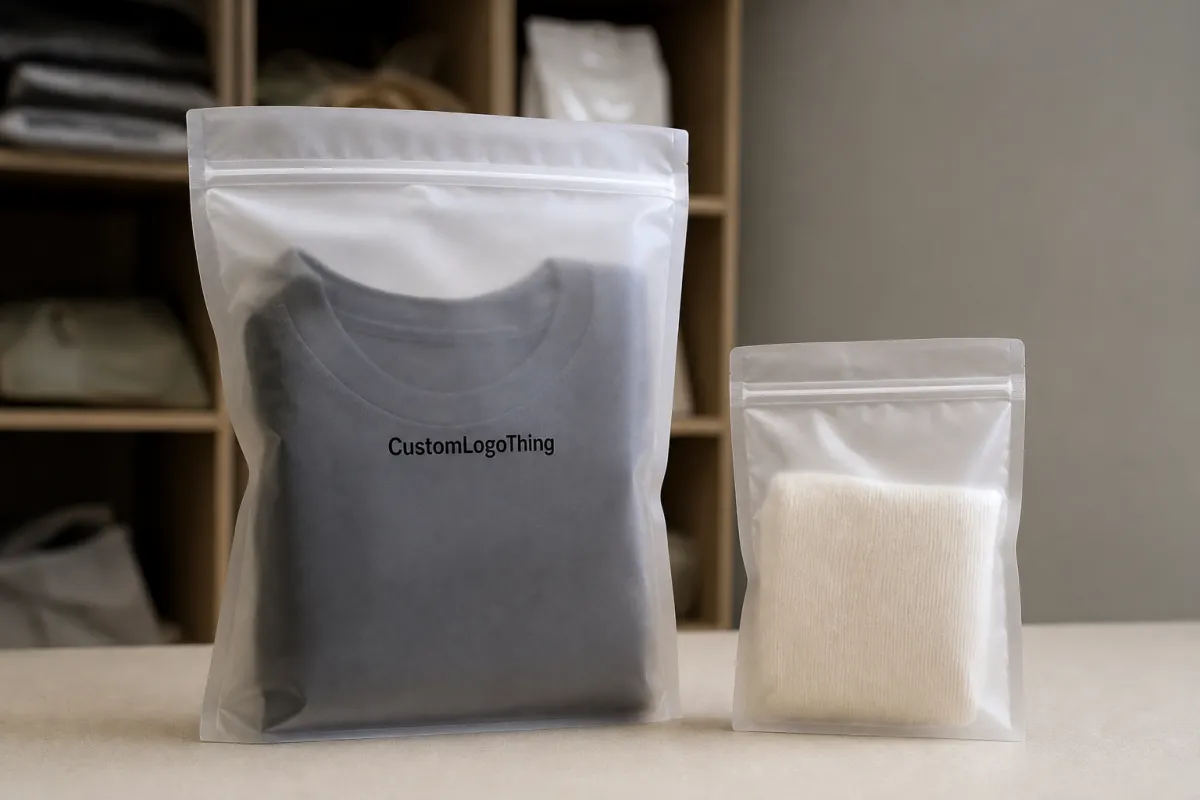
Plain poly is serviceable, but it exposes everything. Fingerprints stand out. Scuffs show up under retail lighting. Gloss can create glare that hides the product instead of framing it. Frosted film smooths those flaws over, which is why so many buyers compare Frosted Zipper Bags minimum order quantity with plain clear stock before they commit to a larger branded run.
The difference is not subtle in use. A frosted surface gives the package a softer, more finished appearance without demanding full-color print. That matters for small items that are too modest to carry premium packaging on their own. If the product is being sold in photos, in a display bin, or across a crowded shelf, the bag often does more visual work than people expect.
There are practical advantages too:
- Reduced glare: the product is easier to photograph and easier to read on shelves.
- Fewer visible marks: handling during packing leaves less obvious evidence.
- More consistent appearance: small surface scuffs blend in better than they do on glossy film.
- Less dependence on print: the package can look finished even with a simple one-color logo.
That is why the decision is rarely “frosted or not.” It is usually frosted against plain clear, or frosted against a printed package that may be more expensive than the product justifies. If the bag is going to sit in retail, be included in an ecommerce order, or be handled repeatedly in a packing line, the matte look often pays for itself in perception. If the product already has a strong premium identity, the extra spend may not add much.
Buyers also underestimate how much visual consistency matters. A batch of clear bags can look uneven from piece to piece because fingerprints, light reflections, and minor scratches all behave differently under the camera. Frosted film hides more of those differences. That is not glamour. It is practical control over the way the product shows up in front of a customer.
What To Specify: Film, Zipper, and Custom Options
Vague requests create vague quotes. If a supplier is only told “Frosted Zipper Bags,” the response will usually assume standard material, standard zipper, and standard tolerances. That can be fine for a stock replacement. It is not fine for a product that needs exact fit, specific opening behavior, or a particular level of stiffness.
Start with the film. Most Frosted Zipper Bags use PE, often low-density or a blend that gives a soft matte look. Some versions are more translucent than others, and that affects how much of the product silhouette shows through. If you want the contents visible but softened, say so. If you want the bag to hide the contents more aggressively, that should be stated too.
Then choose the closure. A standard press-to-close zipper works for most retail packs and sample kits. A stronger double-track zipper may be worth the added cost if the bag will be opened repeatedly, especially on refill items or multi-use accessories. Heat-sealed tops are sometimes used for tamper evidence, but they change the way the product is accessed and should only be chosen if that tradeoff is intentional.
Custom options are useful only when they solve a real packing or presentation problem. The most common ones include:
- Logo printing: one-color or multi-color printing on one side or both.
- Finish variation: fully frosted, semi-frosted, or lightly matte.
- Format changes: bottom gusset, side gusset, hang hole, tear notch, or euro slot.
- Opening details: standard zipper pull, extended grip area, or stronger reseal profile.
There is a point where add-ons stop improving the package and start increasing cost without visible benefit. Buyers often learn that too late. A clean frosted bag with accurate sizing and one good logo placement can outperform a crowded spec full of decorative extras, especially if the product itself is doing most of the selling. That is usually the smarter route for samples, internal kits, and lightweight retail packs.
The most useful quote requests list the material, zipper style, print location, bag format, and intended use in one place. If the supplier has to ask three follow-up questions before pricing the job, the quote will take longer and the early numbers will be less trustworthy.
Size, Thickness, and Seal Specs Buyers Should Confirm
Size mistakes are one of the easiest ways to waste money. A sample can look right in the hand and still be wrong in production if the usable space changes by only a few millimeters. That is especially true with zipper bags, where the top closure eats into usable height and the seal area is not always obvious from the outside dimension.
Before approving a quote, confirm the measured width and length, not just the nominal size. Ask whether the stated dimensions include the zipper area or only the open pouch. Then check the usable fill area, because a bag that is technically “200 x 250 mm” may not behave like a true 200 x 250 mm packing space once the closure is applied.
Thickness affects both protection and feel. Moving from 2.5 mil to 4 mil can make the bag stiffer, improve puncture resistance, and reduce the chance of the package folding awkwardly in transit. It also raises material cost and can make the bag feel heavier than the product deserves. For lightweight items, overbuilding the film is a common mistake. For metal accessories, small hardware, or heavier cosmetics, thinner film can be a false economy.
Useful specs to confirm up front:
- Width and length: ask for usable fill dimensions, not only outer size.
- Film thickness: request mils or microns, not “standard” or “heavy duty.”
- Zipper width: some closures reduce effective top space more than others.
- Seal tolerance: confirm acceptable variation across the production run.
- Filled appearance: check whether the bag stays flat or bows once packed.
Quality checks should be straightforward. Close the zipper repeatedly and see whether it holds cleanly. Inspect the seal edge for split lines. Rub the frosted surface to see whether it clouds unevenly or shows weak spots. Pack the actual product, not a dummy fill, because the final shape often changes how the bag sits. A package that looks tidy empty can become bulky, curved, or unstable once loaded.
Testing also needs a common sense view of the end use. If the bags will travel in cartons, get a simple transit check that reflects handling, stacking, and compression. If they will be sold retail or used in fulfillment, the bag should tolerate repeated closing without the zipper edge deforming. A supplier that can describe tolerances, seal behavior, and failure points in plain language is more useful than one that only repeats that the product is “good quality.”
One mistake comes up often enough to mention directly: do not approve a sample only because it looks attractive. Measure it. Then measure it again with the actual contents inside. A millimeter-level discrepancy may seem minor, but on a tightly packed product line it can mean slower packing, more rework, and a higher scrap rate.
Frosted Zipper Bags MOQ, Pricing, and Quote Variables
Frosted Zipper Bags minimum order quantity is usually driven by setup cost, film yield, and print preparation rather than by any arbitrary factory rule. The smaller the run, the more those fixed costs dominate the piece price. That is why a 500-piece order can feel disproportionately expensive next to a 5,000-piece order, even when the product itself looks almost identical.
For planning purposes, these ranges are a useful starting point. They are not universal, but they reflect how custom packaging is often priced:
| Order type | Typical MOQ | Typical unit price | Lead time after proof | Best use |
|---|---|---|---|---|
| Stock-style frosted zipper bag, no print | 500-1,000 | $0.10-$0.18 | 7-12 business days | Pilot runs, samples, internal kits |
| One-color logo print | 1,000-3,000 | $0.16-$0.30 | 12-18 business days | Retail packs, inserts, ecommerce bundles |
| Custom size plus multi-color print | 3,000-5,000+ | $0.24-$0.45 | 15-25 business days | Branded product launches |
Several factors move the quote. Bigger bags use more resin. Thicker film adds material and can slow output. More print colors increase setup time and raise the risk of waste during registration. A zipper upgrade adds parts and labor. Special packing requirements, tighter inspection rules, and carton labeling instructions can also push the landed cost upward. Freight matters too, especially on orders that ship internationally or in heavy cartons.
Tiered pricing is the only fair way to judge the order. Ask for three breakpoints, such as 1,000, 3,000, and 5,000 pieces. That shows where the real savings begin and how quickly the unit price changes once setup cost is spread across more bags. Sometimes the larger run creates obvious savings. Sometimes the price drops are too small to justify extra inventory sitting in storage.
The lowest unit price is not always the best deal. If the MOQ is high enough to force overbuying, the cash tied up in stock can offset the savings. If the product is stable and forecastable, a larger buy can absolutely make sense. The right answer depends on turnover, storage capacity, and how quickly the packaging is consumed. That is why buyers should compare landed cost, not just factory price, before committing to frosted zipper bags minimum order quantity.
A second cost point is often missed: change management. If the artwork is not final, or if the size may shift after sampling, the true cost rises because the supplier may need to remake plates, adjust print files, or rework film cutting. Those are avoidable costs, but only if the spec is locked before production starts.
Process, Proofing, and Production Timeline
The production process should be boring in the best way. Inquiry, spec review, quotation, artwork check, proof approval, production, inspection, and shipping. If a supplier cannot describe that chain clearly, there is a decent chance that later delays will be treated as normal rather than preventable.
- Inquiry: send size, thickness target, print needs, and quantity.
- Spec review: the supplier checks feasibility and flags weak points.
- Quote: you receive tiered pricing and lead time estimates.
- Artwork check: files are reviewed for placement, bleed, and resolution.
- Proof approval: you sign off on the layout or printed sample.
- Production and QC: the run is made and inspected.
- Shipping: cartons are packed, labeled, and dispatched.
The schedule starts after proof approval, not when the first email goes out. Stock-style orders are usually quicker. Custom print, thicker material, and stricter inspection add time. A realistic window for many custom runs is 12 to 18 business days after approval, with longer timelines if the artwork changes late or if the order requires special packing instructions.
Most delays are caused by missing information on the buyer side. A rough size estimate slows everything down. So does sending a raster logo that cannot be printed cleanly. Late proof approval is another common bottleneck. If speed matters, send the exact dimensions, vector artwork, print position, quantity, and target use in the first message. That saves more time than buyers usually expect.
It also helps to ask what the quoted lead time actually includes. Sample production, main production, and freight are often separate clocks. A quote that says “two weeks” may refer only to factory output, not to the full timeline until the goods arrive. That distinction sounds small until a launch date is on the calendar.
Proofing deserves attention even on simple jobs. A printed proof can reveal that the logo sits too close to the zipper, or that the frosted surface reduces contrast more than expected. Catching that before the full run is cheaper than discovering it in the finished cartons. Good suppliers will slow down long enough to catch those problems; weak suppliers will rush past them.
What a Reliable Supplier Should Show Before You Order
A polished catalog does not prove anything. What matters is whether the supplier can document the spec, explain the tolerance, and support the run from sample to shipment. If those details are difficult to obtain before payment, they will not become easier afterward.
The basic proof points are straightforward:
- Written spec sheet: dimensions, thickness, zipper style, print count, and tolerance.
- Sample support: plain sample, printed sample, or pre-production sample.
- QC steps: closure testing, seal inspection, visual check, and count verification.
- Shipping terms: carton count, pallet details, and responsibility for freight.
- Clear explanations: where cost rises, where lead time extends, and why.
The best suppliers are direct about tradeoffs. If a thicker film raises the MOQ because the film yield changes, that should be said plainly. If a certain print layout will increase waste, the buyer should hear that before approval. That sort of honesty is more useful than polished reassurance. Packaging buyers need information that protects margin and delivery dates, not warmed-over sales language.
Documentation matters because it reduces confusion later. A clear quote should match the sample, the final production spec, and the shipment paperwork. When those three do not line up, the buyer ends up paying for someone else’s ambiguity. That is especially dangerous on packaging orders, where small differences in size or finish can be enough to affect the whole packout.
There is also a trust test hidden in the technical details. Suppliers who can explain seal strength, zipper behavior, and print tolerances usually understand the work. Suppliers who avoid specifics often do not. The difference shows up later in the form of rework, delayed shipments, or packages that do not match the sample.
Next Steps: Send Specs, Request Samples, Lock the Quote
The fastest way to get a useful quote is to send complete information the first time. Finished dimensions, target thickness, zipper style, print needs, quantity, and any format changes like a hang hole or gusset should all be listed together. If the bag needs to look clean in retail display or product photography, say that plainly. Presentation requirements can change the recommended finish.
For frosted zipper bags minimum order quantity, the smartest comparison is usually between two or three realistic scenarios. Ask for the smallest acceptable MOQ, then ask again at a larger breakpoint. That shows whether the savings justify the extra inventory. A small price drop may not be worth the storage burden. A larger discount can be decisive if the product moves quickly.
Request a sample whenever appearance, zipper feel, or fit matters to the decision. A sample costs far less than a full production run that misses the mark. If possible, compare an unprinted sample with a printed proof. That separates material feel from logo clarity and makes it easier to judge whether the final package looks deliberate or merely decorated.
Then lock the quote in writing. Confirm dimensions, tolerance, lead time after proof approval, and freight terms. That part is not exciting, but it prevents the most expensive kind of mistake: a finished order that looks acceptable on paper and wrong in hand.
For buyers trying to balance presentation, performance, and quantity, the right approach is simple. Define the spec tightly, ask for tiered pricing, and compare landed cost rather than chasing the lowest factory number. That is usually the difference between a packaging decision that helps the product and one that quietly eats margin.
What is the usual frosted zipper bags minimum order quantity?
It varies by size, material thickness, and print complexity, but custom runs often begin in the low thousands rather than a few hundred pieces. Smaller orders can be possible for stock-style bags, yet the unit price usually climbs quickly because setup costs are spread across fewer bags. A tiered quote is the cleanest way to see where the breakpoints sit.
Can I mix sizes or print versions to meet the minimum order quantity?
Only sometimes. If the supplier can keep the same film, zipper style, and production setup, there may be room to combine versions. Different sizes or artwork files often count as separate runs, which means separate MOQ requirements and separate setup charges. Ask before assuming the quantities can be pooled.
What affects frosted zipper bag pricing the most?
Dimensions, thickness, zipper style, and print colors are the main cost drivers. Secondary factors include special finishes, tighter QC, and shipping method. Freight can change landed cost more than buyers expect, so the factory price should never be the only number reviewed.
How long does production take after proof approval?
Many custom runs fall in the 12 to 18 business day range after proof approval, while simpler stock orders can move faster. The exact schedule depends on material availability, print complexity, and inspection requirements. Always separate sample time, production time, and shipping time so the total lead time is realistic.
Can I order a sample before placing a full MOQ order?
Yes, and it is usually the right move if the finish, zipper feel, or printed appearance affects the purchase decision. A sample helps verify size, seal behavior, and print placement before bulk production starts. If the sample passes the practical checks, the final order is far less likely to surprise you in packing or in transit.

