A Frosted Zipper Bags packaging cost breakdown is easiest to read when the bag is treated as a complete packaging system. Film, zipper, print, labor, packing, and freight all affect the final number, and the cheapest-looking line item is not always the cheapest landed cost.
Frosted bags are popular because they look finished without heavy decoration. That matters for retail packaging, samples, subscriptions, beauty items, apparel accessories, and lightweight products that need to look presentable the moment they leave the carton.
When buyers compare branded packaging across Custom Packaging Products, the useful question is not whether frosted is always cheaper. It is whether the finish lets you simplify print, reduce secondary packaging, or avoid extras that do not improve the product. In many cases, a slightly higher unit price can still lower total packaging spend.
Why frosted bags can lower your packaging spend
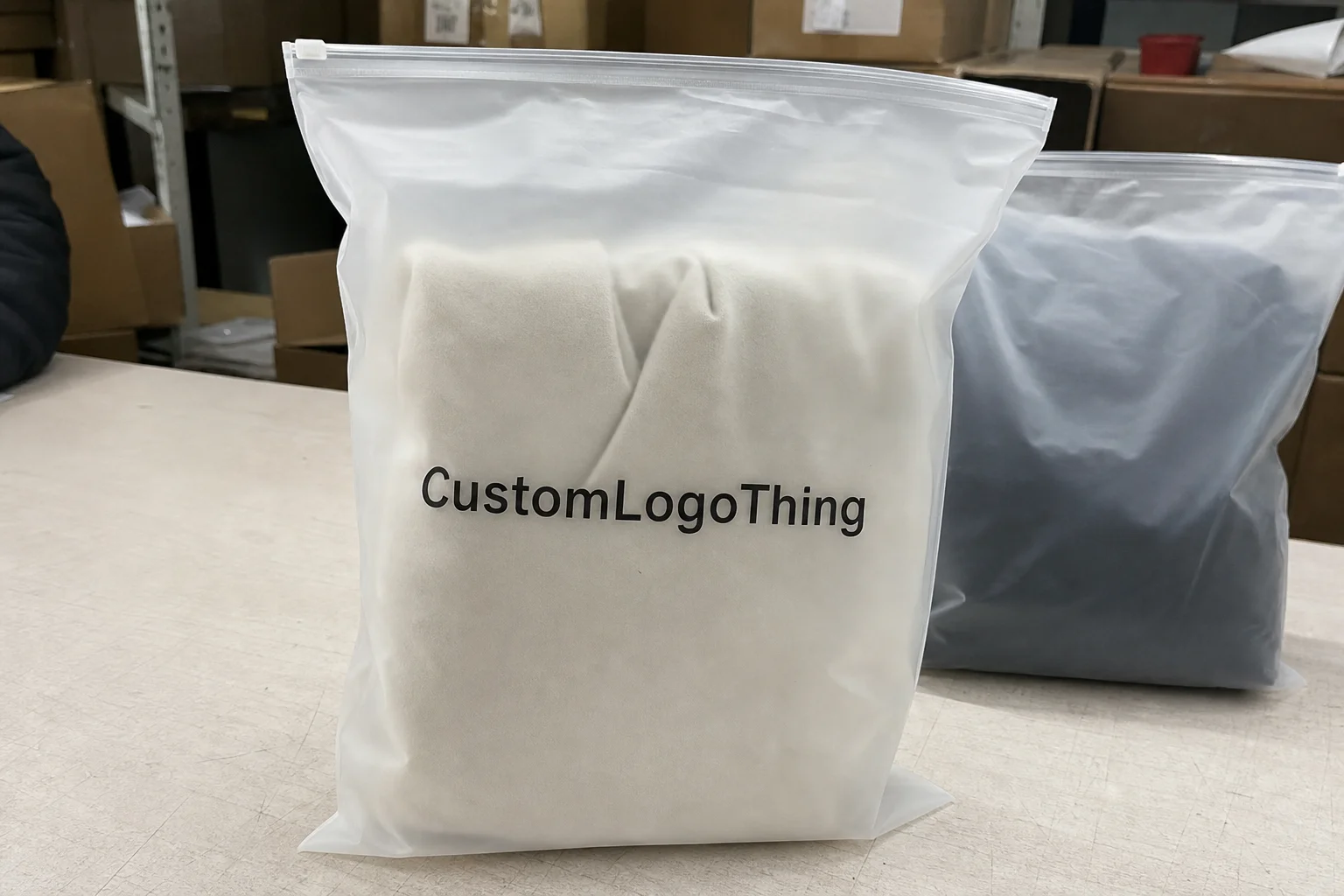
Frosted film gives a clean base appearance before graphics are added. That changes how a quote should be built. If the material already looks polished, branding can stay light: a one-color logo, a small placement mark, or a label-based design for short runs. Less ink coverage often means fewer setup variables and fewer production surprises.
That is why the Frosted Zipper Bags packaging cost breakdown should start with presentation goals, not raw material alone. A clear bag may appear cheaper, but if it needs a full-color design, insert card, or extra finishing work to look retail-ready, the total package can end up higher than a frosted bag with restrained branding.
There is also a shipping and storage benefit. For small retail items, the bag can replace part of the branding function that a box would normally carry. That can reduce carton count, lower cube usage, and cut back on filler. For products seen before they are opened, the frosted finish helps the package carry its own weight.
A bag that looks acceptable with one-color print is usually easier to produce well than a cheap-looking bag that needs a lot of decoration to feel finished.
Frosted film is not the right answer for every product. Industrial parts, utility items, and products that live inside larger shippers may never recover the premium finish. The value shows up when the package is part of the sale or part of the first customer impression.
Material and finish choices that change the look
Most frosted zipper bags are made from PE film, sometimes with layered structures if the application needs added stiffness, better seal performance, or more moisture resistance. The finish may read matte-frosted, semi-clear, or more opaque depending on the film blend and thickness. These differences affect print contrast, hand feel, and cost.
Film thickness is one of the first technical choices that changes the buyer’s impression. Common ranges sit around 2.5 mil to 6 mil, depending on bag size and intended load. A lighter 3 mil bag can work well for samples, light apparel, or small accessories. A 4 to 5 mil bag usually feels better for repeat handling, heavier retail items, or products that need more puncture resistance.
Finish also changes how graphics read. On a semi-clear frosted surface, a dark logo stands out cleanly. On a more opaque film, color can soften unless a white underbase is added. That underbase improves color accuracy, but it adds a production step and raises print cost. The choice is visual and financial at the same time.
Zipper style belongs in the same conversation. A standard press-to-close zipper is usually the most economical option. A double-track zipper or stronger closure adds confidence for repeated use, but it can also add labor and tooling cost. Tear notches, hanger holes, and euro holes improve retail function, though each feature changes the finished price.
Most buyers choose among three practical combinations:
- Matte-frosted, minimal print: lower decoration cost, clean appearance, good for modern product packaging.
- Semi-clear frosted, one-color print: balanced appearance, useful for branded packaging on a tighter budget.
- Opaque frosted, full-color print: stronger shelf presence, but more setup and higher print cost.
If the alternative is custom printed boxes, the bag usually wins on simplicity, storage efficiency, and freight. Boxes still make sense for rigid protection or premium unboxing. Bags are often the better fit for lightweight retail goods, replenishment kits, and products that need visual appeal without a large carton footprint.
For buyers who care about transport testing and transit durability, ISTA test protocols are a practical reference point. If paperboard inserts or outer cartons are part of the build, FSC certification can be worth specifying for the paper component. The bag itself is only one part of the system.
Size, gauge, zipper style, and print specs to lock down
A clean quote starts with specifications that are hard to misread. Before asking for pricing, lock down width, height, gusset depth if needed, film thickness, zipper type, closure strength, print method, and pack count. If any of those items are vague, the numbers that come back are difficult to compare.
Standard sizes usually cost less because they rely on familiar tooling or simpler setup. Custom dimensions can raise lead time and increase the unit cost, especially on smaller orders. The same product can look economical at 10,000 pieces and much less friendly at 1,000 pieces.
Gauge is one of the easiest places to under-spec a bag. A thinner film can look fine in a sample yet feel weak in actual use, especially if the bag is opened repeatedly or packed tight in shipping. A slightly thicker film often improves shelf appearance and reduces damage claims.
Printing needs similar discipline. A one-color logo is usually the simplest path. Full-wrap art, fine gradients, and tight registration are where costs rise quickly. Frosted material sometimes needs a white base layer to keep colors from washing out. That adds a production step, but it can be the difference between a crisp logo and a muddy one.
The most efficient way to quote is to finalize the spec before negotiating the price. Loose requests invite low numbers that are not real savings, because the supplier may later substitute materials, revise the artwork, or add charges after proofing.
- Width and height should match the product with enough room for closure and handling.
- Gusset depth should reflect whether the item lies flat or needs volume.
- Print coverage should be described by placement zones or coverage percentages.
- Closure type should be stated clearly if the bag needs repeated opening.
This is where packaging design stops being abstract. The artwork, bag shape, and finish work together. A strong design on the wrong film still looks wrong. A restrained design on the right film can look more expensive than it is.
Frosted zipper bags packaging cost breakdown and unit pricing
The Frosted Zipper Bags Packaging cost breakdown usually falls into six parts: film, zipper hardware, printing, labor, packing, and freight. Some suppliers bundle those into one line, while others separate them. Either way, a buyer should know what is included and what is not.
Raw film is the base cost. Zipper hardware adds a smaller amount per bag, but that number rises if the closure is wider, stronger, or uses a double-track design. Printing can be modest or expensive depending on color count, coverage, and setup method. Labor becomes more visible on custom sizes, special closures, or orders that require manual inspection and packing.
MOQ has a direct effect on price. Lower minimum order quantities usually raise the unit price because setup costs are spread across fewer bags. Larger runs reduce the per-bag cost, but they increase the amount of cash tied up in inventory. That tradeoff only works if the stock moves at a predictable pace.
For practical planning, the pricing pattern below is a useful reference point for standard frosted zipper bags:
| Order profile | Typical setup | Indicative unit price impact | Best use case |
|---|---|---|---|
| 1,000 to 2,000 pcs | Standard size, light print or no print | Higher unit cost because setup is spread thin | Launches, samples, small batches |
| 5,000 pcs | Standard size, one-color logo, 3 to 4 mil film | Moderate unit cost, often the first workable break point | Retail packaging, subscriptions, repeat SKUs |
| 10,000 pcs and up | Custom print, stable spec, repeat order potential | Lower unit cost, better freight efficiency | High-turn product packaging and replenishment |
As a broad market range, an unprinted standard frosted bag may land around $0.08 to $0.18 per unit at mid-volume, depending on size and thickness. Add a one-color logo and another $0.03 to $0.08 is common. Full-color printing, white underbase work, or custom features can push the number higher quickly.
Freight is the item that most buyers underestimate. On smaller runs, shipping can move the total by 10% to 30%, especially if the bags are bulky relative to their value or the supplier ships internationally. A landed quote matters more than an attractive unit price. Ask for delivery to your warehouse, not just the factory gate.
Common quote problems are easy to spot once you know where to look:
- Shipping is omitted from the quote.
- The quoted film thickness is not the same as the sample.
- Artwork revisions are treated as a new job.
- The zipper style changes from the one discussed.
- Freight estimates ignore carton count and dimensional weight.
If you are sourcing across multiple formats such as Custom Packaging Products, compare the true landed cost of the whole package, not only the bag or box price. That is usually where the bad decisions hide.
Order process and turnaround from quote to ship
The cleanest orders follow a predictable path: inquiry, spec confirmation, artwork review, proof approval, production, inspection, packing, and shipment. The problems usually appear when the buyer requests pricing before the size and print details are fully settled.
For standard custom runs, lead time is often 12 to 18 business days after proof approval. More complex print or custom tooling can extend that to 20 to 30 business days. Sample timing is separate. A sample often takes 3 to 7 business days, sometimes longer if the bag needs a new mold or a closer print match.
Fast turnaround is realistic for standard sizes, simple print, and repeat orders. It is not realistic for a new size, full-wrap artwork, a special zipper, and a compressed ship date all at once. Something has to give, and usually it is either price or schedule.
A workable planning sequence looks like this:
- Week 1: send specs, quantity, and delivery destination.
- Week 1 or 2: review the proof and request a sample if needed.
- Weeks 2 to 4: production and inspection.
- Final week: carton packing, freight booking, and delivery.
That timeline works for a planned launch. It does not work well if the artwork is still changing on the day the quote is requested. If the packaging design is moving, the schedule will move with it.
A reliable supplier slows the process just enough to catch mistakes before production. That is cheaper than discovering a wrong size or weak zipper after thousands of bags are already packed.
What makes a reliable frosted bag supplier worth using
Consistency is the real value. Stable color, accurate dimensions, reliable zipper function, and repeatable print quality matter more than a lower quote that breaks down under inspection. If those basics are not controlled, the bag becomes more expensive later through rework, delays, or rejected stock.
Communication matters because packaging projects change. Artwork gets updated. Sizes get adjusted. Retail deadlines move. A supplier worth keeping can handle those changes without turning every revision into a fresh negotiation. That tells you whether they understand production or only sales.
Look for documented QC standards. Ask about thickness tolerance, seal strength, zipper performance, and visual inspection points. A serious supplier should answer clearly. You do not need theatrics. You need predictable output and a response time that holds when something slips outside spec.
Domestic sourcing can be faster and easier to manage. Overseas sourcing can offer better economies at scale. That is the real tradeoff. For short runs, urgent launches, or frequent artwork changes, local flexibility may be worth the higher per-unit price. For stable SKUs and larger volumes, overseas production can make sense if communication is solid and freight math is honest.
One more point: a dependable supplier protects hidden costs. They catch print errors before production. They flag weak artwork before plates are made. They ask the annoying questions early. That is the part that saves time and money.
Next steps to request a quote without wasting time
If a quote needs to be useful, send a complete spec sheet. Include size, quantity, film thickness, zipper style, print needs, pack count, and delivery destination. Leave one of those out and the response may still arrive quickly, but it will probably be wrong in a way that shows up later.
Ask for pricing at two or three volume tiers. That gives a clearer view of the MOQ break point and the unit cost curve. A quote for 1,000 pieces tells you very little by itself. A quote for 1,000, 5,000, and 10,000 pieces shows where the economics begin to settle.
If the bag carries branding, request a proof or sample before production. That is usually less expensive than correcting a full run. If the order is time-sensitive, confirm the ship date rather than only the production date. Freight delays do not disappear because the factory finished on time.
Use landed cost, lead time, and QC standards as the main comparison points. The lowest price is not the best purchase if it depends on vague specs, weak packaging design support, or a freight bill that arrives later and destroys the math.
For buyers comparing frosted bags with other formats, the cleanest way to read a frosted zipper bags packaging cost breakdown is to compare the landed price, the timeline, and the risk of rework together. That gives a more honest picture than a single unit price ever will.
What affects frosted zipper bags packaging cost the most?
Bag size, film thickness, print coverage, zipper type, and order quantity drive the cost most. Custom shapes or extra features add setup and labor quickly. Freight can shift the total more than buyers expect, so landed pricing is the better number to compare.
Do frosted zipper bag quotes change with MOQ?
Yes. Lower MOQ usually means a higher unit price because setup costs are spread over fewer bags. Larger runs reduce the per-bag cost, but they raise inventory exposure and cash tied up in stock. Asking for two or three volume tiers is the easiest way to see the break point.
How does printing affect frosted zipper bag pricing?
Simple one-color logos are usually cheaper than full-wrap or full-color printing. More ink coverage, more setup, and tighter registration increase cost. Some frosted films need a white underbase for color accuracy, which adds another step.
What is the usual lead time for frosted zipper bags?
Lead time depends on whether the size and print are standard or fully custom. Artwork approval, proofing, and sample requests often add more time than production itself. If the order is urgent, confirm whether the supplier can meet the ship date before placing it.
What should I check before approving a frosted zipper bags quote?
Confirm size, thickness, zipper style, print method, quantity, packing method, and shipping terms. Make sure the quote matches the material and finish you actually want. Ask whether tooling, samples, and freight are included so the final number does not change later.


