If you are comparing Frosted Zipper Bags Wholesale b2b sourcing options, the question is not whether the bag looks good in a mockup. It is whether it helps the product move through packing, shipping, and retail display without adding hidden costs. Plain clear poly bags still work, but they often read as utilitarian rather than intentional. Frosted zipper bags solve that problem with a modest shift in material and finish instead of a full packaging overhaul.
That middle ground is why buyers keep coming back to them. The structure stays familiar. The filling process usually stays familiar. Carton planning rarely changes much. Yet the finished package feels more deliberate, and that affects how customers judge the contents before they even touch them.
For retail, ecommerce, promo kits, and subscription inserts, the appeal is practical as much as visual. Less glare in photography. A softer presentation on shelf. More privacy for contents that should not be fully exposed. A small uplift in perceived value can matter a lot when the product itself is already price-sensitive.
Why frosted zipper bags outperform plain poly in retail presentation
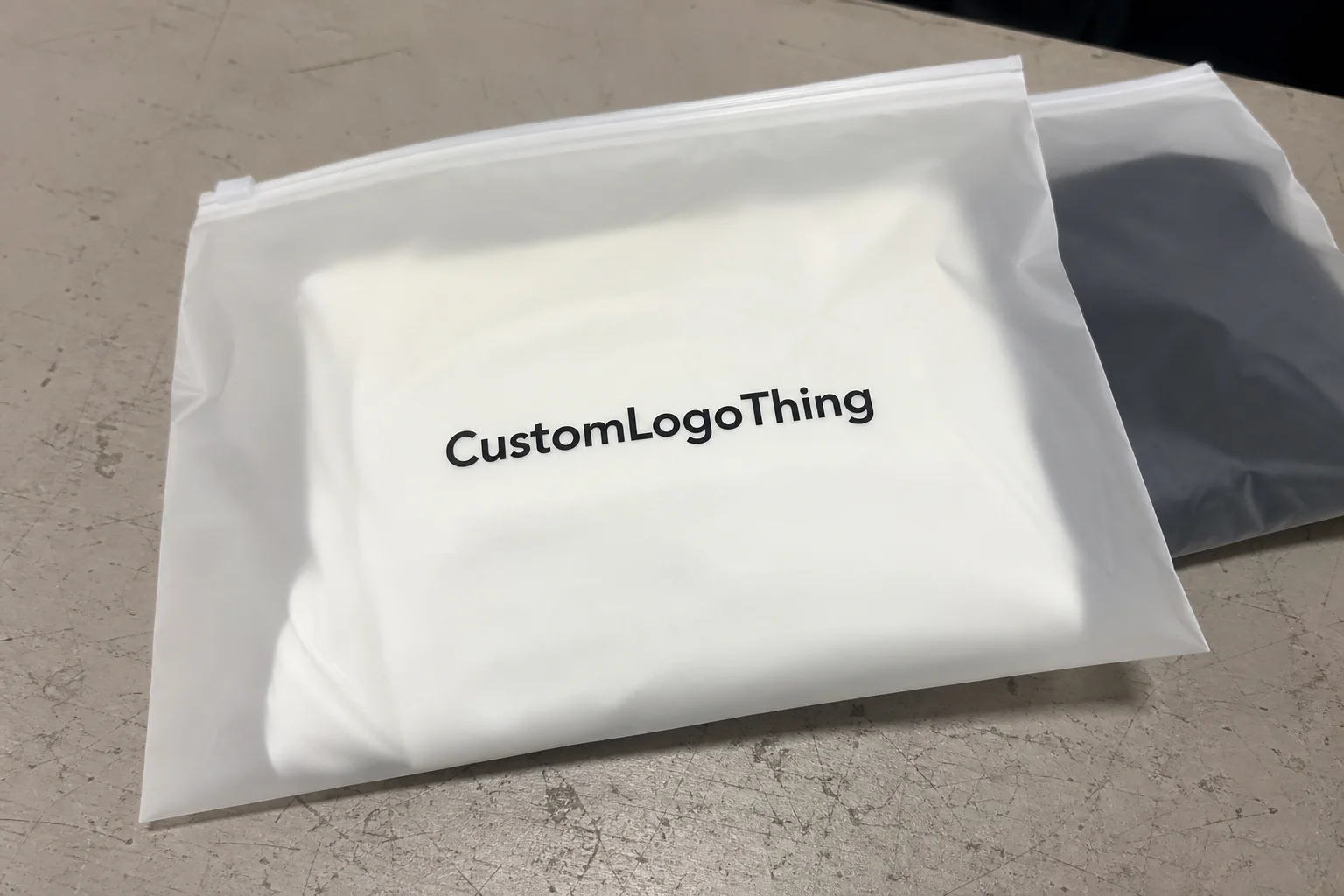
Clear poly can make a decent product look unfinished. That is the part buyers often discover after the first photo shoot or store reset. Frosted film softens reflections, reduces the “plastic bag” look, and creates a cleaner visual tone. On a crowded shelf, that subtle difference is enough to make a product feel more intentional.
The benefit is not only cosmetic. Frosted bags tend to photograph better under mixed lighting because the surface diffuses shine. That helps ecommerce teams, especially when product images need to be consistent across a large catalog. Less glare means fewer retakes and fewer awkward reflections hiding the contents.
These bags are used most often for:
- Apparel and accessories that need protection without looking overpackaged
- Cosmetics and wellness kits where a softer presentation supports the brand position
- Promo packs and event kits that must look ready to hand out
- Ecommerce inserts where the unboxing experience matters but the budget is still controlled
The cost profile is usually manageable. Frosted Zipper Bags are not the cheapest option in flexible packaging, but they are far less expensive than moving into printed cartons, rigid boxes, or laminated pouches. For many buyers, that is exactly the point: a visible improvement without a major production change.
“Most buyers do not switch to frosted bags because they want luxury packaging. They switch because they want the product to look finished without creating a second packaging program.”
That is the real appeal in Frosted Zipper Bags wholesale b2b sourcing. You are buying perception, but not at the price of a full custom structural package.
Product details buyers should verify before ordering
Before asking for quotes, define the construction. Most frosted zipper bags are made from PE or PP film, and the difference matters. PE is usually softer and more flexible. PP tends to feel crisper and can present a slightly sharper finish. Neither material is universally better. The right choice depends on product weight, handling, and the visual effect the buyer wants.
The zipper mechanism deserves just as much attention. Single-track zippers are common for lighter retail items and insert packs. Double-track zippers generally close with more resistance and feel more secure during repeated opening and closing. A zipper that catches or misaligns is a small defect with a big consequence: it makes the package feel cheap immediately.
Finish changes the look more than many procurement teams expect:
- Light frost keeps more product visibility and is closest to clear poly
- Matte frost cuts glare and reads more polished in photos
- Heavier opaque frost hides more of the contents and can feel more premium or more private, depending on the use case
Functional performance matters just as much as appearance. Confirm tear resistance, moisture protection, and how the zipper behaves after several open-close cycles. Ecommerce buyers should test how the bag holds up when customers inspect the product before use. Retail buyers should test how it survives handling in bins, displays, and shipping cartons.
Customization choices should be written down early. Ask whether the supplier supports:
- Custom sizes
- Thickness selection
- Logo printing
- Hang holes or euro slots
- Hang tab reinforcement
- Tear notches
Compliance should not be treated as a footnote. If the bags touch food, request food-contact documentation. If they are used for cosmetics, wellness products, or retail kits, ask for the relevant material declarations. If you plan to print recycling language, confirm the resin and local guidance first. Recycling claims that look tidy on a proof can become a liability if they do not match regional rules.
For buyers checking broader packaging standards, industry resources such as the Packaging School and packaging industry resources can help with terminology and material context. The supplier still needs to provide the exact spec sheet for the product being quoted.
Frosted bag specifications that affect fit, durability, and shelf appeal
Spec sheets decide whether a sourcing project stays tidy or turns into a string of revisions. Vague requests lead to vague quotes. Vague quotes lead to shipping surprises, and then everyone acts as if the problem appeared out of nowhere.
Start with the basics in writing: width, height, gusset depth, film thickness in microns or mil, zipper profile, print coverage, and packing format. Size affects more than fit. It affects seal integrity, labor speed, carton count, and waste. Oversized bags cost more and can look slack on shelf. Undersized bags stress the zipper and seams, which is one of the fastest ways to trigger returns or customer complaints.
Thickness is a straightforward cost-versus-performance decision. Thinner bags reduce unit cost, but they also feel lighter and can puncture more easily. Thicker bags improve stiffness and perceived quality, especially for products with corners, edges, or multiple components. A light apparel insert may do fine with a thinner gauge. A cosmetics set, accessory bundle, or premium gift pack often needs more material to survive handling without collapsing visually.
Printing deserves more discipline than it usually gets. One-color logos tend to look cleaner on frosted film and keep costs down. Full-color artwork is possible, but it needs proper file prep, proofing, and realistic expectations about contrast. Thin lines may disappear. Tiny text can blur. Busy designs can flatten on a frosted background. Strong prepress review matters more than a polished mockup.
A practical sample review should look at function, not mood. Check these points:
- Zipper alignment across the full width
- Seal strength at edges and corners
- Opacity consistency from one bag to the next
- Print registration and logo placement
- Product visibility inside the bag
If the frosted effect hides too much, the bag loses one of its main advantages. If it shows too much, the package slips back toward the look of basic poly. The useful range sits in the middle, where the contents are visible enough to identify but softened enough to feel curated.
| Option | Typical use | Pros | Tradeoff |
|---|---|---|---|
| Light frost, 2.5–3 mil | Apparel inserts, lightweight accessories | Lower cost, softer visual effect | Less puncture resistance |
| Matte frost, 3–4 mil | Retail kits, cosmetics, gift packs | Cleaner shelf look, better photo appearance | Moderate cost increase |
| Heavy frost, 4–5 mil | Heavier items, premium gift sets | Stronger feel, more privacy | Higher price and more material usage |
Cost, pricing, MOQ, and unit cost drivers
Pricing for frosted zipper bags usually comes down to a handful of predictable variables: size, thickness, print colors, zipper type, special features, and volume. The bag itself is not mysterious. The pricing structure can still be frustrating because setup costs are spread across the order, and small orders absorb more of that burden.
For standard sizes with simple printing, buyers often see pricing in the range of $0.08 to $0.22 per unit at moderate volumes. Custom dimensions, heavier gauges, add-on features, and more complex artwork can push that higher. At lower quantities, the unit cost rises quickly because plate costs, setup labor, and machine calibration have fewer pieces over which to spread.
MOQ exists for practical reasons, not decorative ones. Film setup takes time. Printing plates or screens cost money. Machines need calibration. Material roll changes interrupt production. Suppliers build minimums around those realities.
For planning purposes, it helps to think in three bands:
- MOQ pricing: highest unit cost, lowest inventory commitment
- Mid-volume pricing: often the best balance for growing brands
- High-volume pricing: lowest unit cost, but more cash tied up in stock
There are a few easy ways to keep costs in check:
- Use standard sizes instead of custom dimensions where possible
- Keep to one or two print colors
- Limit print coverage to the front panel if the back does not need branding
- Consolidate several SKUs into fewer bag sizes when the product range allows it
Request tiered quotes rather than a single price. Ask for pricing at MOQ, a mid-range volume, and a larger break point. That reveals the real landed-cost pattern and shows whether a lower unit price is only available at inventory levels you do not want to carry.
For buyers managing multiple packaging items, Wholesale Programs can help compare order structures across different packaging lines without treating every SKU as a separate negotiation.
Process, timeline, and production steps for wholesale orders
The best sourcing process is orderly enough to feel dull. That is a compliment. First comes inquiry, then spec confirmation, artwork review, proof approval, production, inspection, packing, and shipment. Skipping steps usually shows up later as a delay, a reprint, or a quality complaint.
Lead time depends on how custom the order is. A reorder of an existing size with no artwork changes can move quickly. A new format with custom print and special features takes longer. As a practical range, sample lead time is often 5-10 business days, while bulk production may run 12-20 business days after proof approval. Freight adds its own timing, and that is where many launch schedules get stretched.
Delays often come from the buyer side rather than the factory side. Common blockers include:
- Unclear dimensions
- Late artwork revisions
- Logo placement changes after proofing
- Unapproved sample comments
- Last-minute compliance text edits
Ask for a production calendar before you approve anything. You want to know the proof approval date, material procurement window, print slot, estimated completion date, and shipping date. That matters in frosted zipper bags wholesale b2b sourcing because even small spec changes can affect film procurement and machine scheduling.
If the bags will be reordered regularly, freeze the spec early. Reorders become much easier when the size, thickness, zipper style, artwork, and pack method are already fixed. That is how a replenishment item stays a replenishment item instead of becoming a new project every quarter.
How to compare suppliers and avoid low-quality imports
Low price is not a sourcing strategy. It is a starting point. Compare suppliers on material consistency, zipper reliability, print quality, packing standard, and communication. If one quote comes in far below the others, something is usually missing: film thickness, actual print method, carton assumptions, or shipping terms.
Vague quotes should raise alarms. If a supplier does not specify resin type, thickness, print coverage, pack count, and sample policy, the quote is not finished. It is only a placeholder. The final invoice often tells the real story.
Do not approve a random stock sample if the goal is a repeatable production run. Request a sample made to the intended specification or a pre-production proof from the actual production line. Stock samples can look fine and still tell you almost nothing about the order you will actually receive.
A supplier comparison should cover:
- Factory capacity for your order volume
- Export experience in your market
- Quality control process and inspection steps
- Repeat-order consistency without spec drift
- Communication speed during quoting and proofing
Communication quality is not a soft metric. A supplier that restates your spec correctly, answers direct questions quickly, and sends readable proofs is usually easier to manage than a cheaper vendor who takes days to clarify basic details. Packaging buying is repetitive by nature. Accuracy and speed matter because reorders have little patience for confusion.
If you need context on environmental handling and recycling language, the EPA recycling resources are useful for regional background. Still, local resin guidance and the exact bag structure should be verified before any environmental claim is printed on packaging.
Next steps for placing a wholesale order without delays
The cleanest order submission is plain and complete. Send the target size, thickness, zipper style, print needs, estimated monthly volume, and delivery destination. If you have multiple SKUs, put them in a table. Nothing elaborate. Just enough detail to let the supplier quote the right item the first time.
Ask for three volume tiers in the same quotation. That makes it easier to judge unit cost against inventory commitment without chasing the sales team for a second round of numbers. Also ask whether samples are available, whether proofing is included, and how revisions are handled. Those answers reveal how much friction the order is likely to create later.
Artwork approval should not happen until logo size, print placement, and any compliance text have been checked carefully. Packaging artwork is not just design work. It affects operations, legal exposure, and reprint risk. A small error in a label or claim can delay the entire run.
Carton details matter too, especially if the order is going to a fulfillment center or a retail warehouse. Outer carton size, pack count, and pallet assumptions can change freight cost and receiving speed. That is one of those details that sounds minor until the warehouse refuses the shipment or the parcel rate climbs for no obvious reason.
For buyers working through frosted zipper bags wholesale b2b sourcing, the strongest next move is simple: send the current SKU list, target quantities, print files, and any compliance language together. That gives the supplier enough information to confirm fit, pricing, and timeline without guesswork, which is the quickest way to keep a packaging order from turning into a delay chain.
FAQ
What affects frosted zipper bags wholesale pricing the most?
Size, thickness, print colors, zipper style, and order volume are the main cost drivers. Custom dimensions and heavier print coverage usually cost more than standard-size, one-color bags. Higher MOQ can lower unit cost, but it also increases the upfront inventory commitment.
Can frosted zipper bags be customized with logo printing?
Yes. Most wholesale orders can include logo printing on the front, back, or both sides. One-color print is usually the easiest to keep clean on frosted film, while full-color artwork needs stronger prepress review to avoid contrast and registration issues.
What MOQ should buyers expect for frosted zipper bags wholesale?
MOQ varies by size, material, and printing requirements. Standard sizes with simple printing usually have lower minimums than custom formats with added features. Buyers should ask for MOQ and tiered pricing together so they can compare the real cost of each volume band.
How long does production usually take for custom frosted zipper bags?
Sample timing and bulk production timing are different, so both should be confirmed upfront. Artwork approval, material availability, and print complexity all affect the schedule. Reorders are usually faster when the spec has already been locked and does not need revision.
What should I check before placing a B2B sourcing order?
Confirm size, thickness, zipper quality, print proof, carton packing, and shipping method. Request a sample or pre-production proof to verify feel, opacity, and logo placement. Make sure the quote lists unit cost, MOQ, and lead time clearly so there are no surprises later.


