Buying gable boxes bulk is usually a production decision first and a pricing decision second. The box has to fold quickly, carry cleanly, hold its shape, and still look deliberate when it reaches the customer. If any one of those pieces is off, the savings on paper tend to disappear on the packing line.
That is why experienced buyers look beyond the headline quote. Board strength, cut accuracy, print coverage, coating, assembly method, and shipping format all affect the real cost of the program. For teams comparing packaging formats, our Custom Packaging Products page gives a broader view of available styles, while our Wholesale Programs page is useful for recurring purchase planning and volume-based ordering.
A low unit price is only useful if the box spec is complete. Board type, finish, freight, and packing method can change the landed cost more than the quote itself.
Why bulk gable boxes can reduce packing time and damage
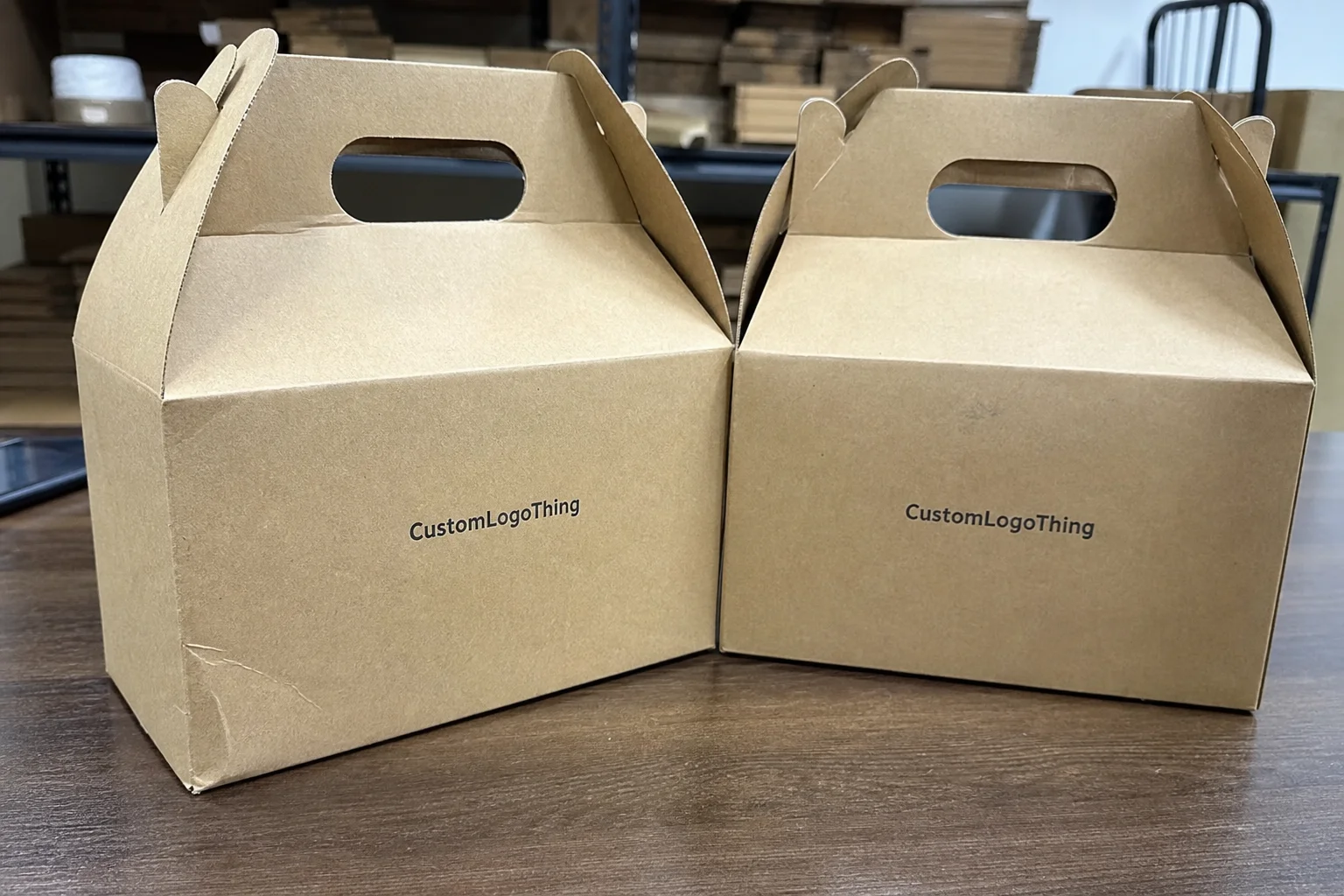
The practical value of a gable box is in the structure. It folds from a single die-cut piece, locks into shape, and includes a built-in handle, so the packer is not building a box from multiple components. That matters on a busy table, a retail back room, or a fulfillment bench where repeated motions add up quickly. A simple fold-and-fill workflow can save real labor over the course of a large order.
The handle also changes the way the package is handled after packing. A well-designed gable carton spreads carry stress across the side panels instead of concentrating it in a weak lid flap or an overworked adhesive point. That makes it a better choice for lightweight gifts, takeaway items, retail bundles, and event kits that are handed directly to the customer or moved short distances before pickup.
In many programs, the savings show up less in material usage than in reduced handling errors. Fewer tape applications. Fewer label placements. Fewer extra inserts just to stabilize a product that should already fit properly. When a pack line is repeating the same motion hundreds or thousands of times, consistency is a cost control tool, not a nice-to-have.
That said, gable boxes are not a universal answer. They are strongest for light to medium-weight contents and presentation-driven packaging. They are not the right choice for dense products that need strong compression resistance, oily goods that require a more specialized barrier structure, or shipments that will be stacked heavily in transit. For heavier distribution, buyers usually move toward corrugated mailers, rigid cartons, or a separate outer shipper.
For most bulk buyers, the key tradeoff is simple:
- Speed at packing versus complexity of setup.
- Presentation versus heavy-duty shipping protection.
- Lower labor cost versus higher finish expectations.
- Bulk volume versus storage and receiving limits.
Product details that affect fit, finish, and usability
Paperboard selection is the first decision that affects both appearance and performance. SBS or C1S boards usually print cleanly, with better sharpness on logos, type, and fine line work. Kraft board gives a more natural look, and for some brands that visual tone is the point. It hides handling marks a bit better, too, which is useful for packaging that will be touched repeatedly before it reaches the customer.
Thickness should be matched to the product, not to the artwork. Lighter retail items often work in the 16pt to 18pt range, while heavier kits may need thicker stock or a corrugated structure such as E-flute. A box that is too light will bow, crease, or open too easily at the closure. A box that is heavier than necessary may be harder to fold and more expensive than the application justifies.
Fit is where many orders go sideways. Buyers sometimes measure the primary item and stop there, but the final packed size is what matters. Tissue, inserts, protective filler, multiple components, or a product that sits off-center can all change the internal clearance needed. A box that is only a few millimeters too tight can slow the line and damage the corners. A box that is too loose can make the contents shift and feel cheap even if the print is excellent.
Closure and handle design affect daily use more than many teams expect. A weak tab opens too easily. A handle cut too narrow can feel uncomfortable or lose strength under load. If the box will be carried by hand, stacked briefly, or opened and closed during sampling, the die line should be checked for accuracy before production starts. On a good run, the folds meet cleanly and the closure sits square without extra force.
Print and finish choices influence both cost and perception. Outside print is enough for a lot of food service and retail applications. Inside printing adds a more premium reveal, but it also adds a production step and more proofing attention. Spot color can keep a job efficient, while full-coverage art asks for tighter color control and often a longer setup. Neither is wrong. The real issue is whether the expected result matches the budget and timeline.
Surface finish is worth attention because it changes how the box behaves in transit and on the shelf. Gloss brightens color. Matte softens reflection. Aqueous coating helps with rub resistance during packing and shipping. Soft-touch can create a more upscale feel, but it is not always the right practical choice for high-volume packaging that will be handled often. Window patches are useful when product visibility matters, though they add converting complexity and can lengthen the schedule.
Common applications include:
- Takeout and food gift packaging
- Corporate kits and welcome packs
- Retail gift presentation at point of sale
- Local promotional mailers
- Seasonal bundles and event favors
For teams making material comparisons, industry references such as Packaging School and related packaging resources can help frame board and finish decisions. If sustainability documentation matters to procurement or your customer, look for recycled content options or fiber certification through FSC where available.
Gable box specifications to confirm before ordering
Good bulk orders start with precise measurements. Length, width, height, handle opening, and internal clearance should all be confirmed before the first proof is approved. If the box must hold inserts, tissue, filler, or multiple components, measure the final packed state rather than the item in isolation. That is the difference between a box that packs quickly and one that needs constant adjustment.
Board weight or caliper should also be part of the specification. A 350gsm paperboard may be enough for a light promotional item, but a denser bundle or a box that gets carried at arm’s length may require a thicker stock or a corrugated build. The right structure depends on product weight, stack pressure, and how much handling the box will see before it reaches the end user.
Artwork placement is another point where small errors become expensive. Confirm the safe area, bleed, panel orientation, and fold lines before sign-off. Logos can end up upside down if the dieline is misunderstood. Taglines can disappear into a crease. QR codes need enough contrast and clear space to scan reliably. These are not design nits; they are production issues that affect whether the box works after folding.
Buyers should also ask about glue quality, fold memory, and carton packing count. A good gable box should open cleanly, hold its form after folding, and ship in a master carton arrangement that fits the receiving setup. If the boxes are headed to a fulfillment center or a stockroom with limited space, the packing method becomes part of the buying decision.
For orders that must fit an existing product line, a physical pre-production sample is usually worth the extra step. A sample reveals more than a PDF dieline. It shows how the closure behaves, whether the handle feels secure, and how the material responds when packed with the actual product. For shipping-sensitive programs, buyers may also want distribution testing or compression checks aligned with common methods such as ISTA procedures or ASTM-based evaluation, depending on the risk level.
Before approving production, confirm these items:
- Final packed dimensions, including inserts and filler.
- Board type and thickness.
- Print sides, color count, and finish.
- Flat-shipped or pre-assembled packing method.
- Master carton count and pallet plan.
Gable boxes bulk pricing, MOQ, and quote factors
Gable boxes bulk pricing is driven by a handful of predictable variables: quantity, material, print coverage, finish, and any extra converting steps such as windows, specialty die cuts, or interior printing. The board itself matters, but fixed costs often explain more of the spread between two quotes than raw material does. Setup, proofing, and production efficiency are usually where the price gap opens.
MOQ should be read as a production threshold, not a penalty. Once a run crosses a certain size, setup work gets spread across more units and the per-piece price improves. Smaller orders can still make sense, especially for launches or limited seasonal runs, but they usually carry a higher unit cost because the same setup work is being divided across fewer cartons.
For simple one- or two-color jobs on standard board, higher-volume pricing often falls somewhere around $0.18 to $0.35 per unit, with smaller runs landing above that range. Full-coverage artwork, premium coatings, windows, and thicker structures all push the price upward. That is normal. What matters is that the quote reflects the actual spec, not a simplified version of it.
| Spec choice | Typical use | Relative cost | Buyer note |
|---|---|---|---|
| 16pt to 18pt SBS, 1-color print | Light gifts, small retail kits | Lower | Best for crisp graphics and efficient packing |
| Kraft board, minimal print | Natural look, simple takeout or favor boxes | Lower to mid | Good for a rustic feel and practical handling |
| 2-color print with aqueous coating | Promotional packaging, food gifts, retail bundles | Mid | Better rub resistance during transport and display |
| Full-coverage artwork with premium finish | Boutique kits, higher-end presentation packs | Higher | Expect more proofing time and tighter color checks |
Use the quote to verify what is included. A clean quote should spell out tooling, setup, printing, finishing, packing, freight, and any sample charges. If freight or sample work is left out, the number can look better than the delivered cost really is. That is a common source of budget surprises, especially when the order is being compared against another supplier on a different basis.
If two quotes are 20% apart, compare board weight, finish, print count, and freight terms before treating one as cheaper. Unit price alone does not tell you what the order will cost at receiving.
Custom sizing often raises both setup effort and schedule risk, especially when the box has to fit an unusual product profile or the art file needs several revisions. That does not make custom work a problem. It just means the buyer should Request a Quote against the exact dieline rather than a rough sketch. Spec discipline saves more money than aggressive price shopping usually does.
Process and timeline from artwork approval to shipment
The most reliable workflow is still the simplest one. Request a Quote, confirm the spec, review the dieline, submit artwork, approve the proof, then move into production. If the box is standard and the file is print-ready, the process can move quickly. If dimensions are still being debated or the art needs corrections, the schedule stretches for reasons that are usually visible early.
Most delays happen before printing begins. Artwork without bleed, files built on the wrong dieline, or missing panel orientation can stop a run before it starts. The same is true when dimensions change after sampling. Proof review should be treated as a control point, not a formality. Once approval is given, any revision can ripple through the rest of the schedule.
A typical production sequence includes setup, printing, cutting, gluing, inspection, and packing for shipment. Straightforward runs can often finish in about 12 to 15 business days after proof approval. More involved jobs take longer, especially if they include heavy coverage, special coatings, larger quantities, or multiple rounds of revision. Seasonal demand also affects timing, which is why holiday and promotional packaging should be planned earlier than most teams assume.
Shipping format matters too. Some gable boxes are shipped flat to reduce freight and save storage space. Others may ship pre-formed depending on the packing plan. Flat shipping can be a real advantage when warehouse space is tight or assembly labor is limited. It is a small operational detail, but it changes both cost and handling at receiving.
For larger programs, it helps to define acceptance criteria in writing: what counts as approved, who signs off, and which changes restart the production clock. That kind of clarity prevents a reorder from turning into a new project. Buyers who manage multiple SKUs know that consistency is often worth more than novelty.
Repeat programs also benefit from keeping approved artwork and dielines on file. That lowers requalification time and reduces the chance of drifting specs from one order to the next. A box that is the same size, same fold, and same finish on every run is easier to pack, easier to store, and easier to forecast.
Why our bulk gable box program fits repeat buyers
Repeat buyers usually care about the same three things: consistency, proof control, and reorder speed. If a gable box arrives with the wrong fold behavior or a different finish than the last run, the change ripples into packing, display, and inventory planning. In bulk packaging, inconsistency is expensive because it wastes time in multiple places at once.
At Custom Logo Things, the useful part of the process is the practical one. Clear dieline checks, straightforward material guidance, and proofing that stays focused on the details that affect the result. That matters more than broad promises. A buyer does not need a vague assurance that the boxes will be good; they need a spec that can be repeated and a production path that does not drift.
Inventory planning is part of that repeatability. Some buyers need all units shipped together. Others need staggered delivery because storage space is limited or demand comes in waves. A well-structured program can handle both if the shipment plan is defined early. That is especially useful for seasonal packaging, where timing often matters as much as the artwork.
If sustainability is part of your procurement criteria, ask for recycled content options or FSC-certified board where available. The important part is documentation. Internal teams and end customers both ask for it, and the answer should be simple enough to stand up on review.
Most of all, repeat buyers benefit from keeping the spec stable. Same board. Same finish. Same fold. Same file. That is what keeps reorders from turning into rework. For Custom Printed Gable boxes, reliability usually matters more than changing the look every time the order repeats.
Next steps for ordering the right bulk size
Before asking for a quote, gather three things: target dimensions, estimated quantity, and whether the box needs print or finish work. That is enough information for a useful first pass. If possible, send an actual product sample or exact packed measurements so the fit can be checked before production starts.
It also helps to compare at least two or three quantity tiers. Sometimes the jump from 2,500 to 5,000 units lowers the price enough to matter. Sometimes it does not, because the print setup or finishing keeps the floor higher than expected. The point is to see where the economics actually move, not to assume volume alone will solve the budget.
Delivery timing should be checked against launch dates, storage space, and labor availability. Boxes that arrive too early can create clutter. Boxes that arrive too late can delay a promotion or a recurring fulfillment run. Good planning solves both problems before they show up on the receiving dock.
If the order needs to move quickly, the cleanest path is usually a spec-based quote, a dieline review, and a sample approval before the full run begins. That sequence is plain, but it prevents most of the costly mistakes that come from guessing. For buyers sourcing gable boxes bulk, the right order is usually the one with the clearest spec, the most realistic timeline, and the least room for surprise.
What size gable boxes bulk buyers should order for their products?
Measure the product in its final packed state, not just the item alone, so inserts, tissue, or filler are included. Leave enough internal clearance for easy loading without creating excess empty space that can shift during transport.
What affects gable boxes bulk pricing the most?
Quantity, board type, print coverage, finish, and special die-cut or gluing steps usually have the biggest impact on unit cost. Freight and packing configuration can also change the landed cost, so quotes should always be reviewed as a delivered total.
Can I get custom printed gable boxes in bulk with my logo?
Yes, logo printing is common and can be done in one or multiple colors depending on the artwork and budget. Request a print-ready file and confirm the safe area on the dieline so branding lands correctly after folding.
What is the usual turnaround for bulk gable box orders?
Turnaround depends on quantity, finishing complexity, and proof approval time, so the schedule should be confirmed before ordering. Simple runs move faster than custom sizes with heavy print coverage, special coatings, or multiple revision rounds.
Do bulk gable boxes ship flat?
Many styles ship flat to save space and reduce freight cost, then fold quickly at packing time. Confirm the packing method before ordering so storage, assembly labor, and shipping volume are all accounted for.