For apparel brands, the packaging decision that looks cheapest on paper is often the one that costs more after freight, labor, and rework hit the warehouse. A poly bag with a low unit price can still be a bad buy if it adds air to the carton, slows packing, or forces a repack before shipping. That is the trap. The bag is not a standalone item. It is part of a carton plan, and the carton plan decides a lot more of the landed cost than most teams admit.
That matters across product types. A tee folds flat and behaves well in a tight pack. A hoodie traps air unless the fold is disciplined. Sleepwear often needs a cleaner presentation because the set is handled more than once before it reaches the customer. Same category, same warehouse, different outcomes once the garment is folded, bagged, and dropped into a shipping carton.
The cleanest way to think about Garment Poly Bags for apparel brands shipping carton plan work is simple: start with carton space, then work backward to the bag. Not the other way around. Bag size, film gauge, fold method, and case pack all move together.
Why carton space, not bag price, is the hidden cost
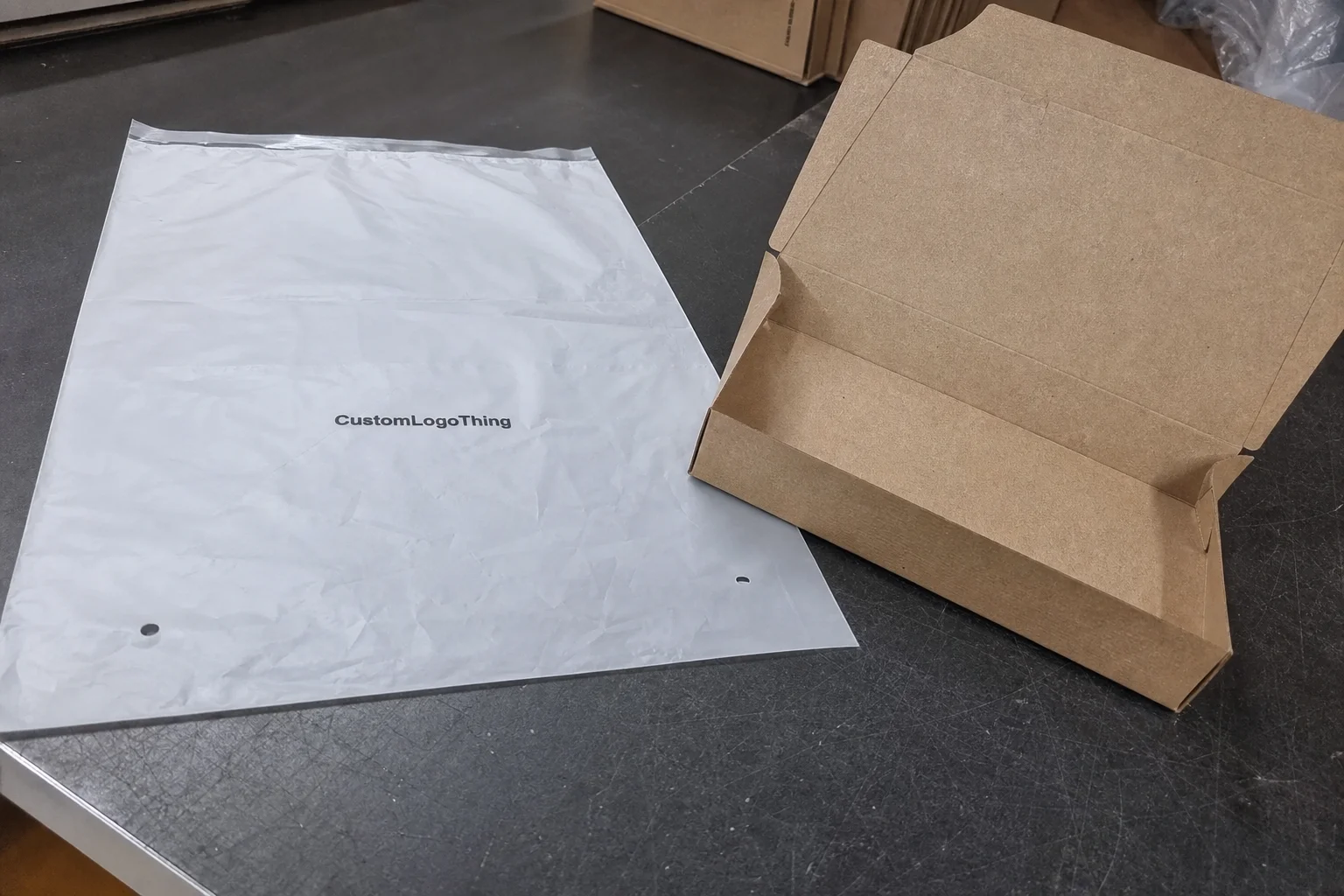
Bag cost gets attention because it is visible. Freight often gets ignored until the invoice lands. That is usually where the real gap shows up. If a bag is oversized by even a small amount, the extra empty space multiplies across the case pack and can push the shipment into a larger carton class or a worse dimensional-weight bracket.
Packaging buyers sometimes compare only unit price. That is too narrow. The bag changes the folded footprint. The folded footprint changes the number of units per carton. The carton count changes freight cube. The labor profile changes too, because a sloppy pack-out takes longer and tends to create more touch points. That chain is where cost hides.
| Option | Bag Unit Cost | Carton Effect | Typical Risk |
|---|---|---|---|
| Oversized stock bag | Lower | More empty space, lower pack density | Higher dimensional weight and more dunnage |
| Matched custom bag | Moderate | Tighter cube, cleaner stacking | Requires better spec control |
| Too-thin film | Lowest | No carton benefit if it splits or wrinkles | Rework, returns, and package protection failures |
The point is not that cheap bags are always wrong. It is that the cheapest bag can be expensive once the carton is full, the pallet is built, and the shipment is billed. A $0.03 savings on the bag does not mean much if the carton needs another layer of void fill or the ship method changes because the cube gets worse.
If the bag helps the garment ship flatter, cleaner, and faster, it is doing real work. If it only adds plastic, the spec is probably too large or too heavy.
Category behavior matters. A fitted tee can often pack 60 to 100 units per case with a disciplined fold and the right bag size. A heavy fleece hoodie may land closer to 24 to 48 units because the folded thickness changes the whole carton geometry. Sleepwear sets tend to sit in the middle, but they are more sensitive to presentation because misalignment shows immediately.
Garment poly bags for apparel brands shipping carton plan basics
The full spec is bigger than most teams expect. Bag dimensions, film gauge, closure type, fold method, carton size, and pack count all interact. Change one, and you usually affect at least two others. That is why the bag should be measured from the actual folded garment, not guessed from the size tag or the style number.
That sounds obvious. It is still where many programs go wrong. A size L tee from one pattern can fold narrower than a size M hoodie from another line. Even within the same brand, brushed fleece, rib knit, and lightweight jersey behave differently after folding and compression. The bag has to match the folded footprint, not the label.
There are two common use cases. Retail-ready presentation bags prioritize clarity, neatness, and easy identification. Bulk protection bags prioritize speed, low cost, and pack density. The first type usually has stricter requirements around print quality and surface finish. The second type is more forgiving, until it starts wasting cube or tearing during handling.
A lot of brands end up with a hybrid plan. Core basics use one standardized bag and carton pattern. Bulky items, gift sets, or styles with special presentation needs get their own spec. That approach is practical because it keeps the warehouse simpler without forcing every SKU into a one-size-fits-all package.
- Universal plan: best for basics with stable fabric weights and one fold spec.
- Style-specific plan: better for mixed categories, giftable sets, and bulky garments.
- Hybrid plan: usually the safest middle ground for a high-volume assortment with a long tail of exceptions.
For ecommerce shipping, that hybrid setup often wins because it avoids an explosion of bag SKUs while still respecting how different garments actually pack. It also gives sourcing and operations a clear line between standard items and exceptions.
Material choice matters too. Most apparel programs use low-density or linear low-density polyethylene because it is flexible, clear, and easy to run in production. Typical gauges land somewhere around 1.25 to 3 mil, depending on the garment weight and handling risk. Thicker is not automatically better. It just becomes more expensive and can add stiffness that hurts carton density.
Cost, pricing, and MOQ tradeoffs that change unit economics
Custom Poly Bag pricing usually comes down to a few inputs: film gauge, dimensions, print coverage, closure style, and order quantity. Add a heavier film or a larger format, and the unit cost climbs. Add custom print, multiple colors, or style-specific labeling, and setup costs rise again. None of that is unusual. The mistake is forgetting to compare those costs against freight and labor.
A stock clear bag may look cheaper than a custom version, but the custom version can still win if it improves carton density. A difference of $0.02 to $0.05 per unit is minor if the carton holds 8 to 12 more pieces or the shipping method stays in a better class. It is not minor if the larger bag pushes the order into more cartons or forces extra dunnage.
MOQ is the part that makes teams nervous, and for good reason. Lower MOQ orders usually carry a higher unit price because setup costs are spread over fewer pieces. Larger runs usually lower the per-unit cost, but they also increase exposure if the spec is wrong. If the bag or carton is off, the mistake gets multiplied quickly.
| Cost Factor | Impact on Bag Price | Impact on Carton Plan | What to Watch |
|---|---|---|---|
| Heavier film gauge | Raises unit cost | Improves durability, may add bulk | Use only as thick as handling requires |
| Custom print | Raises setup and unit cost | Can improve SKU identification | Confirm print area does not affect stackability |
| Custom dimensions | May raise cost at low MOQ | Can reduce cube and freight | Test with real folded samples |
| Standard stock bag | Usually lowest cost | May waste space in carton | Works best for stable, flat SKUs |
Standardizing too aggressively can backfire. Fewer bag SKUs do simplify inventory, purchasing, and picking. That part is real. But a bag that is too generous across the assortment quietly adds cubic inches to every shipment. On a high-volume style, a 20 mm width increase can cost more than the bag savings ever recovered.
There is also a production reality people forget: custom packaging is cheaper only when the spec is stable. If the artwork changes every season, or the bag dimension keeps moving while the garment cut shifts, the savings disappear into setup churn. Stable specs win. Random tweaks do not.
If you need outside references for packaging testing or material choices, the ISTA distribution testing framework is useful for validating pack performance, and the EPA offers general guidance on packaging waste and material management. If the broader program includes paper cartons or inserts tied to sourcing claims, the FSC system may be relevant.
For brands comparing packaging formats across categories, it can also help to review adjacent solutions in Custom Packaging Products, especially where soft goods and hard goods ship from the same operation. Some teams pair garment bags with Custom Poly Mailers for lighter units or move certain styles into Custom Shipping Boxes when the garment cannot tolerate compression.
Process and lead time: from spec sheet to carton pack-out
The cleanest workflow starts with the garment in the form it will actually ship. Fold one sample the way the fulfillment team will fold it. Measure width, length, and thickness after compression. Build a quick mockup. Test it in the intended carton. Then review the print proof and approve the sample. Skipping that sequence is how a spec looks fine in a spreadsheet and fails on the floor.
Lead time is not just a bag question. Custom print runs, film availability, tooling changes, sample revisions, and carton adjustments all affect timing. A simple stock-size clear bag can move quickly. A custom printed bag with style-specific labeling takes longer. If the carton size also changes, the project extends again because the pack-out needs another round of checking.
For straightforward custom runs, many teams should expect roughly 10 to 15 business days from proof approval to production completion. That is a planning range, not a promise. Material availability, print complexity, and how fast feedback comes back all change the schedule. Multiple sample rounds push the date out. So does any late change to the garment fold.
Do not approve the full run before one real carton test passes. A staged rollout is safer: test one hero SKU first, then one size family, then expand. That is especially useful for operations teams still tuning their pack bench, because it exposes problems before the volume order lands.
- Measure one real folded sample.
- Pack it in two or three candidate bag sizes.
- Test the fit in the intended carton.
- Check how long a packer needs to complete the job.
- Review damage, wrinkle retention, and carton closure.
If the fabric weight changes, the fold changes, or the fulfillment process changes, the pack-out should be re-tested. That is not overkill. It is the difference between a stable operating standard and a packaging spec that drifts until freight starts climbing.
Bag specs that affect fit, protection, and shelf presentation
Film gauge is the first spec most teams ask about, and for good reason. Too thin, and the bag can split during handling or stretch around sharp garment edges. Too thick, and you add unnecessary bulk that hurts carton efficiency. For many apparel programs, the useful range sits in the middle, but the right answer depends on how rough the warehouse handling actually is.
Closure style matters too. A straight open-top bag keeps packing fast. Self-seal or adhesive closure adds labor but can improve presentation and reduce accidental opening during transit. Perforation can help with speed at the pack bench. Hang-tab options are useful in some retail-ready programs. Suffocation warnings are not optional where required, and they should not interfere with SKU labels or barcode scans.
Clarity changes the look of the garment and how quickly pickers identify it. Crystal-clear film shows the product well, but it also shows wrinkles, folds, and handling marks more aggressively. Softer clarity can hide minor scuffing, though it may read as less premium. There is no universal winner. The right choice depends on whether the priority is shelf presentation, warehouse speed, or both.
Different garments behave differently inside the bag:
- Tees: usually need the least depth, but print placement and fold consistency matter.
- Underwear and socks: pack small, so bag sizing can be very tight without hurting handling.
- Knits: often trap air, so venting and fold discipline help avoid puffing.
- Outerwear: benefits from more space, but oversized bags can waste a lot of cube.
Barcode placement deserves more attention than it gets. If the barcode lands under a fold or in a wrinkled section, scan speed drops. If the printed area is too busy, the packer may keep rotating the bag to inspect it, which adds seconds to each unit. Small detail. Real labor cost.
One more practical point: humidity and static matter. Some films cling in warm environments, and that creates handling friction that never shows up in a clean sample photo. If the warehouse has seasonal humidity swings, the sample should be tested under the same conditions the team actually works in.
Common mistakes that inflate freight and create rework
The most common error is guessing bag size from garment size alone. That is a shortcut, not a spec process. Fold thickness changes more than people expect, especially across fleece, rib knit, brushed fabric, and layered sets. One style looks flat in a product shot and then turns bulky in production.
Oversized bags create slip, curl, and wasted air. The carton ends up carrying more plastic than product. Undersized bags compress the garment, stress seams, and force rework when the packer has to restart the job. Both outcomes hurt package protection and slow the line down.
Another frequent issue is mixing too many styles in one carton plan without defining the pack sequence. If the warehouse has to improvise the layer order, consistency drops. That leads to count errors, slower packing, and occasional damage from unstable stacking.
Compliance mistakes are quieter but expensive. Missing suffocation language, weak labeling, or barcode placement that slows receiving can create delays that look like labor problems even though the root cause is packaging. If a carton is hard to identify at inbound, the pain spreads downstream.
These are the errors that show up most often:
- Choosing a bag before measuring the folded garment.
- Ignoring thickness after compression and refold.
- Skipping carton test packs with real units.
- Assuming one size works across all garment categories.
- Ignoring how the bag affects dimensional weight.
Another one is treating the supplier catalog as proof. Catalog dimensions are a starting point. They do not tell you how the bag behaves with a specific fold, a specific fabric, or a specific packer. A bench test does.
If the team wants a more disciplined approach, tie the test to the same distribution mindset used for transit packaging: the package should survive the actual handling sequence, not the idealized one in a slide deck. That is where the real evidence lives.
Next steps: test, measure, and lock the carton standard
The practical next step is straightforward. Measure one representative style, pack it three ways, and compare cube, labor, and damage risk. One version should favor the smallest viable bag. One should favor a more generous presentation bag. One should be the current baseline. The numbers will make the tradeoff obvious fast.
Then write the standard down. Include bag dimensions, film gauge, carton dimensions, pack count, fold method, and any approved exceptions for special styles. The document should be usable by sourcing, warehouse operations, and any outside supplier without a long translation layer.
Before rollout, check the plan with the people who touch the cartons every day. Warehouse staff usually spot friction first: hard-to-open bags, awkward carton counts, SKU confusion, or film that clings in humidity. Freight data matters too. If the new spec saves pennies but adds cube, it is not a win.
A disciplined plan for Garment Poly Bags for apparel brands shipping carton flow is not just about protecting apparel. It is about aligning the bag, the fold, the carton, and the shipping lane so each SKU moves with less waste and fewer surprises. That is the real standard. Not the cheapest bag on the sheet.
Start with one carton test, confirm the fit, and approve volume only after the pack-out holds up under real handling conditions.
How do I decide the right bag size for garment poly bags in an apparel carton plan?
Start with the folded garment footprint, then add only the minimum clearance needed for insertion and presentation. Test the bag with real folded samples, because thickness changes more than flat measurements suggest. Check whether the final bag still allows efficient carton packing without forcing extra empty space.
What affects the pricing of garment poly bags for apparel brands shipping carton planning?
The biggest drivers are material gauge, bag dimensions, print coverage, closure style, and order quantity. Carton efficiency matters too, because a slightly higher bag price can be cheaper overall if it reduces freight cube or labor. Ask suppliers to separate bag cost from carton and pack-out savings so you can compare true landed cost.
How long does the process usually take from sample to production?
Simple stock sizes can move quickly, but custom print, revised dimensions, and sample rounds add time. Lead time usually grows when you need multiple sizes or style-specific carton pack-outs instead of one standard spec. Build in time for one real carton test before approving the final production run.
What MOQ should apparel brands expect for custom poly bags?
MOQ depends on film type, print method, and whether the bag is stock size or custom size. Lower MOQ orders usually cost more per unit, so compare setup fees against long-run savings before committing. If you are testing a new carton plan, start with the smallest viable run rather than overbuying unproven specs.
How can I reduce freight cost without sacrificing garment protection?
Reduce empty air first by matching bag size to the folded garment and tightening the carton pack count. Use the lightest film that still protects the product and survives your warehouse handling process. Re-test the carton after any style or fold change, because a better pack-out often cuts freight more than a cheaper bag does.


