A gift set kraft paper shopping Bags Factory Quote usually looks simple on paper and messy in practice. Two bags can share the same outer size and still price very differently once paper weight, handle construction, print coverage, and packing method are counted. That gap matters because the bag is not just a carrier; it is the first physical cue a customer gets about the gift inside. If it buckles, wrinkles, or feels underbuilt, the perceived value drops before the contents even come into view.
Kraft paper stays popular for a reason. It feels direct, familiar, and easy to brand without making the package look overworked. For candles, cosmetics, apparel sets, gourmet bundles, and seasonal gift packs, it gives the impression of restraint rather than noise. That restraint can be expensive to fake. A good kraft bag looks straightforward because the material, structure, and print choices are already doing the heavy lifting.
Why Kraft Shopping Bags Raise Perceived Value for Gift Sets
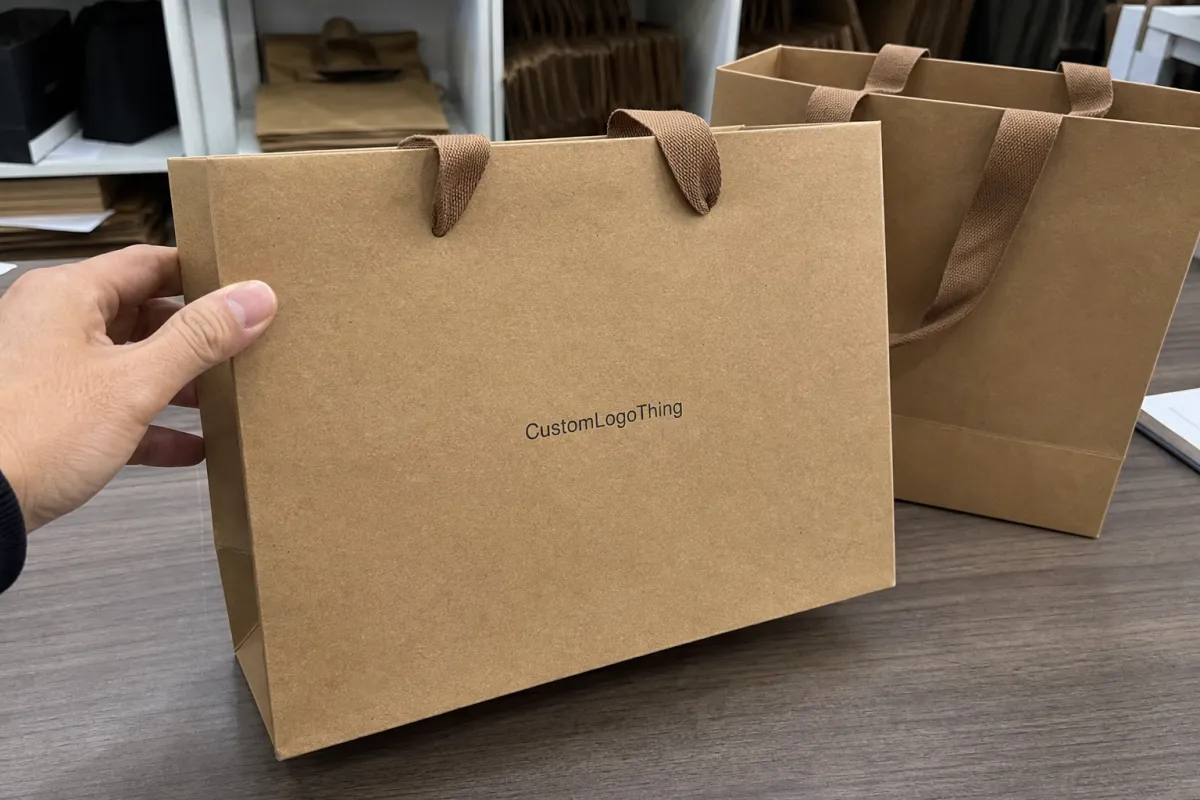
Gift packaging succeeds when the customer can tell the product was handled with care. Kraft shopping bags support that feeling because they sit between utility and presentation. They are less formal than rigid gift boxes, but more deliberate than a plain mailer. That middle ground makes them useful for brands that want the package to feel retail-ready without looking precious.
The visual language is part of the appeal. Natural kraft signals authenticity, recycled content, and a lower-gloss finish that many buyers now associate with better judgment. Black ink on brown stock, or a small foil mark on an uncoated surface, often lands better than full coverage artwork because the contrast feels earned rather than sprayed on. In practical terms, kraft also hides minor handling marks better than bright white stock, which helps during carton packing and store replenishment.
Structure matters just as much as appearance. A gift set bag is expected to stand upright, carry weight without stretching, and keep the bottom square after being lifted a few times. Reinforced bottoms, proper gusset depth, and a top edge that resists tearing do more for perceived value than a second print color. If the bag sags, the brand looks less careful. If it stays crisp, the contents seem more expensive, even when the product mix is modest.
For buyers with sustainability requirements, kraft offers a workable route without forcing vague claims. FSC-certified paper, recycled kraft, and paper handles can support a lower-plastic package profile, but only if the full build is reviewed honestly. Film lamination, heavy coating, and mixed-material handles can complicate recyclability. The material story should match the actual construction, not the campaign copy.
A premium gift bag is judged in seconds: does it stand, does it carry, does it keep its shape, and does the finish still look intentional after handling? If any of those fail, the package feels cheaper than the product inside.
Compared with corrugated mailers or rigid boxes, kraft shopping bags are less about transit abuse and more about presentation in hand. That difference shapes both design and pricing. Corrugated structures tolerate rough shipping better, while shopping bags are expected to look composed, fold flat, and move through retail or fulfillment channels without adding too much bulk. Picking the wrong format can inflate cost without improving the customer experience.
Paper Weight, Lamination, and Handle Choices That Affect Use
Paper weight is usually the first specification worth locking down. Smaller gift bags often perform well in the 150-200 gsm range, especially for light cosmetics, candles, or single-item sets. Larger bags or heavier gift bundles usually need 230-350 gsm stock, sometimes with reinforcement at the bottom or top fold. Once a bag moves into that heavier range, it tends to feel more stable in the hand, but the added weight also changes the folding behavior and can slow production slightly.
Paper alone does not define strength. A bag built from moderate gsm stock can outperform a heavier one if the gussets are cut cleanly, the glue lines are consistent, and the bottom board is sized properly. That is why a factory quote should never be read as a paper number only. The structure around the paper is part of the product.
Handles deserve equal attention. Twisted paper handles are a common choice because they fit the kraft look and usually keep the price in check. Flat paper handles are a little more forgiving for load spread and still suit a recyclable presentation. Cotton rope, ribbon, and braided cord handles move the bag into a more premium territory, but they add sourcing complexity, extra labor, and more variation at the attachment point. A beautiful handle means little if the reinforcement around it is weak.
Lamination and coating create another set of tradeoffs. Matte varnish protects the print while keeping the natural surface visible. Gloss coating makes color pop but can fight the kraft aesthetic. Soft-touch lamination gives a richer feel, though it adds cost and can complicate end-of-life recycling in some markets. Uncoated kraft remains the easiest choice if the brief values simplicity, recyclability, and a straightforward tactile finish over shine.
There are also structural details that often get missed in first-round sourcing. A wider gusset helps boxed gift items sit square. A bottom board keeps jars and bottles from punching through. A reinforced top edge reduces tearing during carry tests and in retail handoffs. Small changes like these can decide whether a bag feels engineered or merely assembled.
Print, Finish, and Insert Options for Custom Gift Packaging
Print should follow the artwork, not force the artwork to adapt to the press. A brand using one or two solid colors can usually keep the build simple and still look polished. Once the design becomes layered, photographic, or heavily shaded, offset or more advanced print methods start to matter. On kraft stock, the surface is not as forgiving as coated paper, so fine typography, light tints, and small reversed-out details need careful proofing.
White ink is a common request, but on brown kraft it behaves differently from white ink on coated paper. Coverage can look softer, texture can show through, and exact brightness is harder to keep stable across lots. That is not a defect; it is how the material behaves. Buyers who expect pure-paper whiteness on uncoated kraft often end up disappointed, while those who plan for a slightly warm, natural finish usually get better results.
Decorative finishes can add value without turning the bag into a cost trap. Hot stamping works well for logos or short marks, especially in gold, silver, or black foil. Embossing and debossing create tactility, which is useful if the bag is meant to sit on a counter or be photographed. Spot UV can work, but only if the design has enough contrast and the surface treatment is compatible with the bag's coating. On natural kraft, restraint is often smarter than volume.
Inserts are easy to overlook because they are hidden, yet they often decide whether the gift set travels cleanly. Tissue wrap, a simple partition, a collar insert, or a base board can prevent shifting and protect the presentation if the bag is going through a fulfillment center first. For mixed-item gift sets, even a small movement inside the bag can make the arrangement look careless by the time it reaches the customer.
One detail buyers sometimes miss is the inside view. A clean interior fold, an inside-print accent, or a coordinated board can make the opening experience feel finished, especially for higher-end seasonal or corporate gifts. Inside decoration should not be added just for effect; it should answer a specific need, such as hiding structure marks or supporting a reveal moment. Used that way, it earns its place.
Gift Set Kraft Paper Shopping Bags Factory Quote: Cost, MOQ, and Quote Drivers
An accurate gift set kraft paper shopping Bags Factory Quote starts with matching specs. The biggest price drivers are bag dimensions, paper grade, handle type, print coverage, finish, and packing requirements. Change any one of those and the unit price can move sharply. A bag that appears almost identical in photos can differ materially in production if the factory has to source custom handles, add reinforcement, or run extra finishing passes.
MOQ rises and falls with complexity. A straightforward kraft bag with one-color printing and twisted paper handles can usually be quoted at a lower threshold than a premium version with foil, embossing, rope handles, or soft-touch coating. That is less about arbitrary policy and more about setup time, waste allowance, and material coordination. A supplier comparing only unit price without matching build details is not really quoting the same product.
| Build | Typical Use | Relative MOQ Pressure | Indicative Factory Price at 5,000 pcs |
|---|---|---|---|
| 150-180 gsm natural kraft, twisted paper handle, 1-color print | Light gift sets, candles, small cosmetics | Lower | $0.18-$0.28 per unit |
| 230-280 gsm kraft, flat paper or cotton rope handle, 2-color print, matte varnish | Apparel, medium gift bundles, retail promotions | Medium | $0.30-$0.48 per unit |
| 300+ gsm reinforced kraft, rope or ribbon handle, foil or embossing | Premium gifting, luxury sets, seasonal launch packs | Higher | $0.55-$0.95 per unit |
Those figures are directional. A smaller bag can cost more than expected if it uses a premium handle or high-coverage decoration, while a larger bag can stay moderate if the structure is simple and the quantity is strong. Factory pricing is rarely linear. A 10% increase in size may add very little, while a modest change in finish can add a much bigger jump because setup and labor matter as much as raw material.
The quote also needs context beyond the bag itself. Sample cost, tooling, packing standard, carton count, export paperwork, and freight terms can all change the landed number. Two quotes that look close on a spreadsheet can separate quickly once packing density, palletization, and local delivery are included. For that reason, a serious buyer should always ask for the same paper grade, the same handle construction, and the same shipping assumptions before comparing suppliers.
Material origin can influence both appearance and consistency. Virgin kraft usually gives a more even surface and cleaner print response. Recycled kraft may show more fiber variation and a rougher texture, which can be attractive or distracting depending on the design. Blended stock often sits between the two, but the exact outcome depends on the mill and the batch. If the order depends on a very specific brown tone, ask for a physical sample rather than trusting a screen image.
Production Process and Lead Time From Proof to Shipment
The production path is predictable, but only if the specification is clear. A typical order moves through inquiry, artwork review, dieline confirmation, proofing, sample approval, bulk printing, finishing, inspection, packing, and shipment booking. Each stage has its own failure mode. The fastest way to lose time is to send a vague brief and then revise it after the quote has already been prepared.
Artwork is a frequent bottleneck. Files with low resolution, unclear Pantone references, or unconfirmed print areas can slow everything down. Handle sourcing can also add time if the requested style is not standard. Custom dies and plates need preparation, and premium finishing steps may require extra setup or drying time. None of this is unusual; it just needs to be acknowledged early instead of discovered halfway through the order.
For a simple build, bulk production often takes about 12-15 business days after proof approval. More complex jobs can take longer, especially if the order includes custom inserts, special coatings, or sourced handles. That window is only the factory time. Sample production, revisions, sea freight, and customs clearance sit outside it. Buyers who confuse the two often think a supplier is late when the order is actually moving exactly as planned.
Seasonal gifting adds another layer of pressure. Peak periods compress paper supply, handle sourcing, and shipping availability at the same time. A quote that looks attractive in quiet months may become less useful if production slots are already full. If timing matters, ask not only how long the job takes, but when the factory can start it. A realistic schedule is worth more than an optimistic one.
For buyers who want to think through shipping durability, transit testing standards from ISTA provide a practical framework for drop and vibration risk. For material sourcing, FSC is a useful reference point for chain-of-custody and certified paper options. Neither replaces a sample test, but both help anchor the discussion in concrete terms rather than broad claims.
Quality Checks, Packing, and Shipping Details Buyers Should Confirm
Quality control for gift bags should focus on what customers and warehouse teams actually notice. Print registration matters if the logo must sit cleanly on the front panel. Color consistency matters if the brand depends on a specific brown, black, or white-on-kraft contrast. Handle pull strength matters because a tear at the attachment point is visible, immediate, and hard to ignore. Add seam integrity, bottom support, and surface cleanliness, and most common defects are covered.
Bag shape is another quality signal. A bag can pass basic dimensions and still look wrong if the gusset is off, the top edge waves, or the base does not sit flat. Those defects are not dramatic in a spec sheet, but they change how the bag behaves on a shelf and in hand. For gift sets, the visual standard is usually closer to retail presentation than to plain packing utility.
Packing method should protect structure without making cartons inefficient. Flat packing is still the most common approach because it preserves the bag shape and makes counting easier. Bundling should be tight enough to avoid shifting but not so tight that it leaves pressure marks. In humid shipping lanes, moisture protection matters. Kraft stock can curl, warp, or pick up scuffs if cartons are over-compressed or stored badly.
Master carton weight and dimensions deserve written confirmation. These numbers affect freight charges, warehouse handling, and even storage plans at the destination. A carton that is too heavy slows receiving. A carton that is too loose wastes space and raises shipping cost. For retail distribution, smaller cartons may be easier to handle; for fulfillment centers, efficient stacking can matter more. The end use should guide the packing method, not the other way around.
If the bags will move through a shipping network before reaching the customer, ask for carton markings, palletization, and compression limits. If they will sit on a store shelf first, ask how the top edge is protected from scuffing and how the handles are bundled to avoid tangling. The right packing spec depends on the route, and the route should be known before production starts.
What to Send for a Fast Quote, Sample, and Order Review
To get a useful factory response, send the bag dimensions, paper weight target, handle style, print artwork, estimated quantity, and delivery location. That is the minimum. If you already know whether the bag needs a bottom board, matte varnish, foil stamping, or a reinforced top fold, include that too. The closer the brief is to the actual build, the less room there is for guesswork in the quote.
A reference image or dieline helps more than most teams expect. It tells the factory whether the goal is a natural kraft look, a premium retail finish, or a structural gift carrier with a more substantial feel. It also reduces the chance that the supplier quotes a visually similar bag with different material assumptions. Packaging sourcing is full of near-matches; clear references cut through that noise.
The useful follow-up questions are direct. What is the sample cost? How long will the sample take? What is the bulk lead time after approval? How are the bags packed? Is freight included or separate? What paper grade is being used? If the answer to any of those is vague, the quote probably is too. A clear supplier should be able to separate sample timing, production timing, and transport timing without mixing them together.
Before placing an order, compare each quote on the same basis. Check paper grade, handle attachment method, finish, insert structure, and carton packing. If one supplier includes a base board and another does not, the lower price is not really lower. Approval should follow a sample, not just a PDF. That simple discipline avoids a long list of avoidable surprises.
FAQ
How do I request a gift set kraft paper shopping bags quote that is accurate?
Provide the dimensions, paper weight, handle type, print method, quantity, and destination. If you have artwork or a mockup, send it with the inquiry so the factory can price the same build instead of a rough approximation. Ask whether sampling, packing, and freight are included, since those items can change the landed cost more than the bag price itself.
What affects the unit cost of printed kraft shopping bags the most?
Paper thickness, handle material, and print coverage usually create the largest changes. Extra steps such as embossing, hot stamping, lamination, or special inserts raise setup and labor. Larger quantities often lower the unit price, but they also increase the total order value and storage requirement.
What MOQ should I expect for gift set paper bags from a factory?
MOQ depends on size, print complexity, and whether the bag uses standard or custom components. Simple single-color builds usually carry a lower threshold than premium multi-finish versions. If the launch is uncertain, ask for both a test order and a full run so you can compare risk and pricing.
Can kraft paper shopping bags support heavier gift sets?
Yes, if the paper weight, handle attachment, bottom reinforcement, and bag geometry are specified correctly. Heavier contents usually need stronger stock, a wider gusset, and a base board or insert. The safest check is a physical sample loaded with the actual gift set weight before bulk approval.
How long does production usually take after sample approval?
For a simple build, bulk production often takes about 12-15 business days after proof approval. More complex decoration, custom handles, or larger orders can add time. Sample time, production time, and shipping time should be confirmed separately so the schedule is realistic.
A good gift set kraft paper shopping Bags Factory Quote should do more than state a unit price. It should tell you what the bag is made of, how it will be built, how it will be packed, and where the cost pressure sits. That clarity matters because a gift bag is part container, part presentation, and part brand signal. If the spec is vague, the quote will be vague too.
Clear requirements, a sample that matches the intended use, and a comparison based on the same construction details will usually produce the best result. The final bag does not need to be elaborate to feel premium. It needs to be consistent, sturdy, and honest about what it can carry. In packaging, that combination often reads as quality long before anyone notices the logo.

