Custom Logo Things
Restaurant Matte Laminated Paper Bags Factory Quote Request
A restaurant Matte Laminated Paper Bags factory quote should do more than name a unit price. It should tell you whether the bag will carry a full takeaway order, survive repeated handoffs, and still look presentable when it reaches the customer. That last part matters more than many buyers expect. A bag can photograph well in a mockup and still fail at the base seam, the gusset fold, or the handle anchor once hot meals, drinks, and cutlery are packed together.
Matte lamination is popular for restaurant packaging because it reduces glare, softens the print finish, and protects the surface from rub marks during packing and delivery. It also reads as more controlled than a high-gloss finish under counter lighting. For restaurants that use packaging as part of the dining experience, the bag becomes a small but visible extension of the brand.
The strongest quotes are built from physical facts: finished size, board weight, handle style, print coverage, lamination type, and destination. Artwork matters, but artwork alone does not tell a factory how the bag should carry weight or how it will hold up in carton packing. If the brief leaves out the construction details, the quote may look accurate and still miss the real production cost.
Restaurant Matte Laminated Paper Bags Factory Quote: What Buyers Miss First
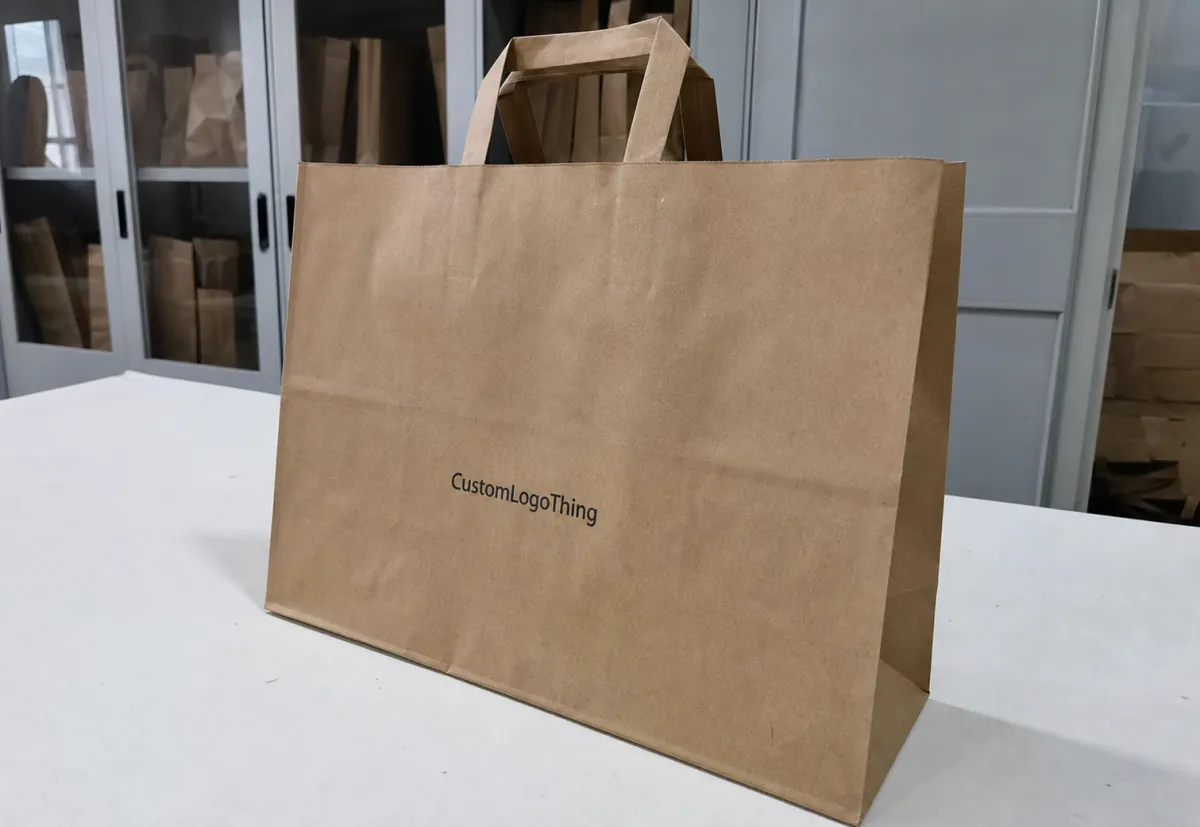
Most buyers begin with appearance. Factories begin with construction. That gap creates trouble when a restaurant asks for a premium-looking bag but does not define what the bag must carry. A simple lunch set, two boxed meals, or a mixed order with bottles and napkins each needs a different structure. The design may be identical on paper, yet the bottom patch, gusset depth, and handle reinforcement can change the outcome completely.
The first weak point is often the load path. The bag does not fail because the logo is too large or the matte finish is the wrong shade. It fails because the base board is too light, the glue line is inconsistent, or the handles are attached without enough reinforcement. For moderate takeaway programs, 250gsm to 350gsm is a common working range, but the right spec depends on the bag size and the contents. A wide bag with deep gussets usually needs more stiffness than a narrow bag carrying one box.
Matte lamination changes how color behaves on the finished bag. It cuts reflections, so solids appear calmer and logos look more refined in bright service areas. That can be useful at pickup shelves, delivery counters, and restaurant entrances where a glossy surface may look busy or show fingerprints more easily. Dense blacks and large color fields often benefit from matte lamination because the finish holds the artwork together visually.
For buyers who need standards to compare, the Paperboard Packaging Council at packaging.org and the Forest Stewardship Council at fsc.org are useful references. They do not price bags, but they help separate material claims from marketing language.
- Bottom seam: needs a full glue line and enough board strength for the intended load.
- Gusset: should open cleanly without forcing the sidewalls outward.
- Handle area: needs reinforcement if the bag carries bottles, soups, or multiple containers.
- Matte surface: should protect print from rubbing during stacking and transport.
Paper Grades, Board Weight, and Matte Finish Options
The substrate decides more than the artwork does. Kraft paper gives a natural, earthy look and usually feels sturdy in hand, but lighter graphics can appear muted because the texture shows through. White board, including duplex and SBS-style options, gives a brighter print face and cleaner logo edges. Duplex board often sits in the middle: practical stiffness, solid print clarity, and a price point that works for many restaurant programs that want a polished takeaway presentation without moving into premium display packaging.
Board weight deserves more attention than it usually gets. A lighter board can work for napkins or a pastry box, but it is not the right choice for a mixed dinner order. In practice, laminated restaurant bags often sit in the 250gsm to 350gsm range. That is only a starting point. Size, depth, and the expected contents determine whether the bag stays upright, whether the top edge folds neatly, and whether the handles pull the bag out of shape after repeated lifts.
Matte finish usually comes in two forms: film lamination and matte coating. Film lamination adds stronger scuff resistance and better protection against moisture splash, carton wear, and repeated handling. Matte coating is lighter and sometimes cheaper, but it usually does not give the same surface barrier or consistent hand-feel. For bags that move through kitchen prep, dispatch counters, drivers, and customers, film lamination is usually the safer option.
| Build option | Typical look and feel | Strength profile | Best use | Quote effect |
|---|---|---|---|---|
| Kraft board with matte film | Natural, understated, slightly textured | Good stiffness, decent rub resistance | Casual dining, eco-forward brands | Usually mid-range |
| White duplex board with matte film | Bright print, crisp logo edges | Solid everyday carry strength | QSR takeaway, delivery bags | Often the most balanced option |
| Art paper wrap over board | Rich color, smoother premium face | Depends on core board and glue work | High-end dining, branded catering | Usually higher because of extra steps |
Construction details belong in the quote request. A reinforced top edge helps the bag keep its opening shape. A bottom insert or base card improves stability for heavier meals. Folded gussets keep the side panels tidy and reduce awkward bulging. Handle choice matters too. Paper twist handles, rope handles, ribbon handles, and die-cut reinforced handles all affect cost, appearance, and durability in different ways. For bags that carry drinks or dense meal bundles, the factory should be asked which handle style holds up best under real service conditions.
Print Specs That Control Shelf Impact and Reorder Consistency
Print is where brands often spend money without getting enough control in return. Color count, PMS matching, full-bleed coverage, and ink density all change how the finished bag looks after matte lamination. A dense black logo can look elegant on a matte surface, but only if the file is prepared correctly and the factory knows how much coverage the board can take without looking patchy or soft.
Good artwork preparation saves money later. The dieline should be approved before print starts, and the safe area has to account for folds, glue tabs, and handle cuts. A logo can look centered in a flat PDF and still land too close to a crease on the finished bag. That mistake is common in restaurant packaging because buyers approve the layout before they imagine the bag in three dimensions.
Repeat orders need file discipline. Keep the vector logo, specify Pantone references where required, and supply images at proper resolution. Digital proofs are useful for checking layout and copy, but they are not the same as seeing ink on laminated board. If color accuracy matters, a hard proof or press-calibrated sample is worth the extra step because it reduces expensive corrections later. For chains with multiple locations, one approved reference should govern every reprint so the bag does not drift from store to store.
The lowest quote is rarely the most useful one. The better test is whether the bag still looks clean after ten handoffs, not just in a single sample photo.
Three control points usually make the difference: dieline sign-off, proof approval, and a repeat-order reference sheet. Those checkpoints turn a visual idea into a measurable spec. They also make reorders faster because the factory can work from a defined standard instead of reinterpreting the artwork each time.
Pricing, MOQ, and Quote Drivers for Restaurant Bags
A restaurant matte laminated paper Bags Factory Quote is shaped by more than the logo count. Paper grade, board weight, matte finish, handle style, bag size, print complexity, packing format, and freight terms all affect the final number. A compact single-meal bag with one-color print is a different job from a wide catering bag with rope handles, full-bleed graphics, and a reinforced base. Material cost can shift noticeably before labor is even added.
MOQ exists because production has fixed setup costs. Print plates, cut dies, lamination setup, gluing adjustments, and inspection all take time whether the order is small or large. Smaller runs tend to cost more per unit because those setup costs are spread across fewer bags. Larger quantities can reduce the price, but only if the spec stays stable. If the artwork or size changes often, a moderate quantity is usually easier to manage than overordering and holding excess stock.
For a practical benchmark, simple matte laminated restaurant bags in a moderate size can sometimes land around $0.18-$0.28 per unit at 5,000 pieces, depending on board weight and print coverage. More complex builds with thicker board, premium handles, or heavier finishing can move into the $0.30-$0.60 range or higher. Those numbers are directional only. Freight, carton count, destination, and market conditions can move the landed cost in either direction.
| Quote driver | What changes | Typical cost impact | What to ask for in the quote |
|---|---|---|---|
| Board weight | Stiffness and carry strength | Light to moderate | GSM or board spec, not “strong paper” |
| Matte lamination | Scuff resistance and appearance | Moderate | Film thickness or coating type |
| Handle style | Labor and attachment method | Moderate to high | Handle material, color, and reinforcement |
| Print coverage | Ink usage and setup time | Low to moderate | One color, PMS, or full-bleed breakdown |
| Packing spec | Carton count and export protection | Low to moderate | Carton quantity, inner wrap, pallet need |
Ask for itemized pricing, sample charges, setup fees, freight terms, and any extra cost for custom packing. If the quote has a validity period, that should be written down too, especially when paper pricing or shipping rates are moving. A clear quote sheet is easier to compare and easier to approve.
Production Steps, Lead Time, and Approval Checkpoints
The production sequence is straightforward if the approvals arrive in the right order. It usually starts with artwork review and dieline confirmation, then moves into proofing, printing, lamination, cutting, gluing, inspection, and final packing. Every stage can stall if a spec is missing or a handle detail was never confirmed. Fast orders tend to come from buyers who answer technical questions early.
- Artwork and dieline review: confirm size, bleed, safe area, and panel placement.
- Proof approval: sign off on layout, color notes, and special finishes.
- Material prep: paper, board, handles, and glue stock are matched to the job.
- Printing and lamination: the image is produced, then protected with the selected matte finish.
- Cutting and bag forming: panels are trimmed, folded, and glued into shape.
- Inspection and packing: samples are checked, cartons are counted, and the shipment is prepared.
Lead time depends on complexity and how quickly approvals move. For simple builds, 12-15 business days after proof approval is a common planning range. If the order includes multiple colors, heavy board, or special handles, 18-25 business days is more realistic. Seasonal workload and shipping method can extend that window. Buyers should always confirm whether the quoted lead time begins at order confirmation, artwork sign-off, or deposit receipt. Those details matter when a restaurant opening date is already fixed.
Before dispatch, carton count, outer carton marks, pallet requirements, and destination details should be checked carefully. Small mistakes in the shipping data can become expensive delays. For sea freight, packing dimensions and gross weight should be confirmed early so the forwarder can book space correctly. Air freight is possible for urgent runs, but it changes the cost picture quickly.
What to Compare in a Paper Bag Factory Partner Before You Sign Off
A real converting factory is different from a trading layer that only passes along files. The first sign is capability. If the supplier can show in-house printing, lamination, cutting, and bag forming, the quote is usually more reliable because fewer handoffs are involved. That does not make every factory equal, but it does reduce the chances of the bag drifting away from the approved spec.
Quality control should be visible before the order is placed. Ask how they check adhesion, print alignment, handle bonding, and finished dimensions. A capable factory should be able to explain whether they use random sampling, full-line inspection, or another method. They should also be able to discuss load testing for heavier takeaway orders without sounding vague. If a bag is meant to carry soup containers or beverage bottles, the supplier should understand those stress points immediately.
Documentation matters too. Clear spec sheets, order tracking, export packing details, and a quick response to revisions all indicate how the supplier works under pressure. If a quote says only “same as sample” or “strong handle,” that is not enough for a production order. Good quotes name the board weight, finish type, handle material, carton count, and sample policy. That level of detail protects both sides when the run starts.
Response time is also part of the value. A supplier that answers a revision in one business day is easier to work with than one that leaves a week-long gap. And a clean brief helps more than most buyers realize. Dimensions, print notes, and quantity range should be written clearly before the quote request goes out. A vague request usually returns a vague estimate.
Good factory partners make the bag spec measurable, repeatable, and easy to check before production begins.
How to Prepare the Final Quote Request and Move Into Production
If the goal is a serious price, the request should be equally specific. The fastest way to get a useful restaurant matte laminated paper Bags Factory Quote is to send the finished size, quantity, paper type, matte finish preference, handle style, destination, and required delivery date in one message. A factory can work with that. A note that says “premium bag, please quote” usually creates more back-and-forth than progress.
It helps to ask for the next-step items at the same time: sample timing, tiered pricing, production calendar, shipping estimate, and a written list of what is included. Confirm whether the quote covers plates, setup, freight, carton packing, and any certification language that has to appear on the carton or invoice. If the bags will ship to multiple locations or in staggered batches, say so early because logistics can change the landed cost more than the print spec does.
Here is the checklist worth sending before ordering:
- Finished size: width, gusset, and height in millimeters or inches.
- Quantity: first order volume and any repeat forecast.
- Material: kraft, white board, duplex board, or another agreed substrate.
- Finish: matte film or matte coating, plus any special touch requirement.
- Handle: paper twist, rope, ribbon, die-cut, or reinforced carry style.
- Print: one color, PMS, full color, or full-bleed artwork.
- Delivery: shipping address, target date, and packing preference.
Once those details are set, the quote stops being a rough guess and becomes a production plan. That is the point where ordering gets easier, because the factory is pricing the real build, the buyer is comparing like for like, and both sides can reduce surprises before the first sheet is printed.
What details do I need for a restaurant matte laminated paper bags factory quote?
Provide finished bag size, paper grade, lamination type, handle style, print colors, and quantity so the factory can price the actual build. Add delivery location, target timeline, and packing requirements because freight and carton specs can change the final landed cost.
Is matte lamination better than matte varnish for restaurant paper bags?
Matte lamination usually offers stronger scuff resistance and a more premium hand feel, which helps takeaway bags stay presentable. Matte varnish can be lighter and sometimes more economical, but it usually does not protect against rubbing and moisture as well as lamination.
What MOQ should I expect for custom laminated restaurant bags?
MOQ depends on size, print complexity, and paper specification, but it is usually set by production efficiency rather than a single universal number. Ask whether mixed sizes or staggered repeats are allowed, because that can help smaller programs control inventory without losing pricing discipline.
Can matte laminated paper bags be made stronger for takeaway meals?
Yes, strength can be improved with thicker board, reinforced bottoms, stronger gusset construction, and better handle attachment methods. For heavier restaurant orders, request load testing or sample evaluation so the bag is checked against real use, not just visual appearance.
How should I compare two factory quotes for the same bag?
Compare only matching specs: size, board weight, finish, handle type, print colors, carton pack, and delivery terms. Look beyond unit price and check sample policy, lead time, QC process, and freight assumptions so the cheaper quote does not become the more expensive order.

