Buyer Fit Snapshot
| Best fit | Glossy Poly Mailers for Branding projects where brand print, material claims, artwork control, MOQ, and repeat-order consistency need to be specified before quoting. |
|---|---|
| Quote inputs | Share finished size, material target, print colors, finish, packing count, annual reorder estimate, ship-to region, and any compliance wording. |
| Proofing check | Approve dieline scale, logo placement, barcode or warning zones, color tolerance, closure strength, and carton packing before bulk production. |
| Main risk | Vague material claims, crowded artwork, missing packing details, or unclear freight terms can make a low unit price expensive after revisions. |
Fast answer: Glossy Poly Mailers for Branding: Film, Print, MOQ, and Carton Packing should be specified like a repeatable production item. The safest quote records material, print method, finish, artwork proof, packing count, and reorder notes in one written spec.
Production checks before approval
Compare the actual filled-product size with the drawing, then confirm tolerance on folds, seals, hang holes, label areas, and retail display edges. Reserve space for logos, QR codes, warning copy, and material claims before decorative graphics fill the panel.
Quote comparison points
Review material grade, print process, finish, sampling route, tooling charges, carton quantity, and freight assumptions side by side. A quote is only useful when the supplier can repeat the same color, closure quality, and packing count on the next order.
Glossy Poly Mailers for Branding: A Practical Guide
Glossy Poly Mailers for branding do one job especially well: they turn a shipping pouch into a visible brand cue before the box opens, before the tape gets peeled, and before the product has a chance to speak for itself. That first touch matters more than people sometimes admit, because the outer package is often the first physical proof that the brand pays attention to detail. A glossy finish can sharpen that moment, helping a logo read cleanly and a color palette feel more deliberate the instant the parcel lands in a customer's hands.
Some packages are just containers. Others carry a point of view. The difference usually comes down to finish, print quality, color control, and whether the outer layer was chosen with intent rather than convenience. A gloss surface tends to push color forward, make line work feel crisper, and give a shipment a more polished presence. For apparel, accessories, beauty kits, and subscription items, Glossy Poly Mailers for branding can add that extra sense of finish without pushing the packaging budget all the way into box territory.
Shine is not a one-size-fits-all answer. Matte can feel calmer and more editorial. Clear mailers can put the product on display, though privacy takes a hit. Gloss sits in the middle with enough visual energy to pull attention while still keeping the contents covered. That balance is useful when the package needs to carry the brand identity, not just protect the order. The better question is not whether gloss looks nice, but whether glossy poly mailers for branding match the job the package has to do.
A mailer is not just a shipping skin. It is a moving billboard, a protective layer, and a brand signal all at once.
This guide breaks the choice into practical pieces: how glossy poly mailers for branding are made, what drives cost, where the common failures happen, and how to order them without tying up too much cash in inventory. If you are comparing options across Custom Packaging Products, or narrowing the field to Custom Poly Mailers, the aim is to help you choose a finish that supports both the product and the brand story.
Why Glossy Poly Mailers for Branding Stand Out
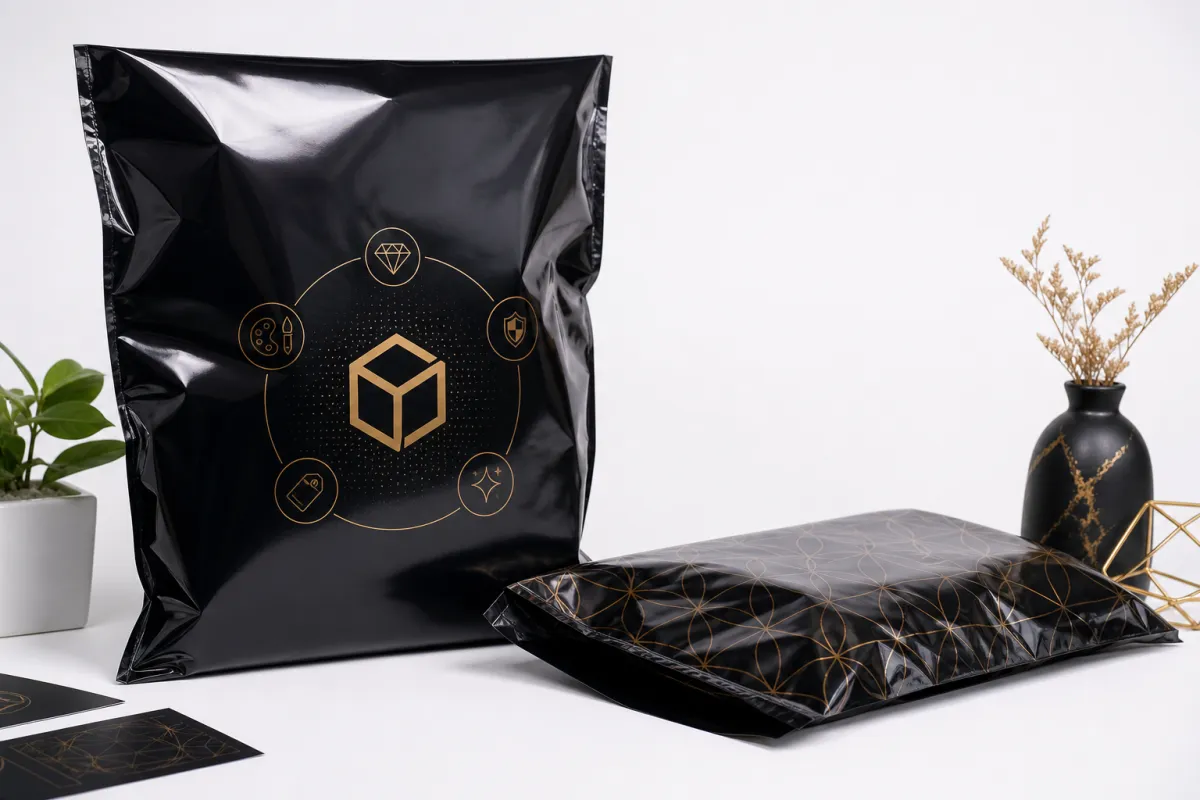
For a lot of eCommerce shipments, the mailer is the first branded surface the customer touches. That makes the outside of the package carry more weight than it seems like it should. Glossy poly mailers for branding stand out because the finish catches light, which makes logos sharper and color blocks read with more force. A design that looks muted on a flat surface often feels more alive once the gloss is doing its part.
There is a perception effect built into that shine. Gloss usually reads as finished, deliberate, and a little more premium. It does not magically make a package luxurious, but it does make the eye linger. For a small parcel, that can be enough to raise the sense of value before the product is even handled. A customer may not say it out loud, yet the package is already shaping the experience.
That effect matters most for items that are repeat-purchase, giftable, or easy to share on social media. Socks, cosmetics, jewelry, skincare samples, stationery, and apparel accessories all benefit from a package that feels intentional. The product is inside, but the package is setting the tone. Glossy poly mailers for branding help that tone land cleanly, which supports recognition on the next order and memory after the first one.
The difference between gloss, matte, and clear is worth sorting out before a purchase. Matte often feels quieter and more design-led. Clear mailers are useful when product visibility matters, though they reveal everything inside and can feel exposed. Gloss sits between those two choices. It delivers visual punch without sacrificing privacy, which is why glossy poly mailers for branding often work well for direct-to-consumer orders that need a bold arrival.
The most useful question is not whether gloss is attractive. It is whether the outer package needs to communicate energy, clarity, and brand consistency in one quick visual hit. If the answer is yes, glossy poly mailers for branding usually deserve serious consideration. The finish does not have to be dramatic to work; it only has to support the identity the brand already wants to project.
Strong results usually come from simple artwork and disciplined color. A clean logo, a restrained palette, and enough white space to let the design breathe will usually outperform a crowded layout. Gloss magnifies both strengths and mistakes. That is exactly why glossy poly mailers for branding need a real design brief rather than a rushed upload and a hopeful proof.
How Glossy Poly Mailers for Branding Work
Most glossy poly mailers for branding are made from polyethylene film, usually co-extruded in layers so the bag can balance flexibility, opacity, and tear resistance. The outer layer carries the gloss. The inner layer helps the mailer hold together and seal well. Between those layers, the structure has to survive sorting belts, stacked cartons, moisture, and rough handling without splitting or opening at the seams.
A standard custom mailer usually includes a peel-and-stick adhesive strip, folded side gussets, and an opaque body that protects privacy. Some versions add a second adhesive strip for returns. Others include a tear notch so the customer can open the bag without fighting the seal. Those details matter because glossy poly mailers for branding are judged as both packaging and transport protection. If either role fails, the package loses credibility fast.
The print method changes the look more than many buyers expect. High-density ink on a gloss film can make logos appear sharp and saturated. On artwork with poor contrast, that same shine can create glare and make the message harder to read. White ink underprint, logo placement, and color contrast all play into the final result. The surface already carries part of the visual load; the print system has to keep up.
Bold graphics usually fare well. So do high-contrast color palettes and clean iconography. Busy layouts can become harder to read once reflective light starts bouncing off the film, especially in product photos. If the customer will share the package online or the brand wants the mailer to look good in handheld photos, glossy poly mailers for branding should be designed with the camera in mind, not only the proof screen.
Gloss has a functional side too. The reflective surface can wipe clean more easily and can look fresh when it comes out of the carton. It also shows scuffs, fingerprints, and handling marks more readily than matte film. That tradeoff is not a reason to avoid gloss; it is a reason to plan the artwork and shipping conditions around real use rather than a perfect mockup.
One practical detail that gets overlooked is where the gloss actually comes from. On some mailers, the shine is built into the film itself; on others, it is affected by the print system or a coated finish. Not every supplier uses the same structure, and that difference can change the final look more than a sample photo suggests. If the finish matters to your brand, ask how the gloss is achieved instead of assuming every glossy mailer behaves the same way.
Three questions keep quality control grounded: Will the seal hold? Will the print stay legible after sorting and delivery? Will the package still look on-brand when the customer picks it up? The best glossy poly mailers for branding answer yes to all three without asking the operations team to babysit the process.
For shipments that need stronger validation, ask whether sample packs were checked against transit-style testing such as ISTA protocols. The framework on ISTA is a useful reference point for package durability discussions, especially when you are comparing Mailers for Apparel, kits, or other light parcels.
The goal is not to turn a mailer into a laboratory exercise. The goal is to make sure glossy poly mailers for branding can do both jobs at once: protect the product and represent the brand without wobbling under normal use. That balance is what makes the finish worthwhile.
Key Factors to Judge Glossy Poly Mailers for Branding
Size comes first. A mailer that is too large wastes material, tends to look less deliberate, and can increase shipping cost depending on carrier rules. A mailer that is too small strains the closure and can crease or bulge the product. The right fit makes glossy poly mailers for branding look planned instead of improvised, which is a small detail that customers absolutely do notice.
Thickness is the next variable. Most Custom Poly Mailers sit somewhere between 2.5 mil and 4 mil, with 2.5 mil better suited to lighter apparel and 4 mil used when puncture resistance matters more. Thicker film generally feels sturdier and handles rougher treatment better, though it also raises the unit price. For glossy poly mailers for branding, thickness affects more than durability; it changes the feel in hand and the way the artwork lies on the surface.
Artwork placement deserves more attention than buyers usually give it. A logo placed too close to a fold can distort once the bag is filled. A QR code near a seam can become difficult to scan. Bleed matters too. If the design sits too tight, trimming can make it feel cramped. The gloss finish adds another layer because reflected light can wash out smaller type. For glossy poly mailers for branding, simpler artwork usually ages better and prints cleaner.
Security features should not be treated as a side note. Opaque film supports privacy. A strong adhesive supports tamper resistance. A second seal strip can help with return flow if the program needs it. Those details affect customer trust. A bag that opens too easily is more than a packing issue; it weakens the entire brand moment, especially for beauty, wellness, and subscription shipments.
Brand fit matters as much as the technical spec. A streetwear label may want a high-contrast finish with loud artwork and an immediate visual hit. A skincare brand may want gloss with tighter color control and a more restrained logo. Both can be right. The better choice is the one that matches product category, customer expectation, and the brand voice already in play.
Here is a simple comparison that can help narrow the field:
| Option | Typical Unit Cost at 5,000 Units | Best Use | Main Tradeoff |
|---|---|---|---|
| Stock glossy mailer + custom label | $0.12-$0.22 for the bag, plus $0.02-$0.05 for the label | Testing a new look, smaller launches, fast turnaround | Less integrated branding and weaker brand consistency |
| One-color custom glossy mailer | $0.18-$0.28 | Simple logos, strong color blocking, recurring shipments | Limited artwork complexity |
| Multi-color custom glossy mailer | $0.24-$0.42 | Bold visual branding and more detailed brand systems | Higher setup and print sensitivity |
| Heavy-duty glossy mailer, 4 mil or specialty finish | $0.30-$0.55 | Higher-value shipments, thicker items, stronger puncture resistance | More cost and sometimes longer lead time |
If the packaging system also includes paper inserts, thank-you cards, or hang tags, it can make sense to choose paper sourced to FSC standards. That does not change the poly mailer itself, but it helps the wider packaging story feel coordinated. For brands trying to reduce waste, the EPA materials guidance at EPA is a practical reference when thinking about reduction, reuse, and end-of-life communication.
Buyers often start browsing Custom Labels & Tags because it feels like the lowest-risk way to add branding. That can work, but it is worth asking whether a full custom mailer would build stronger recognition over time. Labels are flexible. Glossy poly mailers for branding are harder to overlook.
Glossy Poly Mailers for Branding: Process, Timeline, and Lead Time
The production path usually begins with a brief, a dieline, and artwork files. Once the size and structure are set, the supplier prepares a proof. After proof approval, the print run starts. Then the bags are cured, packed, and shipped. The sequence sounds simple, but glossy poly mailers for branding usually slow down at the proof stage rather than on press.
Artwork revisions are the most common bottleneck. Missing bleed, low-resolution logos, unembedded fonts, and weak contrast all create back-and-forth. Color matching can also take time because gloss changes how ink reads. A bright red on screen may appear richer on film, while a pale shade can vanish faster than expected. Clean files save days, and sometimes they save the whole schedule.
A realistic timeline for a standard custom run is often 12 to 15 business days from proof approval, though the schedule can stretch if the order is complex or the factory is already booked. Sampling can add another 3 to 7 days. Freight is its own variable. Air shipping is faster and more expensive. Sea freight lowers unit cost but asks for more patience. If a launch date is fixed, the timeline should include a buffer instead of relying on the best-case estimate.
Here is the practical sequence most buyers should plan for:
- Confirm the size, film thickness, and closure style.
- Send artwork in the right file format and color specification.
- Review the proof carefully, including seam placement and trim.
- Approve samples before full production if the job is new.
- Allow for print, curing, packing, and freight.
- Build a small reserve so the brand does not run out mid-campaign.
Rush orders are possible, but they usually cost more and limit options. If you need glossy poly mailers for branding for a promotion, product drop, or seasonal push, locking the specifications early is usually the better move. The expensive part is not always the print run. Sometimes the real cost shows up in schedule compression and the pressure that comes with it.
Inventory planning matters more than many brands expect. A redesign landing in the middle of peak season can create dead stock or a stockout. If the mailer carries a limited-edition message, order enough to cover the campaign and leave room for unexpected demand. If the artwork is evergreen, the math gets easier. Either way, glossy poly mailers for branding should match the sales rhythm rather than fight it.
For brands with multiple SKUs, standardizing one core mailer size and one visual system often keeps the operation cleaner. Reorder mistakes drop, brand consistency improves, and the team spends less time untangling specs. Plenty of packaging programs get messy because every campaign uses a slightly different bag. The customer may not name the inconsistency, but they will feel that the package has drifted.
One more practical step helps more than most buyers expect: ask for a sample pack before committing. Hold the bag, fold it, fill it with the actual product, and see how the gloss looks under your own lighting. That one check often exposes issues the digital proof never will.
Glossy Poly Mailers for Branding: Cost, Pricing, and MOQ
Pricing usually comes down to five things: size, thickness, print coverage, number of colors, and volume. Glossy poly mailers for branding with a simple one-color logo cost less than a full-coverage design with several inks and fine detail. Larger bags use more film. Thicker film costs more. Higher volume lowers the unit price, though it also increases inventory commitment.
MOQ, or minimum order quantity, is where many buyers get caught off guard. A factory may ask for 3,000, 5,000, or even 10,000 pieces depending on the material, print method, and color count. That is not random. Setup, film roll usage, and press time all have to be spread across the run. The benefit is a lower per-unit cost at scale. The drawback is storage risk if the design changes or demand falls short.
For small brands, the real question is not just "What is the cheapest bag?" It is, "What packaging choice supports the next two or three selling cycles without leaving dead inventory behind?" A stock mailer with a branded label can make sense for a pilot run. A full custom order can also be the smarter move if it improves customer perception enough to justify the cash outlay. Glossy poly mailers for branding often sit right on that line between tactical spend and strategic spend.
Hidden costs are where some quotes become misleading. Samples cost money. Artwork changes can trigger new setup. Freight can be significant, especially on bulky orders. Storage is not free. If the proof gets approved too quickly, mistakes can become expensive to fix later. The cheapest quote on paper is not always the cheapest packaging program in practice.
Use the table below as a rough planning tool, not a final quote. Actual pricing will vary by supplier, country of origin, shipping lane, print method, and seasonality.
| Cost Driver | What It Changes | Typical Impact |
|---|---|---|
| Mailer size | Film usage, shipping volume, and fit | Can shift unit cost by 10% to 25% |
| Film thickness | Puncture resistance and feel | Usually adds a modest premium for thicker gauges |
| Print coverage | Ink usage and setup complexity | Higher coverage generally raises price |
| Quantity | Setup amortization | Larger runs often cut unit cost materially |
| Freight and storage | Total landed cost | Can matter as much as print price on small orders |
It helps to think about glossy poly mailers for branding as a marketing expense, not only a packaging expense. The outer mailer can influence repeat purchase, social sharing, and the perceived value of the shipment. If a $0.12 to $0.20 difference in packaging helps a customer remember the brand, the economics can look different very quickly.
That is why many operations teams compare the mailer decision with Case Studies and past order data instead of relying on instinct alone. If improved visual branding raises retention or improves the unboxing experience in ways customers mention, the packaging is doing more than protecting the order.
Here is the honest version: glossy poly mailers for branding are not automatically worth it for every business. If your product is low-margin, highly utilitarian, or shipped in tiny quantities, a lower-cost option may make more sense. If the package is part of the brand promise, gloss may pay for itself in perception.
Common Mistakes With Glossy Poly Mailers for Branding
The first mistake is oversizing. A mailer that is too large wastes material, can feel sloppy, and may even increase shipping cost depending on carrier dimensional rules. Oversized glossy poly mailers for branding often look less premium than a properly fitted bag, even when the print itself is strong.
The second mistake is overdesign. Too much text, too many colors, and too many competing graphics can fight the reflective surface. On gloss film, clutter becomes harder to read and easier to ignore. If the brand story cannot be understood from a few feet away, the design probably needs a sharper edit. A busy layout is not automatically more expressive; sometimes it is just noisier.
The third mistake is skipping samples. Screens do not show glare, handling marks, or how a logo behaves when the bag is folded or stacked. Real samples do. That matters with glossy poly mailers for branding because the finish changes under store lights, daylight, and phone-camera flash. A design that looks right on a monitor can look busy in hand.
The fourth mistake is ignoring performance testing. Weak adhesive, fragile seams, or poor fit can ruin the package before it reaches the customer. If the bag will hold apparel, cosmetics, or light accessories, place actual products inside the sample and shake, stack, and ship it. For more demanding parcels, ask for evidence of transit-style testing and simple drop checks aligned with recognized package testing logic.
The fifth mistake is inconsistency. A brand that changes finish, color, logo scale, or placement every time it reorders loses visual continuity. Customers may not explain why the packaging feels less polished, but they will feel it. Glossy poly mailers for branding work best when the look repeats often enough to become familiar.
Common warning signs include:
- The logo disappears when the bag is stacked or photographed.
- The mailer looks shiny but not intentional.
- Artwork was built for a box, not a flexible film bag.
- The closure peels open too easily during packing.
- The packaging team keeps making exceptions because the spec is too vague.
If you want fewer surprises, write the spec down. List the size, thickness, print colors, seal type, and acceptable color range. Keep that spec stable across reorders. Glossy poly mailers for branding reward discipline, and sloppy inputs usually show up on the outside.
Expert Tips and Next Steps for Glossy Poly Mailers for Branding
My strongest recommendation is simple: test before scaling. Build a small matrix with two or three sizes, one or two finish treatments, and maybe a few artwork variants. Then ship real orders in those bags and see which version holds up in the warehouse, in transit, and in the customer's hand. Glossy poly mailers for branding are easy to judge on a mockup and much harder to judge after real handling.
Check samples under different lighting. Daylight. Retail lighting. Phone flash. Warehouse fluorescents. Gloss can look rich in one setting and louder than expected in another. If the package is likely to be photographed for social sharing or customer service documentation, the camera test matters just as much as the desk test.
Start with one core SKU and one visual system if the brand is still growing. That keeps ordering simple and improves brand consistency across campaigns. Once the package is working, expand carefully. Add a second size. Adjust the print coverage. Test a heavier film. There is no prize for making the packaging program more complicated than the business needs. Honestly, the cleanest systems are the ones that do a few things well instead of trying to impress everyone at once.
Here is a straightforward rollout sequence that usually works:
- Confirm the shipment profile and product dimensions.
- Choose the right film thickness and bag size.
- Prepare clean artwork with strong contrast.
- Request samples and check them in real lighting.
- Review pricing at several quantities, not just one MOQ.
- Place the first order with enough buffer to cover demand spikes.
If you are unsure where to start, compare the mailer against the rest of the packaging system. Does it match the label, insert card, and outer brand voice? If not, adjust the packaging mix so the customer sees one coherent story. A custom mailer, a clean insert, and a consistent label system usually do more for brand recognition than a single flashy element on its own.
That is where Custom Labels & Tags can complement the mailer, especially for brands that want to extend the visual language without increasing the full custom print budget immediately. If the outer package is central to the customer experience, though, glossy poly mailers for branding usually deserve priority.
There is no universal winner here. The best packaging choice depends on product weight, margin, customer expectations, and how much the outer bag contributes to the unboxing experience. Still, for many online brands, glossy poly mailers for branding hit a useful balance: they are light, fairly economical, easy to print, and strong enough to carry a polished first impression.
Choose them when you want the shipment to feel intentional. Choose them when you want color to pop. Choose them when the package itself should say something about the brand before the product is even opened.
FAQ
What products are glossy poly mailers for branding best suited for?
They work well for apparel, accessories, beauty products, subscription kits, and other lightweight items that benefit from a polished first impression. They are especially useful when the outer package is part of the brand experience and will likely be seen before the product is opened. They are less ideal for rigid, fragile, or high-value items unless you add protective inner packaging. In those cases, glossy poly mailers for branding can still work as the outer layer, but the inner pack has to carry more of the protection duty.
Do glossy poly mailers for branding look better than matte mailers?
Gloss usually makes colors feel brighter and logos pop more, which can improve visibility and shelf appeal. Matte often feels softer and more understated, so the better option depends on whether your brand voice is bold or minimal. If you want a premium, high-energy look, gloss usually wins; if you want subtlety, matte may be the better fit. The right answer depends on the product and the customer you want to reach, not just the finish itself.
How many glossy poly mailers for branding should I order first?
A practical starting point is enough inventory for one to two months of orders, plus a small buffer for spikes. If you are testing a new design, begin with samples or a smaller pilot run before committing to a larger MOQ. Your monthly order volume, storage space, and cash flow should drive the first purchase size. For many growing brands, glossy poly mailers for branding work best when the first order is large enough to avoid panic reorders but not so large that a design change becomes painful.
What affects glossy poly mailers for branding pricing the most?
Size, material thickness, print complexity, and quantity are usually the biggest drivers of unit cost. Setup charges, freight, samples, and any design revisions can add to the total spend. Larger orders typically reduce the per-mailer price, but they also increase inventory commitment. If you are comparing options, ask for the landed cost rather than just the print quote, because glossy poly mailers for branding can look inexpensive until freight and setup are added.
How long do glossy poly mailers for branding take to produce?
The timeline depends on artwork readiness, proof approval, production scheduling, and shipping method. Samples and revisions can add days, while rush orders may cost more and limit available options. If you are launching a campaign, build extra time into the schedule so lead time does not become the bottleneck. A realistic plan keeps glossy poly mailers for branding aligned with the launch date instead of turning packaging into the last-minute problem.
If you want the outer package to do more than simply arrive, glossy poly mailers for branding are worth serious consideration. They can sharpen visual branding, protect the shipment, and lift customer perception without forcing the budget into box-level territory. For the right product mix, that is a very practical trade. The next move is simple: order a small sample set in the size you ship most often, fill it with the real product, and check how the finish looks in your actual packing light before you commit to a full run.


