Buyer Fit Snapshot
| Best fit | To Cellulose Fiber Inserts for Sustainable Packaging projects where brand print, material claims, artwork control, MOQ, and repeat-order consistency need to be specified before quoting. |
|---|---|
| Quote inputs | Share finished size, material target, print colors, finish, packing count, annual reorder estimate, ship-to region, and any compliance wording. |
| Proofing check | Approve dieline scale, logo placement, barcode or warning zones, color tolerance, closure strength, and carton packing before bulk production. |
| Main risk | Vague material claims, crowded artwork, missing packing details, or unclear freight terms can make a low unit price expensive after revisions. |
Fast answer: To Cellulose Fiber Inserts for Sustainable Packaging: Material, Print, Proofing, and Reorder Risk should be specified like a repeatable production item. The safest quote records material, print method, finish, artwork proof, packing count, and reorder notes in one written spec.
Production checks before approval
Compare the actual filled-product size with the drawing, then confirm tolerance on folds, seals, hang holes, label areas, and retail display edges. Reserve space for logos, QR codes, warning copy, and material claims before decorative graphics fill the panel.
Quote comparison points
Review material grade, print process, finish, sampling route, tooling charges, carton quantity, and freight assumptions side by side. A quote is only useful when the supplier can repeat the same color, closure quality, and packing count on the next order.
Guide to Cellulose Fiber Inserts for Sustainable Packaging
A good packaging project can get derailed by one small, familiar problem: the product fits the carton on paper, but in the real world it still shifts, rattles, or lands hard on a weak point. A properly formed cellulose fiber insert fixes that by giving the item a defined nest, holding movement in check, and making the unboxing feel deliberate without falling back on plastic foam or a pile of loose fill.
That matters for more than just breakage rates. For packaging buyers, a custom insert sits at the intersection of protection, line efficiency, and brand presentation, and if any one of those gets ignored, the whole package starts to wobble. This guide to cellulose fiber inserts explains how they work, what drives cost, how the sampling process usually unfolds, and where teams most often lose time by skipping the practical checks that keep a project grounded.
Guide to Cellulose Fiber Inserts: What They Are
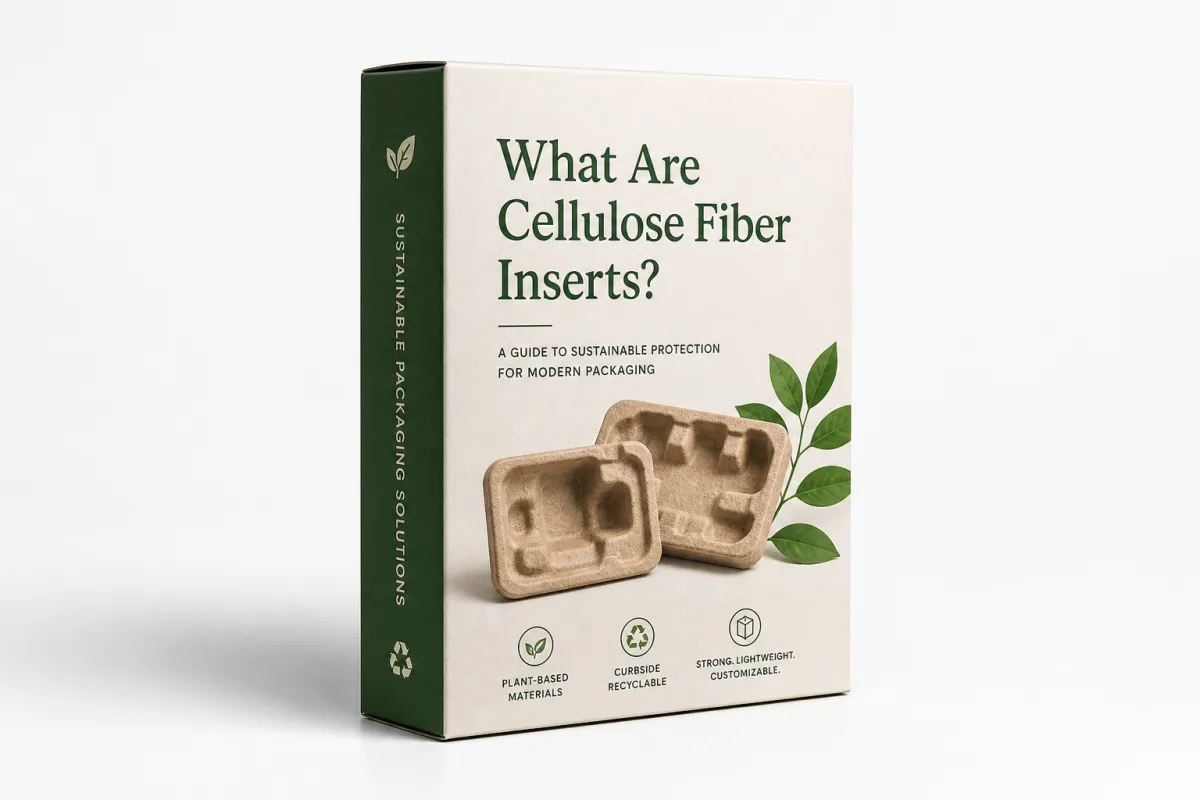
Cellulose fiber inserts are molded packaging components made from plant-based fibers, usually formed into trays, end caps, corner supports, cradles, or multi-pocket layouts that keep a product in place during storage and transit. Put simply, they are the shaped parts that stop a fragile item from wandering around inside the carton like it owns the place.
The name sounds technical, but the idea is straightforward. A well-designed insert follows the product’s geometry, identifies the weak points, and converts those details into a fit that protects instead of just filling space. That is why this subject matters to both procurement teams and brand teams: one side is watching breakage, labor, and freight; the other is watching presentation, sustainability, and the customer’s first impression.
These inserts do several jobs at once. They stabilize the product so it does not shift. They spread impact across a larger surface so one corner does not take the full hit. They hold parts in alignment, which becomes especially useful for kits, accessories, and multi-piece sets. They also shape the unboxing experience, because the item lifts out cleanly from a nested form rather than getting buried in loose material.
From a sustainability perspective, cellulose fiber inserts usually sit in the paper-fiber family of packaging. That is part of the appeal, especially for brands trying to reduce plastic content or move toward materials that may be recyclable or repulpable in the right local systems. Recycled fiber content can strengthen the story too, provided the rest of the package is designed honestly around the same goals.
The reality, though, is a little less glossy than the marketing copy that sometimes surrounds these parts. A package labeled “eco-friendly” is not automatically the right choice. A useful guide needs to balance material story against protection performance, because a broken product creates waste, returns, and customer frustration. If the insert prevents a return, it has already done more for sustainability than a prettier claim on the carton ever could.
In practice, brands often choose cellulose fiber inserts for cosmetics, small electronics, glass bottles, personal care items, premium gifts, tools, and accessory kits. The common thread is not the category itself; it is the need for a custom fit that can protect corners, faces, lenses, closures, or other damage-prone details without making the package feel oversized or clumsy.
I’ve seen teams overcomplicate this part and then spend twice as long cleaning it up later. The better move is usually simpler: define the product’s weak points first, then build the insert around those points. That sounds basic because, honestly, it is basic. It just gets skipped a lot.
Guide to Cellulose Fiber Inserts: How They Work
The protection mechanism is more interesting than it first appears. Molded fiber does not protect by magic; it protects through geometry. Walls, ribs, pockets, ledges, and compression points are arranged so impact energy spreads through the insert instead of striking one fragile point on the product. That is why a well-built insert can feel surprisingly sturdy even when it is relatively light.
Geometry matters as much as material density. A loose insert may use more fiber and still hold the product badly, while a sharper design with the right ribs can control movement and make pack-out faster. In practice, this is less about stuffing the carton and more about fit discipline. If the product cannot move, the package has already won half the battle.
Different form factors solve different packaging problems. Trays work well for flat products or accessories that need separation. End caps help when the product needs support at two ends and the carton provides the middle enclosure. Corner supports protect vulnerable geometry, especially for electronics, framed items, or glass components. Dunnage-style replacements fit heavier or more industrial packaging, where the insert needs to act like a structural spacer. Multi-compartment layouts suit kits, because each part stays in its own pocket and the pack-out sequence stays consistent.
One reason this subject keeps coming up in packaging reviews is that the insert never lives alone inside the carton; it interacts with the shipping environment. Humidity can soften paper-fiber structures over time. Stacking loads can compress weak walls if the design is too thin. Long distribution routes expose the package to more handling points and more vibration. A product that ships locally may need a different insert than the same item traveling through a national e-commerce network. That part matters.
Human behavior matters too. On a packing line, a design that loads in one motion usually performs better than a design that needs constant nudging. Workers should not have to fight the package. The best cellulose fiber inserts reduce ambiguity: the product drops in, the fit is obvious, and the carton closes without forcing or flexing.
A cellulose fiber insert does its best work when it controls movement, not just cushions impact. If the product can rattle, the insert is already late.
For teams that want to compare protection methods against recognized shipping tests, the International Safe Transit Association publishes practical frameworks at ISTA. That matters because a real packaging program should be tested against the actual route, not judged by feel on a desk or by a quick look in the sample room.
A solid guide to cellulose fiber inserts also has to acknowledge the limits. These parts are strong for what they are, but they are not a cure-all for every shipping problem. Very wet conditions, greasy products, or extreme compression loads can demand different surface treatments, coatings, secondary barriers, or even a different packaging architecture. The honest answer is not “yes” to everything. It is “yes, if the route and product fit the material.”
Key Factors That Affect Performance and Cost
Cost is where many teams get surprised. A quote for a custom insert can look higher than foam or generic paper fill at first glance, but that comparison is usually too shallow. The real question is not “What is the insert price?” A better question is “What does the complete packaging system cost once labor, freight, damage, and presentation are included?”
The biggest cost drivers are easy to spot once you know what to look for. Product size affects mold size and material use. Weight affects wall thickness and support geometry. Fragility changes how much retention the insert needs. Box dimensions limit how much clearance is available. Pack-out method shapes labor time. If the product has multiple accessories, the insert may need separate pockets or a larger footprint, which changes both tool design and unit economics.
Tooling complexity is another major lever. A simple tray with broad curves is easier to mold than a part with tight pockets, deep undercuts, or fine embossed detail. More complex geometry can still be the right choice, but it usually takes more development time and tighter process control. Wall thickness matters too. Thicker walls may protect better, yet they can increase material use and sometimes slow drying or curing depending on the forming method.
Order volume changes the math in a big way. At low volumes, tooling cost is spread across fewer parts, so the unit price rises. At higher volumes, the tooling gets amortized and the per-unit cost usually drops. A buyer comparing suppliers should make sure the quote uses the same annual usage assumptions, not just the same product sketch. That is one of the easiest places for a packaging spec to get misread.
Finishing requirements can move the price as well. Some projects need tighter cosmetic consistency, smoother surfaces, or a specific color profile for the fiber itself. Some need added print, embossing, or a more refined edge condition. Even the handling of recycled content can influence cost if the sourcing rules are specific. None of that is bad; it just needs to be priced with open eyes.
Here is a simple comparison that helps frame the choice:
| Insert Option | Best Use | Typical Tooling Complexity | Approx. Unit Price at 5,000 pcs | Notes |
|---|---|---|---|---|
| Simple molded tray | Accessories, flat goods, light consumer items | Moderate | $0.22-$0.38 | Good for fast pack-out and clean presentation |
| End caps | Bottles, small electronics, breakable housings | Moderate to higher | $0.28-$0.45 | Strong at corner and edge protection |
| Corner supports | Fragile corners, framed items, screens | Lower to moderate | $0.18-$0.32 | Material-efficient if the carton provides the rest of the structure |
| Multi-compartment kit insert | Bundles, premium kits, mixed accessories | Higher | $0.35-$0.60 | Reduces loose parts and speeds repeatable assembly |
Those ranges are not a promise; they are a practical way to think about the market. Freight, carton size, recycling targets, moisture exposure, and regional fiber sourcing can all push the final number up or down. If a supplier is quoting FSC-certified or FSC-controlled fiber, ask whether the chain-of-custody documentation is included. For sourcing guidance, the Forest Stewardship Council explains the framework at FSC.
Total landed cost gives a clearer picture than unit price alone. If a cellulose insert reduces damage claims by even a small percentage, the savings can outweigh a slightly higher unit price. If it shortens packing time by a few seconds per unit, that labor savings compounds quickly at scale. The best decisions are made with the whole shipping cycle in view, not just the quote sheet.
Sustainability targets can influence cost as well. Recycled fiber content, regional material sourcing, and certification requirements may change lead time and pricing. Sometimes the difference is small. Sometimes it is noticeable. The honest answer is that it depends on the exact spec, and a good supplier should explain the reason behind the number instead of hiding behind a vague quote.
One more thing: if a project is gonna be judged on both cost and brand feel, the cheapest version is rarely the smartest. The insert that trims a few cents but creates rework, damage, or a messy reveal can end up costing more in the places finance does not always see right away. That is the kind of trade-off worth surfacing early.
Step-by-Step Process and Timeline
A clean project starts with good information. Before any design work begins, gather the product dimensions, weight, accessory list, shipping method, carton size, and any known failure points. If a screen cracks on a corner drop, say that plainly. If a bottle cap loosens under vibration, spell that out. A useful packaging brief begins with the failure modes, because they tell the designer where the package needs the most help.
The design stage usually starts with a concept that matches the product and the box. A packaging engineer or supplier may sketch a tray, end cap, or pocket layout, then refine the geometry for protection, line speed, and carton efficiency. Good design work here is not only about cushioning; it is about making sure the insert supports the box structure, leaves room for seals or closures, and does not force a packing operator to wrestle the part into place.
Physical sampling matters more than many teams expect. CAD can show clearances and dimensions, but a sample shows reality. The product may sit differently when actual accessories are present. Labels can create friction. Surface textures can make a snug fit feel tighter than expected. That is why real samples should happen before final approval, not after the launch calendar gets squeezed.
During sampling, teams often run three kinds of checks. First is fit: does the product sit correctly and remain centered? Second is handling: can the pack-out line load it quickly without force? Third is performance: does it survive the tests that matter for the route? For fragile goods, that may mean drop tests, compression checks, and vibration checks. Depending on the product and distribution channel, teams may use ISTA profiles or ASTM methods such as ASTM D4169 and ASTM D5276 to formalize the review.
Timeline depends on complexity. A simple project with a clean product shape and few revisions can move from brief to sample relatively quickly. A project with new tooling, multiple accessories, or strict shipping-test criteria needs more revision cycles. It is not unusual for fit, surface quality, and pack-out behavior to each require their own round of feedback. If a buyer wants the process to move faster, the single best move is to provide accurate product data up front.
The approval process should include a realistic pre-production signoff. That is where the team checks the final sample against the carton, the printed shipper, the closure, and the rest of the pack components. It is also where first-article expectations are set. If the job is going into production, quality checks should confirm dimensions, wall thickness, visual consistency, and fit against the agreed tolerances.
A practical process also includes launch validation. Before full rollout, run a short pack-out trial on the actual line if possible. Watch where operators pause, where the insert flexes, and whether the carton closes without pressure. Small details here can prevent expensive rework later. I’ve sat through enough of these trials to know that the sample that looks perfect on the table can get weird fast once people are packing at speed.
Typical timeline ranges look something like this:
- Brief and data collection: 1-3 business days if the product information is ready.
- Concept and initial CAD/layout: 3-7 business days for straightforward designs.
- Prototype or sample build: often 5-10 business days, depending on tooling and forming method.
- Fit review and revisions: 1-3 rounds, often adding 5-15 business days total.
- Production approval and launch: usually 5-12 business days after signoff, depending on volume and scheduling.
Those ranges are common rather than universal. Still, they are a far better planning tool than a vague promise of “fast turnaround.” In packaging work, clarity usually saves more time than urgency.
Common Mistakes to Avoid
The first mistake is designing around the box instead of the product. That sounds backward, but it happens constantly. A team locks in carton dimensions, then asks the insert to fit whatever space is left. The result can be loose retention, unnecessary pressure on fragile points, or a structure that looks fine in CAD but behaves badly in transit. The smarter move is to start with the product shape and its damage-prone zones, not the carton alone.
The second mistake is comparing inserts on price alone. A cheaper insert that slows pack-out or increases damage can cost more over a quarter than a slightly more expensive version that works cleanly. Packaging is one of those areas where labor and claims can outweigh a small unit-price difference very quickly. Buyers should compare total packaged cost, not just the insert line item.
Another common miss is under-testing environmental conditions. Humidity, stacking, vibration, and carrier handling can expose weak spots that a short bench test will never reveal. That is especially true for molded fiber, where moisture exposure and compression behavior matter more than many people realize. If the product is going into a damp warehouse, crossing multiple hubs, or sitting in a stacked pallet load, test like those conditions matter, because they do.
Teams also forget the end-user experience. A package can protect beautifully and still frustrate the customer if the product is hard to remove, if the insert tears awkwardly, or if accessories are hidden in confusing pockets. Good packaging feels intuitive. The product should lift out with a clear motion, and any accessory should be easy to find without digging. The unboxing does not need to be theatrical; it just needs to make sense.
Another avoidable issue is skipping accessory validation. Cables, chargers, manuals, warranty cards, replacement parts, and secondary components all need a home in the structure. If they are not measured early, the final insert may force the team to cram items where they do not belong. That usually leads to packaging revisions and lost time.
Finally, some buyers approve a sample before checking whether the pack-out can actually run at line speed. A sample sitting on a table tells only part of the story. If operators must rotate the insert, align it by eye, or force the product into position, the design may be fine for a prototype and poor for production. Keep both the lab and the line in view, or you end up fixing the same problem twice.
Here is a short list of checks that prevent a lot of trouble:
- Measure every product face, corner, and accessory with the final retail setup in mind.
- Test the carton under realistic drop and compression conditions, not just a light hand test.
- Confirm the pack-out sequence with the actual operators who will use it.
- Review humidity and storage exposure if the product will not ship immediately after packing.
- Check that the insert still works after labels, foils, or protective films are added.
Expert Tips for Better Results
The cleanest way to improve a design is to work backward from the failure points. If the screen breaks at one corner, design support around that corner first. If the finish scratches near a shoulder or lens ring, build the pocket so the product never touches that area under load. That approach sounds simple, but it saves a lot of trial and error. Good packaging should be specific, not generic.
Ask for more than one prototype approach if the project allows it. One version can be tighter and more protective. Another can be lighter and lower cost. A third can be tuned for faster pack-out. That comparison often reveals trade-offs that are not obvious in drawings. The “best” design on paper is not always the best one for the packing line, while a slightly simpler version may deliver nearly the same protection with less handling time.
Do not ignore line speed. A great-looking insert that slows loading can become a bottleneck in production. Operators need a design that is repeatable under normal working conditions, not one that requires careful alignment every single time. In a busy pack-out environment, seconds matter. Packaging that saves a small amount of labor per unit can create a very real operational difference over time.
Choose the lightest structure that still passes the relevant tests. Overbuilding is common because teams want a safe margin, but every extra gram has a cost in material, freight, and potentially carton size. Better to use the right ribs, pockets, and supports than to make everything thick by default. Sustainability and durability are not opposites here; smart geometry often gives you both.
When you review a supplier, ask practical questions that reveal whether they understand the job:
- What recycled fiber content is realistically available for this design?
- What test methods were used to judge the sample?
- What tolerances can you hold on wall thickness and formed shape?
- How does the insert behave under moisture or compression?
- Can you show the same part in a lower-cost and a higher-protection version?
Those questions help separate a serious packaging partner from someone simply quoting a shape. A solid buying process should push the conversation toward proof, repeatability, and fit.
One more tip: think about how the insert looks once the carton opens. Clean edges, balanced symmetry, and a clear product reveal can make a low-cost structural material feel premium. That is part of the appeal of molded fiber. It can look natural and intentional without shouting for attention, which suits brands that want their packaging to feel modern but grounded. And if you want to be really picky about it, the reveal should feel like it was planned, not kinda improvised.
Next Steps for Choosing the Right Insert
If you are ready to move from concept to quote, start with measurements. Capture the product dimensions, the exact accessory set, the carton size, and the expected distribution route. Then define the protection goal in plain language: corner support, part separation, premium presentation, stack resistance, or all of the above. A good brief turns that information into something a supplier can actually build and test.
Next, request either samples or CAD-based mockups and compare them on the same assumptions. Make sure every quote includes the same pack-out method, the same annual volume, the same material requirements, and the same freight expectations. If one supplier assumes loose packing and another assumes pre-assembly, the numbers are not comparable. That is where many projects lose time and money without realizing why.
Use a simple decision checklist before final approval:
- Does the insert fit the product with the right amount of retention?
- Does it protect the known failure points under real shipping conditions?
- Does it match the sustainability goals for the program?
- Can operators pack it quickly and consistently?
- Does the finished presentation support the brand experience?
If the answer is yes across those five points, the design is probably in a good place. If not, it is better to adjust the geometry now than to correct breakage after launch. That is the practical value of a well-built packaging spec: it turns a concept into something the team can test, approve, and run with confidence.
For brands balancing protection, presentation, and responsible material choices, cellulose fiber inserts are often a strong fit, especially when the packaging system is built around the product rather than forced around it. The best results usually come from clear data, realistic testing, and honest trade-offs. Start with the product’s weak points, test against the actual route, and choose the lightest insert that still earns its keep in production. That is the real takeaway.
FAQ
What products are best suited for cellulose fiber inserts?
They work well for fragile consumer goods, small electronics, cosmetics, glass items, and premium kits that need a custom fit inside a rigid carton. They are a strong choice when the product needs corner support, part separation, or a cleaner presentation than loose fill can provide. They are less ideal for products that face constant moisture unless the package design includes the right barrier or storage conditions. For many teams, the fit question is the point where the whole decision gets clarified.
How do cellulose fiber inserts compare with molded pulp or foam?
Molded pulp is one of the most common ways cellulose fiber inserts are made, so the terms often overlap in everyday packaging conversations. Compared with foam, fiber inserts usually offer a more natural look, better recyclability in many systems, and a stronger sustainability story. Foam can still win in some extreme cushioning cases, so the final choice should be based on the product, transit conditions, and branding goals. The right comparison is always performance first, label second.
Are cellulose fiber inserts expensive?
The answer depends on tooling, volume, design detail, and the required finish, so low-volume custom work usually costs more than simple standard inserts. At higher volumes, the unit price can become very competitive, especially when freight efficiency and damage reduction are included in the comparison. A fair cost review should look at total packaged cost, not just the insert price by itself. That is why a quote without context can be pretty misleading.
How long does the sampling and approval process usually take?
Simple projects can move quickly when the product dimensions are clear and only a few revisions are needed. More complex inserts take longer because the team may need multiple fit checks, physical samples, and test feedback before approval. The fastest path is to share accurate product data, expected shipping conditions, and clear pass-fail requirements at the start. A disciplined process usually saves more time than trying to rush the first sample out the door.
Can cellulose fiber inserts be customized for branding?
Yes, they can be shaped for a custom fit, embossed with subtle texture, and designed to support a more premium unboxing experience. Branding often shows up more through form, finish, and fit than through heavy printing, which keeps the design clean and modern. A good custom insert can make the product feel intentional and elevated while still supporting sustainable packaging goals. That balance is one of the nicest parts of doing the job well.
Related packaging resources
Use these related guides to compare specs, costs, quality checks, and buyer decisions before making the final call.


