A heavyweight winter beanies woven label quote should do more than list a unit price. It should show whether the beanie spec, label format, packaging, and timing are clear enough to produce without avoidable revisions. On dense winter knit, the label carries much of the brand read, so small spec gaps show up quickly.
The best quote requests treat the beanie as a finished product, not a blank cap with a logo attached later. Body construction, cuff height, label format, and pack-out belong in the same brief. If one of those pieces is missing, the quote is usually incomplete even when the number looks competitive.
On a thick cuff, the label is often the first thing that signals quality. If it looks improvised, the whole beanie reads cheaper.
Why woven labels change the read of a heavyweight beanie
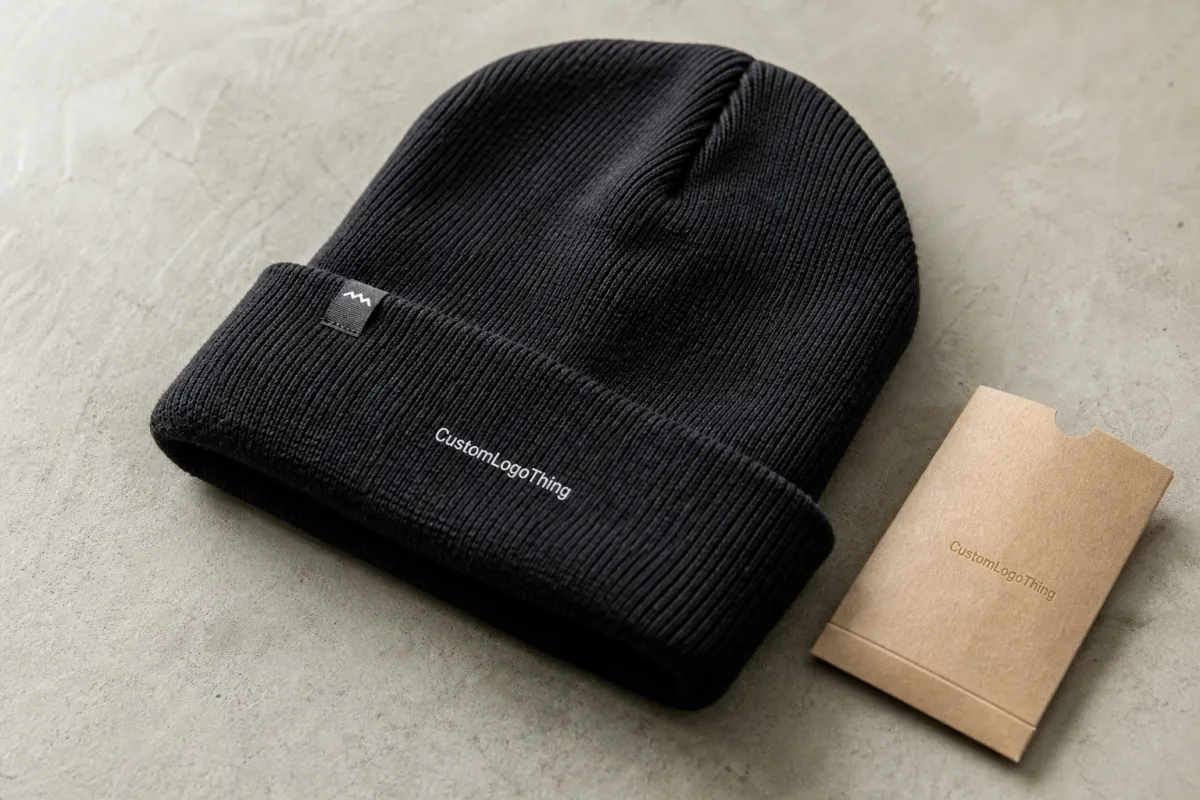
Dense winter knit softens detail. Embroidery can work on a heavyweight beanie, but on a chunky cuff it may read bulkier than intended. A woven label keeps edges sharper, handles small text better, and gives the product a cleaner retail finish.
That matters in wholesale and promotional buying. A dark navy, charcoal, or forest beanie can use the same label artwork and still feel like part of one program. The body color changes; the label stays constant.
Woven labels also reduce approval risk. With embroidery, stitch density can shift the appearance of a logo from sample to sample. A woven label keeps the artwork tighter, which usually means fewer revisions and less chance of distortion.
For cold-weather retail, the label is part of the product value. Clean placement and readable artwork do more for the final read than oversized branding.
Material, knit, and label construction details
The body material drives handfeel, insulation, and most of the base cost. Acrylic is still the most common because it is warm and affordable. Recycled acrylic blends support sustainability claims without changing the feel much. Polyester blends improve color consistency and drying time. Wool-content builds a more natural hand and better warmth, but raises cost and care requirements.
Heavyweight construction usually means a denser knit, a deeper cuff, and more structure in the crown. That helps the beanie hold shape in cold weather, but it also makes decoration more sensitive to size and placement. A label that looks centered in a flat mockup can sit off once the cuff is folded and stretched.
For the woven label itself, the main choices are practical:
- Damask weave for fine text and crisp artwork.
- Satin weave for a smoother face and cleaner finish.
- Folded edge for a tidy sewn-in look.
- Center fold for wrapping over a seam or cuff edge.
- Sew-on placement for the most reliable attachment on thick knit.
- Heat-applied backing only when the fabric and application method support it.
Color count affects cost and legibility. Two strong colors often perform better than four soft ones, especially on darker beanies. A subtle label may look refined on screen but disappear under retail lighting or in photos. If the beanie is meant for resale or uniforms, readable contrast usually matters more than visual restraint.
Size matters as well. A label that is too tall can buckle on a narrow cuff. One that is too small may disappear once the knit stretches. On heavyweight styles, a modest label often performs better than a large panel because it sits flatter and keeps the cuff from warping.
Keep the body spec and label spec separate in the brief. That makes the factory quote more useful and reduces the chance of pricing surprises later.
Specifications to lock before requesting a quote
If the goal is an accurate quote, remove ambiguity before you ask for pricing. Most swings come from a few details that seem small until they are multiplied across the run.
Lock these before sending the request:
- Quantity range - not only one number, but a realistic range if the order is still moving.
- Beanie dimensions - circumference, cuff height, and crown depth.
- Yarn composition - acrylic, recycled acrylic, polyester blend, wool blend, or another build.
- Label size and colors - width, height, color count, and whether the art includes small text.
- Placement - cuff, body, seam, or fold-over edge.
- Packaging - bulk pack, individual polybag, hangtag, barcode sticker, or retail carton.
Heavyweight Winter Beanies are less forgiving than lighter styles. Thick knit stretches differently from batch to batch, and a cuff that is too short can make the label sit crooked. A crown that is too shallow can make the hat feel cramped. Those problems usually trace back to an incomplete spec.
Labor changes with construction too. More label colors, more detail, or a larger label footprint can increase setup time. A four-color label is not automatically expensive, but it can add loom prep and approval steps. Special folds or awkward seam placement add handling time as well.
Packaging often changes the quote more than buyers expect. A beanie packed loose in bulk is not the same as one polybagged with a hangtag and barcode. Export cartons, individual stickers, and carton labeling all influence cost and schedule. If the order needs to move through retail distribution instead of a single warehouse, include that up front.
The cleanest request usually includes one artwork file, one target quantity, and one complete spec sheet. More emails do not improve accuracy; they usually slow it down.
Pricing, MOQ, and unit cost drivers
For bulk headwear, the quote is usually shaped by five levers: yarn composition, knit density, label complexity, order volume, and pack-out. Add multiple colorways and the number moves again. That is why a woven-label beanie quote can vary a lot even when the product looks similar on paper.
MOQ is another place where buyers lose time. Heavier knit production often works best in fixed batch sizes. Smaller runs are possible, but setup cost is spread across fewer pieces, so the unit price rises quickly. If the order is seasonal and intentionally small, the price should reflect that reality.
| Order profile | Typical build | Indicative unit cost impact | Notes |
|---|---|---|---|
| Small test run | Basic acrylic heavyweight beanie, one woven label, simple bulk pack | $3.20-$5.50 | Higher setup share; useful for testing a style or validating demand |
| Mid-size bulk order | Recycled acrylic blend, one or two label colors, polybagged | $2.20-$3.80 | Often the most balanced zone for seasonal programs and promo campaigns |
| Larger production run | Standard heavyweight knit, reused label artwork, bulk carton pack | $1.60-$2.90 | Lower setup burden; freight and finishing still affect the total |
These are working ranges, not promises. The real number changes with country of origin, yarn pricing, label colors, and whether the order includes retail finishing. Freight can move the total more than expected, especially if the shipment is urgent or split across destinations.
A useful way to read the quote is by line item:
- Blank body cost - the knit itself.
- Label setup - artwork prep and loom work.
- Attachment labor - sewing or placement.
- Finishing - trimming, folding, inspection, and packing.
- Freight - cartons, volume weight, and destination.
That breakdown shows where the price is moving. If one supplier is cheaper but leaves out polybags, barcode stickers, or carton labeling, the quote is not really lower. It is simply missing part of the build.
For buyers comparing trim options across a broader product range, Custom Labels & Tags is a useful reference point for how label construction changes the final cost and finish.
Production steps and lead time
A realistic schedule starts with approval, not with the first email. The usual sequence is simple: spec confirmation, artwork proofing, sample or digital approval, production scheduling, knitting, label attachment, finishing, packing, and shipment.
For a heavyweight winter Beanies Woven Label Quote, delays usually come from changes that look minor in an inbox and major on the factory floor. Buyers adjust color references after the proof is sent, revise label text, or change cuff height after sample approval. Each change can push the schedule by days.
Heavyweight beanies are not especially difficult to make, but they reward discipline. Dense knit makes inconsistencies easier to spot, which helps quality control. It also makes rework slower if a batch needs correction. The better factories check label placement, label size, and cuff height before full production begins.
Pre-production and manufacturing should be treated as separate windows. A quote may come back in a day or two. Sampling may take several business days. Production often runs in the 12-20 business day range after approval, depending on volume and season, and shipping adds its own clock. If the beanies are tied to a launch, event, or retail reset, a buffer is not optional.
Packaging and transit deserve the same attention as the knit itself. A beanie can leave the factory in good shape and still arrive with crushed cartons or scuffed labels if the pack-out is weak. Basic transit testing standards such as ISTA are a sensible reference when the shipment needs to survive distribution instead of a short direct move. If the order includes paper hangtags or retail cartons, FSC-certified paper options may also matter; see FSC for certification context.
For cold-weather launches, the calendar should be treated like a material input:
- Allow time for proof revisions.
- Approve the sample quickly once it matches the brief.
- Leave room for freight and customs if the shipment crosses borders.
- Keep a small buffer for replacement units and size drift.
What separates a helpful supplier from a fast one
Fast quoting is useful only if the supplier also understands where the job can fail. A helpful vendor asks whether the woven label is too large for the cuff, whether the artwork will still read at the chosen size, and whether the pack-out fits the freight budget. Those questions save money.
The vendors worth keeping are not simply the cheapest ones. They are the ones that catch problems before knitting starts. A label-size issue found in proofing is cheap to fix. The same issue found after production starts is not.
When comparing suppliers, look beyond the headline number and ask how they handle exceptions:
- Can they revise a quote without restarting the whole process?
- Do they explain what changes pricing and what does not?
- Will they confirm the spec in writing?
- Do they offer a sample or proof before bulk production?
- Can they support mixed colors or split shipments if the order needs it?
Good suppliers reduce hidden friction. They do not overpromise, and they do not pretend every beanie behaves the same way. They translate a rough brief into a buildable product, then flag the points that might change price or timing. That is more useful than shaving a few cents off a quote and discovering later that the label placement never fit the cuff.
Quality control should be specific rather than broad. For heavyweight beanies, that usually means checking label alignment against the approved placement, confirming color match against the proof, inspecting stitch security at the label edges, and verifying that the cuff sits flat after pressing or folding.
How to turn a spec sheet into a real order
The fastest path to a usable quote is simple: gather the right inputs before you ask for pricing. Buyers who send a complete brief usually get fewer revisions and a cleaner schedule.
Start with these five items:
- Quantity range - 500, 1,000, 2,500, or whatever range is realistic.
- Target delivery date - not just soon, but the date the product needs to arrive.
- Beanie color - one color or several colorways.
- Woven label artwork - ideally vector art with clear text.
- Packaging style - bulk, polybagged, hangtagged, or retail ready.
Then send one reference image or sample if you have it. That helps the quote team judge cuff height, label placement, and the practical size of the brand mark. A photo can expose issues that a written spec never catches, and a measurement can confirm what the eye thinks it sees.
Approve the proof promptly. Fast feedback protects the timeline more reliably than hard negotiation on a seasonal order. If the quantity changes, ask for a revised quote. Do not assume the earlier number still applies after you change yarn, label size, or pack-out. Those are material differences, not minor edits.
The most reliable quotes are the ones built on a complete spec, clear artwork, and realistic timing. That is the difference between a beanie that looks finished and one that keeps generating preventable emails.
Frequently asked questions
What do I need to request a heavyweight winter beanies woven label quote?
Send the quantity range, color count, label artwork, beanie size or style, and target delivery date. Add packaging preferences and any material notes so the first quote is accurate. If you have a reference sample, include that too.
What is the typical MOQ for heavyweight winter beanies with woven labels?
MOQ depends on yarn type, label setup, and packaging, but heavier knit runs often work best in fixed production batches. Larger orders usually lower the unit cost because setup and finishing are spread across more pieces.
How long does production usually take after artwork approval?
Lead time depends on sample approval, knit scheduling, and packaging needs, but production should be counted separately from proofing time. Rush orders are possible in some cases, but last-minute label or fit changes can extend the timeline quickly.
Can I see a sample before placing a bulk order?
Yes, and it is the best way to confirm label placement, color matching, and the feel of the heavyweight knit. A sample helps catch sizing or artwork issues before the full run starts.
What changes the unit cost the most on these beanies?
Yarn content, knit density, label complexity, order size, and packaging are usually the biggest cost drivers. A clearer spec sheet usually saves money because it reduces quote revisions and production rework.
A strong quote is rarely the lowest number on the page. It is the one that matches the actual build, the actual timing, and the actual finish the buyer wants. For heavyweight winter beanies, the woven label is part of the product identity, and the quote should reflect that.


