A Pom Pom Beanies woven label quote usually tells you more than the price of a hat. It reveals whether the supplier understands the difference between a cute seasonal accessory and a product that has to survive retail racks, campus bookstores, team shops, and a few thousand handoffs between distribution and the final customer. On a pom beanie, the woven label sits in a very public place: the cuff. That little patch of flat knit is the brand handshake, and it gets seen in product photos, on shelves, and in the tiny square of a social post that decides whether a buyer keeps scrolling.
I have seen a lot of winter headwear quotes that looked tidy on paper and turned messy in production. The usual culprit is not the beanie itself. It is the missing detail hidden inside the quote. Was the woven label folded or straight cut? Was it sewn on one side or centered on the cuff? Was the price based on bulk packing, or did it quietly assume retail polybags and barcodes? Those details matter because a price that seems low can still land high once the actual finish is added. That is not some abstract procurement lesson. It is the difference between a margin that holds and a margin that kind of evaporates.
A good quote should read like a bill of materials, not a hopeful guess. Separate the beanie, the woven label, the sewing, the packing, and the freight before anyone approves the order.
Pom Pom Beanies Woven Label Quote: Why Buyers Ask
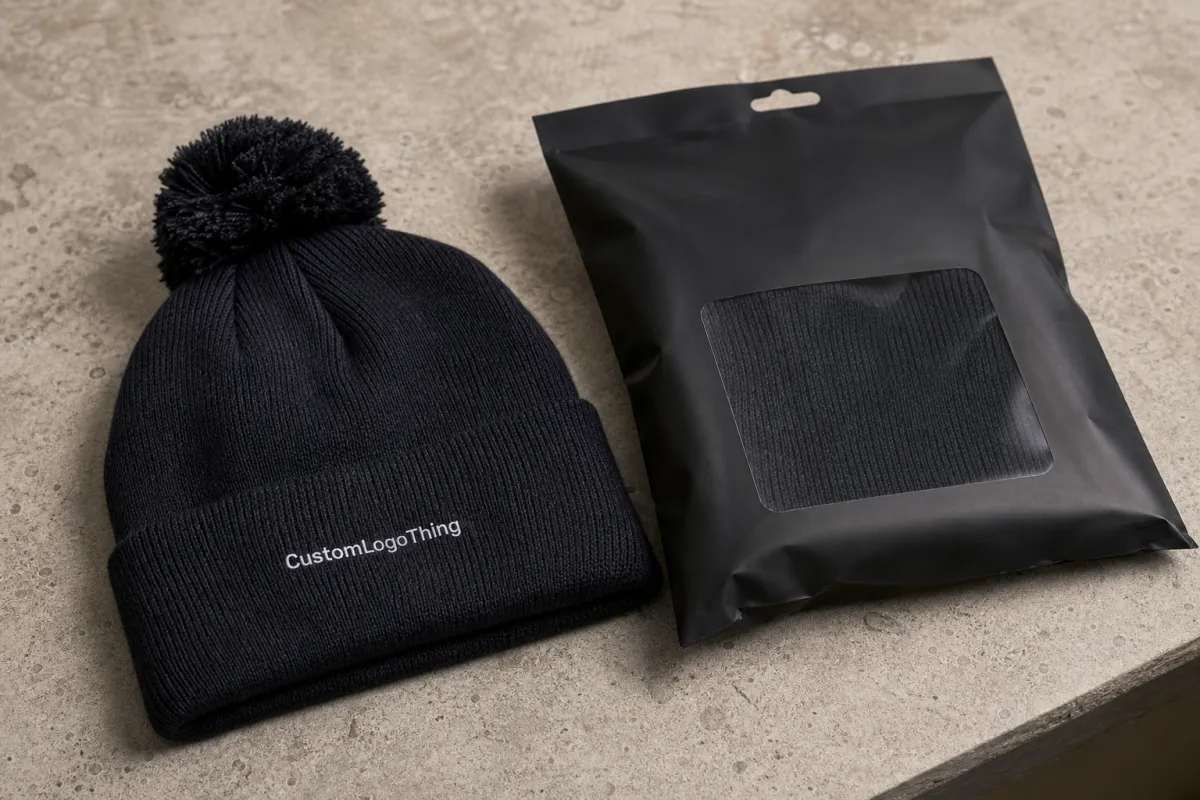
Most buyers start with a practical problem: how do you make a winter accessory feel branded without turning it into a custom knit project that eats the budget? A Pom Pom Beanies woven label quote answers that by pricing a standard base product plus a visible brand detail. The cuff is the reason this works so well. It gives the label a flat, readable surface, which matters more than people expect once the product is photographed in motion or stacked in a retail display.
The product shows up in a few different corners of the market for the same reason. A university shop wants a polished item that can sell at a sensible retail point. A sports team wants something energetic enough for the stands but still clean enough for the team shop. A promo buyer wants a giveaway that feels more considered than a plain knit cap. The woven label is the middle ground. It looks sharper than a blank beanie and usually costs less than a fully custom jacquard knit pattern.
That middle ground is where quotes can get slippery. Mockups tend to flatter everything. A logo that looks crisp on a screen can turn soft once it is woven into a small label, especially if the knit is textured or the label is too narrow. A quote should point out those risks before production begins. It should specify whether the decoration is a folded woven label, a straight cut label, a seam tag, or a custom woven patch sewn to the cuff. If it includes a hang tag or retail card, that should be spelled out too. Buyers do not need poetry here. They need line items.
There is also a competitive angle that rarely gets mentioned. Woven labels make comparisons easier. A buyer can line up a quote against embroidered cuff beanies, patch-decorated beanies, or fully knit-in graphics and see what the branding actually costs. That changes how the order gets judged. Instead of arguing about whether the piece is "premium," the team can compare it against a target retail price or campaign budget. The conversation gets cleaner. The decision gets faster. And yes, faster is often cheaper.
One more thing from the field: the cheapest-looking sample is not always the cheapest order. I have watched buyers save a few cents by shrinking the label and then spend far more on a reprint because the logo became unreadable. Small savings can be false savings. Winter headwear has a funny way of exposing that.
Pom Pom Beanies Woven Label Quote: Product Details That Matter
Material comes first. Acrylic is usually the lowest-cost option and holds color well. Recycled acrylic often adds a modest premium, but not always a dramatic one. Wool-blend knit raises the hand-feel and warmth, and in my experience it often pushes the unit price up by roughly 15% to 35%, depending on yarn mix, knit gauge, color count, and the factory's finishing process. That is not a fixed rule; it is a practical range. A good quote should name the fiber blend, not just say "beanie," because the material changes the feel, the story, and the number at the bottom of the page.
The silhouette matters almost as much as the yarn. Cuff height is not decoration trivia. A cuff that measures around 7 to 9 cm gives the woven label a larger display window than a narrow cuff, and that changes how the item reads in photos and in person. Pom size changes the mood too. A larger pom feels playful and athletic. A smaller pom looks calmer and, frankly, a bit more fashion-forward. Rib gauge matters as well. A tighter rib usually holds shape better and looks more retail-ready; a looser knit can feel softer but less structured. None of that is theoretical. You can spot it in a sample tray in about thirty seconds.
Label placement deserves the same level of attention. Front cuff placement remains the default because it reads cleanly on shelf and on camera. Side placement works well for a minimal logo or a secondary mark. Back placement is less common, but some buyers use it to keep the front open for a larger woven graphic or a brand name that should be visible from a distance. The quote should note the exact position in millimeters, not just "front," because small shifts change the visual balance. A label placed 10 mm too high looks accidental. Ten millimeters on a beanie is not nothing.
Some buyers add a second brand element to make the piece feel more complete. That could be embroidery, a hang tag, a care label, or a retail sticker on the polybag. Each one has a role. A hang tag can help sell the item in-store. A care label keeps the washing instructions from disappearing after the first wear. A sticker or barcode helps receiving teams move faster. If broader label sourcing is part of the project, it can help to compare options in our Custom Labels & Tags range before the spec is locked. That usually saves a round of revisions later, which nobody misses.
Specifications for Woven Labels, Knit, and Finish
Good spec sheets prevent most quote mistakes. They also protect the production schedule, which is often where projects go sideways. A buyer should confirm the finished hat size, cuff width, pom diameter, label dimensions, label fold, thread colors, and attachment method before approval. Woven labels usually come in end fold, center fold, and straight cut formats, and each one changes how the brand sits on the garment. A 40 mm by 50 mm label can work well for a logo and a short wordmark. Shrink it much further and fine detail starts to disappear. The threads do not care how clever the branding is.
Artwork requirements need to be direct. Suppliers need vector files, Pantone references, and exact wording. Thin strokes can become a problem very quickly. Ask whether the smallest line can survive at around 0.3 to 0.5 mm once woven. That is the line between a clean label and a fuzzy one. Type size matters for the same reason. Tiny copy may look acceptable on a screen and become unreadable once thread replaces pixels. I have seen brands try to tuck a tagline into a label that had no chance of carrying it. The result is usually a blur with ambition.
Finish details affect cost too. Higher weave density usually improves definition, but it takes more production time. Extra thread colors add complexity. Special packaging does the same. A beanie packed individually in a polybag with a size sticker and retail insert costs more than a bulk-packed carton, yet the retail version may save a warehouse team hours on arrival. The quote should spell that out line by line so the buyer can decide where the premium belongs. That is the real work of a quote: making tradeoffs visible.
Compliance belongs in the conversation as well. Fiber content, care instructions, and any retailer or marketplace labeling rules need to be confirmed before approval. If the goods will ship in larger cartons or display packs, some buyers also reference ISTA transit-testing guidance so the packaging can survive handling without crushed poms or wrinkled labels. That may sound like overkill for a small run, but it is a sensible check when the order is headed straight into distribution or a chain store intake process. I would rather catch a carton issue before the truck leaves than explain it after the replenishment window closes.
- Finished size: confirm width, height, and stretch range.
- Label size: keep the logo readable at the actual sewn scale.
- Thread count: 2 to 6 colors is common for woven labels.
- Attachment method: sew-on, folded insert, or seam tag placement.
- Packing style: bulk, polybagged, barcode sticker, or retail-ready.
Pricing & MOQ for Pom Pom Beanies Woven Label Quote Orders
Price depends on more than quantity, but quantity matters a great deal. Beanie quality, label size, label complexity, number of thread colors, application method, and packing all influence unit cost. A simple acrylic beanie with a single woven label will sit well below a wool-blend cap with a multi-color label and retail packaging. That gap is normal. What matters is whether the quote shows where the extra dollars go so the buyer can judge what is worth paying for.
MOQ usually follows setup time and label weaving. Smaller runs are possible in some cases, but the cost per piece rises fast when setup is spread over only a few dozen or a few hundred units. Many buyers compare a pilot run against a larger bulk run for that reason. The pilot protects cash and tests demand. The larger order lowers unit cost and improves margin if the style already has a market. There is no magic here, just arithmetic with a little room for judgment.
| Option | Typical MOQ | Typical Unit Price | Best For | Notes |
|---|---|---|---|---|
| Basic acrylic beanie + single woven label | 200-300 pcs | $2.35-$3.60 at 500 pcs | Promo programs and first-order retail tests | Lowest entry cost, clean brand read |
| Recycled acrylic + two-color woven label | 300-500 pcs | $2.80-$4.30 at 500 pcs | Eco-positioned brands and campus shops | Often needs tighter proofing for color match |
| Wool-blend beanie + multi-color woven label + hang tag | 500 pcs+ | $4.25-$7.10 at 500 pcs | Premium retail and gift programs | Higher hand-feel, stronger shelf presence |
| Retail-packed bulk order with barcode sticker | 300 pcs+ | Add $0.18-$0.45 per unit | Store-ready distribution | Packaging adds labor but reduces intake work |
One detail protects budget better than most buyers expect: ask for quantity breaks. A strong Pom Pom Beanies woven label quote should show pricing at 300, 500, 1,000, and 2,500 units if those breaks make sense for the project. That makes the jump from a pilot to a larger run easier to read. In many programs, the move from 500 to 1,000 units produces a better piece price than expected because the label and setup cost get spread across more units. It is a small spreadsheet habit with a big payoff.
Be specific in the request. Send the shipping destination, the packing style, sample needs, and the in-hand date. A quote with a postal code and delivery target is more accurate than one based on quantity alone. If the deadline is fixed, say so early. A supplier cannot schedule what it does not know. The best ones can usually work around a launch date if they hear about it at the start, not three days before the proof is due.
Process & Timeline: From Artwork to Delivery
The production path is straightforward on paper, but only if the buyer sends usable artwork and a clear spec. It starts with the quote request, then moves to spec confirmation, artwork approval, digital proof or sample, bulk production, inspection, packing, and shipment. Each step can move quickly or drag, depending on how much back-and-forth the file set requires. Clean files save the most time. Bad files create the kind of delay nobody remembers asking for.
- Request the quote: send quantity, colors, label artwork, packing preference, and destination.
- Confirm specs: lock the beanie type, cuff size, pom color, and label placement.
- Approve proof: check spelling, logo scale, label fold, and thread colors.
- Run production: knit, label, inspect, and pack.
- Ship and receive: confirm carton count, carton labels, and freight method.
Lead time depends on stock yarn, label weaving, revisions, and demand on the factory floor. Simple orders with final files can move quickly, often around 12 to 15 business days after proof approval, though that still depends on inventory and packing complexity. Orders with new label weaving, special color matching, or Custom Retail Packaging can take longer, especially in seasonal windows. That is manageable when the buyer plans for it. It becomes expensive only when the launch date shows up after production has already started. In winter headwear, that mistake happens more often than people admit.
Packaging choices matter almost as much as the knit if the hats need transit protection or store-ready presentation. A tightly packed carton may reduce freight volume, but individual polybags can protect the label from abrasion and keep the beanies cleaner on arrival. If the buyer wants paper inserts or hang tags, a paperboard or cardstock spec with FSC-backed sourcing is often the cleanest option. None of that sounds flashy. It does reduce surprises, and in my experience surprises are where most of the budget damage lives.
Final files give production a real advantage. A quote that begins with correct artwork and a fixed placement point usually moves faster than one that needs logo cleanup, color guessing, or repeated revisions. The fastest runs are not always the cheapest on paper; they are the ones that avoid waste, delays, and rework. That difference is easy to miss until the launch window starts closing and the beanies are still waiting on approval.
Why It Pays to Quote Cleanly and What to Send
At Custom Logo Things, the point is clarity, not drama. Transparent breakdowns, fast proofing, and spec notes that answer production questions reduce back-and-forth and lower the chance of surprise charges. That matters in bulk orders because every unclear point turns into time, and time turns into cost once the run is scheduled. Buyers do not usually lose money on the beanie itself. They lose it in the gaps between the beanie, the label, the packing, and the freight.
If you want a quote that is actually useful, send five things: quantity, beanie color, label artwork, placement, and shipping ZIP or postal code. Add the required in-hand date if there is one. If the logo is not final, say that too. A supplier can quote a placeholder better than they can quote a mystery. I know that sounds obvious, but the number of incomplete requests says otherwise.
It also helps to ask for two versions of the same order: one standard option and one upgraded option. That side-by-side view shows the difference in price, presentation, and margin. Sometimes the upgraded option adds only a small amount per unit, especially if the change is limited to label size, packing style, or an extra thread color. Other times the extra cost is real and makes sense only for retail-first programs. Either way, the buyer gets a cleaner decision. That is the whole point of a quote review in the first place.
For reference, the same logic applies across our Custom Labels & Tags line. Keep the message simple, keep the specs readable, and keep the proof tied to the final order. If the goal is a winter accessory that looks considered instead of generic, the woven label should be treated as part of the product architecture, not a last-minute decoration. That is a better way to think about it, and it tends to produce fewer surprises once the carton is opened.
The short version is plain: the best pom pom Beanies Woven Label Quote is not the cheapest line item. It is the one that matches the material, the label construction, the packing, and the timing without leaving gaps for later. If you are building a buy, the next move is simple. Send the logo, the quantity, the cuff placement, and the deadline together so the quote reflects the actual job. That single step usually does more for accuracy than any round of follow-up ever will.
What is included in a pom pom beanies woven label quote?
A complete quote should show the beanie base cost, woven label production, label application, packing, and freight separately. It should also note any setup fee, sample charge, or artwork revision cost before production starts. Ask for quantity breaks so you can see how the unit price changes at each order level.
What minimum order applies to pom pom beanies with woven labels?
MOQ depends on the beanie style, the label construction, and the production method used for the order. Smaller runs are possible in some cases, but the per-piece price usually rises when setup is spread across fewer units. If you need a pilot order, ask for a lower-volume quote and a second quote at a larger break for comparison.
Can I get a proof before approving the order?
Yes, most buyers should request a digital proof or sample mockup before bulk production begins. A proof lets you check logo placement, label size, stitch detail, and wording before anything is woven or sewn. Approval should be in writing so the production team has a final reference point.
How long does a pom pom beanies woven label order take?
Lead time depends on artwork readiness, label complexity, stock availability, and current production volume. Simple orders with final files move faster than custom runs that require new weaving or multiple revisions. If you have a launch date, share it early so the schedule can be built around it.
Can the woven label include both a logo and care details?
In many cases, yes, but the label size must be large enough to keep both the logo and the text readable. If space is tight, split branding and care information between the woven label and a separate care tag. Ask for a spec review so the design stays legible and production-friendly.


