A Retail Merch Beanies woven label quote should tell you more than unit price. It should show whether the beanie will read like retail merchandise, how the label is built and applied, what finishing is included, and what the landed cost will be once packing and freight are added. If those details are missing, the quote is not ready for comparison.
Beanies are judged fast. A clean cuff, a centered woven label, and a consistent knit often matter more than a louder decoration that fights the fabric. Buyers and shoppers both notice when the branding looks deliberate, and they notice just as quickly when the label is crooked, oversized, or underbuilt.
That is why the best quote is a production summary, not just a number. It should let a buyer decide whether the spec fits the shelf, whether the MOQ is workable, and whether the supplier has priced the work accurately enough to avoid surprises later.
What a retail merch beanies woven label quote really buys you
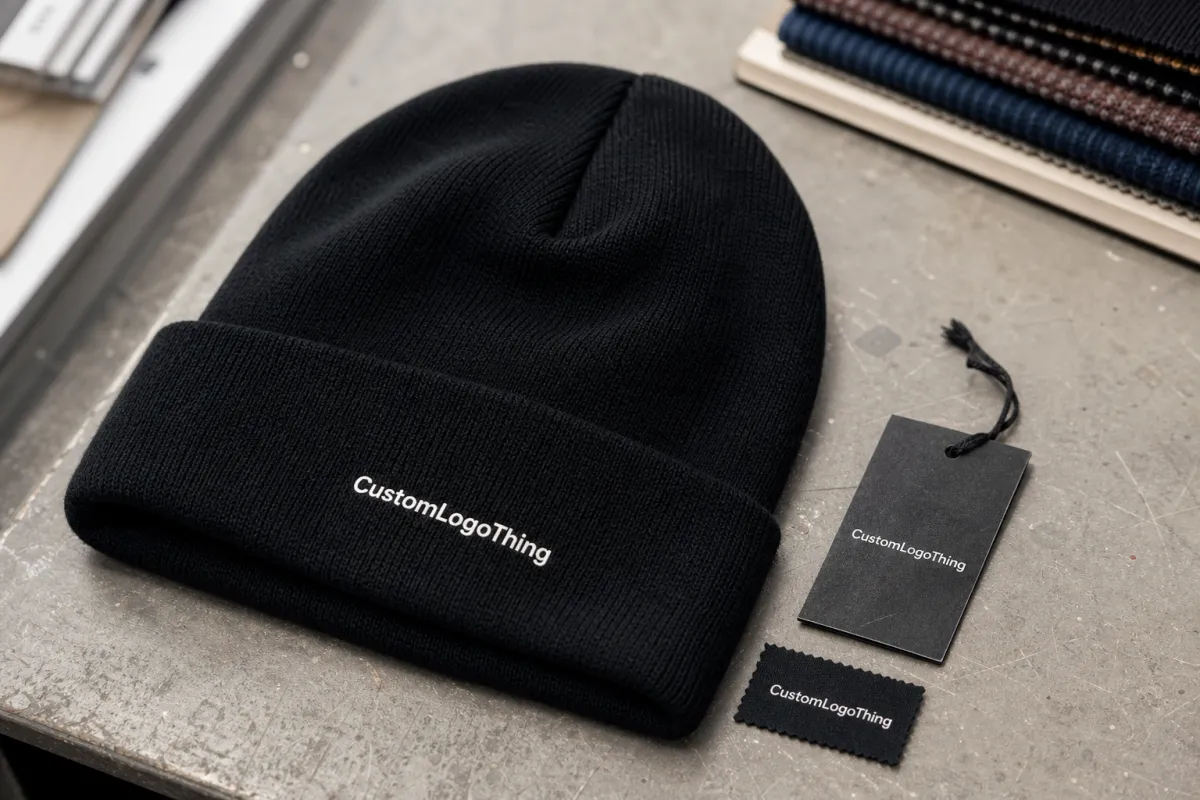
The value of a Retail Merch Beanies woven label quote is in how it translates a concept into a sellable product. A woven label can make a simple knit look brand-owned instead of generic, especially when the color palette is restrained and the label becomes the main visual signal.
The body style matters, but the label often decides the final presentation. A centered woven label on the cuff usually looks cleaner than a decoration that competes with the knit texture. The right version is the one that belongs on the product, not the one that simply takes up the most space.
Working rule: if the quote does not state label construction, placement, and finishing method, it is not yet a useful comparison point.
A useful quote also separates what is included in the blank beanie and what has been added for branding. That difference matters when one supplier includes application, another includes only loose labels, and a third excludes freight. The gap between those scopes is often larger than the unit-price gap.
For repeat orders, consistency matters as much as cost. Keeping the same woven construction, fold, and placement makes reorders easier to approve and easier to compare. Small shifts can be enough to make a second run look off even when the color match is right.
Beanie body choices and label builds that change the product
Beanie body selection changes how the label reads. A cuffed beanie gives you a natural branding zone and usually keeps the label visible after folding. A slouch beanie feels softer, but the label position has to be checked after drape and packing. Double-layer knits add structure and warmth, while rib-knit bodies stretch more and can change how the label sits over time.
The woven label itself comes in a few common builds. A center-fold label works well for a sewn-in finish. An end-fold label hides the edge better when the branding needs a cleaner seam look. A patch-style application feels more substantial, but it adds handling and makes alignment more important.
Placement affects both appearance and labor. Cuff placement is usually the simplest and most consistent. Seam placement can look refined, but it demands tighter control during sewing and folding. Body placement can work well on some styles, though the knit may shift slightly when the beanie is worn or packed.
Heavier knit is not always better. A denser construction can improve shape retention and make the label area look sharper, but it can also add cost without adding much retail value. If the product will be sold folded on a table or wall display, the finished silhouette matters more than technical overbuild.
- Cuffed body: strongest option for label visibility and front-facing branding.
- Slouch body: softer presentation, but label position needs more checking.
- Double-layer knit: better structure and warmth, usually at a higher cost.
- Rib-knit: comfortable stretch, but the label area may move more in wear.
Specifications buyers should lock before they ask for pricing
If the spec is loose, the quote will be loose. Before asking for pricing, lock the core details: fiber blend, gauge, dimensions, cuff depth, label size, logo color count, placement, and any required trim or finishing. Those choices affect both price and lead time, and vague specs usually create revision loops.
Material choice matters more than many buyers expect. Acrylic is common because it is affordable and easy to knit, while acrylic-wool blends can improve warmth and hand feel. Cotton can work for lighter seasonal programs, but it is less typical for cold-weather retail. If sustainability claims are part of the brief, ask for documentation before artwork is approved.
Packaging belongs in the spec sheet too. Individual polybags, hang tags, size stickers, insert cards, fold direction, and carton pack counts all affect the final order. A shop-floor display order is not the same as a warehouse-direct program. One may need bagging and retail barcodes; the other may only need bulk packing and carton marks.
A useful way to structure the brief is to separate the order into product, branding, and distribution. The product is the knit body. Branding is the woven label and any secondary tag. Distribution is how it ships. When those three pieces are defined separately, the quote is easier to audit and re-order.
Quality control starts at the spec stage. Ask for stitch count on the label, yarn and thread references, and acceptable placement tolerances. Even a small shift in label height can matter if the beanie will be displayed folded in a fixed orientation. Precise specs reduce the chance of approving a run that looks close on paper but wrong in person.
Cost, MOQ, and quote structure for woven-label beanies
The cost of a Retail Merch Beanies woven label quote usually breaks into five parts: the blank beanie body, woven label setup, application labor, finishing, and freight. If a quote arrives as one flat number, ask for the breakdown. The point is not to make the supplier do extra admin; it is to see where cost is coming from and what may be missing.
MOQ depends on body style, label complexity, and packing requirements. A stock-supported body with a simple cuff label can often start around 300 to 500 pieces. A custom knit body or a more complex label application usually moves the minimum to 500 to 1,000 pieces or more. Premium packaging pushes minimums higher because the order has more setup steps.
Unit price is sensitive to almost every spec. A smaller label can cost less, but that saving can disappear if the label uses multiple colors or needs a more careful sew-in. Freight also matters. A quote that looks lower at the factory line can become more expensive once cartons, destination charges, and delivery timing are included.
| Option | Typical MOQ | Typical Unit Range | Best Use |
|---|---|---|---|
| Stock beanie + center-fold cuff label | 300-500 pcs | $2.10-$3.40 | Retail tests, smaller gift programs |
| Custom knit body + woven label | 500-1,000 pcs | $3.20-$5.80 | Brand launches, recurring merch lines |
| Custom body + premium packaging | 1,000+ pcs | $4.50-$7.50 | Higher-margin retail and seasonal sets |
Those ranges are directional, not fixed. Yarn blend, stitch density, label thread count, finishing, and packing specs can move the number quickly. They still help because they show what level of complexity the market expects. If a quote is well below the range, check whether setup, packing, or freight has been left out.
To get a usable quote, send the supplier the artwork, target quantity, preferred body style, label size, placement, packaging notes, and delivery address in one pass. The fewer assumptions the supplier has to make, the fewer surprises show up later.
Process, approval, and turnaround from art to shipment
The production path is usually straightforward: brief, artwork review, label proof, sample or swatch approval, production, finishing, inspection, and shipment. The weak point is usually approval. One missed note in proofing can affect label size, color balance, or placement if the order moves ahead before the details are locked.
Turnaround depends on stock availability, artwork quality, and approval speed. For a supported program with clean files and no sample delay, many buyers see roughly 12 to 15 business days after final proof approval. Custom knit styles, multi-color labels, or orders that require a physical sample first can extend into a 3 to 5 week window, sometimes longer if packing or freight routing is complicated.
A few things stop the clock quickly: missing Pantone references, a logo that needs cleanup, a quantity change, or a late packaging revision. That is not necessarily a sign of a bad supplier. It is what happens when the job has to match a specific retail outcome and the details are still moving.
Review the proof against the shelf condition, not just the artwork file. A beanie can look correct as a flat render and still read poorly once folded, bagged, and tagged. If the product will sit in a retail display, the proof should reflect the angle and fold the customer will actually see.
Retail finishing details that make the beanies ready to sell
Finishing is where the product starts to feel retail-ready. Folding controls the first visual read. Banding keeps the silhouette compact. Tagging adds retail identity. Bagging protects the knit and keeps the label clean during transit. If the beanies arrive crushed, twisted, or mis-tagged, the shelf value drops before anyone touches the product.
Case pack and carton labeling are just as important. Clear carton marks help receiving teams count, scan, and distribute inventory without opening every box. That speeds intake and reduces handling damage. It also makes later replenishment easier because the order can be traced by SKU, color, and carton count without guesswork.
Woven labels need protection in transit. A loose pack can twist the label, crease the cuff, or pull at the stitch line if the hang tag is heavy. Tight, predictable packing does not win design awards, but it protects the approved sample. In retail, that consistency is often worth more than a slightly lower line-item cost.
Buyer check: confirm fold direction, bag type, and carton count before production starts. Those three points are easy to miss and expensive to correct after packing.
How to compare suppliers without getting apples-to-apples confusion
The cheapest quote is often the hardest one to compare. One supplier may include sewn-in labels, another may supply loose labels only, and a third may omit freight or bagging from the base price. When the scopes differ, unit cost tells you very little. Landed cost is what matters.
Look for what is missing. Setup fees, sample charges, finishing, and delivery are the usual gaps. A quote that looks attractive at first can become the most expensive one once those items are added back in. That is especially true on smaller orders, where setup is spread across fewer pieces.
Good comparison also depends on proof quality. Sample photos, written approvals, and spec sheets help reduce drift between runs. If the supplier can repeat the same label placement, knit density, and packing format on a reorder, that is a stronger signal than a low opening price. Consistency is what supports a real retail program.
- Ask what is included: label, application, packaging, and freight.
- Confirm what is excluded: setup, sample charges, or destination fees.
- Compare like for like: same quantity, same label build, same packing plan.
- Request proof documentation: photo, swatch, or production sample if needed.
Next steps to request an accurate quote and place the order
The cleanest path to an accurate order is simple: send the body style, material preference, woven label artwork, quantity, delivery address, and packaging notes together. That gives the supplier enough detail to price the actual job instead of filling gaps with assumptions. It also reduces revision loops, which is usually where timelines slip.
For retail runs, ask for a digital proof first and a physical sample when the presentation has to be exact. A digital proof is useful for layout and content. A physical sample is better when you need to verify hand feel, fold behavior, label scale, and how the finished piece reads under store lighting. The extra time is easier to absorb before production than after a bad run.
From there, confirm the specs, approve the proof, lock the timeline, and ship against the same carton and packing plan you approved. That sequence keeps the order closer to the sample and makes reorders easier to manage. The best quote is not just a number on a page; it is a clear map of how the beanie will be made, packed, inspected, and delivered.
What should I include in a retail merch beanies woven label quote?
Include the beanie style, fiber blend, quantity, label artwork, label size, placement, and packaging requirements. Add the ship-to address and target timeline so freight and scheduling are priced correctly. If the product needs a retail barcode, hang tag, or carton mark, list that too.
How does woven label placement affect beanie pricing?
Cuff placement is usually simpler than seam or patch-style application, so labor can be lower. More complex placement requires more alignment checks and handling, which can raise the unit cost. If the logo has to sit in a precise retail-facing position, lock that in the spec before comparing suppliers.
What MOQ is typical for retail beanies with woven labels?
Stock-supported styles with simple labeling often start around 300 to 500 pieces. Custom knit bodies, extra colors, or premium packaging usually move the minimum higher, often into the 500 to 1,000 piece range. The exact MOQ depends on how much setup the order needs.
How long does turnaround take after I approve the proof?
For supported styles with clean artwork, many orders move in about 12 to 15 business days after final proof approval. Custom runs or orders that need a physical sample can take longer, often 3 to 5 weeks or more. Freight timing is separate from production, so ask for both.
Can I get a sample before placing a larger retail beanie order?
Yes. A pre-production sample or approved swatch is the safest way to verify label size, placement, color, and overall hand feel. Samples add time and cost, but they reduce the chance of approving a full run that misses the retail presentation.


