Buyer Fit Snapshot
| Best fit | Honey Jar Labels Custom projects where brand print, material claims, artwork control, MOQ, and repeat-order consistency need to be specified before quoting. |
|---|---|
| Quote inputs | Share finished size, material target, print colors, finish, packing count, annual reorder estimate, ship-to region, and any compliance wording. |
| Proofing check | Approve dieline scale, logo placement, barcode or warning zones, color tolerance, closure strength, and carton packing before bulk production. |
| Main risk | Vague material claims, crowded artwork, missing packing details, or unclear freight terms can make a low unit price expensive after revisions. |
Fast answer: Honey Jar Labels Custom: Design, Cost, and Fit should be specified like a repeatable production item. The safest quote records material, print method, finish, artwork proof, packing count, and reorder notes in one written spec.
Production checks before approval
Compare the actual filled-product size with the drawing, then confirm tolerance on folds, seals, hang holes, label areas, and retail display edges. Reserve space for logos, QR codes, warning copy, and material claims before decorative graphics fill the panel.
Quote comparison points
Review material grade, print process, finish, sampling route, tooling charges, carton quantity, and freight assumptions side by side. A quote is only useful when the supplier can repeat the same color, closure quality, and packing count on the next order.
Honey Jar Labels Custom: Design, Cost, and Fit
A honey line can taste exceptional and still look forgettable if the jar label is undersized, crowded, or finished in a way that dulls the warm color of the honey itself. honey jar labels custom shape the first impression long before a customer twists the lid or tastes what is inside. A well-made label gives the jar a clear voice, a sense of care, and enough visual order to stand out among other small-format products.
From a packaging buyer's point of view, the label is not decoration first; it is the piece that tells the shopper what the honey is, how it fits within the range, and why it deserves attention on a crowded table or shelf. Clear glass, amber fill, narrow body panels, and busy farmers market displays all ask the label to do more than one job at once. That is why honey jar labels custom should be planned with the same care you would give to retail packaging, custom printed boxes, or any product packaging that has to communicate quickly and cleanly.
The strongest label work usually does three things at once: it fits the jar correctly, it holds up through handling and storage, and it carries the brand story without crowding the panel. I have seen otherwise strong honey brands lose attention because the label was off by a few millimeters or the finish made the amber look flat instead of rich. The sections below cover fit, material selection, Pricing, and Ordering decisions so honey jar labels custom feel controlled, repeatable, and ready for production instead of improvised at the last minute.
Honey jar labels custom: why a small label changes the whole jar
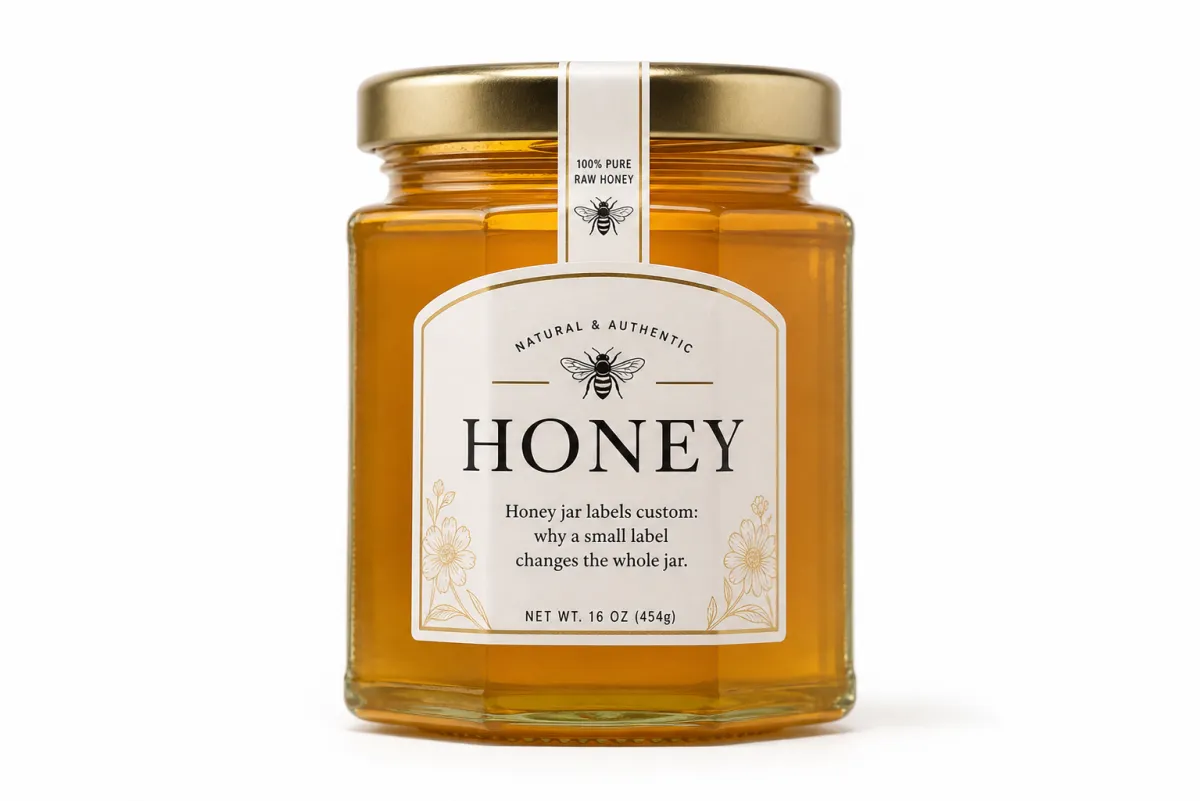
A honey jar is a tricky package because the product already contributes a lot to the visual appeal. Amber honey in clear glass can look rich without any label at all, which creates a higher bar for the branding. honey jar labels custom are what turn a jar from ordinary to deliberate, giving it a presence that feels finished the moment someone sees it from across the room.
What makes this category so sensitive is the amount of information that has to fit into a very small space. A front label may need the brand name, varietal or flavor, net weight, and a note about origin or harvest. If the brand sells clover, orange blossom, wildflower, creamed honey, or a seasonal batch, honey jar labels custom need to communicate that difference immediately. There is rarely room for copy that does not help the sale.
Design choices also shape how the shopper reads quality. A matte paper label with a soft natural tone can feel local and handmade. A bright white BOPP label can feel crisp and retail-ready. A clear label shows more of the honey color, though it asks for disciplined typography because the background offers less forgiveness. That is why honey jar labels custom are as much about package branding as they are about placing a name on glass.
A label on a honey jar has only a moment to earn trust. If the size is off, the text is crowded, or the finish feels cheap, the shopper notices that before they ever reach for the lid.
There is also the matter of shelf competition. Honey often sits beside jam, syrup, tea, and gift items that all rely on small-format retail packaging. If the label is too busy, the product disappears into the clutter. If it is too bare, it may look unfinished. Well-made honey jar labels custom hold the middle ground: enough detail for clarity and compliance, enough restraint to look appealing at a glance.
From a buyer's perspective, the most useful labels are the ones that make the jar easier to manage as part of a business system. A clean label hierarchy helps staff sort SKUs faster, makes product photography more consistent, and keeps a line organized even when several jar sizes are in play. That is one reason honey jar labels custom often belong to a broader branded packaging plan rather than standing alone as a print order.
As the product line grows, that structure matters even more. A producer may begin with one 8 oz jar and later add a 12 oz gift jar, a squeeze bottle, or a seasonal bundle. If the label system has been built carefully, those additions feel related instead of random. Strong honey jar labels custom can support that kind of expansion without forcing a redesign every time a new format appears.
Honey jar labels custom process and timeline: from artwork to application
A clean honey jar labels custom project starts with measurement, not artwork. The body width, shoulder curve, flat panel area, and usable wrap space all matter, especially on round or hex jars where a guessed label can distort once it reaches the glass. If the supplier receives the real jar dimensions early, the dieline can be built correctly before anyone starts laying out text and graphics.
That first step usually leads into artwork setup, where the designer or buyer defines the front panel, side panel, lid label, or tamper seal. With honey jar labels custom, the workflow tends to be direct: choose the panel size, place the copy, confirm bleed and safe margins, and decide whether the label should stand alone or work as part of a coordinated set. A detailed brief reduces the back-and-forth that slows production later.
Proofing is where small errors are caught before they turn into waste. A digital proof helps with layout, spelling, and the order of information. A material sample tells you more about finish, opacity, adhesive behavior, and how the label looks under store lighting. For honey jar labels custom, I would always rather review one careful proof than trust a layout that has not been tested against the curve of the jar or the contrast of the type.
- Measure the jar body and the space available for labeling.
- Confirm the information that must appear on the label.
- Select the material, adhesive, and finish.
- Review the dieline and digital proof.
- Approve the final version before print.
- Decide whether the labels ship flat or are applied in-house.
Timeline depends on how many open decisions remain. A straightforward honey jar labels custom order with standard paper or BOPP, no specialty finishing, and print-ready artwork can often move from approval to production in about 7-12 business days. Once foil, embossing, clear film with white ink, or a custom shape enters the job, 12-18 business days becomes a more realistic expectation. Rush schedules can happen, though they usually carry a higher cost and leave less room for correction.
Application method matters just as much as the artwork. Some labels are hand-applied at a farm stand or in a small packing room. Others need to work with a dispenser or semi-automatic applicator. If a label stock is too stiff, or the adhesive grabs too quickly, the line slows down. That is why honey jar labels custom should be matched to the real handling method, not only to the mockup on screen.
For brands that sell honey alongside other products, it helps to align the label schedule with the rest of the packaging calendar. A honey launch may sit beside Custom Labels & Tags for side items or Custom Packaging Products for gift bundles, and those pieces should feel like they belong to the same family. When the system is planned early, honey jar labels custom become easier to reorder, easier to scale, and easier to keep consistent across runs.
Key factors that affect honey jar label performance and appearance
The first material question is whether the label needs a paper or film face stock. Paper can feel warm, artisanal, and close to the product's natural origin, which is why many small producers choose it for local markets and gift jars. Film stocks such as BOPP usually make more sense when moisture, refrigeration, or frequent handling are part of the equation. For honey jar labels custom, that choice can be the difference between a label that looks great in the packing room and one that still looks clean after shipping and display.
Adhesive choice carries just as much weight as face stock. Honey jars may sit in cool storage, travel through humid trucks, or be handled with slightly damp hands at a market table. A standard permanent adhesive handles many dry applications, but stronger tack or a cold-temperature adhesive may be the better fit for refrigerated retail packaging. In honey jar labels custom, the wrong adhesive can lead to edge lift, bubbles, or early peeling long before the product sells through.
Finish is another major design lever. A matte label can feel soft and grounded, which suits farm-branded packaging well. Gloss can sharpen colors and improve contrast under bright store lights. Soft-touch adds a tactile note that suggests a more premium position, while foil can move the jar toward a giftable shelf presence. The best honey jar labels custom do not treat finish as decoration after the fact; they use it to reinforce the product story.
Legibility deserves more attention than it usually gets. Honey jars are small, so the visual order has to stay disciplined. Brand name should lead. Flavor or varietal should follow. Net weight, origin, and required copy need to be easy to find without crowding the front panel. On honey jar labels custom, a clean hierarchy often sells better than a busy layout that tries to say everything at once.
| Label material | Typical look | Moisture resistance | Common use | Typical relative cost |
|---|---|---|---|---|
| Paper | Warm, natural, handcrafted | Low to moderate | Dry storage, farm stands, gift jars | Lowest |
| BOPP | Clean, sharp, durable | High | Retail shelves, chilled display, shipping | Moderate |
| Clear film | Minimal, product-forward | High | Premium or modern honey branding | Moderate to higher |
| Textured stock | Craft, artisanal, tactile | Low to moderate | Specialty honey, seasonal gifts | Higher |
The jar shape can change the label decision more than buyers expect. Round jars need careful wrap calculations. Hex jars look polished, but their corners and panel breaks may force smaller type or split content across faces. Squeeze bottles usually need a different approach altogether because the panel proportions and flex points are not the same. For honey jar labels custom, fit is not only a measurement issue; it is a visual balance issue too.
There is also the lid and neck area to consider. A top label, a neck seal, or a tamper-evident strip can help the jar feel complete, especially for gift sets or premium lines. Still, more labels are not always better. The strongest honey jar labels custom use extra label areas only when those pieces help with function, branding, or tamper awareness.
If the honey is sold in a climate-controlled store, paper may be enough. If it ships through summer heat, cold storage, or humid display cases, film usually offers a safer margin. That practical split is why honey jar labels custom should be specified from the real use case outward, not from the prettiest mockup inward. A label that stays put in the packing room is usually the one that stays put in the market.
For brands that care about responsible sourcing, paper options can often be paired with FSC-certified materials. For handling and transit expectations, it also helps to review the kind of abuse testing many packaging teams reference through FSC and ISTA. Those organizations are not building the label art, but they do help frame the material and shipping standards that sit behind honey jar labels custom.
Honey jar labels custom cost, pricing, and MOQ factors
honey jar labels custom pricing usually comes down to five variables: quantity, material, print coverage, finish, and whether the shape is standard or custom. Keep those factors simple and the unit price stays manageable. Add foil, specialty adhesive, a nonstandard die cut, or several label sizes for one SKU family, and the quote climbs quickly.
For small runs, setup costs carry real weight. A buyer ordering 500 labels may pay a higher unit price than someone ordering 5,000 because press setup, proofing, and die cutting are spread over fewer pieces. That is why honey jar labels custom often have a minimum order quantity, or MOQ, that fits the printer's production method. It is not just a sales rule; it reflects how the math works on the floor.
Here is a practical way to think about common small-batch pricing. These are broad ranges, and exact numbers will shift with size and coverage, but they are useful for planning:
| Option | Typical MOQ | Approx. unit cost at 5,000 pcs | Strength | Tradeoff |
|---|---|---|---|---|
| Simple paper label | 250-1,000 | $0.03-$0.07 | Lowest cost, warm look | Less moisture resistance |
| BOPP pressure-sensitive | 500-1,500 | $0.05-$0.10 | Durable, clean finish | Slightly higher price |
| Clear film with white ink | 1,000-2,500 | $0.08-$0.14 | Premium product-forward look | More setup and color control |
| Foil or specialty finish | 1,000-5,000 | $0.10-$0.20+ | Giftable, upscale appearance | Higher setup and material cost |
The biggest mistake I see is treating unit cost as the only number that matters. A slightly higher quote can still be the better buy if it includes better proofing, a stronger adhesive, a more accurate die, or fewer application problems. For honey jar labels custom, the real cost is not only the label itself; it is the time saved in production, the lower reject rate, and the cleaner shelf presentation.
Ordering more labels can lower the unit price, but inventory has a cost too. Honey sellers often carry several flavors, harvest lots, or jar sizes, and label storage can become its own problem. If the line moves slowly, a large print run ties up cash and shelf space. For honey jar labels custom, I usually suggest matching the run size to realistic sales velocity plus a modest buffer, not to a theoretical discount alone.
Another place buyers miss costs is in the quote detail itself. Ask whether the price includes prepress, a physical proof, shipping, reruns for print error, and finish upgrades. Ask whether the label is quoted as a standard rectangle or a Custom Die Cut. Ask whether the stock is paper, BOPP, or clear film. Strong honey jar labels custom quotes should be easy to compare line by line so there are no surprises after approval.
If you are comparing suppliers, request apples-to-apples quotes using the same jar size, same adhesive, same print coverage, and same delivery method. That is the only honest way to judge honey jar labels custom pricing because a low quote can hide a smaller label size, thinner stock, or a finish that will not hold up in storage. Clear quoting leads to better decisions.
Step-by-step guide to ordering honey jar labels custom
A practical honey jar labels custom order starts with the jar itself. Measure the body diameter, the flat panel width if you are using a hex jar, the height available before the shoulder curve, and any area reserved for a lid seal or neck band. If you only send the outside diameter and nothing else, the label may arrive looking fine on paper but awkward on glass.
Next, decide what the label must communicate. For many honey lines, that means the brand name, varietal or flavor, net weight, ingredients if there are additions, origin, and any legal copy required by the market. Good honey jar labels custom leave room for the required information without burying the product name under a wall of text. That balance is where packaging design earns its keep.
Then choose the label format. A front label alone may be enough for a minimalist brand. A wrap label gives more room for storytelling and compliance text. A tamper-evident seal can add trust and shelf confidence. Lid labels help color-code multiple SKUs. The right honey jar labels custom structure depends on whether the jar is sold at a market table, shipped in cases, or displayed on a retail shelf under strong light.
- Record the jar dimensions and shape details.
- List the exact text that must appear.
- Choose the material, finish, and adhesive.
- Confirm whether the labels are hand-applied or machine-applied.
- Ask for a proof that shows actual placement on the jar size.
- Approve spelling, color balance, and edge margins before print.
Artwork preparation stays simple when the brief is clear. Use a clean visual hierarchy, leave safe margins, and keep small text out of corners where the jar curve can distort it. On honey jar labels custom, the difference between a polished label and a cramped one often comes down to whether the type sizes were matched to the real panel width instead of guessed from a template.
Proof review deserves a slow pass. Check color accuracy, but also check line breaks, punctuation, and weight formatting. Verify that the label still works if the jar is photographed at an angle or seen from three feet away. For honey jar labels custom, a proof that looks acceptable at 100% on a monitor can still fail if the design has not been tested against the actual container shape.
If the product line includes other seasonal goods, coordinate the honey labels with your broader branded packaging system so the whole range feels connected. That might mean matching typography, color families, or finish choices with Custom Packaging Products, or keeping the label system in step with your other Custom Labels & Tags. For honey jar labels custom, that kind of consistency makes reorders easier and the brand easier to recognize.
Common mistakes with honey jar labels custom orders
The most common honey jar labels custom mistake is measuring the jar the wrong way. People often measure only the widest round point and forget the label needs a true flat panel or a usable wrap area. On a curved glass jar, that small error can cause wrinkling, overlap, or a label that sits too high on the shoulder. Fit comes first.
Another mistake is trying to say too much. A honey label is small, and every extra line of copy competes with the brand name. If the panel is packed with harvest notes, poetic language, ingredients, serving suggestions, and legal copy, the design starts to lose its structure. In honey jar labels custom, hierarchy is not a decorative choice; it is what keeps the product readable in a split second.
Material and finish mismatch often show up after the product has already been packed. A paper stock can look wonderful on a dry shelf, but if the jars sweat in cold storage or sit in humid transport, the label may wrinkle or lose adhesion. That is why honey jar labels custom should be selected around the actual environment, not only the aesthetic goal.
It is also easy to ignore consistency across jar formats. A 4 oz jar, an 8 oz jar, and a 16 oz jar should look related, but not forced. If the labels are all resized by eye, the line can look unplanned and harder to manage. Good honey jar labels custom systems keep the family feel while still respecting the proportions of each container.
If a label only looks right in the file, it is not finished. It has to look right on curved glass, under store lighting, and after someone has handled the jar a few times.
Skipping a physical sample is another expensive shortcut. Digital proofs help, but they do not show how the label behaves on real glass or how the finish changes under lighting. For honey jar labels custom, even a simple mockup on an actual jar can reveal problems with placement, glare, or type size that no screen will catch.
One more issue is forgetting how the product will be sold. A jar sold at a farmers market gets handled a lot. A jar sold through chilled retail display faces condensation. A gift set may need a more premium feel. If those realities are ignored, the label may still print correctly but fail the business goal. Good honey jar labels custom work because they are built around the channel, not just the artwork.
Finally, do not assume every supplier sees the same problem the same way. Some are strongest on price, others on specialty finishes, others on speed. The smartest buyers ask direct questions about material, dieline, adhesive, proofing, and application so they know exactly what they are getting. That is how honey jar labels custom stay predictable instead of turning into a production surprise.
What to do next before you order honey jar labels custom
Before you place an order, build a short working checklist. Include jar dimensions, expected quantity, storage conditions, label placement, and the exact message the label has to communicate. That one page can save days of correction later because honey jar labels custom are much easier to quote accurately when the basics are already settled.
Gather the assets that help the supplier understand the product in context. Product photos, existing packaging, brand colors, logo files, and a sample of any companion items all improve the quote. If the honey is part of a larger line with branded packaging, that context matters because the label should sit comfortably with the rest of the range. Strong honey jar labels custom work best when they are designed as part of the whole shelf presence.
Decide what finish and adhesive match the way the honey will be sold. Farm stand products may benefit from a tactile paper label. Refrigerated retail packaging may need film and a stronger adhesive. Gift jars may justify foil or soft-touch. For honey jar labels custom, the right choice is usually the one that supports both handling and brand perception, not only the one that looks good on a sample sheet.
Then compare one or two quotes using the same information, not different versions of the same request. Ask for a proof that shows placement on the actual jar shape, not just a loose file on a white background. Confirm whether the label ships flat or pre-applied, what the lead time is after approval, and whether the finish or die cut affects the schedule. That kind of detail keeps honey jar labels custom moving in the right direction.
Here is the short version I would give any buyer: measure carefully, simplify the copy, choose the material for the real environment, and review the proof as if the label is already on the shelf. That approach keeps the job practical. It also keeps honey jar labels custom from becoming a design exercise that looks fine in a file and falls apart in production.
If you are building a full product packaging plan, this is the point where the label should be checked against the rest of the system, including cartons, shipping cases, and any gift-ready presentation. A good honey line feels consistent because every piece works together. Done well, honey jar labels custom do not just identify the jar; they help the brand feel trustworthy, organized, and ready to sell.
What size should honey jar labels custom usually be for round jars?
Measure the flat label panel and the curved wrap area, not just the jar diameter. Leave enough margin so the label does not wrinkle near seams or edges. The right size depends on jar shape, neck height, and how much text the label needs to carry.
Are honey jar labels custom better as paper or film?
Paper can look warm and artisanal, especially for small-batch honey. Film options such as BOPP usually hold up better to moisture, condensation, and handling. The best choice depends on storage conditions, brand style, and how durable the label needs to be.
How long does the honey jar labels custom process take?
Timelines depend on proof approval speed, material selection, print complexity, and shipping. Simple jobs can move quickly when artwork and measurements are ready. Specialty finishes, custom shapes, or rush needs can extend the schedule.
What affects honey jar labels custom pricing the most?
Quantity, label size, material, finish, and print method are the biggest drivers. Special adhesives, foil, and custom die cuts can raise the unit price. Ordering a larger run often lowers unit cost, but storage and sales volume matter too.
What should I send when requesting honey jar labels custom quotes?
Send jar dimensions, label placement needs, quantity, artwork files, and finish preferences. Include storage conditions and whether the labels will face moisture, refrigeration, or outdoor markets. The more specific the details, the easier it is to compare accurate quotes.
For a honey brand, the label is not a small detail; it is part of the sales system. The right honey jar labels custom choice supports shelf appeal, protects readability, and gives the product a cleaner, more trustworthy presence from the first glance to the final reorder. Measure the jar carefully, match the material to the real environment, and approve the proof only after you have checked how it will sit on the glass, because that is the point where a good idea turns into a label That Actually Works.