Jacquard Knit Beanies custom pattern quote requests can swing more than most buyers expect because the hat is not just decorated, it is built stitch by stitch. Stitch count, color changes, crown shaping, yarn choice, and even the way the cuff folds all affect cost. I have seen a design that looked simple in a mockup turn into a finicky sample once the knit mapping started. That is the part a lot of first-time buyers miss: the quote is not just a price tag, it is a production plan hiding in plain sight.
Knitted patterns behave differently from prints, patches, or embroidery. The art has to be translated into yarn tension and machine logic, which means the same logo can look crisp on screen and blur in fabric if the gauge is off. That matters for brands, merch teams, and retail buyers alike, because the finished beanie has to work in hand, on head, and on shelf. A good supplier will say that plainly instead of pretending every concept is ready to knit as-is.
Fast estimates come from clear inputs. Vector artwork, a realistic quantity range, preferred construction, and a delivery window usually shave days off the back-and-forth. The better the brief, the tighter the number. A detailed jacquard knit beanies custom pattern quote is valuable precisely because it shows where the time, labor, and material costs are hiding.
Why Jacquard Knit Beanies Custom Pattern Quote Requests Start With Stitch Count
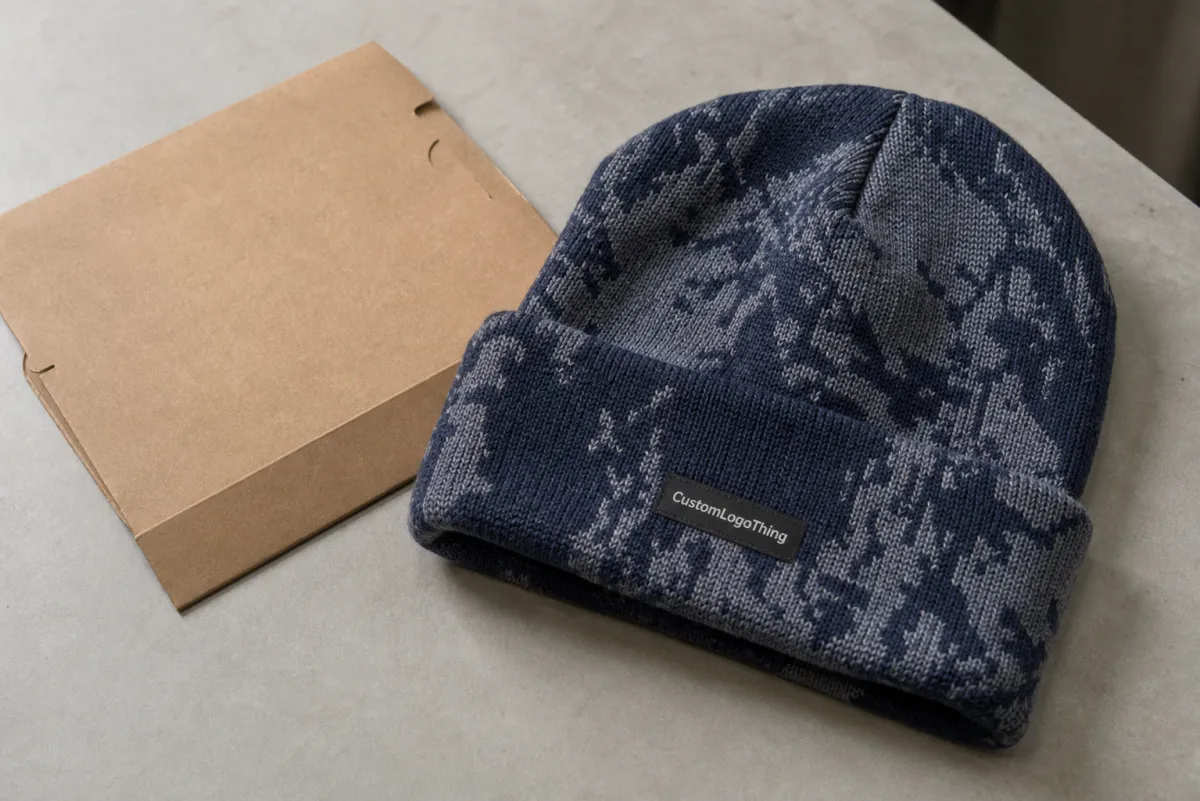
Artwork is only one part of the equation. A jacquard knit beanies custom pattern quote often turns on stitch mapping, not just design complexity, because the logo must be broken into rows, columns, and color changes the machine can actually knit. Tight repeats, dense motifs, and curved crown details take more setup than buyers usually expect. The more the pattern has to be adjusted for the machine, the more time and labor the quote has to cover.
Gauge changes the result too. Fine-gauge knit can preserve detail better, but it may require more setup and tighter yarn control. Looser gauge moves faster and can lower cost, yet it softens small text and delicate lines. A pattern that looks precise on a screen may blur once it is knitted, especially if the art relies on thin outlines or tiny lettering. That is not a defect in the factory; it is a property of knit construction.
Crown construction matters in a way most first-time buyers do not see coming. Decrease points can interrupt a logo or shift a border, which means the top of the hat has to be planned with the design, not after it. Buyers who want a cleaner quote should think in terms of structure first and decoration second. That order usually leads to fewer revisions and a more realistic sample. If a supplier is skipping over crown behavior entirely, the estimate is probably too loose.
Retail teams, outdoor brands, and event buyers usually need more than a unit price. They need sample work, labels, packaging, and freight separated so they can compare vendors fairly. That is especially true when the beanies have to sit beside Custom Printed Boxes, paper inserts, or other branded packaging materials. A quote that lumps everything together can hide the real cost of getting the order to market. It can also hide the places where a project is likely to slip.
The strongest quote is the one with the fewest assumptions. Clear art, clear quantity, and a clear deadline usually beat a vague ballpark every time.
Physical texture changes how color reads. Yarn carries contrast differently from ink or thread, so a digital mockup only gets the conversation started. A buyer who sends a clean vector file, names the target hand feel, and shares a sensible size range will usually get a tighter jacquard knit beanies custom pattern quote on the first pass. I have watched teams save a whole revision cycle just by calling out whether they wanted a chunky retail beanie or a cleaner promotional fit.
Jacquard Knit Beanies Custom Pattern Quote: Product Details That Drive the Sample
Material choice shapes both price and feel. Acrylic is common in bulk because it is predictable, colorful, and efficient to source. Wool blends add warmth and a more premium finish. Polyester blends can be useful when durability or moisture handling matters. Cuffed or uncuffed, single-layer or double-layer, fleece-lined or not: each choice changes how the hat wears and how the factory builds it.
Jacquard is not embroidery. The design becomes part of the knit itself, which means the art must be translated into stitch counts, yarn colors, and transitions that hold up under tension. Fine detail is the first thing to suffer when the gauge is too loose. Bold shapes, strong contrast, and simple lettering survive better than hairline strokes or script fonts with thin joins. If a brand logo depends on tiny serifs, I usually recommend simplifying before sampling rather than hoping for a miracle later.
Placement deserves more attention than most buyers give it. A front-only logo is straightforward. An all-over repeat, mirrored motif, or cuff-wrap design takes more mapping and can change the way the beanie folds. A pom also alters the silhouette: yarn poms feel softer and more coordinated, while faux-fur poms push the piece toward a fashion look. Small changes like cuff height can alter the balance more than the artwork itself. That is why two beanies with the same logo can come back with very different quotes.
Samples should confirm more than color. Fit, stretch recovery, texture, and shape retention matter as much as the artwork. A beanie that feels substantial in a thicker yarn may fit differently than the same design in a lighter construction. One sample can reveal whether the crown sits right, whether the cuff holds its shape, and whether the knit still looks clean after being worn and stretched. A good sample is less a formality and more a stress test.
Color approval works best when the buyer accepts the limits of yarn. Pantone references help, but yarn shades are matched to available stock or custom-dyed equivalents, and small differences are normal. A digital proof helps with placement, yet it cannot fully show texture or thickness. Knit swatches and physical samples are better evidence than a screen image when the order is headed into production. That sounds obvious, but teams still get tripped up by monitor color and forget that yarn reflects light differently.
Specifications to Lock Before You Request a Quote
A workable estimate starts with a short list: vector art, target quantity, size range, color count, intended use, delivery window, and labeling or packaging requirements. Leave out one of those pieces and the quote usually becomes either too loose or too slow. A one-page spec sheet often does more to speed the process than a long email thread ever will.
Fit is not a footnote. Adult and youth sizing are not interchangeable, and cuff depth can change the way the hat sits more than many teams realize. A broad retail program needs enough stretch tolerance for different head sizes. A campaign piece for a narrow audience can be built with tighter control. If the beanie has to fit into a carton, gift set, or display pack, the finished dimensions matter even more. This is one of those details that sounds boring until a pallet arrives and the math no longer works.
Color planning is where a lot of quote accuracy gets won or lost. Stock yarn shades move faster and usually cost less, especially for two- or three-color designs. Custom-matched colors sharpen brand recognition, but they add time and may bring their own minimums. Heather and melange yarns give a softer visual effect, though they also change contrast and can mute small details. Designs meant to be seen from a distance should keep the palette disciplined. If the art depends on five nearly identical shades, the beanie is probably gonna fight back.
Layout choices influence production in ways buyers can feel in the final hat. Front graphics are simpler. All-over repeats take more labor. Mirrored motifs and small text need careful mapping. Thin outlines can vanish in knit form, especially on looser gauges. If a design is heavy on fine detail, it is better to simplify it before the quote is finalized than after the sample comes back distorted. That is not compromising the brand; it is translating it into a medium that has its own physics.
Labeling and compliance belong in the spec from the start. Fiber content, care instructions, country-of-origin information, hang tags, and retail-ready packaging all affect the order. For teams coordinating the full presentation, the Custom Packaging Products page is a useful starting point. Product packaging should support the beanie, not fight it. A hang tag that looks elegant on a rendering can become annoying if it twists the cuff or hides the knit pattern.
Pricing, MOQ, and Unit Cost Expectations
Unit cost moves with the details. Yarn type, stitch complexity, color count, label application, packaging, sample revisions, and freight all matter. A basic cuffed jacquard beanie in stock acrylic will usually price lower than a fleece-lined version with custom dye matching and specialty tags. That gap is not arbitrary. The second version simply asks more of the factory at every step, from sourcing to finishing.
MOQ surprises new buyers because setup cost gets spread across fewer hats on small runs. A 300-piece order may be useful for testing, but a 1,000- or 3,000-piece order often drops the unit rate enough to change the buying decision. The real question is not only what the minimum is. It is where the price break starts to reward a larger run. Many buyers focus on the lowest entry point and miss the more practical question: which quantity gives the best landed cost without tying up cash in dead stock?
Tiered pricing helps. Ask for two or three quantity levels so you can compare a test run with a broader bulk order. The comparison often reveals whether the design is a one-season item or something worth carrying into replenishment. For a jacquard knit beanies custom pattern quote, that side-by-side view is usually more useful than a single number.
| Order Tier | Typical Cost Behavior | Best Use Case | Quote Risk to Watch |
|---|---|---|---|
| Low MOQ test run | Highest unit cost because setup is spread across fewer pieces | Design validation, small launch, limited merch drop | Sample fees, setup charges, and rush freight can hide the real total |
| Mid-volume bulk order | Better balance between setup and unit price | Regional promotions, seasonal retail, team programs | Packaging or label upgrades may shift the landed cost more than expected |
| High-volume program | Lowest unit price if artwork and yarn are approved early | National campaigns, resale lines, repeat replenishment | Lead time and freight planning become more important than the unit number |
Quote traps tend to show up in the margins. Sample fees, rush charges, split shipments, Custom Hang Tags, and freight assumptions can make two proposals look similar when they are not. Compare landed cost, not only base unit price. If one supplier includes packaging and another does not, the lower starting number can end up more expensive by the time everything is tallied.
There is usually a real spread between a simple stock-yarn beanie and a more customized retail-ready build. The exact range depends on stitch density, number of colors, finishing, and shipping lane. A careful quote should say that plainly. Suspiciously flat pricing is often a sign that the estimate is too soft to trust. I would rather see a supplier explain a price increase than pretend the numbers are all magically the same.
Some buyers use general transit and packaging tests, such as the standards published by ISTA, when the beanies are part of a larger retail rollout. That matters less for a single giveaway and more for a shipment that has to survive distribution, stacking, and long truck routes.
Production Process and Timeline: From Artwork to Delivery
The production sequence is usually simple on paper: inquiry, art review, yarn mapping, digital mockup, sample approval, bulk knitting, finishing, quality check, and shipment. A jacquard knit beanies custom pattern quote gets more accurate when the buyer understands that each stage can affect both timing and cost. Skip one stage or rush it too hard, and the calendar starts slipping.
Artwork cleanup is often the fastest step if the file already lives in vector format. Color approval tends to take longer when the buyer is still deciding between shades or trying to match an existing apparel line and package branding system. Sample revisions can stretch a schedule because the team may want to adjust cuff height, contrast, or pom style after seeing the first version in hand. A manufacturer can move quickly, but only if the decisions move with it.
Lead time depends on quantity, yarn availability, revision count, and shipping method. Stock yarn and simple artwork move faster. Custom colors and new knit mapping push the calendar out. Air freight shortens transit and raises cost. Sea freight lowers transport cost and adds time. Domestic freight can help with regional launches, but only if production finishes early enough to make the window. The tradeoff is usually speed versus budget, and pretending otherwise helps nobody.
Buyers can shorten the schedule with disciplined input. Send vector art instead of a screenshot. Confirm colors early. Approve the sample quickly. Share the launch date up front, even if it feels tight, because the quote team needs that date to judge whether a rush is possible. If one step slips, the whole promise moves. I have seen more good projects go sideways from late approvals than from bad knitting.
Packaging should not be an afterthought here. Paper belly bands, hang tags, and retail cartons can be built into the plan while production is still open. FSC guidance can help teams source paper and board responsibly; the FSC site is a practical reference point. That matters in retail packaging and gift-ready programs, where presentation is part of the product. A well-designed carton can protect the hat and make the first unboxing feel intentional rather than thrown together.
The end use drives the schedule as much as the art does. A giveaway order, a resale program, and a premium winter retail line do not move through production the same way. When the supplier understands the end use, the jacquard knit beanies custom pattern quote can reflect the right finishing, carton count, and delivery path from the start.
Why Choose Custom Logo Things and What To Send Next
A supplier that understands knit construction can save time and frustration. The value is not just in taking the order. It is in spotting stitch problems early, keeping color expectations realistic, and reducing the revisions that slow quoting. When the team knows how a jacquard pattern behaves in yarn, the proposal gets sharper and the sample has a better chance of matching the buyer’s intent.
Support matters most in a few places: clear communication, honest MOQ guidance, practical advice on pattern readability, and consistent sample interpretation. That is especially true for brands that care about retail packaging, hang tags, or bundled product packaging, because the beanie is rarely the only item a customer sees. The quote should fit the whole presentation, not just the knit cap. If the supplier is only talking about the hat and ignoring how it will be sold, displayed, or shipped, the estimate is incomplete.
Send the request with enough detail to remove guesswork. That usually means artwork, quantity, construction choice, and a delivery window. A few minutes of preparation can prevent a week of clarification. Here is the cleanest way to package the request:
- Finished artwork in vector format, plus a simple reference image if needed
- Target quantity, with size split if the run includes different fits
- Preferred yarn type, cuff style, and any fleece lining request
- Color count and any brand color references that matter most
- Labeling, tagging, and packaging requirements
- Delivery window, ship-to location, and whether the order is retail or promotional
Options help when the spec is still flexible. Two yarn choices, two quantity tiers, or two cuff styles can make the buying decision easier for marketing, merchandising, or procurement teams. That comparison is useful when a knit cap program has to compete with other branded packaging purchases, because the decision usually hinges on total presentation, not one isolated part. A buyer comparing multiple vendors can spot the honest one quickly: the honest quote shows its assumptions.
If you are building the order from scratch, start with the artwork and the audience, then work back to the knit structure. That sequence sounds simple, but it keeps the design from becoming a frustration disguised as a product. The wrong gauge, the wrong yarn, or the wrong cuff can turn a good idea into a mushy sample. The right build makes the logo read cleanly and the hat feel worth wearing.
Good buying reduces uncertainty. Once the stitch count, material, MOQ, packaging, and timeline are clear, the order becomes much easier to compare, approve, and launch. That is the real point of a serious jacquard knit beanies custom pattern quote: not just a price, but a production-ready route from artwork to finished goods. The practical takeaway is simple: send a vector file, choose the construction you can defend, lock the quantity range, and specify the delivery date before asking for numbers. Everything else gets easier after that.
What details do you need for a jacquard knit beanies custom pattern quote?
Send vector artwork, target quantity, size range, color count, and the delivery date. Add labeling or packaging requirements so the quote reflects the full landed cost, not only the hat itself. If final art is not ready, a sketch or reference image is enough for a budgetary starting point.
How many colors can I include in a custom jacquard beanie pattern?
The practical limit depends on stitch complexity, yarn availability, and how clearly the design reads once it is knitted. More colors usually mean more setup and more yarn changes, which can raise cost and add time. The cleanest result usually comes from using only the colors that carry the design.
What is the usual MOQ for jacquard knit beanies?
MOQ varies by construction, but smaller runs almost always cost more per piece because setup is spread across fewer units. Ask for tiered pricing so you can compare a test quantity with a larger bulk run before deciding. That comparison usually makes the real price break obvious.
How long does a jacquard knit beanies custom pattern order take?
Timing depends on art approval, sample needs, yarn availability, production capacity, and shipping method. The schedule usually includes mockup work, sample approval, bulk knitting, quality inspection, and transit time. A hard launch date shared early gives the factory a better chance to plan around it.
Can you quote a jacquard knit beanies custom pattern order from a sketch?
Yes. A sketch or rough concept is enough for an initial estimate if the pattern intent, colors, and approximate quantity are clear. A vector file is still better for the final production quote because it reduces guesswork and helps translate the artwork into knit stitches correctly. Once the art is cleaned up, the jacquard knit beanies custom pattern quote can be tightened into a firm, line-by-line proposal.

