Plan Your Logo Patch Beanies Production Timeline Right
A cold-weather launch can miss its moment over one small patch. The Logo Patch Beanies production timeline is not one clock. It is a chain of smaller clocks: artwork review, proofing, patch production, sewing, finishing, packing, and shipping.
That surprises buyers because the product looks simple. A ribbed cuff beanie in black, charcoal, navy, cream, or forest green may already be sitting in inventory. Add a logo patch, and the order shifts from basic apparel sourcing into custom production. Proofs need approval. Patch materials need confirmation. Placement needs checking. Someone still has to sew, inspect, fold, bag, count, and ship the finished goods.
The beanie may be ready. The order is not ready until the branded part is ready.
Why the Logo Patch Beanies Production Timeline Surprises Buyers
Most buyers think in delivery days. Manufacturers think in proofing days, queue days, production days, finishing days, and transit days. Those are not the same thing. A quote that says "10 business days after proof approval" does not mean the box lands at your office 10 business days after you email a logo.
Here is the gap. A buyer sends a PNG on Monday, expects production to start Tuesday, and plans a retail drop the following Friday. The supplier may need a vector redraw, a revised mockup, confirmation on patch size, thread or material approval, and inventory verification before the order reaches the production queue. One unanswered email can add a business day. Three slow approvals can eat a week.
The beanie itself is often the easy part. Stock acrylic beanies, recycled polyester blends, and wool-blend styles are common catalog items. The patch creates most of the checkpoints. Spelling, logo clarity, color contrast, border style, placement, stitch strength, and fold direction all decide whether the finished beanie looks retail-ready or rushed.
Buyer rule: never plan a logo patch Beanies Production Timeline from the event date backward only. Add time for receiving, internal check-in, photography, kitting, staff distribution, store allocation, or warehouse intake.
A standard order can still move fast. Clean vector artwork, a common leatherette or woven patch, in-stock beanies, and same-day proof approval can keep the schedule tight. Delays usually come from decisions that feel small: changing a 2.25-inch patch to 2.75 inches, adding a border, switching from woven to PVC, or asking whether the logo can look "a little more premium" after the proof is built. Famous last words.
Buyers lose the most control in the undecided middle. They want options, which is fair. Suppliers need locked specifications, which is also fair. The tension between those two needs is what stretches custom beanie lead time.
How Custom Patch Beanie Production Actually Works
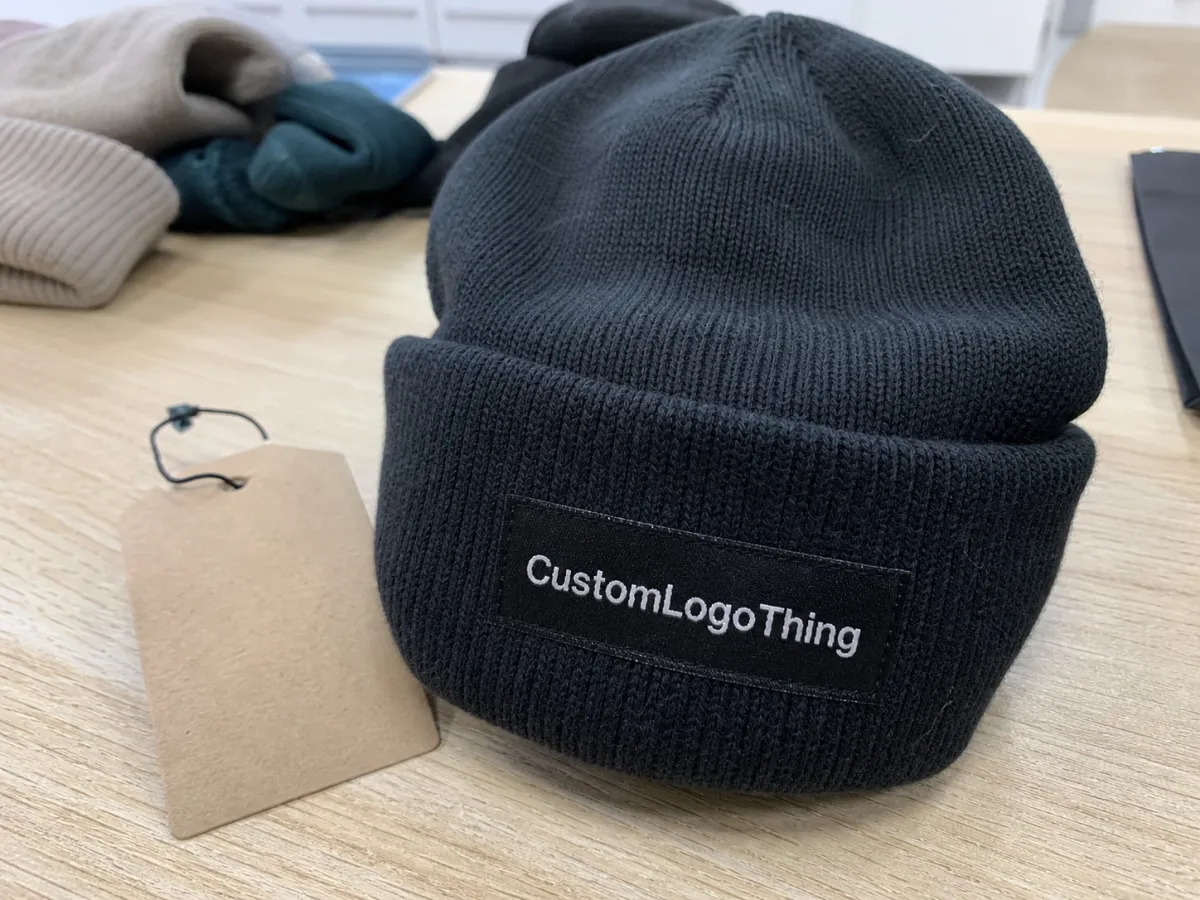
A logo patch beanie combines two products: a knit cap and a separate branded patch. Common patch types include leatherette, genuine leather, woven, embroidered, PVC, rubber, and sublimated fabric. Each option has its own setup logic, cost structure, and weak points.
Most orders run on two production tracks. The first is the beanie track: reserving blanks, confirming stock, knitting a custom color, adding a private label, or preparing blanks for decoration. The second is the patch track: converting artwork, producing the patch, inspecting it, and preparing it for attachment.
Some suppliers run both tracks at the same time. Others wait until the patch proof is approved before allocating beanies, especially if the color is low in stock. That matters during fall and winter, when the safest colors sell through first. Black, charcoal, navy, cream, and forest green are not rare. They are just popular enough to vanish at the wrong moment.
Patch type changes the workflow. Woven patches require loom setup and thread selection. Embroidered patches need digitizing, stitch-count planning, and density checks. Leatherette patches may involve engraving, debossing, laser cutting, or heat-safe backing choices. PVC patches need mold or color setup, which can add both cost and time.
A simple one-color leatherette rectangle is not the same job as a custom-shaped PVC badge with four colors and raised detail. The quote may list both as "patches." Production does not treat them equally.
Placement matters too. A front cuff patch is the fastest and most common because operators can align it consistently. Side placement adds handling. Oversized patches can fight the curve and stretch of the cuff. Wrap labels require careful folding. Multi-location branding means the beanie may move through more than one attachment or inspection step.
Good suppliers treat the proof as a production document, not a pretty mockup. It should show patch dimensions, patch material, colors, placement, border style, backing, and any limitations in fine detail. If the logo has a registered mark, tiny tagline, gradient, distressed texture, or hairline text, that needs review before bulk work starts.
Quality control is not glamorous. It is where many orders are saved. Inspectors check patch clarity, spelling, color contrast, stitch alignment, sewing strength, folding consistency, lint, polybagging, label accuracy, carton counts, and ship-to details. The process resembles a small packaging run with textiles attached: prepress, substrate choice, finishing, and inspection all shape the final result.
Key Factors That Change Lead Time Before Production Starts
The biggest timeline risks often appear before machines run. Unclear artwork, missing Pantone references, late approvals, undecided patch materials, and vague delivery requirements can idle an order before a single beanie is touched.
Artwork quality is usually the first filter. Vector files such as AI, EPS, SVG, or clean PDF files reduce back-and-forth because the logo can be scaled without losing sharpness. Screenshots, low-resolution JPGs, gradients, tiny serif lettering, and detailed crests often require cleanup or simplification. A logo that looks crisp on a laptop can fail at 2 inches wide.
Material availability is another quiet variable. Standard leatherette colors, woven patch bases, and common embroidery threads are easier to source than custom-dyed substrates, metallic finishes, specialty textures, or unusual backing requests. If the patch needs to match a brand color exactly, ask whether the supplier is offering an approximate match or a controlled Pantone-based process. Those are different promises.
Beanie inventory can compress or expand the schedule. In-stock blanks shorten planning. Custom-knit colors, special yarn blends, private labels, recycled material claims, or seasonal shortages extend it. If a recycled-content claim matters, ask what documentation is available before artwork is approved, not after cartons are packed.
Order size matters, but not always the way buyers expect. A 144-piece order may be easier to schedule, yet it carries higher unit handling costs. A 5,000-piece retail program may earn better pricing but needs more patch output, more sewing capacity, more cartons, and tighter inspection discipline. Both can be delayed by one missing approval. Size does not fix indecision.
Shipping mode changes the real deadline. Domestic ground, air freight, ocean freight, split shipments, and fulfillment to several addresses each create a different delivery date. For protective packaging and transit testing context, standards from the International Safe Transit Association are useful because they show how transit risk becomes part of product planning, not a thing to shrug at after production.
Packaging requirements add another layer. Individual polybags, recycled-content mailers, hang tags, UPC labels, inner cartons, master carton labels, and retailer routing documents all require files, approvals, and labor. A company retreat order may ship in bulk cartons with minimal finishing. A retail program may need scannable labels, carton marks, and pack counts that match a warehouse receiving guide exactly.
That finishing work can add 1 to 4 business days on larger orders. Sometimes more if labels arrive late or retailer compliance rules are strict. Nobody wants a chargeback because the beanies were fine but the carton label was wrong.
Step-by-Step Process and Turnaround for a Beanie Order
A typical order follows a predictable sequence: inquiry, quote, artwork review, digital proof, sample or pre-production approval, patch production, beanie preparation, patch attachment, finishing, packing, and shipping. The exact days vary, but the sequence rarely disappears.
At the quote stage, send quantity, beanie style, beanie color, patch material, patch size, logo file, deadline, delivery location, packaging needs, and retail labeling requirements. If the order needs hang tags, UPC labels, individual polybags, carton labels, or size-color breakdowns, say that early. Adding those details after approval is how timelines get messy.
The proofing stage converts your logo into a production-ready mockup. A useful proof shows dimensions, placement from the cuff edge, patch shape, material, imprint method, and color notes. Digital proofs are faster. Physical samples add time, often 5 to 10 business days depending on method, but they reduce risk for retail programs, influencer drops, corporate stores, and premium merch.
Bulk patch production usually begins after approval. For many standard patches, the patch is produced first or alongside beanie preparation, then inspected before sewing. That order matters. Sewing a defective patch onto 1,000 finished beanies creates expensive rework, not efficiency.
Attachment and finishing are more manual than many buyers realize. Operators sew patches onto the cuff, trim threads, check alignment, fold the beanie, lint-check the surface, count units, bag if required, apply labels if needed, and carton-pack the order. For FSC-related paper hang tags or cartonboard inserts, buyers can reference sourcing expectations from the Forest Stewardship Council.
| Order Scenario | Typical Production Path | Planning Range | Common Risk |
|---|---|---|---|
| Stock beanie with standard leatherette patch | Digital proof, patch engraving, sewing, packing | Often 7-12 business days after approval | Late proof approval or out-of-stock beanie color |
| Stock beanie with woven patch | Artwork conversion, loom setup, patch production, sewing | Often 10-15 business days after approval | Small text or color-detail limitations |
| Custom-knit beanie with patch | Yarn sourcing, knitting, patch production, attachment | Often 20-35 business days, sometimes longer | Yarn availability and sample revisions |
| Retail-ready program with labels and bagging | Proofing, sampling, bulk production, labeling, carton routing | Often 15-30 business days after final approval | Packaging specs, UPC files, and routing rules |
The fastest path is simple: in-stock beanie, standard patch, clean vector artwork, no physical sample, and same-day approval. The slowest path stacks complications: custom beanie color, specialty patch material, physical sampling, retail packaging, multiple ship-to locations, and freight constraints. Most real orders sit between those two poles.
One practical benchmark: if you need fewer than 250 stock beanies with a leatherette patch and no special packaging, plan around two to three working weeks from artwork submission to delivery, not just from approval to production completion. If you need 2,500 units with woven patches, UPC labels, and split shipping, a month is a more defensible starting point. Not always. Often enough to protect the launch.
Cost, Pricing, and MOQ Variables Buyers Should Check
Unit cost is shaped by both the beanie and the patch. A cheap blank can become expensive if the decoration method is complex. A premium beanie can stay surprisingly efficient if the patch is standard and the order size is healthy.
Key pricing inputs include quantity, yarn weight, cuff type, patch material, patch size, number of colors, shape complexity, attachment method, packaging, and shipping. As a rough market pattern, a basic stock beanie may fall in the $3.50-$8.50 range before decoration. Custom patch decoration can add about $1.00-$4.50 per unit depending on patch type, size, setup, and volume. Specialty retail packaging may add $0.18-$0.75 per unit before freight.
MOQ rules vary. Stock beanies with standard sewn patches may start lower, often around 48, 72, or 144 pieces depending on the supplier. Custom-knit colors, private labels, PVC molds, and specialty packaging can push minimums higher. A PVC mold may make little financial sense for a 50-piece order because setup can dominate the invoice.
Setup charges deserve scrutiny. Digitizing, mold creation, engraving setup, sampling, proofing, and label setup may appear as one-time charges or order-specific charges. A woven patch may carry artwork or loom setup. An embroidered patch may include digitizing based on stitch count. A molded PVC patch may include tooling. None of these charges are automatically suspicious. Hidden charges are the problem.
Economies of scale are real. The same proofing and setup labor spread across 1,000 pieces usually lowers the unit cost compared with a small run. Larger orders, though, can require more inventory checks, staged production, extra inspection time, or phased shipping. Cost and lead time move together more often than buyers expect.
Do not compare quotes only by the decorated unit price. A quote that excludes setup, sample fees, bagging, carton labeling, shipping, taxes, duties, or rush handling may look cheaper and land higher. Ask for an itemized quote that separates beanie cost, patch cost, setup, sampling, packaging, freight, taxes or duties if relevant, and rush fees. Boring? Yes. Useful? Also yes.
Check the tolerance language too. Patch placement can vary slightly from unit to unit because the cuff stretches, curves, and shifts under the sewing foot. A 1/8-inch movement may be acceptable for promotional goods. A premium retail buyer may want tighter inspection. Stricter tolerance can add time and cost because more units need closer review, and some may need rework.
Common Timeline Mistakes That Delay Logo Patch Beanies
The first mistake is sending artwork late or sending the wrong file type. A supplier can quote from a JPG, but production usually needs cleaner artwork. If the logo has gradients, small text, distressed texture, or multiple outlines, expect a technical conversation. That is not bureaucracy. It is prevention.
The second mistake is approving a proof without reading it. Buyers often look at the logo and ignore the production notes. Patch size, border color, material, and placement may all be written on the proof. If the note says "2.5-inch tan leatherette patch, centered on cuff" and the buyer expected a 3-inch black woven label, the problem was visible before production started.
The third mistake is treating samples as optional and then expecting retail-grade certainty. Samples are not always necessary. For a small internal giveaway, a digital proof may be enough. For a paid merch drop, a sample can reveal texture, stiffness, logo contrast, and whether the patch feels too large on the cuff. Five extra sample days can prevent 5,000 disappointing units.
The fourth mistake is changing specifications after approval. A new patch material, alternate thread color, added tagline, different beanie color, or new packaging request can reset part of the schedule. Sometimes the reset is minor. Sometimes it means new materials, a new proof, and a new queue position.
The fifth mistake is forgetting receiving time. Boxes may arrive at a warehouse on Tuesday, but the goods still need to be checked, counted, photographed, sorted, or routed to sales reps. If a retailer or event team needs the beanies on Friday morning, delivery on Thursday afternoon is not a plan. It is a gamble.
Rush orders can hide quality risk. Suppliers may compress the schedule by skipping a physical sample, using stock colors, limiting patch options, or shipping by air. That can work. But if the deadline forces every decision into the fastest option, the buyer has to accept narrower creative control. Speed has a cost, even when the invoice does not show it as a separate line.
Next Steps to Lock Specs, Approvals, and Delivery Dates
Start with a one-page spec sheet. It does not need to be fancy. It needs to be clear. Include quantity, target delivery date, event or launch date, beanie style, beanie color, patch type, patch size, patch shape, artwork file, placement, packaging, shipping addresses, and any compliance or sustainability claims.
Ask for the production calendar in plain language. A useful answer sounds like this: artwork review takes 1 to 2 business days, proofing takes 1 to 3 business days, patch production takes 5 to 10 business days, sewing and finishing take 3 to 7 business days, and transit depends on destination. If a supplier only says "fast turnaround," ask for the steps. Vague speed is not a schedule.
For packaging claims, be precise. If the hang tag says recycled paper, ask about recycled content. If the carton or insert references responsible forestry, confirm whether FSC certification is available for that component. For transport packaging, ASTM packaging and material standards can help buyers frame test methods and performance expectations; the ASTM International standards library is a useful starting point.
Build an approval chain before the proof arrives. Who approves the logo? Who approves cost? Who approves color? Who has final authority if marketing wants one patch and purchasing wants another? Slow internal approval is one of the least visible causes of production delay because it looks like waiting rather than work.
Set a decision deadline for every open item. Patch material by Tuesday. Proof approval by Wednesday noon. Packaging files by Friday. Ship-to list before production ends. The logo patch beanies production timeline becomes much easier to manage when everyone can see which decision is holding the order.
If your delivery date is fixed, reduce variables. Choose an in-stock beanie. Use a standard leatherette patch or woven patch. Avoid custom-dyed yarn. Skip specialty packaging unless it is central to the program. Approve the proof quickly. Ship to one address if possible. Those choices are not glamorous, but they work.
FAQ
How long does a standard logo patch beanie order usually take?
A standard stock beanie with a common leatherette patch often takes about 7-12 business days after proof approval for production, then shipping time. Woven patches often run closer to 10-15 business days after approval. Add extra time for artwork cleanup, physical samples, retail packaging, split shipments, or busy seasonal queues.
Can logo patch beanies be rushed?
Yes, but rush production depends on inventory, artwork quality, patch type, and sewing capacity. The easiest rush order uses in-stock beanies, a simple patch, clean vector artwork, and no physical sample. A custom-knit beanie with molded PVC patches and individual retail packaging is much harder to rush without raising cost or quality risk.
Which patch type is fastest?
Leatherette patches are often among the fastest because engraving and cutting can be efficient for simple shapes. Some embroidered or woven patches can also move quickly if the artwork is clean and colors are standard. PVC, rubber, custom shapes, metallic finishes, or exact color-matching usually add more setup time.
What artwork file should I send?
Send vector artwork when possible: AI, EPS, SVG, or a clean PDF. Include Pantone colors if brand matching matters. If you only have a PNG or JPG, ask the supplier whether redraw is needed and whether that affects cost or timing. A poor logo file is one of the most common early delays.
Do I need a physical sample before bulk production?
Not always. A digital proof may be enough for a small giveaway or internal uniform order. For retail sales, premium corporate gifting, influencer kits, or large-volume programs, a physical sample is usually worth the extra 5-10 business days because it confirms scale, texture, placement, and perceived quality.
What minimum order quantity should I expect?
For stock beanies with standard sewn patches, MOQs often begin around 48, 72, or 144 pieces, depending on supplier rules. Custom-knit beanies, special yarn colors, private labels, PVC molds, and custom packaging can push the minimum higher. Ask whether the MOQ applies to the beanie, the patch, or the full decorated order.
How can I keep the schedule from slipping?
Lock the specs early, send production-ready artwork, approve the proof quickly, avoid mid-order changes, and give the supplier complete delivery instructions. Also add a buffer after delivery for counting, internal distribution, photography, or retail allocation. The cleanest timeline is built before the order enters production, not after problems appear.
Plan the logo patch beanies production timeline like a packaging project with textiles attached: define the substrate, approve the artwork, check the finishing, control the labeling, and respect transit time. Do that, and a simple winter beanie becomes much easier to deliver on schedule, on budget, and without the quiet panic that usually starts one week before launch.