Retail buyers do not request a Logo Patches Supplier Quote for apparel retailers just to collect prices. They ask because a patch can move a garment from basic to branded faster than a new hangtag, a revised neck label, or a more expensive carton insert. The risk is that a vague quote slows the buying cycle instead of supporting it.
A patch is physically small, but in retail terms it can do a lot of heavy lifting. On a cap, jacket, tote, or hoodie, the right patch changes how the item reads on the rack and in product photography. A 45 mm woven patch may add only a few cents in material, yet it can make the garment feel more intentional and easier to repeat across a line. That matters when a retailer is trying to keep a collection coherent without inflating cost.
For that reason, experienced buyers ask for a Logo Patches Supplier Quote for apparel retailers before sampling begins. They want to compare construction, durability, MOQ, and landed cost while there is still time to adjust the art or backing choice. Once the sample stage starts, every revision costs calendar time.
Why apparel retailers request logo patch quotes before sampling
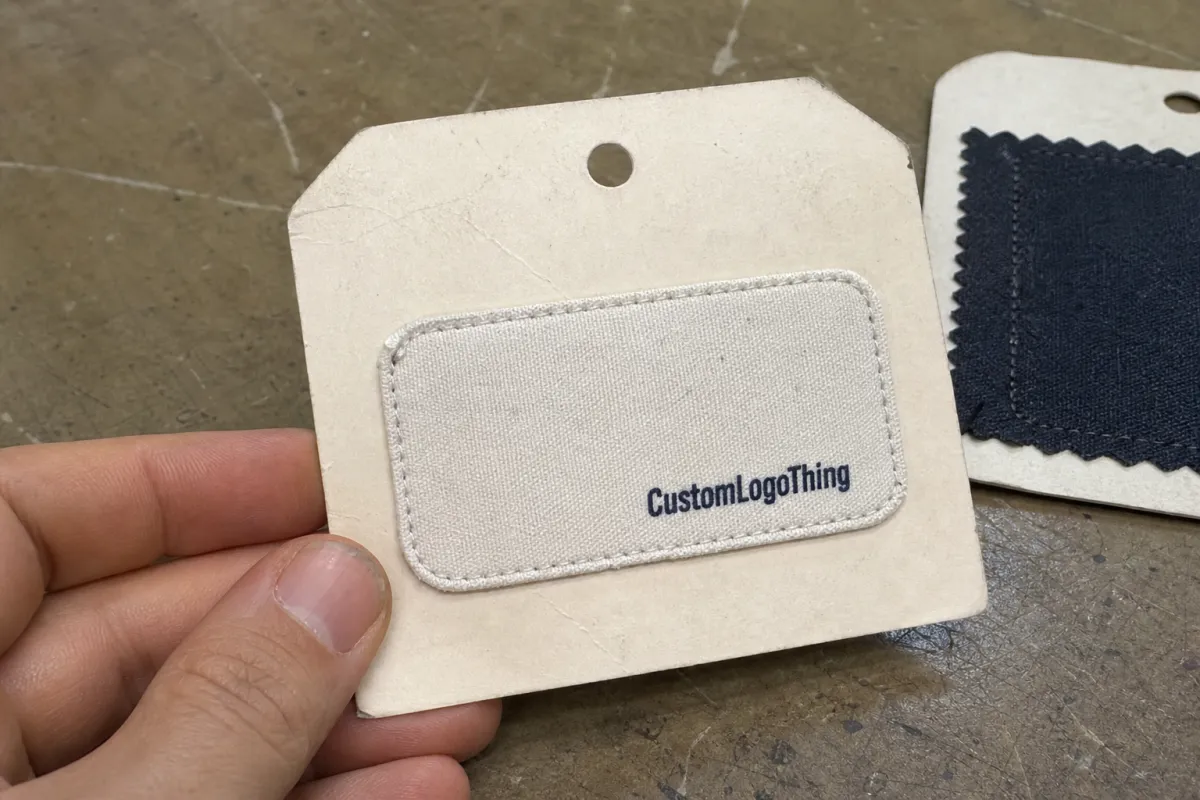
Imagine a retailer building a branded patch program across five SKUs: a hoodie, denim jacket, cap, tote, and knit beanie. If each style needs a different label structure, the decoration plan gets messy quickly. One patch spec, by contrast, can sometimes carry across multiple garments with only a backing change or a size adjustment. That reduces artwork duplication, keeps styling consistent, and makes replenishment easier later.
Retailers also ask for a quote first because they need a usable cost model. The patch itself is only one line in the budget. Setup fees, sampling, packing, freight, and the attachment method can all change the final landed cost. A buyer can approve a sample later, but if the quote already captures the major variables, internal approvals move faster and with fewer surprises.
There is another reason to front-load the conversation: suitability. A patch that performs well on outerwear may fail on a lightweight tee. Heat-seal backing may be ideal for one fabric and unreliable on another. If the supplier understands the garment and end use early, the buyer is less likely to receive a price that looks attractive but creates production problems.
The strongest quote requests are concise and specific. They include quantity, patch type, size, placement, and garment category. That gives the supplier enough information to price material, labor, and finishing correctly the first time.
“The cheapest quote is not always the best buying decision. The quote that matches the garment, the wash requirement, and the replenishment plan is the one that protects margin.”
Patch types, materials, and attachment methods that affect resale value
Patch construction changes how a garment looks on the shelf, and often how it performs online. A clean embroidered patch can suggest heritage or athletic credibility. Matte PVC pushes the item toward a utility or streetwear feel. Leather and suede usually signal a more premium tier. Chenille is still strongly associated with varsity styling, though it now appears in streetwear as well.
Common constructions include woven, embroidered, PVC, leather, suede, chenille, and printed patches. Woven patches are often the best option when the artwork includes small text or fine edge detail because they can reproduce cleaner lines than dense embroidery. Embroidered patches remain popular because they offer texture, strong visual presence, and moderate cost. PVC is good for bold shapes and flat surfaces, but it is not right for every brand voice. Leather and suede can elevate the perceived retail price, though they usually require more testing around wear, cleaning, and color consistency.
Attachment method can matter as much as the patch material. A sew-on patch is still the safest default for many apparel categories. Iron-on and heat-seal backings can speed application, but adhesion depends heavily on fabric content, temperature, dwell time, and wash cycle. Adhesive backing is useful in limited workflows, but it is rarely the best permanent answer for retail apparel. Hook-and-loop is useful where removable branding is part of the product concept or where patches are meant to rotate between garments.
The patch choice should follow the garment category, not the other way around:
- Heavy outerwear: leather, PVC, embroidered, or heat-seal with reinforced stitching
- Streetwear: chenille, woven, PVC, or oversized embroidered patches
- Uniforms: woven or embroidered for repeatable appearance
- Kidswear: soft-edge constructions and secure backing selection
- Premium basics: understated woven, suede, or low-profile leather treatments
Artwork complexity is another practical constraint. Tiny lettering, thin borders, and gradient effects may not translate well into embroidery or chenille. Woven is usually better for detail. Embroidery works best when the logo is simplified and the edges can hold up at size. A supplier worth working with will flag those limits before production starts instead of pretending every logo is patch-ready.
Specification checklist for accurate logo patch ordering
A precise quote starts with precise specifications. If a buyer sends only a logo and the words “need price,” the supplier has to fill in the blanks. That slows the process and often leads to revisions when the quoted patch size, backing, or finish does not match the garment plan.
At minimum, a Logo Patches Supplier Quote for apparel retailers should reference:
- Dimensions: width, height, or diameter in millimeters or inches
- Shape: round, square, shield, custom die-cut, or irregular edge
- Quantity: opening order and likely replenishment volume
- Material: woven, embroidered, PVC, leather, suede, chenille, or printed
- Backing: sew-on, iron-on, heat-seal, adhesive, or hook-and-loop
- Placement: chest, sleeve, hem, collar, cap front, or bag panel
Artwork quality affects quote accuracy too. Suppliers usually prefer vector files such as AI, EPS, or PDF because they preserve line quality and let the production team measure borders, text, and spacing accurately. If brand colors must match across seasons, include PMS references rather than relying on screen color. Tiny text deserves special attention. A 3 mm line of lettering may be technically possible in one construction and a poor idea in another.
Retail buyers should also ask quality and compliance questions early. Depending on the garment category, that can include colorfastness, abrasion resistance, and wash performance. If the patch will sit close to skin or be used on children’s apparel, confirm whether the backing and edge treatment are appropriate. Shipping integrity matters too. For bulk distribution, many teams align packaging and transit expectations with test protocols such as those used by ISTA. That may sound excessive for a trim component, but crushed cartons and damaged goods can still derail a store rollout.
When multiple SKUs or colorways are involved, ask for both a digital proof and, when needed, a physical mockup. A flat proof confirms layout. A physical sample shows thickness, feel, edge finish, and how the patch sits on the garment. Those are not interchangeable checks.
Cost, pricing, MOQ, and unit cost drivers in patch quotes
Patch pricing is a stack of variables, not a single number. The more clearly a retailer understands those inputs, the easier it is to compare a Logo Patches Supplier Quote for apparel retailers without getting distracted by the headline price alone.
The main pricing drivers are patch type, stitch density, setup or mold fees, backing choice, and finishing complexity. A simple woven patch with a standard edge and sew-on backing usually costs less than a molded PVC patch with a custom shape, multiple colors, and specialty finishing. Size also matters. A 30 mm patch and a 70 mm patch are not priced the same because material usage and handling time rise with surface area.
MOQ is tied to production efficiency. A supplier may set minimums at 300, 500, or 1,000 pieces depending on the process. That is not an arbitrary figure. It reflects setup time, equipment use, waste allowance, and the need to keep unit cost workable. Simpler constructions often support lower quantities. Specialty finishes usually push the MOQ upward.
Here is a practical way to compare quotes:
| Quote Element | What It Means | Why It Matters |
|---|---|---|
| Unit price | Cost per finished patch | Useful only when specs are identical |
| Setup or tooling fee | One-time cost for artwork prep, mold, or program setup | Can distort low-quantity orders |
| Sampling charge | Cost for proof or pre-production sample | Important if multiple revisions are expected |
| Freight | Transport cost to the final destination | Can move the landed cost more than the patch itself |
| Packaging | Bulk pack, retail pack, or carton labeling | Affects labor and warehouse handling |
For reference, many retail buyers see broad pricing bands like these for standard programs: woven or embroidered patches may land around $0.18-$0.45 per unit at higher quantities, while PVC, leather, or specialty constructions can rise depending on size, detail, and finishing. At 5,000 pieces, the spread between a simple sew-on patch and a custom molded option can be large enough to affect margin. That is why tiered pricing matters more than a single number.
There are practical ways to lower cost without weakening the product. Simplify the shape. Reduce the number of colors. Choose a standard size that can be reused across styles. Consolidate quantity across multiple garments if the artwork is consistent. Compare quotes on the same terms. A cheaper unit price can disappear once freight, packing, and sampling are added back in.
Process, turnaround, and lead time from quote to shipment
The workflow is straightforward, but incomplete information slows every step. It usually runs like this: inquiry, artwork review, quote, proof approval, sample or pre-production check, production, inspection, and shipping. When a retailer sends clean files and complete specs, the process tends to stay predictable. When the request is vague, the quote stage turns into a revision loop.
Typical turnaround depends on material availability, approval speed, production queue, and destination. Simple patch programs may move from proof approval to shipment in roughly 10-15 business days. Custom shapes, specialty finishes, or added testing can extend that timeline. If the order is shipping to multiple stores or fulfillment centers, transit planning can add time even after production is finished.
Buyers should also allow extra time when the patch requires a new mold, a difficult color match, or a backing designed for a specific fabric. Heat-seal performance on nylon is not the same as on cotton. On some garments, wash durability matters more than application speed. For teams managing packaging or materials targets, the U.S. EPA’s recycling and waste resources at epa.gov can be useful when reviewing trim waste, pack formats, or material reduction goals.
One practical way to speed up the process is to send everything in one message:
- Vector logo file
- Patch size and shape
- Quantity range
- Garment type and placement
- Backing preference
- Required ship date
That reduces back-and-forth and helps the supplier quote the actual job, not a placeholder version of it. If the patch program is tied to a seasonal buy window, ask for both production lead time and total turnaround including freight. Those are not always the same number.
How a retail-focused supplier reduces buying risk and rework
A retail-focused supplier does more than manufacture patches. It manages consistency. That distinction matters when a patch runs one shade darker on the second batch or when the border size shifts between replenishment runs. In retail, those issues become return claims, rework, or delayed resets.
Good suppliers reduce risk through clear communication, repeatable production, and honest limits. They should be able to explain why one backing is better than another, why a design needs simplification, and which materials are most likely to hold up in the intended use case. They should also flag likely failures before production begins: loose thread edges, weak adhesion, inconsistent sizing, or too much thickness for a lightweight garment.
For larger rollouts, production oversight matters. Photos from production checkpoints, proof signoff, and carton-level inspection help the buyer confirm that the patch is being made to the agreed spec. That is especially useful when the same patch is landing on apparel headed to several stores or channels. Reorder continuity is another hidden advantage. A supplier that stores approved artwork, dimension references, and color notes can often quote the next run faster and with fewer revisions.
There is a real difference between a generic factory and a supplier that understands retail timing. A lower number on paper is not much help if the buyer spends days correcting file issues, cleaning up proofs, or chasing inconsistent output. A retail-minded partner is more likely to quote accurately, ask the right questions, and keep revision cycles short. That is not marketing language. It is workflow discipline.
Buyers who care about packaging consistency often care about environmental standards too. If FSC-certified paper inserts or cartons are part of the broader presentation, the trim supplier should be able to fit into that system rather than work against it. The FSC site is a useful reference point for teams managing certified material claims across packaging and presentation assets.
In short, the best supplier reduces rework by making the quote cleaner, the proof clearer, and the production run more repeatable.
Next steps for getting a quote that matches your apparel line
If you are preparing a logo patches supplier quote for apparel retailers, do not begin with “How much is a patch?” Start with “What patch fits this garment and this margin?” That is the better buying question, and it usually gets a more useful answer.
Before requesting pricing, prepare these items:
- Logo file in vector format
- Target patch size
- Estimated quantity range
- Garment type and placement
- Backing preference
- Ship date or season deadline
- Wash or compliance requirements
Ask for at least two material or backing options in the same quote. That makes comparison easier. For example, woven versus embroidered, or sew-on versus heat-seal, can be reviewed using the same dimensions and quantity. That is far more useful than two unrelated quotes that cannot be lined up cleanly.
Also confirm placement and wash expectations before approving the sample. A patch that looks fine on a board may behave differently on a curved cap panel or brushed fleece. Small issues become expensive when they are discovered after sampling.
The process should stay simple: send artwork, request tiered pricing, review proof, approve sample, and lock production. If the supplier keeps forcing you to restate the same details, the quote process is not helping the buy. It is slowing it down.
For apparel retailers, a precise logo patches supplier quote for apparel retailers should save time, reduce revisions, and make the next order easier to place. If it does not, the quote is unfinished.
What should I include in a logo patch supplier quote request for apparel retailers?
Include artwork, size, quantity, patch material, backing type, garment placement, and target delivery date. Add color references and specify whether you need a sample, proof, or production-only quote. The more complete the request, the more accurate the unit cost and lead time.
What is the minimum order quantity for custom logo patches on retail apparel?
MOQ varies by patch type, size, and production method. Simpler woven or embroidered patches may support lower quantities than molded or specialty finishes. Ask for tiered pricing so you can compare entry volume against replenishment pricing.
Which patch material works best for retail clothing lines?
Woven and embroidered patches are common for apparel because they balance detail, durability, and cost. PVC or leather can create a more premium look, while chenille suits varsity or streetwear styles. The best choice depends on garment category, price point, and washing requirements.
How long does production usually take after quote approval?
Production time depends on artwork approval, sample needs, order size, and material availability. Custom shapes or specialty finishes can add time before shipment. Ask the supplier for both production lead time and total turnaround including freight.
How can apparel retailers lower the unit cost of logo patches?
Increase quantity, simplify the design, reduce the number of colors, and choose standard dimensions. Compare quotes that separate setup charges, sampling, and freight so the landed cost is clear. Locking specs early prevents expensive revisions.


