For candle brands, Logo Patches Unit Cost for candle brands is never just a line item. It is a packaging decision that affects shelf presence, giftability, assembly time, and how premium a candle feels before the lid even comes off. The patch may be small, but it can change the whole read of a box.
That is why buyers keep returning to patches for cartons, sleeves, dust bags, and gift sets. A well-made patch adds texture and identity without forcing a full carton redesign every season. In practical terms, it gives brands a repeatable branding element that can stay stable while fragrances, collections, and retail programs change around it.
Candle packaging also lives in a slightly unusual space. It is judged visually, but it is handled like a utility product: stacked in warehouses, picked up on shelves, opened at home, and sometimes stored for reuse. A patch has to survive all of that while still looking intentional. Thin print can disappear into the background. A badge, woven label, or leather-style patch leaves a clearer impression.
Why candle brands are rethinking patch labeling on boxes, sleeves, and gift sets
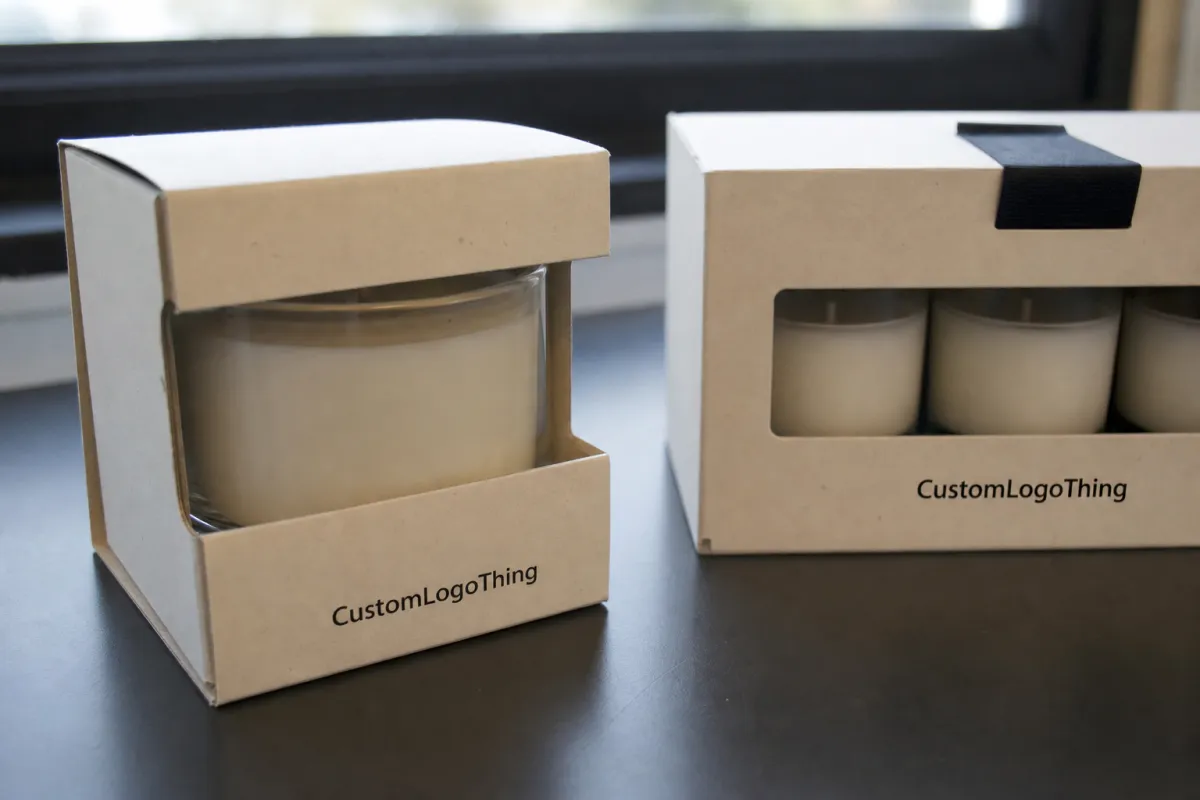
Candle buyers rarely inspect a package with production logic in mind. They react to contrast, texture, balance, and the way a box holds up after shipping. That is where patches have an advantage. They introduce tactile detail on rigid cartons, kraft sleeves, fabric bags, and presentation boxes without requiring full-panel print coverage.
There is also a budget reason that tends to matter more once a brand begins launching frequent collections. A base carton can stay unchanged while the patch shifts for seasonal editions, scent families, or limited runs. That reduces reprint waste and helps prevent dead inventory when the outer box no longer matches the current assortment. For smaller labels, that flexibility can be more valuable than a lower print quote on the box itself.
For gift sets especially, the value is visible. A simple carton with one clean patch often reads as more considered than a busy layout with too many colors and weak contrast. The customer sees restraint first, then detail. That sequence matters in candle retail, where presentation can justify a higher ticket price.
“A candle box does not need expensive ink coverage everywhere. Often, one well-made patch does more for shelf appeal than a full-panel print with weak contrast.”
That is the reason the pricing conversation starts with Logo Patches Unit Cost for candle brands but quickly turns to perceived value per unit. A patch that costs a little more may still be the better buy if it raises the shelf impact of a gift box or helps a private-label line look consistent across multiple SKUs.
It also helps in the back end. Brands that work with fulfillment teams know that packaging gets touched more than expected. Cartons are opened, restacked, taped, displayed, and moved again. Patches with clean borders and reliable attachment hold their appearance better than thin labels that curl, scuff, or lift at the corners.
- Subscription candles: a stable outer pack with changing seasonal branding.
- Wedding favors: a custom look without committing to a fully bespoke carton print run.
- Boutique retail: stronger shelf presence in small-batch assortments.
- Gift sets: a tactile feature that lifts the unboxing moment.
Logo patch formats that work on candle packaging
Not every patch style belongs on every candle format. The best choice depends on the packaging substrate, the detail level in the logo, and the brand position the product needs to communicate. Woven patches are usually the sharpest choice for small text and crisp logos. Embroidered patches add depth and a more crafted feel. PVC patches are durable and modern. Leather and leatherette styles lean premium or rustic. Printed fabric patches can be a practical option when color detail matters more than texture.
For minimalist candle brands, a woven patch or a simple debossed-look leather patch usually works better than a heavily stitched badge. Too much thread density can make the mark feel busy, especially on small cartons. By contrast, a matte box with a restrained patch can look more expensive than a busy layout with more material spend but less visual control.
The brand story should guide the material. Botanical and apothecary lines generally suit softer color palettes and natural textures. Luxury fragrance ranges can carry polished edges, low-gloss finishes, and precise alignment. If the candle is positioned as artisan, the patch should not look overproduced. If it is positioned as premium, the finish cannot feel improvised.
Attachment choices and where they fit
Attachment method affects both cost and performance. Sew-on patches are best for fabric bags and reusable wraps. Adhesive backing is common for flat carton panels, but the adhesive needs testing against the actual board stock and coating. Heat-seal backing can work on compatible materials when speed matters. Hook-and-loop closures are a niche choice for refillable or reusable packaging, not a default option.
Placement matters just as much. Patches should stay away from wax-contact surfaces and from zones that flex too much during packing. Outer cartons, sleeves, insert cards, dust bags, and textile wraps are the safest locations. On rigid boxes, the front panel or a closure band usually gives the cleanest result. If the patch is too large for the panel, the whole pack starts to feel crowded.
| Patch format | Best candle packaging use | Typical look | Cost tendency |
|---|---|---|---|
| Woven | Cartons, sleeves, insert cards | Clean, detailed, refined | Moderate |
| Embroidered | Gift bags, fabric wraps, premium sets | Textured, dimensional | Moderate to higher |
| PVC | Modern outer packs, durable promo sets | Bold, durable, glossy or matte | Moderate |
| Leather / leatherette | Luxury boxes, rustic collections | Warm, premium, tactile | Higher |
| Printed fabric | Short-run branding, colorful logos | Flat, flexible, efficient | Lower to moderate |
The right patch is usually the one that matches both the packaging material and the candle’s price tier. A handcrafted look on a mass-market line can feel inconsistent. A sterile finish on a boutique artisan candle can feel wrong for the same reason. Buyers tend to notice that mismatch before they notice the technical spec.
Specifications that affect patch quality and consistency
Patch cost and patch quality move together, but not always in obvious ways. Size is the first variable. A 30 mm badge and a 70 mm badge are different products in production terms because thread count, backing area, cutting time, and inspection load all change. The more complex the logo, the more the minimum text height starts to matter. Small lettering can fill in, thin lines can disappear, and fine outlines can blur if the spec is pushed too far.
Edge finish is another detail that gets underpriced by first-time buyers. Merrowed borders frame a patch neatly. Laser-cut edges can suit more modern designs. For some candle brands, a cleaner edge does more for the premium read than extra stitching ever could. That is especially true when the logo is simple and the packaging itself already carries visual weight.
Color matching deserves proper discipline. Candle lines often span several fragrances, and the same logo may need to appear on different box sizes, sleeve materials, and seasonal packs. If the brand expects identical appearance across all of them, Pantone references or approved color targets should be fixed early. Otherwise, one batch can drift a little warmer or cooler than the next. That kind of variation is easy to miss in production and obvious on a shelf.
Durability details that matter in real distribution
Scuff resistance, colorfastness, and backing strength all matter once packaging leaves the studio. Candle boxes are not usually abused the way shipping cases are, but they are still handled repeatedly. Humid storage can weaken some adhesives. Paper stocks with heavy coating can behave differently from uncoated kraft. A patch that passes a quick visual check can still fail after compression, rubbing, or time on shelf.
Curved jars need special caution. A patch designed for a flat carton should not be forced to wrap around a round vessel. On a jar, a printed label or wrap sleeve usually makes more sense. On a rigid carton, the patch can stay flat and readable, which preserves the intended shape and avoids edge lift. That distinction sounds obvious, but it is a common source of avoidable rework.
Quality control should include a real-world check, not just a proof approval. Confirm edge cleanliness, centering, adhesive coverage, thread tension if applicable, and how the patch sits after transit-style pressure. Standards such as ISTA are useful for understanding distribution stress, while broader packaging guidance from the Packaging Machinery Manufacturers Institute can help teams think about material behavior beyond the mockup stage.
Logo patches unit cost for candle brands: pricing, MOQ, and quote drivers
Here is the direct answer: Logo Patches Unit Cost for candle brands is driven most by material choice, size, color count, attachment method, and quantity. Setup charges can move the quote as well, especially if the patch uses a custom shape, detailed artwork, or special finishing. If tooling, digitizing, or a cutting template is required, that cost is usually spread across the order.
Small runs cost more per piece because the fixed work does not shrink in proportion to the order. A 500-piece order may still require proofing, artwork prep, and production setup similar to a 5,000-piece run. Divide the same overhead by fewer units and the unit price rises quickly. As volume increases, the price usually steps down rather than falling in a straight line.
MOQ matters because it changes the production rhythm. A custom woven patch at 1,000 units will usually price more efficiently than a 300-piece run. If the candle brand has multiple scent variants, combining them into one artwork family or one size can improve the quote. One master logo in one dimension is almost always cheaper than three slightly different versions with separate setups.
Typical quote components include:
- Sample or proof cost: sometimes waived, sometimes charged depending on complexity.
- Setup charges: artwork prep, digitizing, or file conversion.
- Tooling fees: more common with molded or specialty finishes.
- Unit cost: the price per patch at the chosen MOQ.
- Shipping: air, sea, or express depending on schedule.
- Rush fees: if the timeline is compressed.
Realistic price ranges depend on the spec, but the pattern is consistent. Simpler woven or printed patches can stay in a workable range at mid-volume. Premium materials, custom shapes, dense embroidery, and specialty finishes push the number upward quickly. A quote without size, backing, artwork complexity, and quantity is not very useful. It is better to ask for two options: one at the target MOQ and one at a higher tier that shows the bulk pricing curve.
| Order profile | Likely unit cost trend | Cost driver | Best use case |
|---|---|---|---|
| Low MOQ, custom shape | Higher | Setup charges spread over fewer units | Test launches, small boutique runs |
| Mid-volume, standard size | Moderate | Balanced efficiency and customization | Core candle collections |
| Higher volume, limited colors | Lower | Better bulk pricing and lower prep burden per piece | Seasonal programs, private label |
| Multiple SKUs combined | Often lower overall | Shared setup across variants | Launch bundles and scent families |
The practical question is not which patch is cheapest. It is which spec gives the best presentation at the lowest acceptable unit cost. A flat printed patch might win on price. A woven or leather-style patch may cost more per unit but support a higher retail margin because the box feels finished and intentional.
Production steps and lead time from artwork to delivery
The production sequence is straightforward, and delays usually happen in the same few places. Artwork review comes first. Then the specification is confirmed. Then a digital proof is prepared. If the patch is detailed or color-sensitive, a physical sample may follow. After approval, the order moves into production, inspection, and shipment.
Lead time depends on the patch type and how quickly approvals move. Standard custom patches often take about 12 to 15 business days after proof approval. More complex builds take longer. If sampling is required, add time for transit and any revision cycle. Peak seasons, especially before holiday retail launches, can extend schedules further because many suppliers are handling overlapping gift and promotion orders.
The quickest way to avoid delay is to send complete information at the start. Vector artwork, final size, Pantone references, backing preference, and placement dimensions should all be available before quoting whenever possible. Missing one piece turns into a question. A question turns into another day. That is where most packaging timelines slip.
It also helps to sync patch production with box printing. If the cartons are finished but the patches are late, the launch stalls. If the patches arrive first but the boxes are delayed, inventory sits in storage twice. Coordinating both streams keeps assembly clean and avoids partial material handling.
For brands that use recycled or certified paper in the rest of the pack, material sourcing should be checked carefully. If the outer packaging is part of a certified program, look at FSC where relevant. That does not automatically make a patch sustainable, but it does keep the packaging story honest and internally consistent.
Testing is the part many teams skip too early. A patch can look fine on screen and still misbehave after adhesive exposure, compression, or long storage. A small pilot run costs less than correcting a holiday launch that goes out with lifting edges or color drift.
How to choose a supplier that fits candle packaging requirements
The best supplier is not the one with the flashiest language. It is the one that can repeat a specification accurately. Candle brands need consistent sizing, clean edges, stable color, and backing performance that holds up on the actual pack. If a supplier cannot explain how those factors are controlled, the quote may look attractive for the wrong reasons.
Ask how proofing works. Ask how color is matched. Ask what the QC check covers before shipment. If samples are available, use them. If the supplier suggests a spec adjustment that lowers cost without damaging the look, that usually signals practical experience rather than a push toward the most expensive version.
Packaging-focused vendors often perform better than generic patch sellers because they understand board stock, finishing, and retail presentation. A patch on a candle box is not the same as a patch on apparel. The substrate is different, the handling is different, and the buyer is judging the item as part of a broader gift or home-fragrance presentation.
What repeat ordering should look like
Repeatability matters if you plan collections, reorders, or private-label programs. The patch should come back the same way six months later. That means saved artwork, clear spec sheets, acceptable tolerance ranges, and a supplier that knows how to reproduce the earlier run without visual drift. If a vendor cannot do that, managing a consistent candle line becomes harder than it should be.
For evidence of execution, review supplier examples and packaging-category experience through Case Studies. The useful proof is not marketing language. It is whether the vendor can maintain consistent output across different packaging formats and order sizes.
Communication speed matters too. Suppliers that answer file questions quickly usually handle approvals and production more cleanly. Slow replies often point to slow follow-through later. In packaging, that delay can be more expensive than a slightly higher unit price.
Next steps: request a quote, confirm specs, and place a test order
Start with a clean checklist: logo file, patch size, material preference, backing type, quantity range, and the packaging surface where the patch will sit. If that information can be sent in one message, the quote is usually tighter and the revision count drops. Vague briefs tend to inflate both risk and price.
Ask for two pricing scenarios. One should match your target MOQ. The other should show a higher-volume tier so the bulk pricing curve is visible. That comparison makes it easier to decide whether to combine scent variants, standardize patch sizes, or keep separate packaging programs.
A test order is the safest way to reduce risk. Run one candle collection first and inspect the result under real handling, not studio lighting. Check color consistency, adhesion, edge finish, and how the patch sits after transit. If it holds up, standardize it. If it does not, adjust the spec before scaling.
For candle brands, the smartest approach to Logo Patches Unit Cost for candle brands is simple: specify clearly, compare like for like, and judge the patch by both price and presentation. The lowest quote is not automatically the best value. The better decision is the one that protects margin, supports the brand, and arrives on time.
FAQ
What affects logo patch unit cost for candle brands the most?
Material type, size, color count, backing method, and total quantity are the biggest cost drivers. Special finishes, custom shapes, and low MOQ requests usually raise the per-piece price.
What MOQ should candle brands expect for custom logo patches?
MOQ depends on patch type and complexity, but custom orders usually price better once quantities increase. Brands launching seasonal collections should ask whether multiple SKUs can be combined to reach a better pricing tier.
Which patch material is best for candle packaging?
Woven and embroidered patches work well for texture and premium feel, while PVC offers strong durability and a modern look. The best choice depends on the box style, scent positioning, and whether the patch will sit on paper, fabric, or rigid packaging.
How long does production usually take for custom logo patches?
Lead time depends on proof approval, sample needs, and order size. Providing final artwork and Pantone targets early can shorten the overall turnaround.
Can I lower the unit cost without losing quality?
Yes, by simplifying colors, standardizing sizes, increasing quantity, or choosing a more production-friendly backing. A supplier should be able to suggest spec changes that reduce cost while preserving the premium look candle buyers expect.


