Buyer Fit Snapshot
| Best fit | logo poly mailers for retail what for packaging buyers comparing material specs, print proof, MOQ, unit cost, freight, and repeat-order risk where brand print, material, artwork control, and repeat-order consistency matter. |
|---|---|
| Quote inputs | Share finished size, material target, print colors, finish, packing count, annual reorder estimate, and delivery region. |
| Proofing check | Approve dieline scale, logo placement, barcode or warning zones, color tolerance, and any recyclable or compostable wording before bulk production. |
| Main risk | Vague material claims, crowded artwork, or missing packing details can create delays even when the unit price looks attractive. |
Fast answer: Logo Poly Mailers for Retail What: Film, Closure, Print, and Fulfillment should be specified like a repeatable production item. The safest quote includes material, print method, finish, artwork proof, carton packing, and reorder notes in one written spec.
What to confirm before approving the packaging proof
Check the product dimensions against the actual filled item, not only the sales mockup. Ask for tolerance on folds, seals, hang holes, label areas, and retail display edges. If the package carries a logo, QR code, warning copy, or legal claim, reserve that space before decorative graphics fill the panel.
How to compare quotes without losing quality
Compare board or film grade, print process, finish, sampling route, tooling charges, carton quantity, and freight assumptions side by side. A lower quote is only useful if the supplier can repeat the same color, closure quality, and packing count on the next order.
Logo Poly Mailers for Retail: What Actually Works Best
Logo Poly Mailers for retail do more than carry a shirt from warehouse to doorstep. They shape the first physical impression a customer gets from the brand, and that matters more than most buyers admit. I have watched a good printed mailer make a mid-tier product feel deliberate, while a flimsy one made a premium item look like it had been packed in a hurry. The package is the storefront for the shipping lane. That is not poetic fluff; it is how customers read it.
For apparel, accessories, soft goods, and other non-fragile products, Logo Poly Mailers for retail are one of the cleanest ways to add brand presence without slowing fulfillment. The hard part is not printing a logo on plastic. The hard part is choosing the right size, film thickness, print coverage, and order quantity so the packaging earns its place instead of just occupying shelf space. Brands often compare them with branded shipping bags, Custom Poly Mailers, and other printed mailers before they settle on a format.
Retailers miss that balance all the time. They choose the cheapest printed bag they can find, then the seams split, the artwork prints muddy, or the parcel shows up looking tired before the customer has even opened it. A package can be attractive and still fail. It can also be practical and still damage the brand. The useful version sits between those two extremes.
Used well, logo poly mailers for retail can lift perceived value, keep packing lines moving, and make a small business look more established than its size suggests. Used badly, they become expensive noise. The difference usually comes down to choices that look minor on paper and obvious in real life. That is why the spec sheet matters, but the sample matters more.
What Should Retailers Look for in Logo Poly Mailers for Retail?
Before buying logo poly mailers for retail, retailers should check three things first: fit, print clarity, and closure strength. If the bag is too large, too thin, or too hard to seal, the branding never gets a fair chance. The package has to work as packaging before it can work as marketing. That sounds basic, but teams still skip straight to the artwork.
The best starting point is product type. A soft knit top, a pair of socks, or a small beauty accessory can ship well in logo poly mailers for retail. A fragile item, a heavy item, or something with sharp corners may need a different format entirely. The right answer is not always the most decorated one. Sometimes the strongest choice is the simplest one with a clean logo and a sturdy seal.
Retail buyers should also think about their operating rhythm. Fast-moving stores need packaging that packs quickly and stacks neatly. Seasonal shops need inventory that can be reordered without drama. If logo poly mailers for retail slow down labor, raise damage rates, or create storage problems, the branding benefit will not cover the cost for long.
Practical rule: if the product looks premium and the mailer looks cheap, the package becomes the weak link in the experience.
For brands trying to keep sourcing decisions tidy, it helps to treat packaging as part of the product line rather than an afterthought. I have seen teams save more money by choosing one mailer that fits the product family than by chasing a slightly lower unit price on three mismatched versions. Many teams compare logo poly mailers for retail with Custom Packaging Products and other branded shipping supplies before they commit to a full run.
What Logo Poly Mailers for Retail Actually Change
Logo poly mailers for retail change the customer’s first tactile encounter with the order. Before the item is even visible, the package already signals something about the brand. A solid printed mailer can make a modest purchase feel intentional, while a generic bag makes the same order feel purely transactional. Customers notice that shift faster than sellers expect.
In practical terms, logo poly mailers for retail are lightweight plastic shipping bags printed with a logo, pattern, or short brand message. They are common for apparel, socks, scarves, cosmetics kits, and other non-fragile products that do not need a box. Their value is not limited to appearance. They keep outbound packaging consistent across stores, warehouses, and pop-up fulfillment, which sounds unglamorous and often saves money exactly because it is unglamorous.
Branded mailers also alter the reading of the order. A plain gray bag says a shipment left the building. A branded mailer says the package belongs to a retail system with standards. That distinction is subtle, but retail is built on subtle distinctions. Customers feel them even when they do not describe them aloud.
Logo poly mailers for retail fit especially well in direct-to-consumer shipping, marketplace orders, and ship-from-store programs. A return strip can make them even more useful by reducing the friction of exchanges. That does not make returns pleasant. It just keeps them from becoming more irritating than necessary, which is a more realistic goal.
The tradeoff is straightforward: logo poly mailers for retail only raise perceived value when the presentation matches the product. A thin bag with a great print is still a thin bag. A thick bag with poor sizing can look worse than no branding at all. Buyers who ignore that detail often pay twice, first for the mailers and later for customer complaints or re-orders.
For teams comparing options across retail packaging, custom poly mailers, and branded shipping bags, the useful question is not “Which looks nicest?” It is “Which one supports the product, the labor flow, and the margin at the same time?” That is a harder question. It is also the right one.
How Logo Poly Mailers for Retail Work in the Real World
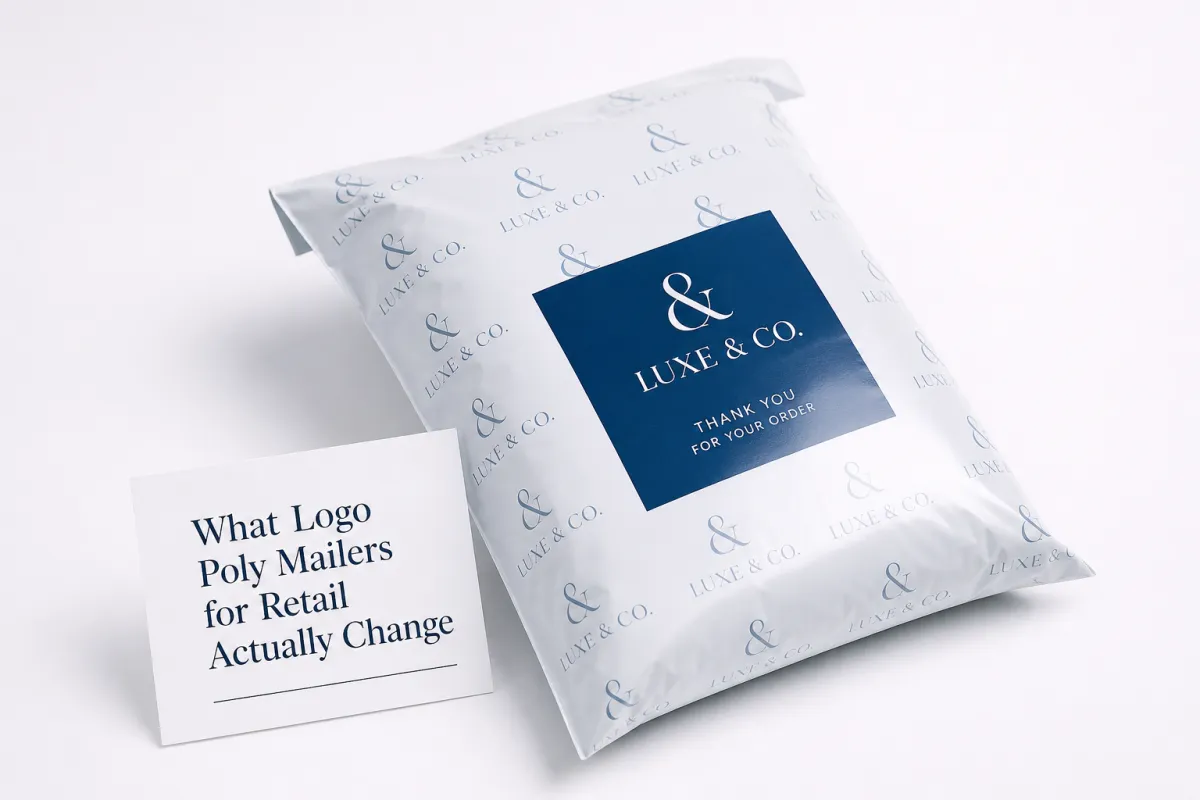
The structure of logo poly mailers for retail is simple, and that simplicity is part of the appeal. A basic mailer uses a poly film body, sealed edges, a peel-and-stick adhesive closure, and a printed surface. Some versions add a return strip, a tamper-evident seal, or a tear notch. Nothing fancy. Just enough engineering to survive ordinary carrier handling without pretending it is invincible.
Print method matters more than many buyers expect. Flexographic printing and rotogravure printing are the two processes that come up most often for larger production runs. Flexo tends to work well for repeat production with a small number of solid colors. Gravure is built for very high volumes and strong image consistency, especially when the design uses full coverage or fine detail. Digital printing can make sense for small runs or frequent artwork changes, though unit cost usually climbs quickly. Short runs are a different calculation, and the setup cost can erase the savings if the order is too small.
The packing flow is simple. Product goes in, inserts or tissue go in if the brand uses them, the adhesive strip is closed, a label is applied, and the parcel enters the carrier stream. That sounds ordinary because it is ordinary. That is the point. Logo poly mailers for retail are popular because they do not slow the line down. A good mailer should make packing easier, not force the team to babysit each order as if it were fragile museum glass.
What customers notice first is rarely the entire design. It is usually color, logo placement, and whether the bag arrives clean. Scuffed film, weak contrast, or a crooked seal can undo the impression fast. A good mailer rarely earns praise. It simply makes the brand feel sharper. Quiet improvement is often worth more than flashy packaging that nobody remembers after disposal.
There are a few functional details worth checking before ordering logo Poly Mailers for Retail:
- Strong adhesive: a seal that fails in transit turns a branded bag into a liability.
- Opaque film: protects privacy and keeps product colors from showing through.
- Tear notch: gives the customer a cleaner opening experience.
- Dual-seal return strip: useful for retail programs with frequent exchanges.
- Surface finish: matte can look calmer and more premium; gloss can look brighter but may show scuffs faster.
If the packaging will face rough handling, think in terms of transit testing rather than hope. The ISTA test framework exists for a reason: carriers are not gentle, and packaging should survive actual shipping abuse instead of an idealized version of it. Brands with sustainability goals can also learn from the EPA recycling basics page. End-of-life choices matter, and local recycling rules vary, so it is worth checking what your market actually accepts instead of assuming every plastic mailer belongs in curbside bins.
Brands comparing logo poly mailers for retail against other formats usually get the clearest answer by lining up three options: a plain mailer, a printed mailer, and a more rigid branded shipper. The right choice depends on product weight, perceived value, and how much protection the item actually needs. Fancy is not the same thing as fit.
Key Factors That Decide Quality and Performance
Thickness is the first spec most buyers should inspect because it affects how logo poly mailers for retail hold up during handling. Thinner films cost less and weigh less, but they puncture more easily and are more likely to split at the seam if the product has sharp edges or the parcel gets crushed. Thicker mailers cost more, yet they usually earn that cost back by reducing damage and re-ships. A tiny increase in film gauge can matter a lot across thousands of orders.
Size matters just as much. Oversized logo poly mailers for retail can look sloppy because the product shifts inside, the artwork sits awkwardly, and the finished parcel feels underfilled. Too small, and the seams strain or the print stretches where the bag folds. A proper fit looks deliberate. A poor fit looks guessed. Customers usually notice the difference without needing it explained.
Color and contrast decide whether the branding reads from a normal viewing distance. Dark ink on dark film wastes setup money. Tiny text on a busy background works against the package. For logo poly mailers for retail, bold marks often outperform delicate linework, especially when the bag is moving or stacked with other parcels. The design should be readable fast. If it needs a patient inspection, it is already losing the moment.
Print coverage changes the result as well. A single logo on one side keeps costs down and suits minimalist brands. A repeat pattern or full-wrap design creates a stronger retail impression and can make the package feel more custom, but it adds complexity and usually raises unit cost. That is the real tradeoff: simple is cheaper, full coverage is louder, and neither choice is automatically better.
Then come the performance details that sound boring until they prevent waste:
- Opacity: keeps contents private and prevents product outlines from showing through.
- Moisture resistance: helps in wet weather and humid transit environments.
- Closure strength: matters if parcels are packed quickly or handled by multiple carriers.
- Print durability: good ink adhesion keeps the logo from rubbing off during sorting.
- Secondary protection: useful for items that need an inner bag or tissue wrap.
From a branding perspective, logo poly mailers for retail should look like they belong to the product line. The packaging should not fight the item inside. A bold streetwear brand can handle a high-contrast printed mailer. A softer lifestyle label may need a calmer layout with more negative space. Same material. Very different visual job.
The best packagers ask one simple question: what does this bag need to do besides exist? If the answer is “protect the order, fit the product, and look like the brand,” the spec is probably close. If the answer is “make the cheapest possible print work,” compromise is coming. Cheap bags usually advertise that fact sooner or later.
Logo Poly Mailers for Retail: Cost, Pricing, and MOQ
Pricing for logo poly mailers for retail depends on quantity, film thickness, bag size, number of print colors, coverage area, and setup charges. That is the honest version. Anyone offering a flat answer without asking those questions is guessing or simplifying the quote for convenience. Packaging pricing rarely works that way for long.
For smaller runs, setup fees can matter almost as much as the bags themselves. For larger orders, unit cost drops, but more cash gets tied up in inventory and storage. That is why minimum order quantity matters. Low-MOQ runs are useful for testing artwork, fit, and customer response. Higher-MOQ runs can bring the cost down sharply once the design is settled and the volume is predictable. Neither option is perfect. Both can make sense.
Logo poly mailers for retail are also one of those purchases where landed cost matters more than sticker price. Freight, proofing, plate charges, and rush fees can make a quote look cheap on paper and annoying in real life. A bag that costs a few cents less but arrives late, prints poorly, or forces a reorder sooner is not actually cheaper. It is only cheaper at first glance.
Here is a practical comparison of common order approaches for logo poly mailers for retail:
| Option | Typical Use | What Drives Cost | Best For |
|---|---|---|---|
| Plain stock mailers | Fast shipping with no branding | Size, thickness, freight | Lowest upfront spend, internal test runs |
| One-color custom print | Simple logo presence | Setup, plate cost, quantity | Smaller brands testing branded packaging |
| Multi-color printed mailers | Stronger retail presentation | Number of colors, print coverage, order volume | Brands with consistent order flow |
| Full-coverage custom mailers | High-impact unboxing and branding | Ink coverage, print method, QC tolerance | Higher-volume retail programs |
That table avoids pretending there is one universal number. The market does not behave that way. For many buyers, simple printed logo poly mailers for retail may land somewhere in a broad range such as $0.18-$0.35 per unit at moderate volume, while more complex or lower-volume runs can cost more. Size, thickness, and freight can move that figure quickly. If someone gives you a price without asking for dimensions and quantities, they are not quoting. They are improvising.
A better way to think about the math is simple. If logo poly mailers for retail reduce the need for extra inserts, make packing faster, improve repeat purchase perception, or support a higher average order value, the packaging can pay back more than the line item suggests. That matters especially for retail brands, where the mailer is seen by the customer and by anyone else handling the parcel along the way.
Some buyers also compare logo poly mailers for retail with other packaging through Custom Poly Mailers before locking in specs. That is smart. It keeps the conversation centered on size, film, print style, and cost instead of chasing a unit price that may not survive the rest of the quote.
Logo Poly Mailers for Retail: Order Process and Timeline
The normal order flow for logo poly mailers for retail starts with specs. Size, thickness, print coverage, adhesive style, and order quantity should be defined before artwork review. If those basics are vague, the quote will be vague too. Then comes artwork submission, proof review, sample approval if needed, production, and freight. Simple enough on paper. Less simple once real humans begin approving revisions.
Timing depends on what you ask for. A straightforward one-color run with clean art may move quickly once the proof is approved. Custom colors, multiple revisions, or special film requirements add time. In practice, the biggest delay is often not the printing press. It is the back-and-forth before production begins. One misspelled line on a proof can cost days if nobody catches it early.
That is why proofing matters so much for logo poly mailers for retail. You want to catch logo placement, bleed, color matching, and spelling before anyone prints thousands of units. A bad print run is not only a design problem. It is inventory you now own, store, explain, and probably discount. Five minutes on a proof review is cheaper than a warehouse full of regret.
Freight affects the timeline in ways buyers like to ignore until the truck is late. Domestic shipping, overseas transit, customs checks, and warehouse receiving all change when the mailers can actually be used. Even if production is quick, the bags are not helping the business until they are physically on the shelf. That sounds obvious. Plenty of teams still plan a launch around a packaging ETA they never pressure-tested.
A solid timeline for logo poly mailers for retail usually needs buffer for these checkpoints:
- Artwork cleanup and sizing confirmation
- Digital proof review
- Sample or press approval if required
- Production scheduling
- Freight transit and receiving
- Warehouse count-in and QC
Building a reorder buffer matters just as much as the first buy. Retail demand is lumpy. One good promotion can burn through packaging faster than expected. If a team waits until the last carton is open, fulfillment speed becomes a gamble. That is not strategy. It is a fire drill with a shipping label.
Common Mistakes That Make Branded Mailers Look Cheap
One of the fastest ways to weaken logo poly mailers for retail is to cram too much onto the bag. Tiny logos, too many messages, too many colors, too many graphics. The result usually reads as busy instead of premium. Strong packaging is not a billboard. It needs room to breathe. Clean layouts also tend to survive production better, which is a welcome bonus.
Another common mistake is mismatched sizing. A product swimming in empty space feels lazy. A bag stretched tight at the seams feels like a failure waiting to happen. Logo poly mailers for retail should fit the item closely enough to look intentional while still allowing normal sealing and handling. If the spec forces the package to work harder than the product, the product loses.
Contrast problems show up constantly. Dark print on dark film, weak ink density, and low-resolution artwork make even a good concept look bargain-bin cheap. This is not the place for subtlety that only works on a screen. Flexible packaging is unforgiving. What looks neat in a mockup can turn muddy once it lands on plastic.
There is also a habit of designing for the mockup instead of the actual parcel. That is a mistake. The proof may look fine on a monitor, but logo poly mailers for retail get folded, stuffed, sealed, labeled, and tossed into a sorter. Real-world testing tells you more than the prettiest render ever will. If the mailer cannot survive one packing shift, the artwork is irrelevant.
Here is a quick reality check before approving a run of logo poly mailers for retail:
- Does the logo read from arm’s length?
- Does the product fit without stretching the seams?
- Does the bag still look clean after labeling?
- Does the film resist scuffs during packing?
- Does the closure hold when handled roughly?
Brands that skip these checks often end up with packaging that looks fine in photos and awkward in shipment. That gap costs money. It also weakens customer perception in a way that is hard to measure and easy to feel. The mailer becomes an apology instead of a brand asset.
One more point: logo poly mailers for retail should be tested with real inventory, not sample swatches. Fold the garment, insert it, seal the bag, apply the label, and inspect the finished parcel. A design that works on paper can still fail once the product has actual bulk. Packaging teams learn this lesson quickly. Better to learn it once, not during peak season.
Expert Tips and Next Steps Before You Place an Order
If you are serious about logo poly mailers for retail, start with samples. Hold the film. Seal it. Tear it open. Compare different thicknesses side by side. One sample may feel too flimsy, while another costs more than needed because the spec is heavier than the product demands. That small hands-on test usually answers questions a spec sheet cannot.
Next, build a simple quote sheet so every vendor is bidding on the same job. Include size, thickness, color count, print coverage, closure style, and target quantity. That keeps the conversation honest. It also saves time because nobody has to guess whether you wanted a 12x15 bag or something close enough to be annoying later. For teams looking at broader packaging programs, Custom Packaging Products can help frame the mailers as part of a wider brand system instead of a one-off purchase.
Then test the finished parcel against actual inventory. Packed product, real label placement, normal handling, and the exact seal the team will use on the line. This is the point where many logo poly mailers for retail either prove themselves or expose weak spots. A mailer that looks stylish but slows packing is not a win. A mailer that protects the product and keeps the brand clear is.
Branding level should match volume and customer expectation. Some retailers only need a subtle logo in one corner. Others can justify a bold repeat pattern because the package itself does part of the marketing work. There is no single right answer, but there is a wrong one: choosing a design because it looked good once on a sample image and ignoring how it behaves at scale.
A sensible rollout plan for logo poly mailers for retail looks like this:
- Request samples and compare film quality.
- Approve artwork only after checking placement and contrast.
- Start with a quantity that covers one sales cycle plus buffer.
- Set a reorder trigger before stock gets tight.
- Track damage rates, packing speed, and customer feedback after launch.
That last point matters more than many teams admit. Packaging should be reviewed like any other business tool. If it saves time, reduces breakage, and supports repeat sales, keep it. If it creates friction, adjust the spec. The first order is not the final verdict. It is the beginning of the comparison.
The best buying rule is simple. Choose logo poly mailers for retail for fit, presentation, and repeatability first. Price matters, obviously. Nobody is ignoring the invoice for entertainment. But the cheapest mailer that fails in transit or looks off-brand is not a bargain. It is a lesson, and usually not a cheap one.
If you want the short version: logo poly mailers for retail should make the order easier to pack, better to receive, and more consistent to reorder. If they do those three jobs well, the rest tends to follow. If they do not, the supposed savings disappear quickly. That is the whole equation.
Are logo poly mailers for retail worth it for small brands?
Yes, if the package is part of the customer experience and the volume justifies setup. Logo poly mailers for retail can make a small brand look more established without adding much packing labor. If budget is tight, start with a simple one-color design instead of chasing full coverage on the first run. The smartest small-brand move is usually the one that keeps the order moving and the art readable.
How much do logo poly mailers for retail usually cost?
Pricing depends on size, thickness, quantity, print colors, and setup fees. A quote that looks low at first can become less attractive after freight, proofing, and rush charges. For logo poly mailers for retail, compare landed cost per order, not only the bag price. That gives you the number that actually matters when the shipment lands at the dock.
What artwork works best on logo poly mailers for retail?
Bold logos, simple marks, and high-contrast colors usually print and read best. Tiny text and thin details are risky on flexible film. If the goal is a premium look, a clean layout with one strong brand element usually beats a crowded design for logo poly mailers for retail. The bag only has so much visual real estate; spend it carefully.
How long do logo poly mailers for retail take to produce?
Simple jobs can move quickly after artwork approval, while custom colors or special finishes take longer. Proofing, sample approval, and freight can add time even when production itself is fast. Build in a buffer if the order supports a seasonal launch or promotion. The calendar usually looks more optimistic before the proof comes back.
Do logo poly mailers for retail protect products well enough?
They work well for apparel, accessories, and other non-fragile items. Choose the Right thickness and seal strength if the parcel will face rough handling. For fragile or high-value goods, pair logo poly mailers for retail with inner protection or use a different mailer type entirely. Packaging should match risk, not just branding goals.
What should I compare before ordering logo poly mailers for retail?
Compare film gauge, closure type, print method, artwork complexity, and minimum order quantity. A low quote on logo poly mailers for retail can hide weak adhesive, thin material, or expensive freight. The cleaner comparison is the finished landed cost and the quality of the packed parcel, not the headline price alone.
Done right, logo poly mailers for retail are not just shipping bags. They are a practical branding tool that can improve presentation, reduce packing friction, and keep the economics under control. That only happens when the size, print, and material spec fit the product and the volume. If you want the mailer to earn its keep, treat logo poly mailers for retail like part of the product experience, not an afterthought with a logo on it.