Buyer Fit Snapshot
| Best fit | Luxury Retail Packaging Paper Bags projects where brand print, material claims, artwork control, MOQ, and repeat-order consistency need to be specified before quoting. |
|---|---|
| Quote inputs | Share finished size, material target, print colors, finish, packing count, annual reorder estimate, ship-to region, and any compliance wording. |
| Proofing check | Approve dieline scale, logo placement, barcode or warning zones, color tolerance, closure strength, and carton packing before bulk production. |
| Main risk | Vague material claims, crowded artwork, missing packing details, or unclear freight terms can make a low unit price expensive after revisions. |
Fast answer: Luxury Retail Packaging Paper Bags: Film, Print, MOQ, and Carton Packing should be specified like a repeatable production item. The safest quote records material, print method, finish, artwork proof, packing count, and reorder notes in one written spec.
Production checks before approval
Compare the actual filled-product size with the drawing, then confirm tolerance on folds, seals, hang holes, label areas, and retail display edges. Reserve space for logos, QR codes, warning copy, and material claims before decorative graphics fill the panel.
Quote comparison points
Review material grade, print process, finish, sampling route, tooling charges, carton quantity, and freight assumptions side by side. A quote is only useful when the supplier can repeat the same color, closure quality, and packing count on the next order.
Luxury Retail Packaging Paper Bags: Smart Buying Guide
Luxury retail packaging paper bags carry more than merchandise. They carry the first signal a shopper receives about price, restraint, and brand discipline, and that signal lands fast. A bag that feels flimsy can drain confidence from the purchase before the receipt is even folded. I have seen that happen in review meetings more than once, and the odd part is how quickly people sense it without being able to explain exactly why. They just know the package does not match the promise.
From a packaging buyer’s perspective, a strong bag is not just a container. It holds the store’s positioning, the product packaging story, and the visual language of the brand in one compact format that moves through the world. That is why luxury retail packaging paper bags belong in the same conversation as branded packaging, packaging design, and custom printed boxes. They are not decoration after the fact. They are part of the sale itself, and sometimes they are the part a customer carries around longest.
Anyone sourcing luxury retail packaging paper bags for a boutique, cosmetics line, jewelry label, apparel chain, or gift program needs to look past the sales pitch and into the build. Stock weight, handle choice, print coverage, finishing, and lead time all affect the quote. They also change the way the customer feels when the bag lands in their hand and when it carries the brand outside the store. In other words, the bag is doing branding work even after the register has closed.
What Luxury Retail Packaging Paper Bags Really Are
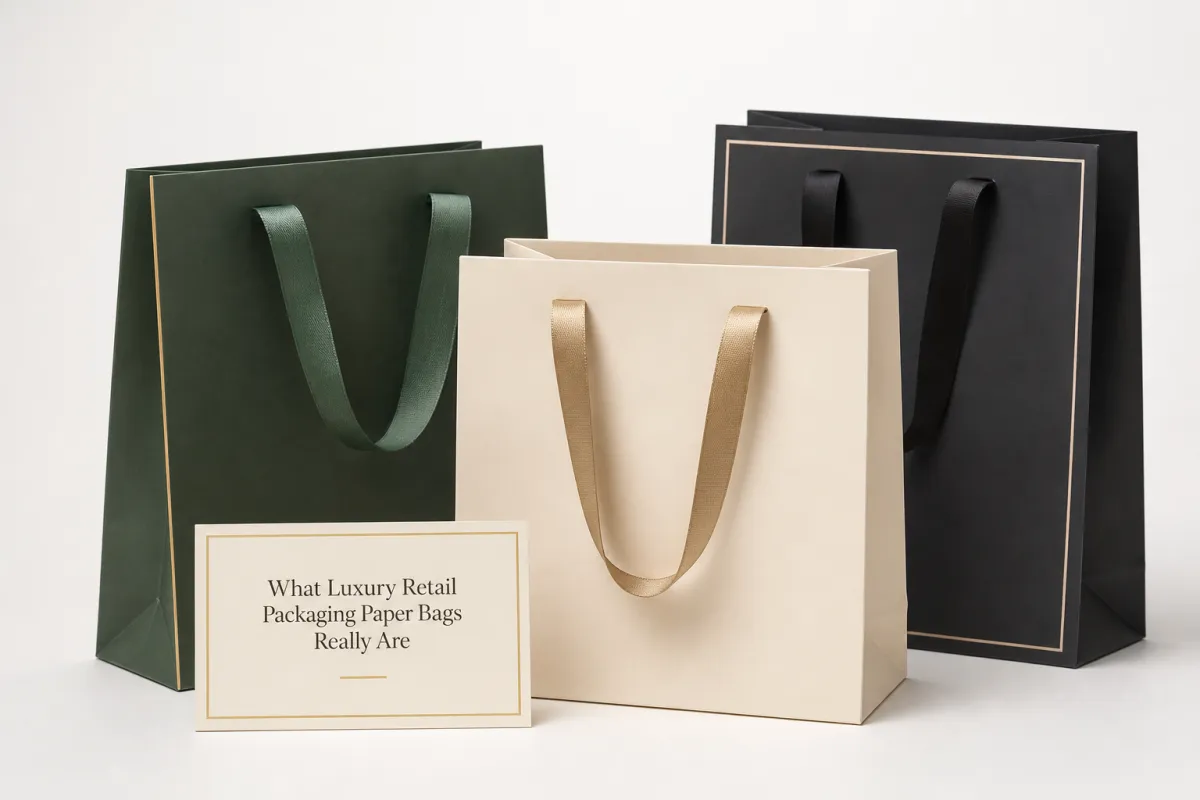
Luxury retail packaging paper bags are Branded Carrier Bags built to communicate quality through structure, print, finish, and feel. That definition sounds simple because the idea is simple, yet the execution is not. A basic shopping bag is made to be cheap, fast, and forgettable. A luxury bag is made to be seen, carried, reused, and remembered long after the product leaves the counter. That difference starts in the spec sheet, not in the logo file.
The first difference shows up in the stock. A standard retail bag might use light kraft paper or thin art paper with minimal reinforcement. Luxury retail packaging paper bags usually move into heavier art paper, thicker paperboard, or laminated stock that keeps the walls crisp and the silhouette upright. In practical terms, that means better shape retention, less sag at the base, and fewer awkward moments when the handles start leaning like they are negotiating their own exit.
Construction matters just as much. A premium bag usually has tighter folds, cleaner edges, stronger handle attachment points, and a bottom that holds up under real use. You can feel the difference right away. It does not collapse in the hand or flutter like a convenience-store carryout bag trying to pass for something more expensive. That extra structure is part of why luxury retail packaging paper bags fit so well in boutiques, cosmetics, jewelry, apparel, fragrance, premium gift sets, and seasonal launches.
Luxury retail packaging paper bags also support package branding in a way that is easy to see and hard to ignore. The bag becomes part of the visual system. It can echo the store interior, match the product box, and keep the brand story consistent from shelf to street. That consistency matters more than many teams realize. A luxury jacket inside a flimsy bag sends mixed signals. A compact jewelry box inside a well-finished bag feels deliberate from the start.
Handled well, luxury retail packaging paper bags do more than carry goods. They frame the purchase and shape the handoff. If the product is already positioned as premium, the bag should not look as though it lost a fight with the budget.
Practical rule: if the bag would look out of place sitting beside the merchandise on the checkout counter, it probably does not belong in a premium retail program.
For brands building a full packaging system, I usually suggest thinking about the bag alongside Custom Packaging Products as one connected set rather than a random add-on. When the bag, insert, shipper, and box feel like they come from the same family, the retail packaging experience gets stronger at every touchpoint.
How Luxury Retail Packaging Paper Bags Shape the Customer Experience
Luxury retail packaging paper bags are often the first physical object a customer carries after the sale. That makes them a touchpoint, not a leftover detail. Shoppers notice more than the logo. They notice the weight in the hand, the texture of the paper, the sound the bag makes when it moves, and whether the handles cut into the fingers after two blocks. Those details seem small on paper, but the customer experiences them all at once.
That sensory layer may sound soft, yet it has clear commercial consequences. A bag with heavier stock and a smooth finish feels more expensive. A bag with weak handles or floppy sides feels less trustworthy, even if the product inside is excellent. People build value judgments quickly. Luxury retail packaging paper bags either support those judgments or quietly undermine them, and the decision is usually made before anyone says a word.
Consistency matters just as much. The bag should match the product category, the interior fixtures, and the price point. A restrained black bag with foil in the right place can suit premium fashion or fragrance. A warm kraft bag with precise print placement may fit artisan beauty or gift sets. A bag with too much visual noise can feel off unless the rest of the brand carries the same energy. Retail packaging should not argue with itself, because customers can smell uncertainty a mile away.
There is also repeated visibility. Premium bags are reused far more often than low-cost ones. They travel through parking lots, offices, transit, lobbies, and restaurants, which gives luxury retail packaging paper bags a second life as moving brand exposure. That visibility only works when the bag looks good enough to keep. Nobody keeps a sad bag out of respect for the recycling effort.
Good luxury retail packaging paper bags also affect staff behavior. Associates hand over a sturdier bag with more confidence. That small shift changes the pace of the transaction. A clean handoff can make a routine purchase feel like a small event, and that matters in premium retail where the service experience is part of the product story. I have watched even experienced floor teams straighten up a little when the bag feels right in the hand.
If your team is already investing in Custom Packaging Products, the bag should be held to the same standard as the carton or sleeve. Customers do not separate those pieces in their heads. They remember whether the brand looked polished or improvised, and they usually remember the weaker link first.
Good retail rule: if the bag and the product packaging feel like they belong to different price tiers, the customer notices the gap before the sales team does.
Luxury Retail Packaging Paper Bags: Cost, Pricing, and MOQ Basics
Luxury retail packaging paper bags can look simple and still land at very different price points. Stock, size, print colors, handle type, finishing, and quantity all influence the quote. Anyone who skips those variables is skipping the part that reaches the invoice. The cleaner the bag and the more custom the build, the more the price shifts. That is not a trick; it is just manufacturing doing its thing.
The basic math is straightforward. Heavier paper costs more. Larger sizes cost more. More print colors cost more. Special finishing costs more. Lower quantities cost more per unit. None of that is mysterious. Luxury retail packaging paper bags reward clear specs and punish vague briefs, which is one reason the best quotes usually come after the team has done its homework.
For planning, it helps to think in tiers instead of chasing a perfect quote that does not match the real build. A simple framework makes the market easier to read.
| Tier | Typical Build | Common Unit Range | Best For |
|---|---|---|---|
| Stock premium bag | 157-200 gsm art paper, matte laminate, rope or twisted paper handle, one-color logo | $0.35-$0.75 at 5,000 pieces | Boutiques, gifts, low-complexity retail packaging |
| Mid-range custom bag | 210-250 gsm art paper or reinforced kraft, 1-3 color print, foil or emboss option | $0.70-$1.60 at 3,000-5,000 pieces | Apparel, beauty, premium resale, seasonal campaigns |
| High-end specialty bag | Heavier board, soft-touch lamination, foil, embossing, ribbon handles, reinforced base | $1.60-$3.50+ at 1,000-3,000 pieces | Luxury launches, jewelry, fragrance, VIP gifting |
Those ranges are not fixed rules. They move with order quantity, print coverage, paper availability, and shipping lane. Even so, they are more useful than broad promises about affordable premium options. Buyers need numbers they can compare, and luxury retail packaging paper bags are easier to approve when the team can see where each tier sits.
MOQ is the other major lever. Lower quantities usually mean higher unit cost because setup is spread over fewer bags. Larger runs lower the unit price but increase inventory risk. A smaller run can be the smarter choice if the brand is testing a new look or entering a new market, even if the unit price stings a little. Dead inventory is nobody’s favorite asset. It sits there taking up space and looking expensive in the least flattering way.
Hidden costs also deserve attention early. Common extras include plate or die charges, sampling fees, freight, customs clearance, rush production, and carton upgrades. A quote that looks clean on page one can turn messy once those details appear. Ask whether the price includes artwork setup, proofing, and shipping terms. If not, luxury retail packaging paper bags can move from “reasonable” to “why is finance asking questions?” very quickly.
For brands focused on material responsibility, paper selection matters here as well. FSC-certified stock can support a responsible sourcing story, especially when the brand wants controlled or recycled forestry inputs. Certification information is available at FSC. That does not automatically make every bag sustainable, but it is a stronger starting point than hoping an eco label on a quote solves the issue.
Unit price also changes with finishing. Matte lamination is usually cheaper than soft-touch. A single foil hit costs less than foil across a full panel. Embossing adds tooling and press time. These are not decorative details. They are pricing drivers, and they shape where luxury retail packaging paper bags land on the budget ladder.
If your team is balancing bags with boxes and inserts, compare the full packaging stack instead of one item at a time. A broader packaging mix from Custom Packaging Products can keep the story aligned and the spend easier to control, especially when procurement starts trying to shave a few cents in one place and quietly spends them somewhere else.
Buying tip: ask for quotes at three quantities, not one. A 1,000-piece price, a 3,000-piece price, and a 5,000-piece price usually expose the real break point faster than any sales call.
Production Process and Lead Time for Luxury Retail Packaging Paper Bags
Luxury retail packaging paper bags follow a fairly predictable production path, but every stage has room for delay if one detail is missing. The process usually starts with a brief, moves into dieline work, then artwork approval, sampling, printing, finishing, assembly, quality checks, and packing. Straightforward on paper. In practice, each step can stall when the spec is incomplete.
The brief is where many delays begin. If the size, handle style, stock, finish, and quantity are not clear, the supplier has to ask questions. That sounds harmless until the back-and-forth starts eating days. A good brief for luxury retail packaging paper bags should include dimensions, product weight, print areas, color references, target budget, and the shipping deadline. The more complete the brief, the less the production team has to guess. That is better for everyone.
Sampling is the next pressure point. A flat digital proof is not enough for premium work. Physical samples are better because they show structure, color feel, handle comfort, and finish quality. Sample approval often takes 5-10 business days, sometimes longer if the bag uses custom finishing or a special handle. If the sample is wrong, fix it before mass production. A rushed approval usually creates a rushed mistake, and there is no point pretending otherwise.
Standard production for luxury retail packaging paper bags often falls in the 12-20 business day range after artwork approval and sample signoff. More complex builds can take longer. If the order includes foil, embossing, soft-touch lamination, or rigid reinforcement, expect extra time. If the factory is in peak season, add buffer. If the order supports a launch, add more buffer. Bags arriving after the event are still bags, just not useful ones.
Shipping can also change the schedule. International freight may take a few days or several weeks depending on the lane, customs, and transport mode. Air moves faster and costs more. Ocean works better for larger runs and slower timelines. If the launch date is fixed, the bags should be ordered with shipping and customs in mind, not only the factory production time. Luxury retail packaging paper bags are not helpful if they are still in transit when the store opens.
For products that need to survive long-haul transport or distribution handling, packaging test methods matter. The ISTA standards are worth reviewing if you want a practical benchmark for shipment stress and pack performance. Paper bags are not always tested the same way as shipping cartons, but the mindset stays the same: design for the real journey, not just the mockup.
Here is a simple lead-time framework I use when planning luxury retail packaging paper bags:
- Brief and quote: 1-3 business days if the spec is complete.
- Dieline and artwork prep: 2-5 business days.
- Sample production and approval: 5-10 business days.
- Mass production: 12-20 business days, longer for specialty finishing.
- Freight and delivery: 3-30 days depending on route and mode.
The mistake is treating those steps like they can be compressed without consequence. They usually cannot. If the launch date is fixed, a buffer of at least two to three weeks beyond the happiest-case estimate is the safer plan. That is not pessimism. That is packaging experience, and it saves a lot of last-minute scrambling.
Key Factors That Decide Bag Quality
Quality in luxury retail packaging paper bags is not one feature. It is a stack of small decisions that either support each other or fight each other. Beautiful print on weak stock still feels weak. A strong bag with a poor finish still looks cheap. Premium results come from balance across the build, and the balance is usually obvious once you hold a sample under real light.
Paper weight is the first place to look. For smaller premium bags, 170-250 gsm is a common range. Heavier products usually need thicker stock or internal reinforcement. Larger tote-style retail bags may use even heavier board or laminated construction to keep their shape. If the bag is meant to carry cosmetics, bottles, or boxed apparel, shape retention matters almost as much as graphics. Nobody wants a luxury bag that slouches after one lipstick and a receipt.
Handle choice changes both function and perceived value. Twisted paper handles are economical and clean, though they read more basic. Rope handles feel more premium and are usually more comfortable under weight. Ribbon handles can look elegant for gift-oriented luxury retail packaging paper bags, although they are not always the most durable choice for heavier loads. Die-cut handles create a sleek look, but they need careful reinforcement or they can tear at the opening sooner than anyone wants.
Finishes are where buyers often overspend or underspend. Matte lamination is a safe premium option. Soft-touch coating feels rich but can show scuffs if the bag sees heavy use. Foil adds sparkle and a stronger brand mark, yet too much foil turns the bag into a loud little billboard. Embossing creates tactile depth and works well for logos or monograms. Spot UV helps with contrast, though it can feel scattered if the artwork is already busy. Luxury retail packaging paper bags are usually strongest when the finish supports the logo instead of trying to outshine it.
Structure is the quiet hero. Reinforcement cards at the top, cardboard inserts at the bottom, solid gusset depth, and well-formed folds all help the bag hold its shape. These details do not always appear in the first sales conversation. They should. The bag should feel stable in the hand and upright on the counter. That steadiness is part of package branding.
For brands building a more complete packaging system, the same logic applies across custom printed boxes, inserts, and bags. A coherent design language across product packaging feels more expensive than a random set of nice-looking items. Luxury retail packaging paper bags are one piece of that system, not a one-off expense.
Color accuracy matters more than people expect. Black that prints as charcoal, cream that turns yellow, or metallic ink that lands muddy can weaken the luxury effect. Store lighting changes how the bag reads as well. What looks elegant in a bright office can look dull under warm retail lighting. Always check samples under the actual environment if possible. If that is not practical, compare them under similar lighting conditions.
There is no magic material that fixes bad execution. A reliable pattern does exist: thicker stock, clean print, restrained finishes, and solid construction usually beat flashy but unstable designs. That is why luxury retail packaging paper bags with fewer gimmicks often age better on the shelf and in the customer’s hand.
When I review bag samples, I usually check the bottom board, the handle attachment, and the fold memory first. Those three details tell you more about the final experience than a glossy mockup ever will.
If you need a starting point for comparing structures, browse our Custom Packaging Products and look for the build details, not only the headline look. The right spec is often the one that survives contact with a real store day.
Step-by-Step Buying Process for Retail Teams
Buying luxury retail packaging paper bags gets easier once the team stops winging it. A solid process saves money, cuts revision loops, and keeps the final bag aligned with the brand. Retail teams often move too fast here. They choose the look first and the spec later. That order is backwards, and it is usually how a decent concept turns into a messy purchase order.
Start with the use case. What is being packed? How heavy is it? Where will the bag be handed out? Will customers carry it for ten minutes or two hours? Will it sit in a flagship boutique, travel through a mall, or support gift-with-purchase campaigns? Luxury retail packaging paper bags for jewelry are not the same as bags for folded outerwear. That sounds obvious, yet it gets ignored often enough to cause real problems.
Next, build a clear spec sheet. It should list the bag size, paper stock, handle style, print count, finish, quantity, ship date, and budget target. Add product weight if the bag needs to support something heavy. Add the desired feel if the brand has a specific positioning. This is the part that keeps quotes comparable. Without it, every supplier will price a different bag and call it a quote.
Then request estimates from at least two suppliers, preferably three. Do not compare only unit price. Compare sample quality, communication speed, proof accuracy, and how well the supplier understands your packaging design goals. Sometimes the cheapest quote becomes the most expensive choice once rework and delay are counted. Luxury retail packaging paper bags are not a place to buy on sticker price alone.
A useful procurement checklist looks like this:
- Confirm bag dimensions and product weight.
- Choose stock, handle, and finish.
- Approve print method and color references.
- Request a physical sample before mass production.
- Check carton counts, labeling, and ship terms.
- Set a delivery buffer before the retail launch.
Physical samples deserve special attention. A rendered mockup can hide a lot of sins. A real sample shows whether the handles are comfortable, whether the bag stands upright, and whether the finish looks premium under normal light. It also shows whether the supplier interpreted the artwork correctly. That one step prevents a surprising amount of regret.
Once the sample is approved, confirm carton counts and delivery schedules in writing. If the bags are being shipped to multiple stores, clarify how they are packed and labeled. If the order is tied to a regional campaign, make sure the ship-to list is final before production begins. Retail operations like complexity. Suppliers like clarity. Luxury retail packaging paper bags become far easier to manage when both sides know the job.
For teams building multiple items at once, it often makes sense to coordinate the bag with other branded packaging pieces instead of buying each item in isolation. That is why working with a partner like Custom Packaging Products can help keep the look aligned across the full rollout, especially if the packaging mix includes inserts, sleeves, and outer cartons.
Quick filter: if a supplier cannot explain the stock, handle, finish, and shipment plan in plain language, they are probably not ready for premium retail work.
Common Mistakes and Expert Tips for Luxury Retail Packaging Paper Bags
The biggest mistake is choosing the cheapest stock and expecting a luxury result. That never ends well. Thin paper makes the bag feel disposable, even when the printing is excellent. Luxury retail packaging paper bags need enough body to carry weight and enough substance to support the brand. Without that, the whole presentation feels underfunded.
The second mistake is overdesign. Too many finishes can make the bag feel busy, expensive, and oddly less premium. Foil, embossing, spot UV, metallic ink, and glossy lamination all on one bag is usually too much. Good luxury packaging is controlled. It should look intentional, not assembled by committee. A clean design with one strong accent often beats a bag trying too hard to prove it belongs. Honestly, the bag is kinda telling on itself when it does too much.
A third mistake is ignoring handle comfort. Buyers focus on appearance and forget the bag still has to be carried. If the handles dig in, twist, or break early, the customer experience gets worse fast. Test luxury retail packaging paper bags with actual product weight, not just air. A bag holding a perfume box and a scarf behaves differently than an empty sample.
Color checks are another easy win. View samples under store lighting, not only office lighting. Warm bulbs can muddy some neutrals. Bright retail fixtures can flatten dark colors. If the bag is meant to sit beside product packaging or custom printed boxes, compare all of them together. Package branding works better when the whole set reads as one family.
Here are a few practical expert Tips That Save time and budget:
- Order a sample kit before locking the final spec.
- Test one bag with your heaviest product.
- Ask for a quote at multiple quantities.
- Confirm whether the finish affects recyclability or local waste rules.
- Keep artwork simple if the budget is tight.
On the sustainability side, look at the full build, not just the paper label. Recycled or FSC-certified stock helps, but the finish, ink system, and lamination matter too. Water-based inks and lighter coatings are usually easier choices than heavy plastic-like finishes. If the brand wants to reduce waste, the better move is often a cleaner spec rather than a louder sustainability slogan. The U.S. EPA has useful background on waste reduction and material management at EPA, which is worth checking when a team needs a practical framework instead of a marketing line.
My blunt advice: audit the current bag first. Check the stock, handle, finish, and real customer use. Write a tighter spec. Request sample quotes. Compare the actual store need against the look you wish the bag had. That is how luxury retail packaging paper bags stop being a loose expense and start becoming a deliberate part of the retail program.
The simplest next step is to compare your current retail packaging against product weight, store lighting, and customer carry time. That one exercise usually exposes the weak point faster than a deck or a brainstorming session. Once you see the mismatch, tighten the brief, revise the construction, and treat the bag as part of the selling environment rather than a leftover accessory.
Luxury retail packaging paper bags are not magic. They are a practical tool with a visible job. Get the stock right, the handle right, the finish right, and the timing right, and they do exactly what premium retail packaging should do: raise the product before the customer even opens it.
What paper weight works best for luxury retail packaging paper bags?
A common premium range is around 170-250 gsm for smaller fashion or gift bags. Heavier products usually need thicker stock or added reinforcement so the bag does not sag. The right weight depends on product load, bag size, and the impression the brand wants to create.
How much do custom luxury retail packaging paper bags cost per unit?
Unit cost usually drops as quantity goes up, but setup and finishing can change the number fast. Simple printed bags sit lower than laminated, foiled, or embossed versions. Ask for pricing at multiple quantities so you can see where the real break point is.
What is the typical turnaround for luxury retail packaging paper bags?
Standard production often takes a few weeks after artwork approval and sample signoff. Complex finishes, busy factory schedules, and shipping can add extra time. If the bags are tied to a launch or promotion, build in buffer time so the schedule does not get wrecked by one missing proof.
Are luxury retail packaging paper bags eco-friendly?
They can be, especially when made with FSC-certified or recycled paper. Water-based inks and lighter coatings usually improve recyclability compared with heavy plastic-like finishes. The most sustainable option depends on the full build, not just the paper label on the quote.
What details should a supplier quote include for luxury retail packaging paper bags?
The quote should list size, stock, handle type, print method, finish, quantity, and delivery terms. It should also show setup charges, sample costs, freight, and any rush fees. If the quote is vague, the final invoice usually gets less pleasant. Funny how that works.


