Mesh Trucker Hats Private Label Order: Specs, MOQ, Pricing
Most buyers do not get stuck in production. They get stuck in the decision pile that shows up before production even starts. Crown height. Mesh color. Logo placement. Closure type. Packaging. A Mesh Trucker Hats private label order can look simple on a mood board and still turn messy once the real choices begin to multiply. That is not a failure of the product. It is just how headwear works.
The good news is that this category is one of the easier private label launches to control. The silhouette is familiar, sizing is forgiving, and the style has a broad audience. Retail brands use it for seasonal drops. Event teams use it for promo runs. Apparel labels use it to test graphics before they go deeper into headwear. I have seen a small cap order carry an entire launch calendar because the buyer wanted one product that could move across merch, retail, and corporate programs without a lot of redesign. That is the appeal here: low drama, decent margin potential, and a product people actually wear.
It also gives you room to learn without taking a huge swing. A first run can be tight, measured, and practical. If it sells through, you reorder with cleaner data. If it misses, you have not locked yourself into an oversized warehouse headache. That part matters more than a glossy rendering. The gap between a good mockup and a real sell-through report is where the actual lesson lives.
Mesh Trucker Hats Private Label Order: Why Buyers Use Them First
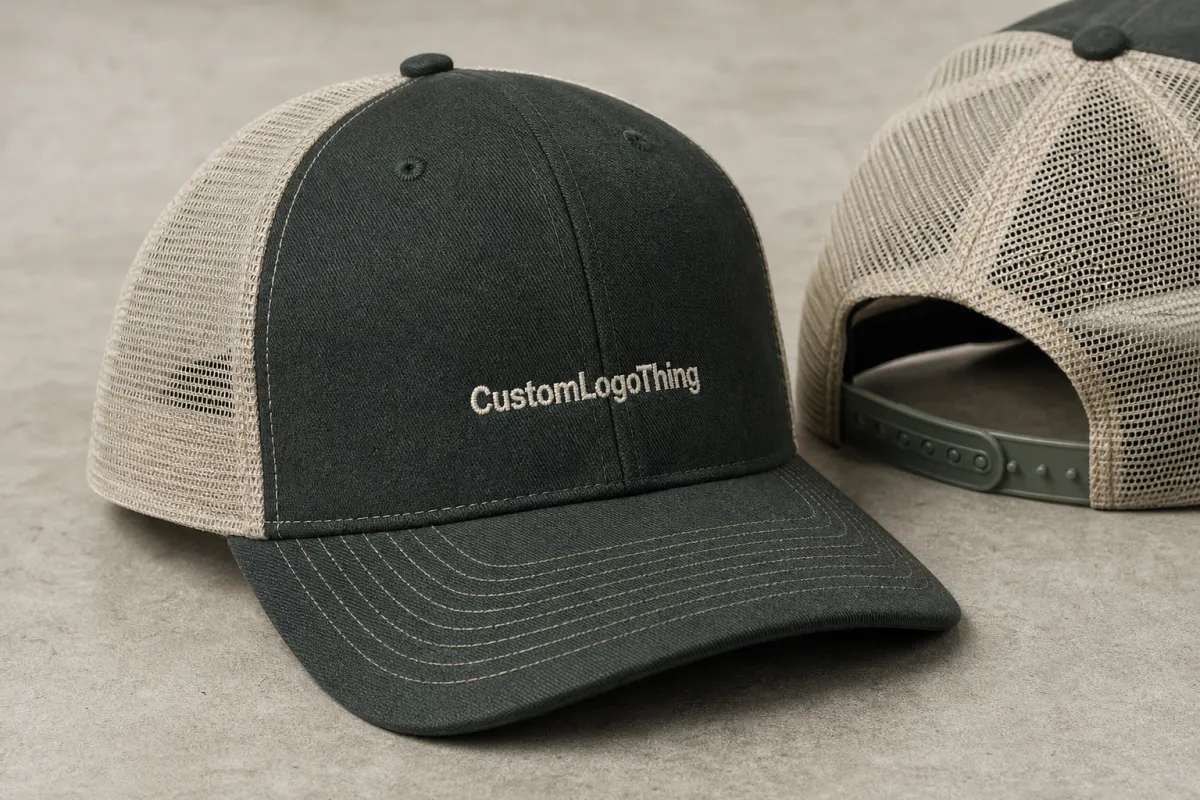
The first reason buyers choose this style is not trendiness. It is speed. A Mesh Trucker Hats private label order is easier to approve than a more complicated cap build because the product has a narrow range of acceptable variations. That sounds boring, but boring is useful in manufacturing. It reduces revision loops and gives the supplier a clearer target.
Mesh trucker hats also solve a basic comfort problem. The mesh back allows airflow, which makes the hat easier to wear in warm weather and at outdoor events. The snapback closure makes fit more flexible across head sizes. The front panel gives the brand a clean decoration zone. Put those three together and you get a cap that is practical enough for workwear, casual enough for lifestyle drops, and simple enough for promotional use.
From a buyer's perspective, that makes the style a low-risk SKU. It is easy to explain to sales teams. It is easy to quote. It is easier to replenish than a cap with multiple custom parts. A clean first run can start with a neutral colorway and a single brand mark, then expand later if demand justifies it. That is usually the smarter path. Not flashy. Just smarter.
"The orders that move fastest are the ones where the spec was clear before anyone started interpreting it three different ways."
That pattern shows up again and again. A sports team wants summer inventory. A streetwear label wants a cap that matches a graphic tee drop. A company wants branded merch for onboarding. A retailer wants to test a style without committing to a full headwear line. In each case, the hat does its job because it does not ask the buyer to solve too many problems at once.
If you need branded inserts or sewn identity pieces, use Custom Labels & Tags so the cap feels intentional rather than generic. If the order is still in the planning stage and you want a structure for quantity, packing, and replenishment, the format used in Wholesale Programs can help frame the conversation.
Mesh Trucker Hats Private Label Order: Product Details and Materials
A workable mesh trucker hats private label order starts with the build. Structured and unstructured fronts behave differently the minute the cap is on someone’s head. Structured fronts keep their shape, read more retail-ready, and make logos sit more upright. Unstructured fronts feel softer and more relaxed. One is not universally better than the other. They answer different briefs.
The classic trucker construction usually includes a foam or cotton twill front, polyester mesh on the side and back panels, and a snapback closure. Foam fronts create a louder retro look and are still common in promo programs. Cotton twill fronts tend to photograph better and feel a little more balanced in hand. Some suppliers offer performance blends or brushed fabrics for a cleaner finish, although those can shift the product away from the classic trucker feel. That is fine if the brief calls for it. It is not fine if the buyer thought they were ordering one thing and approved another.
Decoration changes the read of the hat almost as much as the base material. Embroidery is still the default for many private label projects because it is durable and familiar. Woven patches sharpen detail and can raise the perceived value. Rubber patches add a more modern texture. Printed patches can work for larger graphics, though tiny text often turns muddy. Sewn-in labels and under-brim labels matter for private label identity even if they are not the hero element.
A few style choices carry more weight than buyers expect:
- Mid-profile vs. high-profile: mid-profile sits lower and usually feels easier to wear; high-profile reads bolder and more retro.
- Flat visor vs. curved visor: flat creates a sharper retail look; curved feels more casual and ready to wear.
- Matching mesh vs. contrast mesh: matching keeps the cap quiet; contrast mesh adds separation without another decoration step.
- Thread color: tone-on-tone stays subtle, while contrast thread can hide small fabric variation and make the logo stand out harder.
The right combination depends on the audience. Lifestyle brands usually want a cleaner front panel, a mid-profile crown, and either embroidery or a woven patch. Outdoor merch programs tend to do better with breathable mesh, simple branding, and restrained colors like black, navy, olive, or sand. Workwear and team programs lean toward durability and easy repetition. Premium retail asks for tighter stitching, a better hand feel, and trim colors that look controlled rather than accidental.
One thing gets missed all the time: a photo approval is not a material approval. Mesh sheen, crown stiffness, and trim shade can look fine on a screen and feel wrong in person. Ask for a real sample. Better yet, ask someone to wear it. A cap can look perfect on a flat lay and still sit oddly if the crown depth or visor shape is off by a few millimeters. That is the kind of detail that only shows up on a head, not in a spreadsheet.
If sustainability is part of the brief, keep the packaging simple and ask whether the supplier can source paper-based inserts or FSC-certified stock for hangtags and cartons. The FSC standards and certification guidance can help if the brand needs to support a responsible sourcing claim. Just be precise. Claims need documentation, not wishful thinking.
Mesh Trucker Hats Private Label Order: Specifications That Affect Fit
Specs are where pricing stops being abstract. A solid mesh trucker hats private label order depends on the details being locked before the quote goes out. Crown height, panel count, visor shape, closure type, sweatband finish, and stitch density all affect fit, appearance, and the amount of labor the supplier needs to do.
Crown depth matters more than many buyers expect. A shallow crown and a deep crown can use the same logo, but the cap will read differently on the head. One may look balanced and one may look a little off. That is why sample approval should involve wearing the cap, not just holding it up and saying it feels fine. I have watched a shipment get delayed over a crown that looked right in a product photo but felt too tall once it was worn. Small miss, big annoyance.
Artwork rules deserve just as much attention. Vector files are still the safest starting point. For embroidery, ask for stitch-safe sizing so fine lines and tiny letters do not vanish once they are translated into thread. If Pantone matching matters, say so before proofing starts. If the logo is going onto a patch, the minimum line weight may differ from embroidery. That is not the factory being difficult. That is the medium doing what the medium does.
Packaging and labeling belong in the spec sheet, not in a late email thread. If the order is going into retail or resale, decide early on private labels, hangtags, polybags, barcode placement, and carton markings. A disciplined mesh trucker hats private label order should make it clear whether the supplier is packing one cap per bag, adding cards separately, or bulk shipping to reduce handling cost.
What to lock before quoting
- Crown height: low, mid, or high profile.
- Panel count: usually five-panel or six-panel construction.
- Visor shape: flat, pre-curved, or gently curved.
- Closure: snapback, fabric strap, or hook-and-loop.
- Decoration zone: embroidery, patch, label, or a mixed placement.
- Packaging: bulk packed, polybagged, retail tagged, or boxed.
Each of those choices changes the quote. A different sweatband finish can add labor. A custom thread color can add setup. A woven label can increase the minimum. Packaging can add per-unit cost and handling time. That is why a single spec sheet works better than scattered approvals spread across a bunch of messages. Clarity saves money because it prevents rework, and rework is usually where margin disappears.
For shipping and carton durability, the ISTA testing framework gives buyers a useful language for parcel handling and transit stress. It is especially helpful if the hats are moving through ecommerce fulfillment or direct-to-consumer delivery. Not glamorous, I know. Still worth understanding before the cartons leave the floor.
Mesh Trucker Hats Private Label Order: Cost, MOQ, and Unit Pricing
Pricing for a mesh trucker hats private label order breaks into parts. If a supplier gives you one number and refuses to explain what is inside it, that is not simplicity. That is a future argument waiting to happen. Ask for the blank cap cost, decoration, setup or digitizing, labels, packaging, and freight separately.
Typical cost structure on a normal run looks something like this:
- Base blank cap: about $1.10-$2.30 each, depending on fabric, crown style, and closure.
- Embroidery: about $0.60-$1.80 per cap for standard front logo work.
- Patch decoration: about $0.90-$2.20 per cap, depending on patch type and size.
- Woven or sew-in label: about $0.08-$0.25 each, usually more visible in the packing line than the cap line.
- Polybag or retail bag: about $0.05-$0.12 each, plus any inserts or barcode work.
- Setup or digitizing: often $25-$85, sometimes waived on larger runs.
MOQ depends on how much custom work the cap needs. A stock blank with embroidery can often start around 100 to 300 pieces per style or colorway. Add custom front panels, unusual mesh colors, multiple decoration zones, or private label trim, and the minimum usually rises. A more customized mesh trucker hats private label order can land in the 300 to 500 piece range, while a fully custom build may push toward 500 to 1,000 pieces or more.
Unit price improves with volume, but it also improves when the order is not fragmented. One colorway is simpler than four. One decoration method is simpler than two. One tight spec is simpler than a moving target. If price matters, keep the order focused and avoid tiny split runs unless there is a real commercial reason for them. Otherwise, you are paying for complexity and calling it strategy.
| Option | Typical MOQ | Unit Price Range | Best For | Timeline |
|---|---|---|---|---|
| Stock blank + embroidery | 100-300 pcs | $2.40-$4.80 | Fast merch, event sales, simple retail test | 2-4 weeks after approval |
| Stock blank + patch + label | 200-500 pcs | $3.30-$6.10 | Private label retail, brand launches, team gear | 3-5 weeks after approval |
| Custom panels + trim + decoration | 500-1,000 pcs | $5.80-$9.50 | Longer-term program, premium placement | 4-7 weeks after approval |
Use that table as a comparison tool, not a promise sheet. The cheapest quote is often cheap for a reason: thinner sampling support, fewer revision rounds, slower approval turnaround, or tighter limits on customization. If the hats are tied to a launch date, a slightly higher unit price can be the better buy than a bargain quote that misses the ship window. Delays cost money too. Sometimes more than the price difference.
Keep the spec constant when comparing vendors. Same decoration method. Same closure. Same packaging. Same ship point. Otherwise you are not comparing pricing. You are comparing different products and pretending the numbers mean the same thing. If the order is part of a broader branded program, the same logic applies to repeat support through FAQ resources and to restock planning through Wholesale Programs.
Mesh Trucker Hats Private Label Order: Process and Timeline
A disciplined mesh trucker hats private label order usually follows a clear path: quote, artwork review, sample approval, bulk production, quality check, shipment. The timeline gets longer when the decisions stay open. Manufacturing is rarely the real problem. Indecision is.
Sampling usually takes about 7 to 14 days, depending on how much needs to change. Stock components and standard decoration move faster. A new front-panel layout, an engineered patch, or a custom label size takes longer. Bulk production commonly runs 2 to 5 weeks after sample approval. Freight sits on top of that, and transit can swing a lot depending on destination and shipping method.
The blockers are usually plain and annoying. Missing artwork. Color indecision. Revision loops. Late approvals. Vague shipping instructions. Those issues do more damage than the actual factory work because they break the rhythm of production. A cap order does not usually fail in one dramatic moment. It drifts.
There are a few ways to shorten turnaround without making the order sloppy:
- Choose stock components: use available front panels, mesh, and closures where possible.
- Limit revisions: one clean proof review is better than five rounds of "almost right."
- Approve one spec sheet: design and sales should not be working from different versions.
- Keep artwork ready: vector logo, placement notes, and Pantone references if color matters.
- Define packaging early: retail bag, hanging tag, barcode, or bulk ship should be decided before production starts.
Quality checks should happen more than once. First, approve the sample. Second, approve the pre-production details if the supplier offers that step. Third, inspect bulk output for trim consistency, stitching, label placement, and panel alignment. Multiple colorways or mixed decoration methods make this step even more important because small deviations are easier to miss once the caps are packed. And once they are packed, you are kinda stuck with the result unless you catch it fast.
"If the launch date is fixed, every open question gets expensive. Decide the cap, approve the artwork, then let the factory repeat the same thing."
Mesh Trucker Hats Private Label Order: Next Steps and Launch Checklist
Before you request a quote, pull the basic packet together. A strong mesh trucker hats private label order moves faster when the supplier is not chasing five missing details in three separate emails.
Use this checklist:
- Logo file: vector format preferred.
- Target quantity: total pieces and pieces per colorway.
- Colorway: front panel, mesh, visor, and stitching.
- Decoration choice: embroidery, woven patch, rubber patch, printed patch, or mixed.
- Packaging: labels, tags, polybags, inserts, barcode, carton notes.
- Delivery location: warehouse, fulfillment center, retail address, or event site.
Then decide what the order actually needs. There is a difference between a stock blank with branding and a more custom build. A stock blank is faster and usually cheaper. A custom build gives more control over the look, but it raises MOQ and usually adds time. Neither choice is wrong. Pretending they cost the same is the mistake.
For a first run, one focused spec sheet is enough. Keep the order to one or two colorways, one main decoration method, and one packing method. If the style performs, move into a reorder plan that protects consistency on color, trim, and labeling. Buyers notice when the second run does not match the first. So do customers. That kind of mismatch is the sort of thing that quietly undermines trust.
Ask for a sample and a production calendar together. If a supplier will not provide both, that tells you something. A usable quote should state price, MOQ, sample timing, bulk timing, and what happens if one detail changes after approval. That is the difference between a clean mesh trucker hats private label order and a mess with a hat attached.
What is the MOQ for a mesh trucker hats private label order?
Most runs start around 100 to 300 pieces per style or colorway, but the exact MOQ depends on the decoration method and how custom the build is. Stock blanks usually allow lower minimums than fully custom caps with special panels, trims, or labels. If you want multiple colorways, expect the effective MOQ and unit cost to rise.
Can I add embroidery and a woven label in the same private label hat order?
Yes, if the hat construction leaves enough space for both decoration zones. Keep the front logo within the stitch-safe area and confirm label placement before artwork proofing. The more decoration steps you add, the more important it is to approve a sample first.
How long does a mesh trucker hats private label order usually take?
Sampling often takes about 7 to 14 days, depending on artwork complexity and material availability. Bulk production commonly runs 2 to 5 weeks after sample approval, with freight added on top. Rush timelines are possible on stock bases, but revisions and color changes slow everything down.
What information do you need to quote mesh trucker hats private label orders?
You need the target quantity, colorway, logo file, decoration method, packaging requirements, and delivery location. Pantone references and a rough reference image help avoid back-and-forth on style expectations. The cleaner the spec sheet, the faster the quote and the fewer surprise price changes later.
Can I split one private label order into multiple mesh trucker hat colors?
Usually yes, but each colorway can add setup work and may affect MOQ and unit pricing. If price matters, keep the order to two or three colorways and avoid tiny split runs. For the best consistency, ask whether the supplier can keep the same dye lot and trim package across repeats.
What usually goes wrong in a first-time order?
The usual problems are vague artwork, late spec changes, and approving a sample without trying it on. Those mistakes are common because the cap feels simple, so buyers rush the details. The fix is straightforward: lock the spec, sample it in hand, and confirm packaging before production starts.
The practical takeaway is simple: treat the cap like a product program, not a decoration task. Lock the fit, materials, and packing method before you ask for pricing. Keep the first run narrow enough to approve without guesswork. Then use the sample to verify what the render could not tell you. That approach saves money, shortens revision cycles, and gives your next mesh trucker hats private label order a better starting point than the first one had.


