Buyer Fit Snapshot
| Best fit | Order Custom Pallet Cartons Online projects where brand print, material claims, artwork control, MOQ, and repeat-order consistency need to be specified before quoting. |
|---|---|
| Quote inputs | Share finished size, material target, print colors, finish, packing count, annual reorder estimate, ship-to region, and any compliance wording. |
| Proofing check | Approve dieline scale, logo placement, barcode or warning zones, color tolerance, closure strength, and carton packing before bulk production. |
| Main risk | Vague material claims, crowded artwork, missing packing details, or unclear freight terms can make a low unit price expensive after revisions. |
Fast answer: Order Custom Pallet Cartons Online: Specs, Price, Process should be specified like a repeatable production item. The safest quote records material, print method, finish, artwork proof, packing count, and reorder notes in one written spec.
Production checks before approval
Compare the actual filled-product size with the drawing, then confirm tolerance on folds, seals, hang holes, label areas, and retail display edges. Reserve space for logos, QR codes, warning copy, and material claims before decorative graphics fill the panel.
Quote comparison points
Review material grade, print process, finish, sampling route, tooling charges, carton quantity, and freight assumptions side by side. A quote is only useful when the supplier can repeat the same color, closure quality, and packing count on the next order.
Order Custom Pallet Cartons online, and you are usually fixing a freight problem before it turns into a claims problem. Most shipping headaches start earlier than people think. A carton that overhangs the pallet, leaves dead space, or folds under stack pressure can wreck a shipment long before the receiver signs for it. Shipping does not forgive sloppy fit. It just charges you for it later.
From a packaging buyer's point of view, this is not about pretty graphics. It is about control. The right pallet carton footprint can cut void fill, reduce overhang, improve stack stability, and make the load easier to band, stretch wrap, and receive. That matters whether you are moving components, bulk retail replenishment, or oversized product packaging that will never fit a stock box without drama. If you need Custom Packaging Products that match real shipping conditions instead of wishful thinking, the spec sheet matters more than the sales pitch.
Manufacturers, distributors, and brands shipping heavy or bulky runs usually care about speed as much as fit. Ordering online should let you compare dimensions, board grades, lead times, and price tiers without a week of back-and-forth. That is the point of a decent sourcing process. You can order custom pallet cartons online with enough detail to avoid guesswork, but without dragging every purchase into a full engineering project. Nobody has time for that kind of circus.
Why Businesses Order Custom Pallet Cartons Online
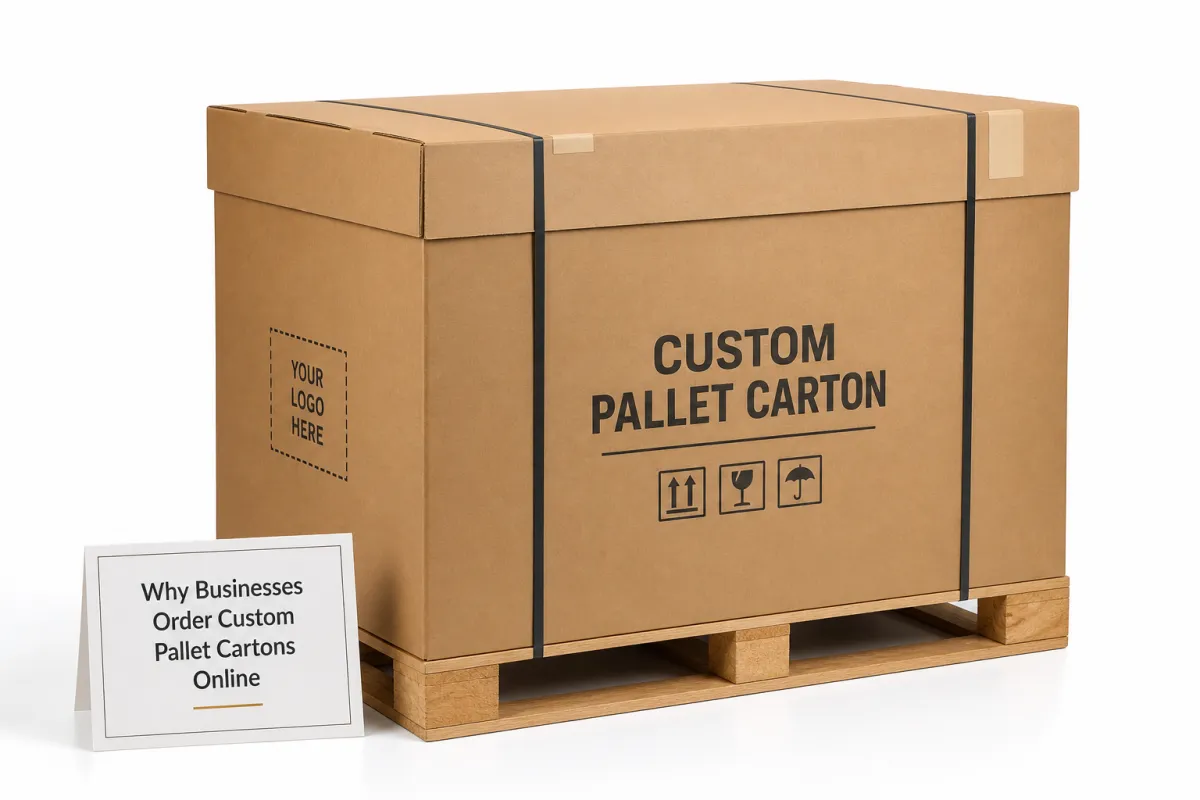
Businesses order custom pallet cartons online for one simple reason: stock sizes often waste space or create risk. A 48 x 40 pallet pattern can look efficient in a spreadsheet, then fall apart in practice because the carton footprint does not match the actual product count. That mismatch forces extra void fill, weak corners, and awkward edges that catch during transit. Packing slows down. Repacking goes up. Damage follows.
Heavy, awkward, or repetitive shipments make the problem obvious fast. A manufacturer sending machine parts, a distributor replenishing retail shelves, or a brand shipping mixed SKUs to a regional warehouse all need cartons that behave the same way every time. A carton that is too tall invites stack compression. A carton that is too wide creates pallet overhang and corner crush. A carton that is too weak fails before the pallet even leaves the dock. None of that is mysterious. It is just bad fit with a freight bill attached.
That is why many teams choose to order custom pallet cartons online instead of guessing with corrugated stock. Online ordering gives procurement, operations, and packaging teams a faster way to compare specs. It also keeps branding, logistics, and budget in the same conversation. A carton can still carry handling marks or package branding, but its real job is to protect the shipment and preserve cube.
The smartest buyers are not chasing the cheapest unit price. They are looking at total landed value. A carton that costs $0.40 more but reduces damage, fits a fuller pallet pattern, and cuts loading time can pay for itself fast. I have watched perfectly “cheap” packaging get expensive in one bad week. One cracked pallet, two claims, and suddenly the savings are gone. That is why repeat programs keep coming back to the same conclusion: order custom pallet cartons online, then measure claims reduction, warehouse efficiency, and freight utilization instead of obsessing over the sticker price alone.
Timing matters too. Standard cartons may ship quickly, but they rarely solve a structural problem. A custom pallet carton can be built around the actual product dimensions, pallet type, and stacking environment. Export loads make that even more important because humidity, vibration, and longer dwell times expose weak board choices in a hurry. Freight does not care about your timeline. It only cares whether the box survives.
Buyers comparing corrugated options should also look at the broader packaging mix. Sometimes a tray, sleeve, or case pack is the better answer. Sometimes custom printed boxes make sense for retail packaging, but not for warehouse pallet movement. The goal is simple: choose the format that matches the shipment, not the one that looks easiest to order.
Custom Pallet Carton Product Details and Applications
Custom pallet cartons are large corrugated containers built to fit palletized freight more precisely than standard stock boxes. Size is part of it. Performance is the bigger story. A pallet carton is usually engineered with a footprint that matches the pallet pattern, a height that supports stacking, and a board structure that can handle compression, vibration, and lift-truck handling. Order custom pallet cartons online, and you are usually buying a transport structure as much as a box.
These cartons show up across a wide range of operations. Mixed-SKU shipments use them because they let teams organize multiple items in one outer container. Replacement parts and service kits benefit because the carton can be sized to the real inventory mix instead of a generic case. Retail replenishment often needs a cleaner cube, especially when the load moves through distribution centers with strict pallet rules. Oversized goods, promotional bundles, and export loads all benefit from cartons that do not waste the pallet footprint.
The customization options are practical, not decorative. Buyers can specify the footprint, height, board construction, flute profile, hand holes, closure style, and print. Hand holes can speed handling on smaller high-value shipments. A friction-fit or tuck-in closure can support faster packing. Print can add product IDs, orientation arrows, lot information, or branded packaging elements without turning the box into a billboard.
Good packaging design often shows up in what the carton avoids. It avoids overhang, which protects the corners. It avoids excessive void fill, which saves material and labor. It avoids a loose stack pattern that wastes cube and weakens wrap performance. If the goal is to order custom pallet cartons online for repeated use, those small design choices matter more than flashy graphics.
Here is a practical way to think about applications:
- Mixed-SKU palletizing: keeps units organized and easier to count at the receiving dock.
- Bulk replenishment: supports retail packaging programs where the outer carton must move fast through distribution.
- Heavy component shipment: helps protect metal parts, assemblies, or tools that punish weak board.
- Export freight: benefits from stronger board, tighter fit, and better moisture planning.
- Contract manufacturing: allows repeatable pack-out across multiple runs and customer orders.
The best pallet carton usually reduces handling decisions. If warehouse staff can pack the same way every time, the line moves faster and the load looks cleaner. That is why many operations choose to order custom pallet cartons online after the first few failed tries with generic cartons. Experience has a way of making the obvious expensive.
Specifications That Matter Before You Place an Order
Before You Order custom pallet cartons online, confirm the measurements that actually control fit. Buyers often start with inside dimensions, but outside dimensions matter just as much because they determine pallet coverage and stack geometry. Usable height matters because a carton that fits the product but not the pallet pattern still creates freight waste. Inserts, dividers, and liner bags change the usable interior too, and those details get missed when someone is rushing through a call.
Board construction comes next. Single-wall corrugated can work for lighter loads or short transit lanes, especially when the carton is large but not heavily compressed. Double-wall is a better fit for heavier product packaging, longer trips, or pallets that will be stacked in a warehouse. Triple-wall shows up less often, but it can be the right call for extreme loads, export use, or industrial parts that are dense enough to crush standard board. Flute profile matters as well. C-flute, B-flute, and double-wall combinations behave differently under compression and print requirements.
There are also performance specs buyers should not skip. ECT, or Edge Crush Test, tells you how the board resists edge loading. BCT, or box compression strength, matters for stack safety. If cartons travel through hot docks, cold storage, or humid export lanes, temperature and moisture exposure change the real-world result. A board grade that looks fine in a dry warehouse may fail on a damp trailer floor. That is why a supplier should ask about the transit environment Before You Order custom pallet cartons online.
Use this checklist before approval:
- Inside dimensions: confirm the product fit, including inserts or liners.
- Outside dimensions: verify the pallet pattern and wrap coverage.
- Target load weight: check the total weight per carton and per pallet.
- Pallet footprint: specify 48 x 40, 42 x 42, 48 x 48, or another pattern.
- Handling method: note forklift, clamp truck, conveyor, or manual movement.
- Storage environment: identify dry warehouse, chilled space, or export exposure.
- Print needs: include logos, handling instructions, SKU marks, or compliance text.
Logistics details can change the build as much as the product dimensions. Bundle count, pallet pattern, warehouse stack limits, and export requirements can all influence the final spec. If a shipment must be unitized in a particular way, say so early. If the carton needs to clear a mezzanine conveyor or fit a specific rack bay, that belongs in the quote request, not buried in a later email thread when production is already moving.
Technical references help, too. Many buyers compare load assumptions against industry standards like ISTA test protocols and ASTM compression guidance. Those standards do not replace real-world ship tests, but they give the conversation a useful baseline. When a supplier can explain how the carton relates to compression, drop risk, and transit vibration, you are usually talking to a packaging partner, not a generic box seller trying to move inventory.
| Board Option | Typical Use | Strength Profile | Approx. Value Range |
|---|---|---|---|
| Single-wall 32 ECT | Lighter palletized goods, short lanes, lower stack pressure | Good for moderate loads, lower cost | Lower unit price, often best for simpler runs |
| Double-wall 44-61 ECT | Heavier products, longer transit, warehouse stacking | Higher compression resistance, better corner protection | Mid-range to higher unit price, stronger delivered value |
| Triple-wall heavy-duty | Industrial freight, export loads, dense product packs | Very high rigidity and load support | Highest unit price, used when failure risk is expensive |
For sustainability claims, do not confuse a recyclable format with a documented sourcing claim. If recycled content, FSC-certified fiber, or chain-of-custody documentation matters, ask for it up front. The EPA recycling guidance and FSC certification resources are useful reference points when a buyer wants packaging choices to align with internal sustainability reporting. That gets even more relevant when the same carton family supports both product packaging and warehouse shipping.
Pricing, MOQ, and What Changes Your Cost
Pricing is usually the first question, and it should be. Still, the cheapest quote is not always the smartest buy. When you order custom pallet cartons online, unit cost is shaped by carton size, board grade, print coverage, die-cut complexity, quantity, and freight distance. A bigger carton uses more board, so it costs more. More print colors add cost. Special features like hand holes, reinforced corners, or die-cut locking tabs can shift the number too.
For planning purposes, a plain brown single-wall pallet carton in a moderate run might land around $2.10 to $3.80 per unit, depending on dimensions and board. Double-wall versions often move into the $3.50 to $7.00 range, and heavy-duty or highly customized structures can go higher. Those are reference points, not promises. Final pricing depends on carton footprint, board grade, and the supply chain behind the order. Freight can add a meaningful amount, especially on large-volume or bulky shipments.
MOQ logic is simple once you see the tooling side. Custom dies, cutting setups, and print plates cost money before the first box ships. A small run carries a heavier setup burden per carton. At larger volumes, that setup cost spreads out and the unit price improves. That is why a buyer comparing 250 units to 2,500 units may see a dramatic difference even if the carton design looks identical on paper.
Here is the comparison most procurement teams should ask for before they order custom pallet cartons online:
| Option | Best For | Typical Cost Behavior | Buyer Takeaway |
|---|---|---|---|
| Stock size | Fast replacement orders, low variation | Lowest setup burden, limited fit control | Works if the product already fits standard dimensions |
| Short-run custom | New launches, pilot programs, limited SKUs | Higher unit cost because setup is spread over fewer cartons | Useful for testing fit before a larger commitment |
| Volume custom | Repeat programs, warehouse replenishment, export lanes | Better unit economics as quantity rises | Usually the best delivered value over time |
Delivered value should matter more than the unit sticker. A carton that fits the pallet pattern cleanly can lower void fill, reduce wrap time, and cut damage. If a box saves ten cents but creates a two percent damage rate, the savings disappear fast. Good procurement teams compare cost at several quantity tiers before they buy. Tiered quotes show where the real breakpoints sit instead of hiding them behind a single neat number.
If your business orders recurring runs, ask for pricing at 500, 1,000, and 2,500 units, or whatever quantities make sense for your storage and shipping plan. Those tiers reveal how much setup is driving the cost. They also help you decide whether a slightly larger order makes sense. Sometimes the jump from one tier to the next is small enough that the lower per-unit rate pays back quickly.
Keep freight terms visible too. FOB, prepaid, or third-party shipping can change the headline number in ways that matter more than a small difference in board grade. If you need to order custom pallet cartons online for a high-velocity program, ask for the carton cost and freight cost separately. That keeps the comparison clean and the surprises minimal.
How to Order Custom Pallet Cartons Online: Process and Timeline
The most efficient path to order custom pallet cartons online is straightforward, but the details need to be exact. Start by submitting dimensions, product weight, pallet type, and a few product photos. A supplier can then check whether the design needs a standard corrugated build, a reinforced structure, or a die-cut feature such as hand holes or a locking closure. If you already know the pallet pattern and expected stack height, include that immediately. It cuts out avoidable revisions.
The usual flow looks like this: you request a quote, the spec gets reviewed, pricing is issued, artwork or structure is confirmed, production begins, and freight is arranged. A simple repeat order may move in roughly 10 to 15 business days after proof approval, while a first-time custom project can take longer if the structure needs sampling or changes. If the box is highly engineered or requires print coordination, give it extra time. Most delays happen because a dimension was estimated instead of measured or because artwork approval arrived late.
When buyers order custom pallet cartons online, the fastest approvals usually come from clean data. Give the exact pallet size, target load weight, destination ZIP code, and whether the order needs rush handling. If the product has a fragile finish, sharp edges, or an unusual weight distribution, say so. A carton for uniform parts is not built the same way as a carton that carries mixed objects with odd center-of-gravity issues. That part matters, even if it sounds boring.
“The quote that wins is usually the one that asks the right questions early. The best carton is not the strongest carton on paper; it is the carton that ships cleanly, stacks correctly, and arrives without creating a second job for the warehouse.”
Before you pay, confirm four things: lead time, proof window, freight terms, and the damage claim process. Those items should be clear before production starts. A good seller will tell you whether the quote includes a digital proof, whether structural samples are available, and what happens if the shipment arrives with transit damage. That level of clarity matters more than a polished sales page.
If your team is still comparing formats, it may help to review FAQ content or browse other Custom Packaging Products before locking the order. Some buyers also use Wholesale Programs once the carton becomes a repeat item. That can help standardize pack counts and keep reorders from turning into a fresh specification exercise every time.
For repeat programs, document the approved spec in one place. Keep the dimensions, board grade, print notes, and pallet pattern in a shared file. Then every time you order custom pallet cartons online, the team works from the same baseline. That reduces mistakes more than most people expect. It also saves the person in operations from digging through old email chains like a detective with a headache.
Why Buy From a Packaging Partner Instead of a Generic Seller
A generic seller can move boxes. A packaging partner helps solve the load. That distinction matters. When you order custom pallet cartons online, the final outcome is shaped by fit, compression, transit behavior, and warehouse handling, not just by whether the carton exists in the right size. A partner asks how the carton will be stacked, whether the pallet will be wrapped or banded, and how much margin exists between product weight and board capacity.
Consistency is another reason to work with a partner. Repeat orders only help if every run matches the approved spec. Warehouses need the same pack count, the same pallet layout, and the same closure style every time. If a supplier changes a board profile without warning, the receiving team notices immediately. That is why better packaging relationships often beat low-bid sourcing. Predictability saves time, and time is money whether procurement wants to hear it or not.
Transparent quoting also matters. A strong supplier explains the cost drivers instead of hiding them. That makes it easier to compare options and decide whether to order custom pallet cartons online in a single spec or in two versions, such as a lighter carton for domestic lanes and a stronger one for export. Good suppliers give honest tradeoffs. A heavier board may improve compression but add cost and weight. A printed carton may help identification but not automatically improve shipment safety.
There is a service advantage too. Reorders should be simple. Documentation should be easy to recover. Engineering checks should be responsive. If a carton needs to shift because product dimensions changed by half an inch, that conversation should happen quickly and with data. That kind of support is especially useful for brands balancing product packaging, retail packaging, and warehouse shipping in the same program.
A packaging partner can also help match the carton to the shipping condition. A pallet moving across a local route is not the same as one going through a cross-country network or export lane. Moisture exposure, vibration, and storage time all influence the right board choice. A generic seller may never ask. A better partner will, because nobody likes cleaning up after a box that failed for a predictable reason.
If sustainability or compliance is part of the conversation, ask for documentation. FSC sourcing, recycled content, and carton recyclability are easier to defend when the supplier can provide clear paperwork. Buyers who need to support internal reporting or customer-facing claims should not treat that as an afterthought. The box is part of the supply chain, but it is also part of the evidence trail.
For many businesses, the real value of a packaging partner is speed with fewer surprises. You can still order custom pallet cartons online, but you are doing it with someone who understands board strength, pallet fit, and freight behavior. That combination usually beats shopping a generic listing and hoping the carton behaves.
Next Steps to Order Custom Pallet Cartons Online Confidently
If you want a cleaner buying process, prepare the basics before you request a quote. Gather carton dimensions, product weight, pallet type, product photos, and destination details. If the product has multiple pieces or inserts, note that too. When you order custom pallet cartons online with complete information, the first quote is usually more useful, and the back-and-forth drops sharply.
Ask for at least two or three options by price and strength. That gives you a useful comparison. One option might be the best value for domestic shipping. Another may be better for export or higher stack loads. A third may split the difference. Comparing those options is more useful than accepting the first number that comes back and pretending that is strategy.
For fragile, export-bound, or unusually heavy loads, ask for a sample or proof. The extra step is worth it if the carton will carry expensive inventory or move through a tough freight lane. A proof can reveal weak assumptions before production starts. It can also prevent a costly reprint or structural revision later. In practice, that is often the cheapest insurance available.
Use this quick checklist before approval:
- Confirm fit: inside and outside dimensions, plus pallet footprint.
- Confirm strength: ECT, BCT, and board construction.
- Confirm handling: forklift, clamp truck, pallet jack, or manual lift.
- Confirm environment: dry, humid, chilled, or export transit.
- Confirm timeline: proof window, production lead time, freight transit.
- Confirm print: logo, product ID, handling marks, or compliance text.
If you are still comparing packaging formats, a short conversation with a supplier can clarify whether a custom pallet carton is the right answer or whether another corrugated structure would do the job better. That is normal. Good sourcing is not about forcing every shipment into the same box. It is about matching the structure to the load, the lane, and the labor available in the warehouse.
The strongest programs keep the spec visible and the reorder path simple. Store the approved dimensions, board grade, closure notes, and freight terms in one place. Then the next time you need to order custom pallet cartons online, the team is not starting from scratch. That makes the buying process faster, the shipment cleaner, and the freight line easier to defend.
Before you approve the order, check the basics one more time: footprint, height, board grade, closure style, and shipping lane. If those five things line up, you are probably in good shape. If one of them is fuzzy, fix that first. The carton does not care about optimism.
When the fit is right, pallet handling gets easier, damage risk drops, and the load looks organized before it even leaves the dock. Review the specs, approve the quote, and place the order only after the carton matches the actual shipment. That is the most reliable way to order custom pallet cartons online without paying for avoidable mistakes later.
FAQ
What do I need to know before I order custom pallet cartons online?
Have the carton dimensions, product weight, and pallet size ready before you request a quote. It also helps to share how the cartons will be stacked, stored, and shipped so the structure matches the load. If you want print, send artwork files early so the proof does not slow the order down. Clear inputs get better quotes. Foggy inputs get expensive surprises.
How much does it cost to order custom pallet cartons online?
Price changes mainly with size, board grade, quantity, print coverage, die-cut complexity, and freight distance. Larger runs usually lower the per-unit cost because setup is spread across more cartons. Delivered cost matters more than unit price if the carton design reduces damage or cube waste. A cheap carton that fails is not cheap for long.
What is the MOQ when I order custom pallet cartons online?
MOQ depends on the converter, the board construction, and whether the carton needs printing or a custom die. Simple brown cartons often have lower minimums than printed or highly engineered designs. If volume is low, ask for a standard-size alternative or a short-run option to avoid overspending. You do not need to overbuy just to make the quote look prettier.
How long does it take to receive custom pallet cartons online?
Lead time depends on whether the order needs artwork approval, a sample, or a new tool. Simple repeat orders move faster than first-time custom projects because the spec is already approved. Freight transit time is separate from production time, so confirm both before placing the order. A fast build that sits in transit is still not fast.
Can I print branding when I order custom pallet cartons online?
Yes, most pallet cartons can be printed with logos, handling marks, product IDs, or warehouse instructions. Keep the print layout practical so it supports logistics instead of adding unnecessary cost. Ask for a proof before production if the carton carries compliance, export, or customer-facing information. Pretty is optional. Legible is not.
Should I choose single-wall or double-wall cartons?
Single-wall can work for lighter loads and shorter lanes, but double-wall is usually safer for heavier cartons, taller stacks, or rougher freight routes. The right answer depends on product weight, stack height, and how much compression the pallet will see in storage. If there is any doubt, compare both options before you order custom pallet cartons online. Guessing is a bad packaging strategy.

