Order Custom Pom Beanies for Event Merch: Buyer Guide
Custom pom Beanies for Event merch are one of the few giveaway formats that keep working after the booth closes and the lanyards are tucked away. A good one does not disappear into a drawer. It gets worn on the train, at the rink, outside a concert venue, or on the walk back from a conference hall. That matters because a wearable item is not just a handout; it is moving brand media. Sometimes, honestly, it outperforms flatter swag by a mile because it stays in circulation.
From a merchandising and packaging standpoint, custom pom beanies for event merch sit in a sweet spot. They are practical like apparel, visible like signage, and flexible enough for concerts, road races, university activations, winter retreats, trade shows, and sponsor kits. They also avoid one of the classic promo failures: the item looks great in a mockup and then has almost no real-world use. A pen is cheap. A sticker is easy. Neither gets the same repeat exposure.
If you are planning a merch drop, attendee gift, or sponsor bundle, the hard part is not deciding whether beanies are popular. The real work is understanding how they are made, what pushes cost up or down, and how to order them without missing the event window. That is the part buyers usually feel in their gut. The calendar gets tight, the design gets debated, and suddenly everyone is asking for updates at once.
One quick reality check: custom pom beanies for event merch are not a last-minute item unless the order is simple and the factory already has the base cap in stock. Even then, you are betting on clean approvals. A slow internal review can turn a manageable order into a rushed one, and rushed orders tend to cost more than people expect.
Custom Pom Beanies for Event Merch: Why They Work at a Glance
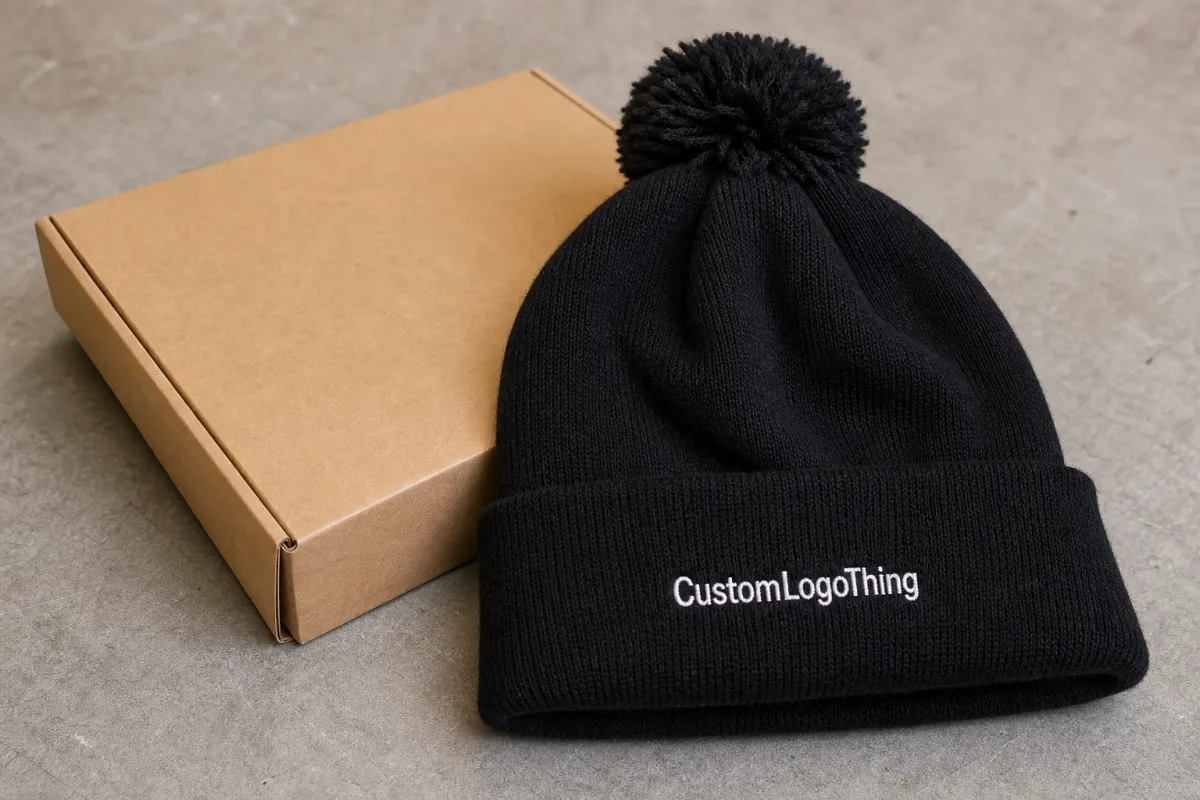
Most teams underestimate how much mileage a winter headwear item can get. A clever event shirt may get a few wears. A tote may be used until the stitching gives out. But custom pom beanies for event merch often stay in rotation for months because they solve a real problem: warmth. That utility is the first reason they beat disposable promo items. The second is visibility. A beanie sits above shoulder level, which means the logo, woven patch, or knit pattern shows up in group photos, shuttle rides, elevator mirrors, and social posts that were never planned as marketing.
In practical terms, custom pom beanies for event merch are knit caps topped with a decorative pom and finished with branding tied to the event. The branding can be built into the knit, added as a woven label, stitched as a patch, or presented on a sleeve tag or hang tag. They work especially well for concerts, races, conferences, company retreats, ski trips, campus events, and holiday activations because they fit a broad audience without the sizing headache that comes with many apparel items.
There is also a perception issue that buyers sometimes miss. A wearable item feels more valuable than a desk item. A pen disappears into a cup. A sticker gets stuck to one laptop and stops there. Custom pom beanies for event merch move through the room, onto transit, and into daily life. That gives them a better shot at being seen by people who never attended the event at all. From a packaging and brand-recognition standpoint, that is a strong return on a single unit.
I have watched this play out in real event programs: the beanie that looked like a “nice extra” became the thing people kept on after the keynote, then again on the drive home, then again two weeks later when the weather turned. That kind of carryover is rare. It is also why the item can feel more expensive on paper than it really is in practice.
They also fit into a broader merch strategy. If the event is already using retail packaging, Custom Printed Boxes, or curated welcome kits, the beanies can become the anchor item rather than the leftover item. Pairing them with thoughtful packaging design turns the handout into a better experience. A beanie tossed into a plain mailer feels different from a beanie placed in a branded carton or folded paper sleeve. That difference is small on a spreadsheet and obvious in the hand.
Practical rule: if the item is comfortable enough to wear twice, custom pom beanies for event merch usually earn more attention than half the budget spent on novelty swag that never leaves the hotel room.
For brands comparing merchandise options, that is the core trade-off. Custom pom beanies for event merch cost more than stickers or pens, but they deliver more impressions per unit because they are visible, useful, and harder to throw away. If you are trying to make a small number of pieces feel bigger, this is one of the better bets. If you are trying to fill a massive attendee count on a tight budget, the design needs to be disciplined. Either way, the product has a clear job.
One more thing: custom pom beanies for event merch are unusually forgiving for broad audiences, but only if you Choose the Right build. A thick, heavy knit may be perfect outdoors and miserable in a warm convention hall. A light-gauge knit may look sharp in photos but not hold up in freezing weather. The right answer depends on the event, the climate, and whether the beanie is supposed to feel like utility wear or premium giftware.
Production Steps and Timeline for Custom Pom Beanies for Event Merch
Production for custom pom beanies for event merch usually follows a familiar chain, and every step matters more than buyers expect. The process starts with artwork review and spec confirmation. Then comes yarn and color selection, knit programming, sample or proof approval, bulk knitting, finishing, and packing. It sounds straightforward. It rarely is. A small delay in artwork can ripple through the entire calendar, especially when a factory is waiting on final logo files or a color decision before it can start the knit program.
The biggest timing risk is not the machine itself. It is approval lag. A buyer may spend days debating the exact shade of charcoal, or they may route the proof through too many internal reviewers. That is understandable, but custom pom beanies for event merch do not wait patiently. If the event is tied to a fixed date, the order should be scheduled backward from the event, not from the moment finance signs off. Those are not the same thing, and the difference can cost an entire production slot.
There is also a meaningful split between stock-style decoration and fully custom knit construction. A stock-style beanie with an applied patch or woven label can move faster because the base cap is already established. A fully custom build, where the pattern, crown, cuff, and pom color are all being programmed to spec, usually needs more setup time. In practice, a simple program may take 10 to 15 business days after proof approval, while a more custom knit run often sits in the 15 to 25 business day range, sometimes longer if sampling is involved.
When you are buying custom pom beanies for event merch for a large audience, the planning window should stretch even further. A 300-piece run may be fine with a short lead time if the design is simple and the vendor has yarn in stock. A 1,500-piece run with three body colors, a two-color logo, and a custom pom can become a mini production project. That does not mean it is difficult. It means it should be treated like one. Buyers who ignore that reality are the ones who end up paying for express freight to rescue a late delivery.
For teams that want a cleaner logistics picture, the packaging stage deserves attention too. If the beanies are being mailed, kitted, or handed out with other items, ask how they will be folded, labeled, and packed. This is where branded packaging and product packaging decisions begin to matter. A neat stack in a carton is not the same as a retail-ready fold with a belly band. If you are building event kits, pairing the beanies with Custom Packaging Products can make the whole presentation feel intentional instead of improvised.
Transit testing is another hidden variable. For shipments that will move through multiple hands or fulfillment centers, the carton should be packed so the beanies do not crush or smear against coatings and tags. For more rigorous ship-readiness, the ISTA resources are a useful reference point. Not every order needs formal lab testing, but it helps to think in those terms when the delivery path is long or the merch is part of a bigger campaign.
In one winter program I reviewed, the beanies arrived on time but were packed so tightly that the poms needed reshaping before anyone could hand them out. The product was fine. The presentation was not. That kind of fix is cheap at the planning stage and annoying on-site, which is why the packing spec deserves the same attention as the knit spec.
- Artwork review: 1-3 business days if files are ready, longer if logos need rebuilds.
- Sampling or digital proof: 2-7 business days depending on complexity.
- Bulk production: often 10-25 business days after approval.
- Packing and shipping: 3-7 business days domestically, longer for international lanes.
That timeline is not universal, and it should not be treated as one. But it gives event planners a usable framework. If the delivery date is immovable, custom pom beanies for event merch need to be ordered early enough to absorb revisions, freight delays, and one unexpected internal approval round. The safest schedule is almost always the one that feels slightly too early during planning and perfectly normal by the time the boxes arrive.
Key Factors That Shape Custom Pom Beanies for Event Merch
The quality of custom pom beanies for event merch is mostly decided before the first stitch is knitted. Buyers often focus on the logo and forget the structure underneath it. That is a mistake. Yarn weight, knit gauge, cuff height, stretch, pom style, and decoration method all change the way the final item looks and wears. A thicker 7-gauge knit feels substantial and warm. A tighter 9- or 12-gauge knit can look cleaner and more refined. Neither is automatically better. The right choice depends on the event climate and the impression you want to create.
Decoration method is another big decision. A jacquard knit logo becomes part of the fabric, which is excellent for integrated branding and repeated wear. A woven label gives more detail and often looks sharper for small marks. An embroidered patch can create a premium retail packaging feel because the logo has depth and contrast. A debossed or faux-leather tag can help when the logo is simple and the brand wants a more rugged or lifestyle-driven look. The same beanie can feel sporty, premium, or casual depending on that one choice.
Color strategy deserves more attention than it usually gets. Exact brand-color matching sounds ideal, but yarn behaves differently from ink. If a sponsor requires strict color alignment, ask for the closest available yarn match and do not assume the Pantone reference will translate perfectly. High-contrast combinations often read better on camera, which matters for conference photos, athlete shots, and stage images. A carefully chosen contrast can outperform an exact-but-flat match in real life.
Fit and comfort also matter more than buyers admit. Most custom pom beanies for event merch are unisex and stretch to fit a wide audience, but not all knits feel the same on the head. Acrylic is common because it is durable and affordable. Acrylic/nylon blends can feel softer and hold shape better. Wool or wool-blend caps feel warmer and more premium, though they can raise cost and care questions. If the audience is outdoor workers, runners, or skiers, warmth and coverage matter. If the audience is conference attendees sitting indoors, a lighter hand may be better.
Event type changes the equation. A marathon rewards visibility and warmth, so a bold logo and brighter colorway work well. A leadership retreat may call for quieter package branding and a more polished finish. A music event can tolerate playful pom colors, while a corporate summit may want a cleaner silhouette. Custom pom beanies for event merch are flexible enough to live in all those settings, but they should not be designed as if every audience wants the same thing.
There is also a presentation angle that is easy to forget. When the beanies are folded into gift sets, the surrounding materials matter. A simple hang tag on FSC-certified paper can support the sustainability story. If that matters to your brand, you can reference the sourcing standard directly with FSC. That does not make the beanie itself greener by magic, but it does help the overall merch package feel more deliberate.
In my view, the best custom pom beanies for event merch start with the audience, not the logo file. Ask who will wear them, where they will wear them, and what the item needs to do on day one and day thirty. That simple question will usually point you toward the right knit weight, decoration style, and trim package faster than any trend board can.
One practical rule helps here: if the beanie must photograph well from a distance, do not bury the identity in tiny details. If it needs to feel premium in hand, focus on finishing, label quality, and stitch density. Custom pom beanies for event merch can do both, but not all at once on a tiny budget. Trade-offs are real, and pretending otherwise usually produces a dull result.
Another thing buyers often miss is how the item feels once it is worn for a few hours. A beanie that looks perfect on a flat lay can still itch, sag, or stretch out in real use. That is why a short sample cycle is worth the time when the event is high visibility or the audience is paying attention to quality.
Custom Pom Beanies for Event Merch Pricing: What Changes the Cost
Pricing for custom pom beanies for event merch is shaped by a handful of variables that behave a lot like the rest of product packaging and apparel buying: quantity, complexity, setup, and shipping. The first one is quantity. Lower quantities carry more unit cost because the factory has to absorb artwork setup, knit programming, and material sourcing across fewer pieces. Larger runs spread that work out, so the unit price usually drops as the order grows. That part is simple, even if the quote sheet is not.
Decoration and construction make the next biggest difference. A stock-style cap with a woven patch or embroidered label may land in the rough range of $4.50 to $7.50 per unit at a few hundred pieces, depending on trim and shipping. A semi-custom knit can move into the $6 to $10.50 range. A fully custom design with multiple body colors, a custom pom, and more detailed finishing can climb to $8.50 to $14 or more, especially at lower volumes. Those are broad ranges, not promises. Still, they are useful because they show how fast the spec choices can change the quote.
Custom pom beanies for event merch also vary by how many colors appear in the knit. A one-color body with a single woven label is usually easier than a three-color jacquard pattern with custom striping and a contrast cuff. Poms matter too. A standard yarn pom is generally cheaper than a densely constructed faux-fur style or a custom two-tone pom built to match a sponsor palette. Small changes can add a surprising amount of labor when multiplied across several hundred units.
Proofing and sampling are worth budget attention. Some buyers expect the first mockup to be production-ready and then get frustrated when a sample fee appears. That fee is normal. A digital proof may be included, but a physical sample often costs extra, anywhere from roughly $35 to $120 depending on how the supplier handles sample production and shipping. If the event depends on color accuracy, fit, or sponsor sign-off, that expense is money well spent. If it is a straightforward internal giveaway, a digital proof may be enough.
Freight can also move the number more than buyers expect. A beanie is light, but cartons, packing density, and destination still matter. Domestic ground shipping may be modest on a 200-unit order and much more noticeable on a split shipment or an expedited deadline. International orders add customs, duties, and longer transit windows. None of that is unique to custom pom beanies for event merch, but these orders are often treated like small apparel purchases when they behave more like a compact production project.
The smartest way to think about cost is not unit price alone. It is cost per impression, cost per wear, and cost per photo appearance. A $9 beanie worn six times and photographed twice can outperform a $2 giveaway that disappears in a pocket. That is the part many first-time buyers miss. Custom pom beanies for event merch are not cheap in the sticker-price sense. They can be excellent value in the visibility sense.
To make the trade-offs clearer, here is a practical comparison that event teams can use before they request quotes.
| Option | Typical Unit Cost | Common MOQ | Lead Time | Best Fit | Trade-Off |
|---|---|---|---|---|---|
| Stock knit + woven label | $4.50-$7.50 | 100-300 | 10-15 business days after proof approval | Fast-turn events, staff gifts, simple branding | Less control over body knit and trim detail |
| Semi-custom knit + patch | $6.00-$10.50 | 200-500 | 15-25 business days | Conference merch, campus programs, sponsor activations | More setup and revision time than stock options |
| Fully custom jacquard + custom pom | $8.50-$14.00+ | 300-1,000+ | 20-35 business days | Premium launches, outdoor events, resale merch | Higher cost and tighter approval discipline required |
That table is not a quotation sheet. It is a decision tool. If your event is more about speed than product detail, the stock knit route may be the right answer. If the beanies are part of a sponsor bundle or premium retail packaging moment, the custom knit version may justify the extra spend. In both cases, custom pom beanies for event merch should be priced against the use case, not compared mechanically to a low-value promo item that serves a different job.
There is a final cost layer buyers often ignore: packaging style. Folding the beanies loose into cartons is cheaper than adding belly bands, tissue, retail sleeves, or custom printed boxes. Yet presentation can change how premium the entire campaign feels. If the beanies are going into press kits, VIP welcome boxes, or sold as retail packaging, the extra spend on presentation may be exactly what turns an ordinary item into a memorable one. That is a branding choice, not just an operations one.
For teams trying to make the budget make sense, the right question is not “How cheap can we get these?” It is “What spend level gives us the mix of warmth, visibility, and presentation we actually need?” That answer is usually less dramatic than people hope and more useful than the lowest quote on the page.
Step-by-Step Ordering Plan for Custom Pom Beanies for Event Merch
The easiest way to order custom pom beanies for event merch is to start with the purpose before you start with the artwork. Who is receiving them? VIPs, staff, athletes, attendees, or retail customers? That answer affects the budget, the finish, the packaging, and the quantity. A giveaway for 4,000 attendees should not be planned like a 150-piece sponsor gift. Those are different jobs, and the spec should reflect that difference.
Once the use case is clear, translate the event brief into a spec sheet. Keep it simple but complete. Include quantity, target date, color preferences, logo files, decoration method, packaging needs, ship-to address, and any brand restrictions. If there are multiple audience groups, note them. Custom pom beanies for event merch move faster when the supplier can see the whole picture at once instead of chasing details through email. A neat spec sheet is not glamorous, but it is the most underrated production tool in the process.
Next comes proofing. This is where many teams lose time. A mockup should be reviewed by the people who can actually approve it, not by six people who each want a different shade of blue. If corrections are needed, send them quickly and in one place. For custom pom beanies for event merch, the proof cycle should lock logo size, placement, body color, pom color, and any label or patch placement before anything goes into production. Tiny changes after knit programming can become expensive or impossible.
Map the calendar backward from the event. If the event is on a Friday, do not treat Thursday as the delivery deadline. Build in time for production, transit, receiving, count checks, and one buffer day in case the cartons arrive after hours or one lane gets delayed. For custom pom beanies for event merch, a comfortable planning window is usually several weeks before the live date, and more if you want a fully custom knit or a physical sample. Bigger or more decorated orders should be treated like mini production projects, not quick promo buys.
Distribution planning matters too. The handout point should match the goal. If the beanies are meant to create social posts, hand them out at the entrance or in a branded photo moment. If they are meant to support staff, stage them in a back-of-house kit or locker room pack. If they are going into welcome boxes, think about the fold, the insert order, and the carton size. Good product packaging reduces chaos. Poor product packaging turns a nice merch item into a clutter problem.
That is where the presentation layer connects back to the operational layer. Custom pom beanies for event merch feel more valuable when they are stacked cleanly, wrapped with a simple band, or placed in a box with other branded pieces. If your campaign already uses packaging design to support the story, the beanie should fit that system instead of fighting it. The best event merch programs look coherent because every item has a role.
For larger programs, I would add one more step: inventory logic. Decide whether every unit goes out at once or whether some are held for VIPs, media, or late additions. A small overage is smart. Exact-headcount ordering sounds efficient until a rain delay, a sponsor change, or a damaged carton creates a gap. For custom pom beanies for event merch, a buffer of 3% to 8% is usually a lot cheaper than scrambling for a last-minute reprint or second shipment.
One practical tip from the field: if the event has multiple handout moments, label the cartons by distribution point before they ship. It saves a surprising amount of chaos on arrival day, and nobody wants staff sorting winter hats under pressure.
- Step 1: Define the audience and the event goal.
- Step 2: Build a spec sheet with size, color, trim, and deadline.
- Step 3: Review proofs fast and in one approval loop.
- Step 4: Confirm shipping, receiving, and on-site distribution.
- Step 5: Add a small overage for event-day surprises.
That process may sound methodical, but that is the point. Custom pom beanies for event merch reward buyers who plan like operators and think like merch strategists. The order goes smoother, the final product looks better, and the event team spends less time solving avoidable problems on arrival day.
Common Mistakes to Avoid With Event Merch Beanies
The first mistake is waiting too long. This is the classic event-planning error because the order feels small. It is not. Custom pom beanies for event merch require artwork review, color approval, production, and shipping, and each step can stall if someone in the chain is slow to answer. Waiting until the budget is fully settled often means the production calendar is already tight. That is when buyers lose decoration options, pay more for freight, or settle for a weaker spec than they wanted.
The second mistake is choosing a logo treatment that looks good on a screen but disappears in knit texture. Fine lines, tiny text, and overcomplicated gradients often fail when translated into yarn. The beanie is not a billboard. It is a textile surface with stretch and stitch structure. Custom pom beanies for event merch work best when the logo is simplified enough to survive real-world wear, dim light, and distance. If the design only works in a high-res render, it probably needs another pass.
The third mistake is overcomplicating the artwork. Buyers often want the sponsor logo, event name, date, tagline, and social handle all in one knit. That is a lot for a small headwear item. A cleaner mark usually wins. In package branding terms, restraint tends to look more intentional than crowding every available square inch. If your event already has strong branded packaging or custom printed boxes elsewhere, the beanie does not need to repeat every message. It just needs to connect back to the event clearly.
Audience fit is another blind spot. A race may need units for runners, volunteers, and VIPs. A conference may have speakers, sponsors, general attendees, and staff. A music event may have merch buyers and free-gift recipients. Those groups do not always want the same item. Custom pom beanies for event merch can be universal in size, but the perceived value changes depending on who receives them. If the item is too premium for one group and too plain for another, it can create an awkward split in the room.
Packaging mistakes show up quietly and then all at once. If the beanies are loose in a carton, the on-site team may spend time sorting, refolding, and rebagging them. If they are packed too tightly, the poms can flatten and the caps can lose shape. If the tags are wrong, the presentation looks rushed. Small details matter because these items are often handed out in public, where event merch is part of the brand experience, not just the inventory.
Then there is the deadline illusion. Buyers sometimes hear a supplier say a run can be produced in two weeks and assume that means the event is covered. It usually does not. That estimate may exclude proof revisions, transit, receiving, customs, or a weekend buffer. For custom pom beanies for event merch, the real deadline is the date the items must be physically in hand, counted, and ready to distribute. If that date is missed by even a day, the promotion can miss the event entirely.
A useful rule of thumb: if the answer to “What happens if the shipment is late?” is “We hope it is not,” the plan needs another review. Good merch planning is not about optimism. It is about timing, proof discipline, and practical backup options. It is also about being honest about what can and cannot be changed once production begins.
Expert Tips and Next Steps for Custom Pom Beanies for Event Merch
My first tip is simple: begin with the event use case, then choose the beanie construction. Too many buyers do this backward. They decide they want a cable knit, a faux-fur pom, or a leather patch before they know whether the item is going to staff, attendees, or retail buyers. Custom pom beanies for event merch get better when the construction reflects the job. Utility first. Style second. That order usually leads to fewer regrets.
Second, request a mockup that is as close to reality as possible. A flat digital proof is useful, but a more detailed rendering helps buyers judge proportion, contrast, and logo visibility in context. If the event is high-stakes, ask whether a physical sample makes sense. It will add time and cost, but it can prevent a batch from missing the mark on color or fit. That is not always necessary, but it is a smart move when sponsors or executives will inspect the result closely.
Third, keep a short approval checklist. Before production starts, confirm quantity, colorway, logo placement, decoration method, packaging, shipping address, and arrival date. That list sounds basic because it is basic, and basic is where production jobs stay on track. For custom pom beanies for event merch, a one-page approval recap can save days of back-and-forth later. I have seen far more delays caused by missing addresses and vague sign-offs than by any knitting issue.
Fourth, think about the distribution moment as part of the product. If the beanies are going to look good in photos, give the event team a moment to hand them out where they will be seen. If they are meant for VIPs, make the packaging feel special. If they are part of a mailer, make sure the fold and insert size are right. Good merchandising is a combination of packaging design, timing, and audience behavior. The item itself is only one piece.
Fifth, do not ignore the broader program around the beanie. If it is part of a kit, align it with the rest of the branding so the box, insert card, and product packaging all speak the same language. If you are using a sustainability message, keep the claims accurate and the materials traceable. If you are pairing it with other merchandise, make sure the hierarchy is clear. A beanie can be the hero or the supporting player. It should not be both at once.
For buyers who want a clean next step, the path is straightforward: confirm the event date, estimate the quantity with a small buffer, choose the construction that fits the audience, and request quotes from suppliers who can show real production timelines. That is the point where custom pom beanies for event merch stop being a concept and become an actionable order. A good supplier will help narrow the options. A good buyer will keep the brief focused enough to make that help useful.
There is a final detail that often decides whether the campaign feels polished: how the beanies are packed. A careful fold in a branded carton can make custom pom beanies for event merch feel premium even before anyone puts one on. Loose, crumpled units can make a strong design look cheap. That is why packaging choices matter even for apparel. The presentation frame shapes the perceived value of the product.
If you only remember one thing from the planning side, make it this: the best custom pom beanies for event merch are the ones ordered with enough lead time to approve the details, enough discipline to keep the design clean, and enough care in packing to make the first handoff feel deliberate. That is the whole formula, and it is a pretty solid one.
Handled well, custom pom beanies for event merch do more than keep people warm. They extend the event, carry the logo into real life, and keep the brand visible in places where flat swag never travels. If the goal is repeat wear, better photos, and a stronger impression after the venue clears, custom pom beanies for event merch are one of the better formats to put in motion.
How far in advance should I order custom pom beanies for event merch?
Plan earlier than you would for a simple promo item because knitting, proofing, and shipping all need time. For most custom pom beanies for event merch orders, build the schedule backward from the live date and leave room for revisions, transit, and one backup buffer. If the run is large or highly customized, treat it like a small production project rather than a quick purchase.
What is the usual MOQ for custom pom beanies for event merch?
Minimums vary by supplier and build type, so there is no single number that fits every order. More custom knit patterns, special poms, and broader color choices often raise the starting quantity. If your audience is small, ask about tiered pricing or a mix of event merch and later resale inventory so custom pom beanies for event merch can still make sense financially.
Which decoration method works best for custom pom beanies for event merch?
Jacquard knit is strong when the logo should feel built into the fabric. Woven labels and patches are useful when you want sharper detail or a more premium finish. The best method depends on logo complexity, budget, and how close people will be when they see custom pom beanies for event merch in use.
Can custom pom beanies for event merch match exact brand colors?
They can usually get close, but yarn and knit construction do not behave like printed ink. Exact Pantone matching is not always the right expectation. When color accuracy matters for sponsors or licensed branding, ask for a physical sample or yarn reference. In some cases, a higher-contrast colorway will photograph better than a subtle near-match.
How do I choose the right quantity for custom pom beanies for event merch?
Start with expected attendance, staff needs, VIP allocations, and a small overage for replacements or last-minute additions. If the beanies will be handed out in stages, decide who gets them first. A slight buffer is usually safer than ordering to the exact headcount, especially for custom pom beanies for event merch tied to a fixed event date.

