What Custom Triangle Stickers Are Best For
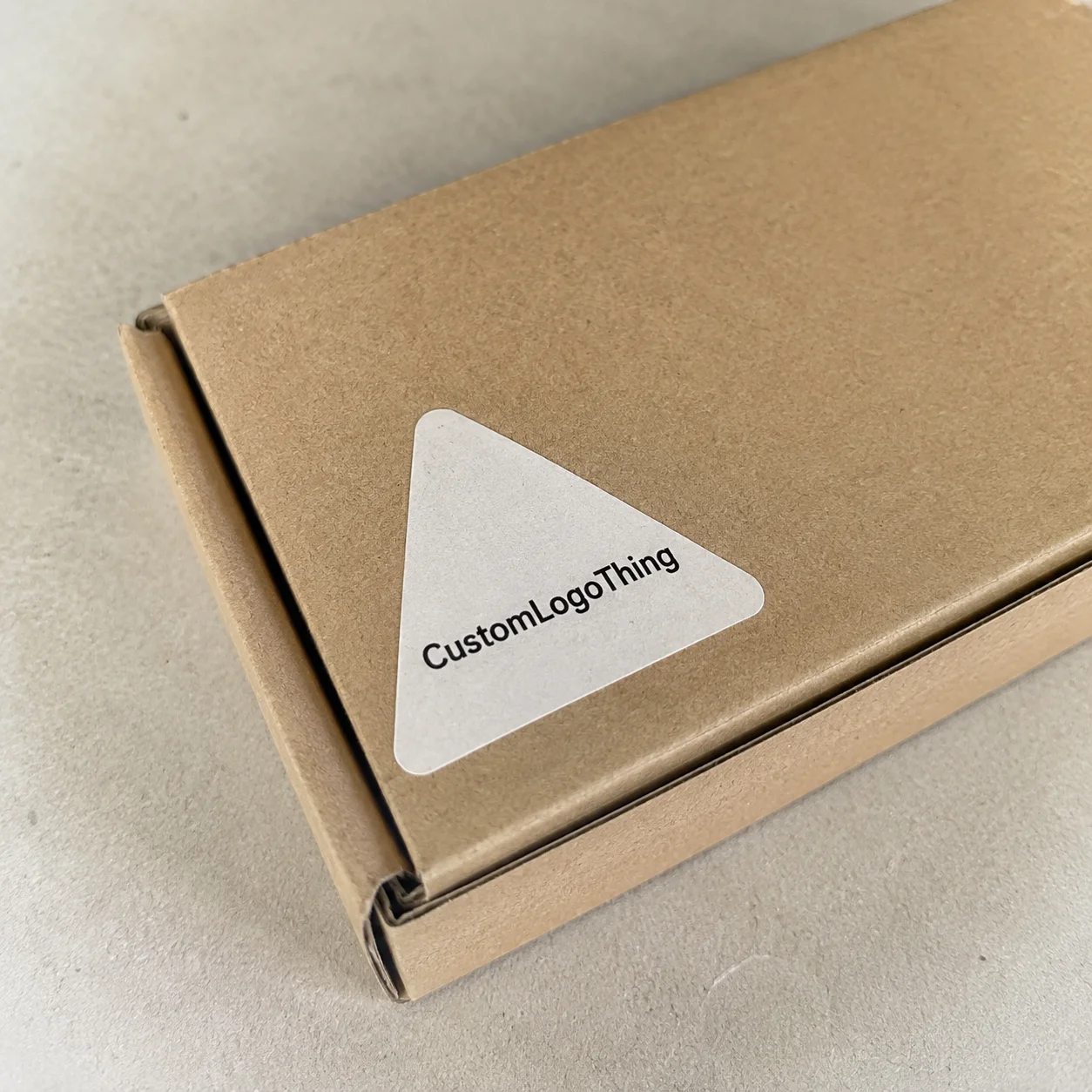
A triangle sticker earns attention before the artwork even starts working. Most labels, seals, and decals are rectangles or circles, so a triangular mark interrupts the expected pattern. That is why custom triangle stickers can look sharper on packaging, especially when a brand needs a small label to carry more visual weight than a standard square badge.
In production terms, these are adhesive labels cut in a triangular format, usually through die cutting or digital kiss cutting. The face stock may be paper, BOPP film, clear film, vinyl, textured stock, or another specialty material. The construction can include laminate, varnish, removable or permanent adhesive, freezer adhesive, and either sheeted or roll-fed backing.
The shape is not limited to one clean geometry lesson from school. Triangles may be equilateral, right-angle, rounded-corner, long and narrow, or built to match a specific package corner. A 1.5-inch triangle can work as a jar lid seal or envelope closure. A 3-inch triangle gives enough room for a simple logo, short claim, icon, or promotional callout on a carton panel.
Common uses include product seals, packaging corners, warning labels, boutique brand marks, event giveaways, food jars, candle packaging, laptop decals, retail price bursts, and mailer stickers. Sideways triangles can act as arrows. Right triangles can sit cleanly against box corners. Rounded triangles soften the shape for cosmetics, wellness products, stationery, and gift packaging.
There is a real difference between a decorative triangle decal and a functional triangular label. Decorative decals mainly need to look good and stay attached. Functional labels have a job: wrapping a corner, pointing to an opening tab, covering a tuck flap, sealing a sleeve, or sitting cleanly on a tapered jar, bottle neck, or folding carton edge.
That job changes the specification. A flat handout sticker can use a simple paper stock. A corner seal may need a flexible film, stronger adhesive, and a radius on the corners to reduce lifting. A freezer product needs adhesive chemistry that still grips after cold exposure. Small details decide whether the label looks intentional or starts peeling before the product reaches the shelf.
If the sticker is part of a broader packaging system, treat it like a small engineered component rather than a last-minute decoration. The piece may cost only a few cents, but it can affect shelf impression, packing speed, waste, and rework. One crooked or lifting seal can make a premium box look rushed.
How the Triangle Shape Changes Design, Fit, and Readability
Triangle layouts behave differently from squares and circles because the eye is pulled toward the point. That can make a logo feel active, directional, and modern. It can also make small text look trapped if the artwork is simply squeezed into the shape.
The most common design mistake is easy to spot: a square badge gets cropped into three corners, and nobody rebuilds the hierarchy. The logo sits too close to the edge. The claim runs into the point. The shape has energy, but the layout fights it.
Orientation matters. Point-up triangles feel like badges, warning marks, mountain emblems, or achievement symbols. Point-down triangles can work for hang-tag style branding, especially on bags, folded paperboard, and narrow panels. Sideways triangles read like arrows, which makes them useful for peel tabs, opening cues, “new” callouts, and directional seals.
Equilateral triangles feel balanced and graphic. Right triangles are often better for packaging corners because they align naturally with a 90-degree edge. Long, narrow triangles can look striking, but they reduce usable text area quickly. If readability matters, the available face area matters more than the widest measurement.
Build the file with three zones in mind: bleed, trim, and safe area. Bleed is the extra printed artwork extending past the cut line, often 0.0625 to 0.125 inch depending on the supplier’s template. Trim is the intended finished edge. Safe area is the space inside the trim line where logos, text, QR codes, and legal marks should sit so they are not clipped by normal cutting tolerance.
Triangle points need extra breathing room. A 1 mm cut shift may barely register on a rectangle, but it can look obvious at a sharp tip. Fine borders create the same problem. If the border follows the edge too closely, normal die movement can make one side look heavier than the other.
Short copy works best. Use bold icons, strong contrast, and simple logo lockups instead of long claims. If you need nutrition facts, compliance text, warnings, or an ingredient panel, a triangle is usually the wrong primary label. Use it as a seal, badge, accent, or callout, then keep dense information on a rectangle.
Package geometry can make the shape useful beyond decoration. A corner seal on a carton can bridge two panels and suggest tamper awareness. A small triangle on a bottle neck can point toward a tear strip. A folded paperboard sleeve can use a right triangle to cover a seam while adding a branded mark. Good designs respect both the printed shape and the object underneath it.
Materials, Adhesives, and Finishes That Affect Performance
Material choice decides how the sticker prints, bends, peels, and survives handling. White BOPP is a dependable film for durable product labels because it resists moisture better than paper and handles full-color printing cleanly. Clear film gives a no-label look on glass or glossy containers, although white ink may be needed behind logos for opacity.
Paper stocks are economical for dry indoor use and can feel warmer on kraft cartons, bakery boxes, stationery, and gift packaging. Vinyl is common for outdoor decals, equipment labels, hard-use laptop stickers, and water bottles where abrasion and weather matter. Textured papers, laid stocks, and uncoated premium sheets can add a tactile feel to hand-applied retail packaging, but they usually need more care around moisture and scuffing.
Adhesive deserves the same scrutiny as the face stock. Permanent adhesive fits most cartons, jars, tins, pouches, and mailers. Removable adhesive is better for temporary promotions, price changes, event giveaways, or surfaces where residue would create complaints. Freezer-grade adhesive is designed for cold chain products because standard adhesive can stiffen and lose tack at low temperatures.
Aggressive adhesive may be needed for textured kraft, low-energy plastics, powder-coated tins, recycled board, or slightly uneven molded surfaces. That does not mean stronger is always better. An adhesive that grips too hard can tear paper packaging, leave residue, or make repositioning impossible during hand application.
Finish changes appearance and durability. Gloss laminate adds shine, color pop, and scuff resistance. Matte laminate softens glare and often feels more retail-friendly for cosmetics, candles, tea, coffee, and gift products. Soft-touch laminate creates a premium hand feel, though it can show oils and fingerprints on dark colors. Uncoated paper is useful when the sticker needs to be written on with a pen or marker for batch codes, names, dates, or short notes.
Surface testing matters because glass, kraft paper, coated cartons, flexible plastic pouches, and powder-coated containers accept adhesive differently. A label that bonds beautifully to a smooth PET jar might lift on a recycled kraft mailer after two days, especially near a corner or score line. If the sticker wraps an edge, check whether the adhesive can hold against the material’s memory as it tries to spring back flat.
Shop-floor rule: test the sticker on the real surface, at the real temperature, with the real handling pattern. A clean lab peel is useful, but shipping rub, refrigeration, condensation, and human hands tell the fuller story.
Exposure should guide the specification. Moisture, oil, abrasion, refrigeration, sunlight, and repeated consumer handling all push the construction in different directions. For transit-heavy packaging, guidance from groups like the International Safe Transit Association can help teams think through vibration, compression, and shipping rub as part of the wider package system.
Process, Timeline, and Production Steps from Art to Delivery
The ordering path is simple when the details come in the right order. First, choose the size and triangle shape. Then confirm the face stock, adhesive, finish, and backing format. After that, submit artwork, review the proof, approve the die line or digital cut path, and move into production.
Production usually includes printing, laminating or coating if needed, cutting, weeding if required, inspection, packing, and shipping. For roll labels, the job may also require a specific core size, roll outside diameter, copy position, and unwind direction. These details sound minor until an operator loads the roll and the triangle points the wrong way in the dispenser.
A useful proof should show the cut line, bleed, safe area, color placement, quantity, sheet or roll format, and special notes such as corner radius or exact orientation. It should also identify white ink on clear materials, spot colors, laminate, and any tolerance-sensitive border. If the sticker feeds through a label dispenser or packing station, confirm unwind direction before approval.
Timeline depends on the job. Simple digitally cut stickers with clean artwork may move faster than specialty film labels with laminate and exact roll setup. Typical drivers include artwork readiness, proof revisions, material availability, cutting complexity, finishing requirements, order quantity, inspection needs, and shipping method.
A practical planning range for many custom sticker orders is 7 to 15 business days after proof approval. That range can stretch if the material is special order, the colors need a production sample, the cut path is complex, or the run is large. Rush production may be possible on straightforward jobs, but it leaves less room for testing and correction.
Rolls and sheets serve different workflows. Rolls help with machine application, label dispensers, and fast hand application because operators can peel repeatedly without chasing individual pieces across a sheet. Sheets are convenient for giveaways, retail inserts, small batches, influencer kits, and manual packing stations where counting, storage, and distribution matter more than speed.
If the stickers are tied to cartons, inserts, bags, Custom Printed Boxes, or product photography, build review time into the schedule. A one-day proof delay may be harmless on a reorder. It can be painful if the sticker must appear in a photo shoot or match a retail packaging launch. If several printed pieces are being produced together, the broader Custom Packaging Products lineup should be planned as a group so colors, finishes, and arrival dates do not collide.
Cost, Pricing, MOQ, and Unit Cost Drivers
Sticker pricing is shaped by size, quantity, material, adhesive, finish, number of designs, roll or sheet format, and whether the order uses a custom cutting die or digital cut path. A 1-inch paper triangle on sheets is a different job from a 3-inch clear BOPP triangle on rolls with white ink, matte laminate, and a tight unwind requirement.
Unit cost usually drops as quantity increases because setup time, proofing, press preparation, color checks, and cutting calibration are spread across more pieces. The first usable sticker carries a lot of preparation cost. The five-thousandth carries far less.
Minimum order quantity depends on production method. Low minimums may be possible with digital printing and digital cutting, especially for sheeted stickers. Specialty films, laminates, freezer adhesives, exact roll formats, or spot-color work may require larger runs because setup, material waste, and machine time need to make sense.
| Option | Best Use | Typical Cost Direction | Practical Notes |
|---|---|---|---|
| Paper, sheeted | Dry indoor packaging, inserts, envelope seals | Lower | Good for short runs; not ideal for moisture or oil exposure |
| White BOPP, roll-fed | Food jars, cosmetics, candles, retail products | Moderate | Durable print surface; efficient for repeated application |
| Clear film with white ink | Glass, clear boxes, premium no-label effects | Moderate to higher | White ink improves opacity but may add setup cost |
| Vinyl with laminate | Outdoor decals, laptops, equipment, high-touch use | Higher | Better abrasion and weather resistance than basic paper |
For ballpark planning, a small paper or BOPP sticker at a few thousand pieces might land around $0.05 to $0.18 per unit, depending on size and finish. Short-run specialty stickers can be much higher, sometimes $0.40 to $1.00 each, because setup is spread over fewer units. Those ranges are planning numbers, not quotes. Real pricing depends on artwork, material, production format, inspection requirements, and freight.
Ask for two or three quantity tiers. Pricing at 500, 2,500, and 5,000 pieces often tells a buyer more than a single quote because it shows where the price break starts. If monthly usage is predictable and storage is clean and dry, ordering extra inventory may make sense. If artwork changes seasonally, a lower quantity may be safer even when the unit cost is higher.
Also ask whether multiple designs can share a run. Sometimes a supplier can gang similar stickers with the same material and finish, especially for sheeted digital work. Other times, each design creates a separate setup. The answer affects both price and reorder planning.
Step-by-Step Guide to Ordering the Right Triangle Labels
Start with the application. Identify exactly where the sticker goes, what surface it touches, whether it wraps an edge, and how long it needs to stay in place. A promotional mailer sticker used for three days does not need the same construction as a freezer label on a sauce jar or an outdoor vinyl decal on a water bottle.
- Measure the available area. Use the real product or package, not only the dieline or screen mockup. Check width, height, curves, seams, score lines, and raised texture.
- Choose the orientation. Decide whether the triangle should sit centered, align to a corner, point toward an opening feature, or act as a seal across two panels.
- Prepare clean artwork. Vector logos such as AI, EPS, SVG, or print-ready PDF files are best for crisp edges. Convert fonts to outlines or package them properly.
- Protect the safe area. Keep small text, QR codes, and fine logos away from points and edges. Add bleed according to the supplier’s template or proof instructions.
- Select the construction. Match material, adhesive, finish, and roll or sheet format to handling conditions rather than choosing by appearance alone.
- Review the proof slowly. Check spelling, size, orientation, cut line, color notes, quantity, roll direction, and whether the triangles will peel easily during application.
For refrigerated, oily, outdoor, or high-touch products, ask about samples before ordering the full run. A quick application test can save far more than it costs. Press the label down with normal hand pressure, wait 24 to 72 hours, then check edges, corners, and wrapped areas. If the label lifts, tunnels, or slides, adjust the adhesive or face stock before production.
Teams building a complete packaging design system should compare the sticker to cartons, pouches, bands, and inserts under the same light. Matte lamination on a triangle label may look slightly different from matte varnish on a carton, even if both carry the same brand color. Paper texture can shift color too, especially on uncoated or recycled stocks.
If sustainability claims matter, review material choices carefully. Paper-based options may support a different claim than film-based labels, but adhesive, liner waste, coatings, and local recycling rules complicate the picture. Recognized references such as the Forest Stewardship Council can help when specifying paper components, but the claim should match the actual construction being purchased.
If you need matching hang tags, seals, wraps, or other label formats, the Custom Labels & Tags category can help frame the whole label family instead of treating the triangle as a one-off item.
Common Mistakes and Practical Next Steps Before You Order
Do not treat a triangle like a cropped square design. Logos and text often need to be rebuilt around the geometry, not forced into it. The best triangle labels usually have one dominant element, one supporting line, and enough empty space to let the shape breathe.
- Text too close to the point: sharp corners magnify trim variation and make small type look cramped.
- No surface test: adhesives behave differently on glass, kraft, coated board, flexible film, and textured containers.
- Paper in wet environments: condensation, oil, and refrigeration can stain, curl, or weaken unprotected paper.
- Ignored roll direction: the sticker may face the wrong way in a dispenser, slowing down application.
- Proof checked only on screen: a 2-inch label can look readable at 200% zoom and fail at actual size.
- Application time underestimated: wrapping a corner neatly takes more labor than placing a flat label on a square panel.
Color needs careful handling. Screens glow; printed ink reflects light. That alone can shift the way a brand color feels. Use Pantone references or clear CMYK builds for critical colors, and ask for production notes if the sticker must match Custom Printed Boxes, bags, or other retail packaging pieces.
For high-value launches, a sample or press proof can be worth the extra time because it reduces surprises before the full run ships. The same is true for labels crossing a corner or touching unusual surfaces. A triangle that looks perfect in a flat proof may behave differently once it meets a curved jar shoulder, a kraft mailer fiber, or a powder-coated tin.
Before asking for a quote, gather the details that affect both pricing and performance. Measure the application area. Photograph the package surface. Decide on indoor or outdoor use. Estimate monthly usage. Gather artwork files. Choose roll or sheet format. List exposure to moisture, oil, cold, sunlight, abrasion, or heavy handling.
If the label belongs to a regulated category such as food, supplements, cosmetics, or chemicals, confirm which information belongs on the main label versus the triangle accent. Small stickers can support branding, sealing, and callouts, but they rarely carry complex compliance information well.
Good ordering is not complicated, but it is specific. With the right size, surface details, artwork files, material notes, and quantity tiers ready, a supplier has what they need to produce custom triangle Stickers That Look intentional, apply cleanly, and hold up in real use.
Frequently Asked Questions
What size should custom triangle labels be for product packaging?
Start by measuring the flat area or corner where the label will sit, then leave room for trim tolerance and hand placement. For small jars, boxes, or pouches, a compact triangle can work as a seal or logo mark. Larger retail labels need enough face area for readable text. Print a paper mockup at actual size before ordering so you can check scale, orientation, and readability on the real package.
Are custom triangular stickers better on rolls or sheets?
Choose rolls if the stickers will be applied quickly by hand, used with a label dispenser, or integrated into a packing line. Choose sheets for small batches, promotional inserts, event handouts, or teams that need easy counting and storage. Confirm unwind direction for rolls if the point or logo orientation matters during application.
How much do custom triangle stickers cost?
Cost depends on size, quantity, material, adhesive, finish, cut complexity, and whether the order is produced on rolls or sheets. Higher quantities usually lower the unit cost because setup and proofing are spread across more stickers. Ask for tiered pricing at a few quantities so you can compare budget, inventory needs, and reorder timing.
What artwork file is best for triangle sticker printing?
Vector files such as AI, EPS, SVG, or print-ready PDF are best for logos, icons, and sharp edges. Raster images should be high resolution at final print size, typically 300 DPI or better for clean results. Include bleed and keep important details inside the safe area so points and edges do not trim too close.
How long does it take to produce custom die-cut triangle stickers?
Timeline depends on proof approval speed, material availability, finishing, order size, inspection needs, and shipping method. Simple digitally cut orders can move faster than specialty film, laminate, or high-volume roll orders. Approve the proof only after checking size, orientation, cut line, color notes, and roll or sheet format to avoid delays.