Order PVC Zipper Garment Bags Lead Time Planning Tips
Lead Time Planning Starts Before Artwork
A fashion brand can approve logo artwork on Monday and still miss a retailer delivery window two weeks later. Not because the factory “moved slowly.” Because the zipper tape color was still undecided, the PVC gauge was listed as “standard,” carton labels were missing, and nobody confirmed whether each suit bag should be folded once, packed flat, or bundled by size.
Order PVC Zipper Garment bags lead time planning is not about begging production to move faster after the file is already messy. It is about removing uncertainty before the factory clock starts.
The slow part is rarely the zipper sewing or edge sealing. Most delays come from late decisions on thickness, closure style, print coverage, carton marks, packing counts, and inspection requirements. A one-color logo on a clear 0.12 mm PVC shirt cover is a different job from a 0.20 mm gusseted bridal gown bag with reinforced handles, colored zipper tape, warning labels, and retail-compliant cartons. Same product family. Very different production file.
Good planning protects more than a packaging date. It protects seasonal inventory, trade show setups, uniform rollouts, warehouse receiving appointments, retailer compliance windows, and sample room resets. The garment bag may look like a sleeve around the product, but it affects storage, presentation, returns handling, identification, and the customer’s first read of garment value.
Packaging buyer reality: If the factory has to ask five basic questions after quote approval, the order has not really started. It is still being defined.
Custom Logo Things helps buyers turn loose requirements into production-ready specifications: size, gauge, zipper style, logo placement, packing method, carton labeling, and delivery deadline. That cleaner file gives quoting, sampling, production, inspection, and freight planning a real chance of staying on schedule. Miracles remain unavailable. Clear specs, however, are shockingly effective.
Product Details Buyers Should Lock Before Production
PVC Zipper Garment Bags are clear or semi-clear protective bags used for suits, dresses, uniforms, gowns, coats, costumes, samples, and premium apparel storage. Buyers usually start with the logo. Fine, branding matters. But the better first question is simpler: what job must the bag perform for 30 days, six months, or several reuse cycles?
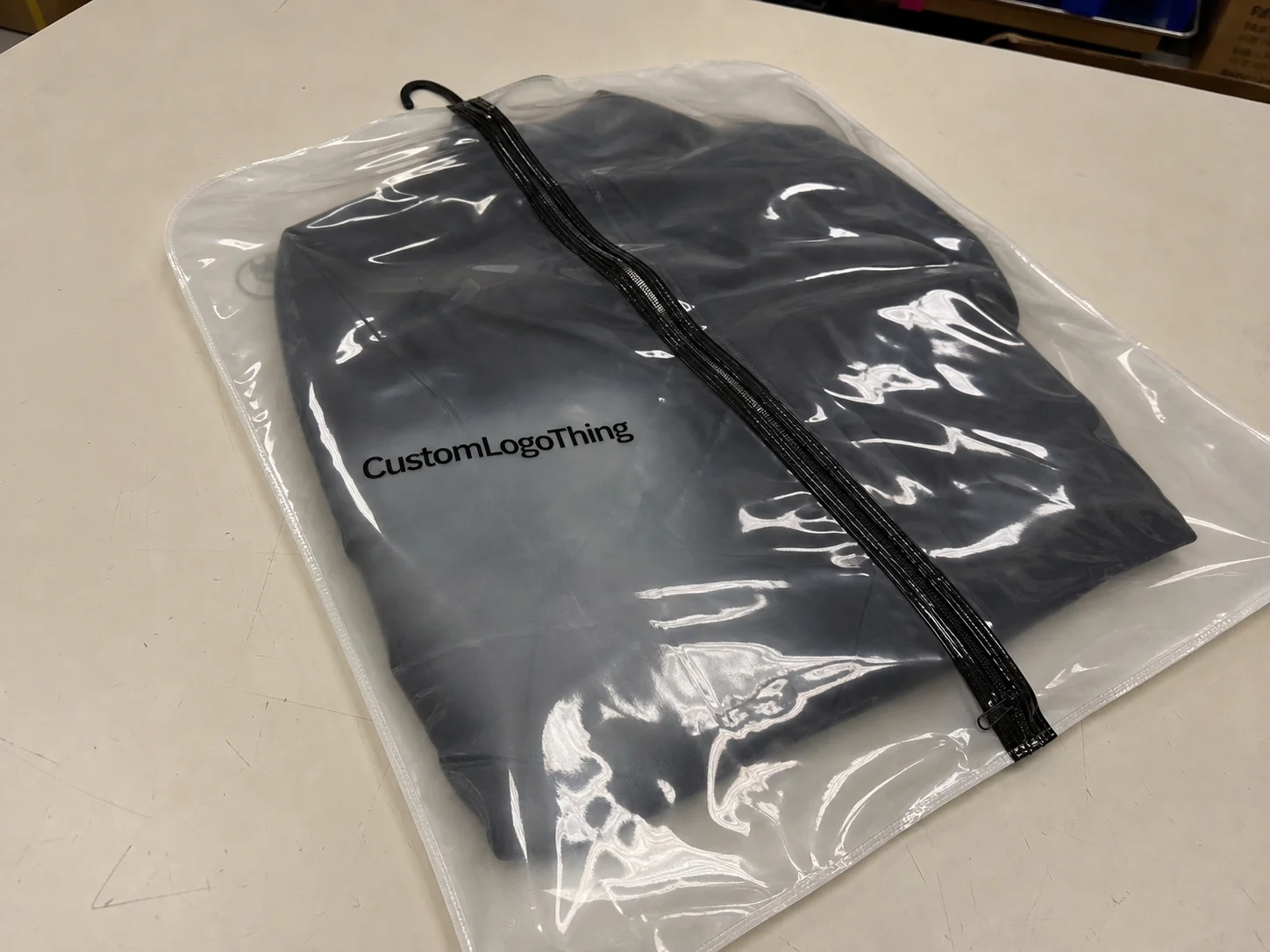
The basic construction includes a PVC film body, zipper track or slider, stitched or heat-sealed edges, and a hanger opening. Depending on the use, the bag may also need a side or bottom gusset, handles, snaps, reinforced seams, a front document pocket, vent holes, warning labels, hang tabs, or inner packing sleeves. Each option changes cost, setup, handling, or inspection time.
Use drives construction. A lightweight shirt cover may work with thinner PVC and a simple hanger opening. A bridal gown bag needs more length, more room for fabric loft, and stronger stress management near the zipper and handles. A long coat bag often needs a gusset because compressed sleeves and shoulders make the finished garment look cheap, even if the garment is not.
Visibility is another practical choice. Transparent PVC supports fast warehouse identification. Frosted PVC looks more polished but slightly reduces product visibility. Colored zipper tape can match a brand palette, though non-stock colors may add sourcing time. Logo placement can sit near the chest, lower front panel, back panel, or pocket. Vent holes may help with storage, but they should match the garment and retail environment instead of being added because someone saw them on another bag.
Compliance-sensitive details belong in the first conversation, not the last proof. Confirm the intended market, suffocation warnings, labeling rules, barcode placement, and retailer packaging requirements before approving samples. For broader packaging performance guidance, buyers can review resources from ISTA, especially if cartons will move through parcel networks, retail distribution, or mixed freight.
The smartest suppliers do not ask buyers to guess technical details. They translate the use case into specs. That is the useful work: fewer vague assumptions, fewer quote revisions, and fewer production surprises.
Specifications That Change Fit, Strength, and Scheduling
Before asking for bulk pricing, prepare a simple specification sheet. It does not need to be pretty. It needs to be precise.
Include bag length, bag width, gusset depth, PVC thickness, zipper style, hanger opening size, seam style, print size, print colors, order quantity, and packing quantity per carton. If the order includes multiple sizes, list each size separately. A combined total of “5,000 garment bags” is not enough if production needs 2,000 suit bags, 1,500 coat bags, and 1,500 gown bags.
Sizing starts with the garment on the hanger, not folded on a desk. Measure shoulder width, total hanging length, sleeve bulk, and fabric loft. Then add enough allowance so the bag does not compress the product. For suit jackets, a common mistake is measuring only the front panel and forgetting that padded shoulders need room. For gowns and long coats, bottom clearance matters because fabric bunching at the base can stress the zipper and make the bag harder to pack.
Flat bags are efficient for shirts, samples, and lightweight garments. Gusseted bags are better for coats, bridalwear, uniforms, robes, costumes, and bulkier apparel. A 5 cm gusset can change the user experience. It adds material and carton volume, yes. It can also prevent wrinkling, zipper strain, and that sad overstuffed look nobody paid for.
PVC thickness affects both performance and scheduling. Thinner film may suit short-term retail protection or internal sample movement. Heavier gauges support reuse, longer storage, and a more premium hand feel. A common apparel range is roughly 0.10 mm to 0.20 mm, depending on bag size and use. Thicker PVC improves structure, but it also increases unit weight, carton size, freight cost, and sometimes material preparation time.
Print method matters too. A small one-color logo usually moves faster than dense ink coverage, large flood print, multiple colors, metallic effects, or registration-sensitive artwork. Vector artwork reduces proofing risk. Pantone references reduce color arguments. A logo pulled from a website header usually creates the opposite result: fuzzy edges, wrong proportions, and one more email thread nobody needed.
- Fit specs: length, width, gusset depth, hanger opening, and garment allowance.
- Strength specs: PVC thickness, zipper type, seam style, handle reinforcement, and snap position.
- Branding specs: print location, print size, ink colors, logo file format, and approval proof.
- Logistics specs: pieces per inner pack, carton count limits, carton marks, destination, and deadline.
The repeat offenders behind revision cycles are easy to spot: unclear logo files, missing Pantone colors, unconfirmed zipper color, mixed sizes in one combined total, and late changes to hanger openings. A short spec sheet prevents most of it. It also makes lead time planning factual because price, MOQ, sample timing, and bulk production timing are all based on the same assumptions.
Pricing, MOQ, and Unit Cost Drivers
Unit cost is driven by film thickness, bag dimensions, zipper type, printing complexity, order quantity, packing method, and freight conditions. That sounds obvious until two quotes differ by $0.18 per unit and nobody can tell whether the gap is PVC gauge, carton size, print coverage, or shipping method.
MOQ is not an arbitrary punishment, even when it feels like one. It is a production efficiency issue. Factories need enough units to justify material setup, printing preparation, cutting, sealing or stitching, inspection, carton packing, and line scheduling. A printed zipper garment bag with three sizes may require separate cutting runs, separate packing labels, and separate quality checks, even if the logo is identical.
Size is one of the quiet cost drivers. A longer garment bag consumes more PVC, takes more carton space, and increases shipping weight. Freight can erase the savings of a cheap unit price if cartons cube out before they weigh out. With bulky garment bags, carton volume often matters as much as material cost.
Print cost has its own logic. A one-color logo in one location is usually the most economical. Full-panel branding, dense ink coverage, multiple locations, metallic effects, or tight registration can increase setup time and scrap risk. If the goal is premium presentation without unnecessary cost, a moderate logo size on a clear or frosted front panel is often the cleaner commercial choice.
| Specification Choice | Typical Buyer Use | Cost Impact | Lead Time Impact |
|---|---|---|---|
| 0.10 mm clear PVC, flat bag | Shirts, samples, short-term protection | Lower material and freight cost | Usually faster if material is available |
| 0.15 mm PVC with logo print | Suits, uniforms, retail storage | Mid-range cost; balanced durability | Depends on print approval and order quantity |
| 0.18-0.20 mm gusseted bag | Coats, gowns, premium apparel | Higher material, carton, and freight cost | May require longer material and packing setup |
| Custom zipper color and reinforced handle | Branded retail or reusable storage | Higher component and labor cost | Can add sourcing or sampling time |
As a practical benchmark, a simple printed garment bag order may price very differently at 1,000 pieces versus 5,000 or 10,000 pieces because setup cost spreads across more units. Ask for tiered pricing at a launch quantity, a reorder quantity, and an annual program quantity. That gives procurement a real comparison instead of one lonely unit price floating in space.
Custom Logo Things supports larger-volume buyers through Wholesale Programs, which is useful when garment bags are part of a recurring apparel packaging system. Repeat programs can also make artwork, carton labeling, reorder timing, and approved construction easier to control across seasons.
For an accurate quote, include size, thickness, quantity, artwork, zipper preference, destination, packing requirements, and required in-hands date. If any of those are missing, the quote is a placeholder. Sometimes placeholders are useful. They should not be mistaken for buying decisions.
Production Timeline From Approval to Delivery
The timeline has a sequence: quote request, specification confirmation, artwork review, sample or digital proof approval, material preparation, production, inspection, packing, and shipping. The clock does not truly begin when the first inquiry is sent. It begins after the core approvals are complete.
For many custom PVC Zipper Garment bag orders, sample or proof preparation can take several business days after specs and artwork are clear. Bulk production timing then depends on material availability, order quantity, print complexity, factory workload, and inspection requirements. A small one-color repeat order is not the same as a first-time, multi-size order with custom zipper tape and carton labeling.
Pre-production bottlenecks are predictable. Incomplete artwork. Undecided PVC thickness. Unclear size mix. Delayed deposit. Missing ship-to details. Retailer labeling changes after the proof is approved. Each one can pause the file because production teams cannot cut material, prepare print screens, or assign cartons against assumptions that may change tomorrow.
Sampling and bulk production should not be confused. A sample confirms construction and branding. Bulk production means buying materials, setting up the line, making all units, checking them, packing them, and moving them. If the bags must meet retailer handling requirements, ask early whether carton dimensions, barcode labels, inner pack counts, or master carton weights need to follow a routing guide.
Inspection time should be planned, not squeezed in at the end. Basic checks usually include finished bag dimensions, PVC thickness, zipper function, seam strength, handle placement, logo position, print clarity, color match, odor, packing count, carton marks, and visible defects such as wrinkles, scratches, ink smears, or weak sealing. For reusable garment bags, zipper and handle stress points deserve extra attention. Those are the first places users complain when the specification is too light.
Shipping belongs inside the production plan. Air freight can support urgent launches, but it raises delivered cost. Ocean or consolidated freight can reduce cost per unit, but it requires earlier ordering and more calendar buffer. For environmental and materials policy context, the EPA Sustainable Materials Management program is a useful reference point for buyers reviewing packaging choices across cost, handling, and waste reduction.
Add buffer for first-time custom orders. A 5 to 10 business day cushion can be the difference between a controlled launch and a warehouse scramble. Share the real in-hands date, not only the preferred ship date. A supplier plans backward from the date the bags must be usable at destination.
Mistakes That Delay PVC Zipper Bag Orders
The most common delay is painfully ordinary: a buyer requests a rush order before finalizing the exact bag size. That forces re-quoting. It can reset material assumptions, carton counts, sample needs, and even the production slot. Rush plus uncertainty is not a plan. It is a cost risk with a calendar attached.
Artwork is the second trap. Low-resolution logos, missing vector files, unspecified colors, and vague print placement all create proofing delays. “Put the logo near the top” is not enough. A production-ready instruction says something closer to: front center, 90 mm wide, one-color white print, 80 mm below hanger opening, Pantone reference supplied.
Choosing PVC thickness only by price is another expensive shortcut. Under-specifying material can cause sagging, tearing, zipper stress, poor shelf presentation, or unhappy end users. Overbuilding the bag can waste money and increase freight. The right gauge depends on garment weight, storage period, reuse expectations, and presentation goals.
Packaging requirements hide in the background until they suddenly do not. Carton marks, barcode labels, inner poly counts, maximum master carton weights, warehouse routing instructions, and mixed-size packing plans should be confirmed early. Retailers and distribution centers care about these details because they affect receiving speed and inventory accuracy.
Approval chains create their own mess. Merchandising wants the logo larger. Operations wants fewer pieces per carton. Compliance asks for a warning label. Procurement asks for a lower unit price after the sample is approved. One late comment can stop production. A single decision owner and a written checklist reduce that risk.
- Confirm size, thickness, zipper, logo, quantity, packing, delivery address, and required delivery date in writing.
- Send vector artwork and Pantone references before proofing starts.
- List mixed sizes by exact quantity instead of one combined total.
- Share retailer routing rules before carton labels are prepared.
- Approve one final spec sheet before deposit and production scheduling.
These are preventable planning failures, not supplier mysteries. Better documentation gives buyers more control over timing and cost. It also turns garment bag planning into a purchasing discipline rather than a last-minute rescue attempt.
How to Place a Clean Bulk Order
A clean bulk order starts with a short checklist. Confirm the garment type, measure finished hanging dimensions, choose flat or gusseted construction, estimate quantity, select PVC thickness, decide print placement, and define the delivery deadline. If the bag must work for suits, gowns, uniforms, coats, or retail samples, say that directly. Different garments put pressure on different parts of the bag.
If sizing is uncertain, send garment photos or a physical sample. Photos help confirm shoulder width, fabric loft, zipper position, hanger opening, and whether a gusset is justified. A sample garment is even better for premium apparel, bridalwear, costumes, or outerwear because the bag must fit the real product, not an average measurement.
Ask for pricing at the target quantity and the likely reorder quantity. A first purchase of 1,000 pieces may be a pilot order, while 5,000 or 10,000 pieces may reflect the actual production economics. If the team expects repeat buying, say so. It can affect recommendations for MOQ, packing, carton labeling, and reorder timing.
Include must-have dates: retail launch, warehouse receiving appointment, trade show setup, uniform rollout, seasonal inventory deadline, or sample room reset. A preferred ship date is useful, but the in-hands date is stronger because it tells the supplier when the bags need to be at the destination and ready for use.
Custom Logo Things can prepare the practical next steps: specification review, quote, artwork proof, sample recommendation, and production schedule based on the buyer’s deadline. Buyers still comparing product types can also review the FAQ for common ordering questions before sending final specs.
The fastest path is not a frantic inquiry with missing details. It is a complete specification package that lets production start cleanly. Boring? Absolutely. Effective? Also yes.
FAQ
How early should I start order PVC zipper garment bags lead time planning?
Start as soon as garment dimensions, quantity, logo direction, and delivery deadline are known. First-time custom orders need extra time because sampling, artwork proofing, and specification changes can add several business days before bulk production begins. Share the required in-hands date so production and shipping options can be planned backward.
What details are needed to quote custom PVC zipper garment bags?
Provide bag size, PVC thickness, quantity, zipper style, print artwork, print colors, packing requirements, destination, and deadline. If the order includes mixed sizes, list the quantity for each size instead of giving only one combined total. Vector artwork and Pantone color references help reduce proofing delays.
Does thicker PVC increase the lead time for zipper garment bags?
Thicker PVC can affect lead time if the material is not immediately available or if heavier construction requires different handling. It also increases weight and carton volume, which can affect freight timing and cost. Confirm the intended use first so the bag is durable enough without overbuilding the specification.
What affects the MOQ for PVC zipper garment bags with logo printing?
MOQ is influenced by material setup, printing setup, bag size, zipper selection, and whether the order includes multiple sizes or designs. Larger or more complex bags may need higher minimums to keep production efficient. Ask for tiered pricing if comparing a trial order with a larger reorder program.
Can PVC zipper garment bags be rushed for a retail launch?
Rush options depend on final specifications, material availability, artwork readiness, order quantity, and shipping method. The biggest speed advantage comes from approving size, thickness, zipper color, artwork, and packing details before requesting a rush timeline. Air freight may shorten transit time, but it usually raises total delivered cost.