Order PVC Zipper Garment Bags Bulk Reorder Plan for Apparel Buyers
A garment bag is easy to ignore until it fails. One missed Order PVC Zipper Garment Bags Bulk Reorder Plan can leave finished suits, dresses, uniforms, or seasonal launch kits waiting in the packing area while everyone hunts for protective packaging that should have been ordered weeks earlier.
That is not a tiny miss. A PVC zipper garment bag may cost pennies to a few dollars depending on size, gauge, zipper, print, and construction. The apparel inside may be worth 50 to 500 times more. Yet the bag affects dust protection, handling speed, carton organization, showroom presentation, and the first impression a buyer gets before the garment ever reaches a rack.
Cheap item. High consequence.
The risk is rarely “Do we need a bag?” Apparel teams already know the answer. The risk sits in the details: PVC gauge, zipper stock, hanger opening, gusset depth, logo placement, carton packing, approval timing, freight method, and whether the next order matches the last one. If one of those details changes late, the reorder can slide past the garment packing window.
Custom packaging should be treated as a specification file, not a vague product request. Dimensions matter. Material thickness matters. Print method, MOQ, artwork files, proof approvals, carton labels, and repeat-order notes matter even more after the first run. A useful reorder plan gives purchasing, marketing, and operations the same reference point instead of forcing everyone to decode an old invoice or a blurry phone photo.
The goal is simple: move from a rough bag idea to a quote-ready reorder file without overbuying, under-specifying, or missing production timing. Good packaging procurement is not glamorous. It is controlled, documented, and boring in the best possible way.
PVC Zipper Garment Bag Product Details That Affect Reorders
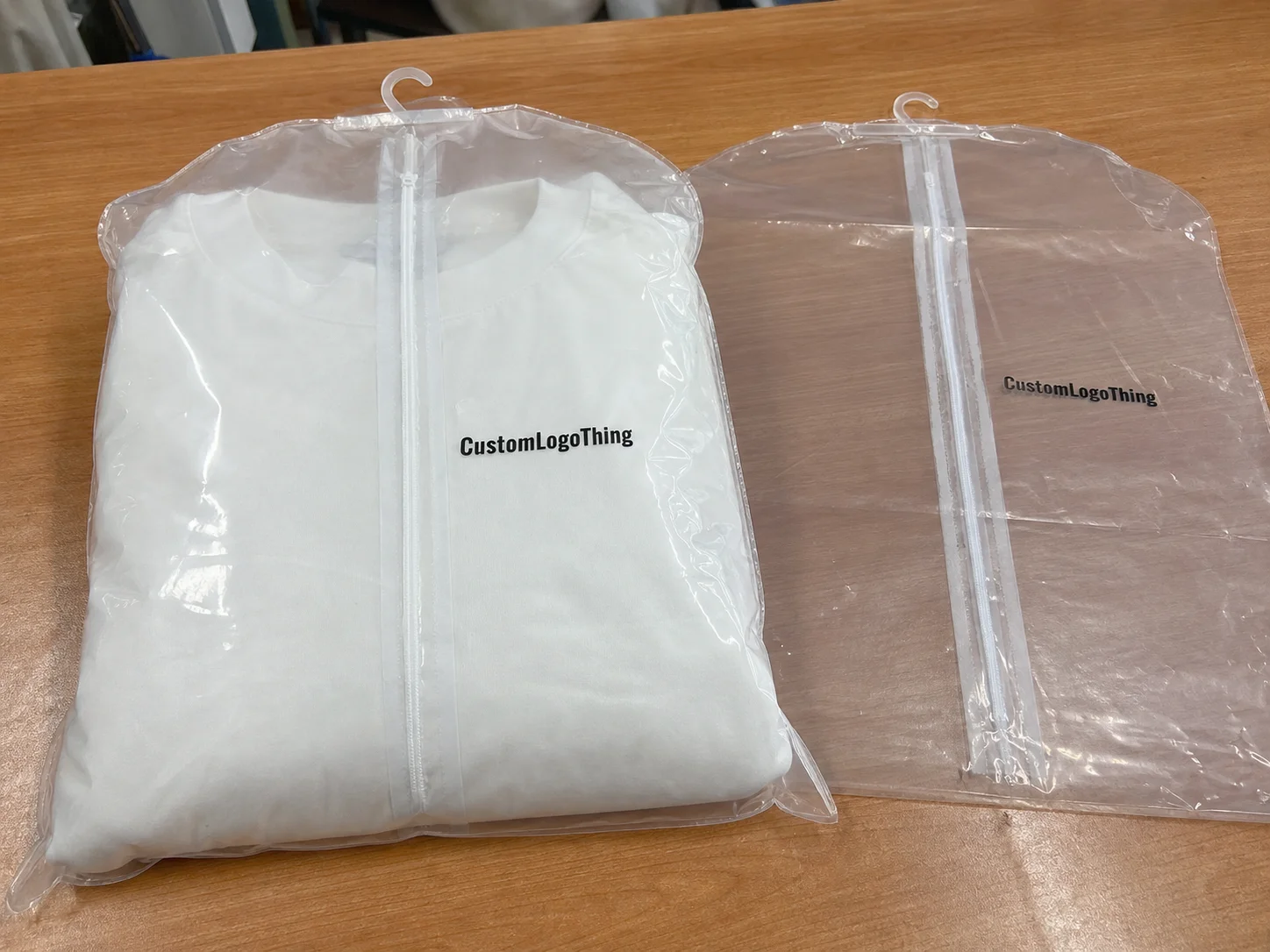
PVC Zipper Garment Bags are transparent or semi-transparent protective bags used for hanging apparel such as suits, dresses, coats, uniforms, bridal gowns, costumes, choir robes, dancewear, retail samples, and storage garments. The common format is straightforward: flexible PVC film, a front zipper, a hanger opening at the top, sealed or sewn edges, and enough clearance for the garment to hang without crushed shoulders or a distorted hem.
The construction options are where repeat orders get serious. A basic garment cover may use a full-length front zipper, centered hanger slit, and straight sides. A more durable showroom or rental bag may add reinforced seams, side gussets from 2 to 6 inches, a bottom gusset for bulkier garments, carry handles, snap closures, card pockets, vent holes, or reinforcement around the hanger opening. Every feature adds utility. Every feature also changes cost, setup, packing volume, and lead time.
PVC has practical advantages for apparel teams. It gives clear garment visibility, resists moisture better than uncoated fabric bags, blocks dust, accepts logo printing well, and has enough structure to look clean in a stockroom or showroom. For high-SKU programs, transparency is not cosmetic. Staff can identify colorways, sizes, and styles without opening every bag.
PVC is not automatically right for every program. Buyers should disclose destination markets, product contact expectations, retailer restrictions, labeling requirements, and storage conditions before quoting. Some retailers restrict certain plastics. Some brands have sustainability targets that rule out PVC even when the material would perform well. For broader packaging policy context, the EPA’s sustainable materials management guidance is a useful reference point, although the correct material decision still depends on the application.
Here is the common mistake: reordering the previous bag size without checking the current garment line. A dress length changes by 2 inches. A hanger changes from slim plastic to padded wood. A coat gets thicker insulation. Suddenly the old bag closes, technically, but it pulls at the zipper and looks undersized. Technically closed is not the same as acceptable.
The smarter method is to group garments into size families. Do not create one custom bag for every SKU unless there is a real handling reason. A 24-by-40-inch bag may cover shirts and short jackets. A 24-by-60-inch bag may cover suits and many dresses. A longer gusseted version may be reserved for bridal, robes, or outerwear. Fewer sizes usually mean cleaner inventory, stronger order quantities, and fewer receiving errors.
Specifications to Lock Before Bulk Production
A serious Order PVC Zipper Garment Bags bulk reorder plan starts with measurements, not adjectives. “Heavy duty” is not a specification. “Suit size” is not a production instruction. A quote-ready file should include width, finished length, gusset depth, hanger slit position, zipper length, zipper direction, handle placement, logo size, print location, carton packing preference, and delivery destination.
Material gauge is one of the biggest decisions. Lighter PVC can work for short-term retail coverage, dust protection, or garments that move once from packing to customer pickup. Medium films usually suit stockroom handling, show samples, and standard apparel programs. Heavier PVC is better for repeated showroom handling, rental garments, uniform issue programs, bridal storage, costumes, and coats.
Exact gauge availability depends on supplier stock and construction method, but buyers should compare films by intended handling cycles, not by feel alone. A bag that feels impressive on a conference table may be too stiff for fast warehouse packing. A bag that feels soft and economical may fail after repeated zip-open, zip-close use. That is the fun part of packaging. There is always a tradeoff.
Zippers deserve the same attention. Nylon zippers are common because they are flexible and cost-effective. Plastic pulls keep weight down and reduce metal-to-garment contact. Metal pulls can feel more premium, but they may add cost, weight, and a small snag risk around delicate fabrics. Stock zipper colors are usually easier to source than custom colors. Black, white, and clear options cover most programs, but buyers should confirm availability before designing around a specific shade.
Zipper direction matters too. Some bags open from top to bottom. Others open from bottom to top. The zipper may stop above the bottom seam to reduce stress at the lower corner. For long gowns, choir robes, or bulky coats, that detail can affect how easily staff load garments during a packing rush.
Branding should support visibility, not fight it. A one-color logo in the upper chest area often works well for suits and uniforms. Multi-color printing can help retail branding, but it increases setup complexity and requires tighter artwork review. Common print details include front panel logos, back panel care instructions, QR codes, retailer-specific markings, and open areas where the garment must remain visible.
Packaging control point: Save the approved dieline, artwork version, PVC gauge, zipper type, carton count, and production notes after the first order. A reorder without those details is not a reorder. It is a new project pretending to be simple.
Flexible plastic bags also have tolerances. Length, width, gauge, seam placement, and print position can vary within normal production limits. Buyers should confirm acceptable variance before approval, especially for garments with tight fit requirements or retail display rules. Standards bodies such as ISTA focus heavily on transport testing and packaged-product performance; garment bags are not always tested as standalone shipping packs, but the same discipline applies: define the conditions before judging performance.
| Specification Area | Typical Buyer Choice | Reorder Risk If Unclear |
|---|---|---|
| PVC gauge | Light, medium, or heavier film based on handling frequency | Bag may tear, feel too stiff, or cost more than needed |
| Bag size | Width, length, and gusset matched to the largest garment family | Zipper strain, crushed shoulders, or excess inventory sizes |
| Zipper | Nylon zipper with plastic or metal pull, stock or custom color | Performance and appearance may shift between orders |
| Logo print | One-color or multi-color print with fixed placement | Logo may block garment view or move from approved position |
| Packing | Bulk packed by count per carton, with labels if needed | Warehouse receives hard-to-count or hard-to-stage cartons |
Pricing, MOQ, and Unit Cost Drivers for Bulk Garment Bags
Pricing is not based on size alone. A 24-by-54-inch clear PVC garment cover with a stock zipper, one-color logo, and bulk carton packing is a different product from a gusseted bridal garment bag with reinforced handles, metal pulls, multi-color printing, and custom carton labels. The invoice may call both items garment bags. Production does not.
The main cost drivers are PVC thickness, zipper type, gusseting, sewing or sealing method, logo colors, print coverage, order quantity, packing method, and shipping destination. Larger orders usually lower unit cost because setup work spreads across more pieces. Material preparation, printing setup, cutting, zipper assembly, inspection, and packing all carry fixed labor before the first sellable bag is packed.
For many custom PVC zipper garment bag programs, buyers should ask for tiered pricing at 500, 1,000, 2,500, and 5,000 pieces. Those tiers are not magic numbers, but they reveal the cost curve. The right tier depends on cash flow, storage space, carton count, forecast confidence, and how likely the garment line is to change.
A lower unit price is not automatically a win if it leaves the warehouse holding 18 months of slow-moving bag inventory. Smart buyers compare unit cost against usage rate, not against ego-sized volume targets. Nobody gets a medal for owning too many empty bags.
Repeat orders can reduce friction if the prior production file is complete. Approved print files, known carton counts, stable dielines, and recorded specifications can cut quoting loops. That does not always mean the unit cost drops. Resin pricing, freight conditions, currency movement, and labor inputs still move. A clean reorder plan usually speeds confirmation and reduces the chance of paying for corrections, which is where the real savings often sit.
Be careful with quote comparisons. A thinner PVC gauge, shorter zipper, smaller gusset, lighter carton, or reduced print coverage can make one quote look cheaper while changing actual performance. Ask for landed-cost visibility where possible: product cost, setup, proofing, packing, freight, and any special handling. If the bags are part of a wider procurement program, Custom Logo Things can also align packaging discussions with Wholesale Programs for buyers managing recurring custom items across multiple departments.
Process and Timeline From Quote to Reorder Delivery
The ordering sequence should be traceable. Send specifications. Receive the quote. Approve artwork. Review a digital proof or sample. Confirm the production invoice. Enter manufacturing. Inspect. Pack. Ship. Receive and count cartons. Save the reorder file.
First orders take longer because the specification work is heavier. A new buyer may need to confirm garment measurements, choose gauge, select zipper direction, test logo placement, and decide whether sampling is needed. Depending on customization, production volume, and shipping method, custom bag programs often require multiple approval steps before manufacturing begins.
Repeat orders move faster only when the previous file is approved and unchanged. That caveat matters. “Same as last time except…” is often where delays start. A small artwork change may need a new proof. A new delivery location may change freight. A different garment size may require a revised dieline. A custom zipper color may require availability checks.
Several issues slow the timeline. Unclear dimensions are common. Low-resolution logos are another. Late artwork changes, unusual PVC gauges, pre-production sample requests, and freight decisions made after production can each add days. If the garment launch date is fixed, the bag timeline should be worked backward from that date, not squeezed in after apparel is ready.
Sampling is useful when the bag must match a premium presentation standard or protect high-value apparel. A digital proof can confirm logo placement and general layout. A pre-production sample can confirm physical size, gauge, zipper feel, seam construction, and handle placement. A production reference sample can become the control item for long-term reorders. Sampling adds time, but it may prevent a much more expensive mismatch at 2,500 pieces.
Quality control should be basic but specific. Check finished size, zipper function, seam integrity, hanger opening, print placement, print color, carton count, and visible film defects. For printed bags, confirm that ink is not scuffed, misregistered, or placed where it blocks critical garment visibility. For gusseted bags, check that the gusset opens cleanly and does not twist under garment weight.
The practical reorder buffer is simple: request the next quote before stock becomes critical. If garment bags are tied to seasonal apparel drops, trade shows, school uniform programs, bridal collections, rental returns, or warehouse packing windows, do not wait until the last carton is open. Emergency air freight can erase bulk-order savings in one ugly shipment.
- Low-risk reorder: Same bag size, same gauge, same zipper, same logo file, same destination, and enough stock for normal transit.
- Medium-risk reorder: Same bag with a small artwork change, adjusted carton label, or new delivery location.
- High-risk reorder: New garment size, new material thickness, new zipper color, urgent deadline, or sample required before approval.
Common Buying Mistakes That Raise Risk or Waste
The biggest mistake is ordering by garment length alone. A 48-inch garment does not always fit well in a 48-inch bag. Hanger height, shoulder width, garment thickness, padding, train length, folded inserts, and whether items are packed individually or layered all change the required clearance. Add handling room. A bag that closes but strains at the zipper is not the right size.
Overbranding is another quiet problem. A logo that is too large can block the garment view, which defeats one of PVC’s main advantages. Ink color matters too. White may pop on dark garments but fade visually against a bright showroom wall. Black may look sharp on clear PVC but disappear against navy or black apparel. A practical proof should consider the garment color behind the bag, not just the logo on a blank template.
Under-specification causes worse trouble. “Standard zipper” can mean different pull materials, tooth sizes, zipper tapes, and color choices. “Thick PVC” can mean one thing to a boutique and another to a uniform distributor handling hundreds of garments per week. Replace vague terms with measurable details: finished dimensions, gauge target, zipper type, print size, print position, and carton count.
Inventory waste often comes from too many bag sizes. Apparel teams sometimes request separate bags for every garment style because that feels precise. In practice, three well-chosen size families may cover shirts, jackets, suits, coats, and dresses with less warehouse confusion. Fewer SKUs can mean stronger reorder quantities and cleaner purchasing approvals.
Another mistake is ignoring storage conditions. PVC garment bags packed tightly in cartons should be stored away from excessive heat, sharp carton edges, and heavy compression. Long-term storage is not the same as short-term staging. If bags sit for months before use, carton labeling and rotation matter. First in, first out is not exciting. It works.
Last-minute air freight hurts twice. First, it adds direct freight cost. Second, it proves the reorder system failed. If a bulk order saves $0.12 per unit but rush freight adds $600, the math collapses quickly. A disciplined plan should include reorder triggers based on monthly usage, carton quantity, production lead time, approval time, and transit method.
Maintain a record with the approved artwork, supplier quote, carton quantity, net weight, gross weight, delivery destination, and production notes. If internal purchasing teams need general policy answers before ordering, the Custom Logo Things FAQ can help clarify common custom order and proofing questions.
Repeat Order Control for Apparel Packaging Teams
Repeat apparel programs need specification control, not just the closest stock bag someone can source in a hurry. A commodity approach may work for a one-time storage need. It breaks down when packaging has to match across seasons, departments, store locations, or garment categories.
The useful work is documentation. Saved artwork, repeatable dimensions, material guidance, proofing support, and quote records give purchasing teams a cleaner path from reorder request to approval. Nobody wants to rebuild a logo placement file every season. Nobody wants to re-measure the same suit bag because the previous order never had finished dimensions recorded.
Bulk-order suitability is broad. Apparel brands, uniform suppliers, dry-cleaning support programs, boutiques, bridal retailers, costume companies, school outfitters, and promotional garment distributors can all benefit from custom garment packaging when the bag is part of the customer experience or operating workflow. A uniform program may care most about durability and carton counts. A bridal retailer may care most about presentation and length. A boutique may want a small logo and strong garment visibility.
The practical decision is not “add more features.” It is balancing presentation, durability, cost, and reorder frequency. Handles can be useful. They are not always necessary. A heavier gauge can be smart for rental garments. It may be wasteful for short-term retail coverage. Multi-color printing can look premium. It may be excessive if a one-color logo delivers the same brand recognition.
Operational coordination also matters. Carton labels, packing counts, repeat-order references, and production notes reduce receiving confusion. Clearer pricing, fewer approval loops, and better packaging inventory control are not flashy benefits. They are the benefits that keep apparel moving.
Build a Quote-Ready Reorder File
A quote-ready file should answer the basic production questions before the supplier has to ask them. Start with bag width, finished length, PVC gauge, zipper color, zipper direction, hanger opening, gusset requirement, handle requirement, logo file, print colors, quantity, packing preference, and delivery destination. If you know the carton count target or pallet limitations, include those too.
If you are reordering from an old supplier or trying to match an existing package, send clear photos. Photograph the full bag, zipper, hanger opening, seams, handles, logo placement, card pockets, and any labels. Then measure the bag flat: outside width, finished length, gusset depth, zipper length, logo size, and distance from the top edge to the logo. Photos help. Measurements decide production.
Measure the largest garment in each category and add handling clearance. Do not build the size around the smallest sample in the line. For suits and uniforms, check shoulder width and hanger height. For bridal, formalwear, and costumes, check skirt volume, train length, embellishments, and whether the garment will be stored hanging or transported by hand. For coats, check depth. Bulk creates pressure fast.
Ask for tiered pricing and estimated lead time at the same time. Purchasing needs both numbers to make a rational decision. A 2,500-piece tier may improve unit cost, but a 1,000-piece order may make more sense if the garment line changes frequently. The right answer depends on usage rate, forecast confidence, storage space, and launch timing.
After production, label the approved specification as the reorder file. Include date ordered, quantity, artwork version, PVC gauge, zipper description, carton count, delivery destination, and any changes made during approval. Future buyers, assistants, and warehouse teams will thank you. More importantly, the next reorder will not depend on memory.
A reliable Order PVC Zipper Garment Bags bulk reorder plan starts with locked specs, realistic timing, and a quote built around actual use. That is the difference between controlled packaging inventory and a scramble at the packing table.
FAQ
What details do I need to order PVC zipper garment bags in bulk?
Provide bag width, finished length, gusset depth, PVC gauge, zipper style, hanger opening, logo artwork, print colors, quantity, packing preference, and delivery address. If you are matching an existing bag, send photos, measurements, and any prior purchase order or supplier specification available.
How does a bulk reorder plan reduce PVC zipper garment bag costs?
A bulk reorder plan keeps dimensions, artwork, material gauge, zipper details, and packing instructions consistent. That reduces quoting delays, avoids unnecessary redesign, and helps buyers order at better quantity tiers instead of paying rush freight or placing small emergency orders.
What MOQ should I expect for custom PVC zipper garment bags?
MOQ depends on bag size, PVC thickness, printing, zipper type, and customization level. Buyers should request tiered pricing at several quantities, such as 500, 1,000, 2,500, and 5,000 pieces, to see where the unit cost improves enough to justify the larger order.
How long is the lead time for custom PVC zipper garment bag production?
Lead time depends on proof approval, sampling needs, production volume, material availability, and shipping method. Repeat orders are usually simpler when the previous specifications and artwork are already approved, but buyers should still plan around garment readiness dates and warehouse packing windows.
Can I reorder PVC zipper garment bags with the same logo and size?
Yes, if the approved artwork, dimensions, material, zipper details, and prior production notes are available. Before reordering, confirm that garment dimensions, branding requirements, retail rules, packing method, and delivery location have not changed.