Recyclable Poly Bags Wholesale Custom Logo Printing: What Buyers Should Lock In Before Ordering
For buyers comparing Recyclable Poly Bags Wholesale custom logo options, the logo is only one line item in a much larger decision. The bag has to fit the product, survive handling, print cleanly, and run efficiently on the packing line. If any of those pieces are off, the order tends to cost more than expected, even when the art looks good on screen.
That is why experienced buyers usually start with film type, thickness, and closure before they talk about color count or layout. Recyclable polyethylene film remains a common choice for apparel, literature, kits, and many light-to-midweight goods because it keeps tare weight low and presents a clean surface for branding. The caveat is straightforward: recyclability depends on local collection and processing rules, so “recyclable” should be understood as polyethylene film designed for recycling streams that accept it, not as a universal curbside guarantee.
A bag that is one mil too light can fail at the seal or corner. A bag that is one mil too heavy can lift cost across the whole order. The difference is rarely theoretical once production starts.
That tension between appearance and performance is what makes this category interesting. Buyers often arrive with a logo-first mindset, then discover that the film spec, seal style, and print setup account for most of the real cost and most of the real risk.
Why the bag spec often matters more than the logo
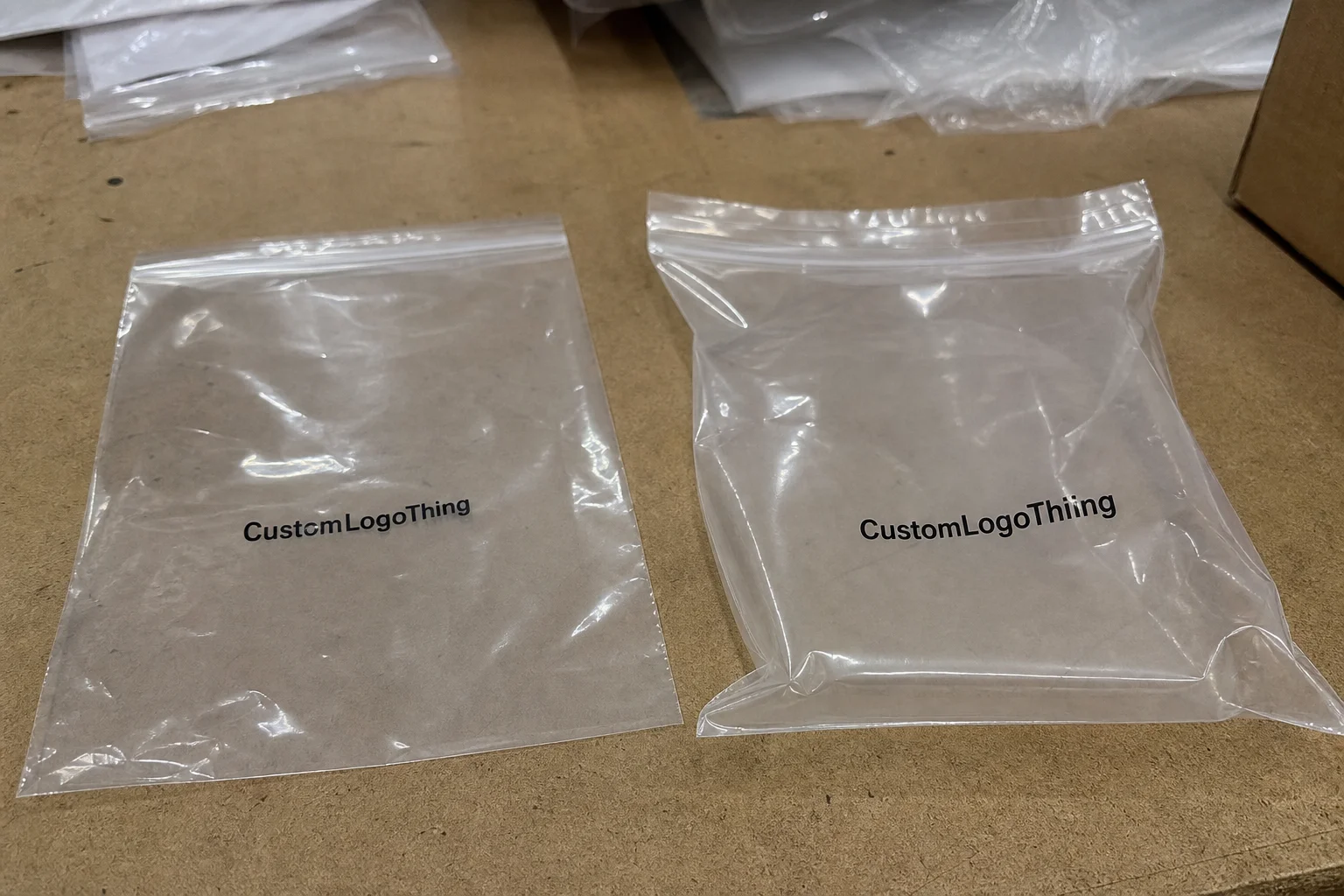
Branded packaging looks simple from a distance. Up close, it is a small manufacturing system. The image on the bag matters, but the film gauge, seal integrity, and packaging flow usually decide whether the order is smooth or frustrating.
A 1.5 mil bag and a 2.0 mil bag can look nearly identical in a mockup. In production, they behave differently. The heavier film usually gives more puncture resistance and a firmer hand feel, but it also uses more resin and can print differently depending on the artwork and ink coverage. Buyers sometimes assume a tiny thickness change will not move price much; in wholesale packaging, that assumption is usually wrong.
The same is true of closure style. Layflat bags are usually the simplest and least expensive. Gusseted bags give extra room for bulkier products. Reclosable bags are useful when the pack needs to be opened more than once, such as with accessory kits, sample packs, or apparel sets. Wicketed bags help on faster lines because the stack feeds more efficiently. Each choice affects labor, speed, and conversion cost.
For products with edges, corners, or uneven shapes, the safest approach is to test the actual item rather than relying on a catalog size. A bag that looks large enough can still split at the seal if the contents press against the edge. A bag that is too generous may shift product around, which looks sloppy and wastes film. In practice, the right spec is the one that loads easily and protects the contents without excess material.
Buyers managing a broader packaging program often end up comparing the bag spec with cartons, inserts, and mailers at the same time. That context matters because a branded poly bag is rarely the only packaging component on the order. If other items are being sourced too, the same team may also be working through Custom Packaging Products or a recurring Wholesale Programs order, and consistency across materials becomes part of the value.
Film, closure, and print options that shape the order
LDPE is common for flexibility and clarity. LLDPE is often chosen when the buyer wants better puncture resistance or a slightly tougher feel. Some bags use blends to balance softness and strength, which can be useful when the contents are irregular or when the package will be handled several times before it reaches the end user.
For print, flexography remains the most practical method for many wholesale runs. It is efficient, repeatable, and well suited to logos, short copy, warning text, and simple graphics. The cleaner the artwork, the more predictable the result. Heavy ink coverage, tiny reversed type, and fine gradients are possible, but they raise the risk of registration issues and can increase proofing time. Buyers who simplify a design from three colors to two often save more than they expect.
Not every bag needs to be treated like a poster. A sharp logo on the right film with a clean seal usually performs better than an overdesigned package that strains the production process. If the artwork depends on delicate details, it is worth checking them at actual print size rather than assuming they will hold up once transferred to film.
Practical add-ons can also shape the final spec:
- Hang holes for retail display.
- Warning or handling copy when required for internal use or compliance.
- Opaque, tinted, or clear film depending on whether the brand wants product visibility or stronger logo contrast.
- Bottom seal, side seal, or reclosable closure depending on how the bag will be filled.
For programs where transit protection matters as much as presentation, buyers sometimes reference testing standards such as the ISTA framework or ASTM methods for material properties like tensile strength and puncture resistance. Those standards do not replace real sample testing, but they help define what “good enough” means before production begins.
Dimensions, gauge, and performance checks
Width, length, gusset depth, and gauge are the numbers that decide whether the bag works in the real world. Those numbers should be based on the actual product footprint, not a previous order that happened to be close or a rounded size pulled from memory. A package that is too tight slows packing and increases stress at the seam. A package that is too loose allows the product to move around and can make the branded presentation look careless.
The best spec review starts with the contents. What is the final product size? Does it include a zipper, a rigid insert, a sharp corner, or a textured edge that can snag film? Does the bag need extra headroom for easy loading on the line? Those details matter more than broad labels like “small,” “medium,” or “large,” because those terms are not standardized across suppliers.
Gauge should be matched to handling conditions, not just to the look of the sample. A lightweight film might be fine for a folded shirt, a booklet, or a soft accessory. The same film could be underbuilt for a rough-edged product or a pack that will move through multiple touchpoints before shipment. On the other hand, adding thickness just to feel safer can push cost higher without making the order materially better.
Before a run is approved, a proper sample check should cover the basics:
- Seal strength so the bag does not open or split under normal handling.
- Puncture resistance if the contents have corners, clasps, or other hard points.
- Print clarity so the logo reads cleanly on the selected film.
- Line compatibility so operators can load bags without slowing the packing flow.
That sample review is usually the best place to catch problems. A digital proof can confirm artwork placement, but it cannot show how the film behaves when the product is inserted or how the seal feels once a real item is inside. Buyers who skip that step often discover the issue after production has already started, which is the expensive way to learn.
There is also a broader packaging context. If the same brand is sourcing cartons, inserts, or paperboard pieces, the bag should not be specified in a way that clashes with the rest of the program. A well-run branded line usually feels consistent from the outer package to the inner presentation, even when the materials are very different.
Pricing, MOQ, and what drives unit cost
Pricing for Recyclable Poly Bags Wholesale custom logo orders usually comes down to a few core variables: bag size, film gauge, resin grade, closure style, print colors, and the amount of setup required. If a quote looks unusually high, the reason is often hidden in one of those details rather than in the bag itself.
MOQ is tied to the economics of production. Plates, press setup, converting time, trim waste, and packing all have to be spread across the order. That is why a larger quantity often lowers the unit price even if the bag design does not change. Standard dimensions generally support lower MOQ than unusual dimensions, and a simple print layout usually moves more efficiently than a dense full-coverage design.
For context, wholesale pricing pressure often falls into broad bands like these. Exact numbers vary by material, print complexity, and freight.
| Bag option | Typical use | Unit cost pressure | Setup impact |
|---|---|---|---|
| Standard layflat, one-color print | Apparel, literature, light kits | Lower | Lower |
| Gusseted bag, one to two colors | Bulkier product packs | Moderate | Moderate |
| Reclosable bag with print | Accessories, samples, repeat-open packs | Moderate to higher | Moderate to higher |
| Heavy gauge or high-coverage print | Rougher handling, stronger brand presence | Higher | Higher |
There are simple ways to keep cost under control without weakening the bag. Use standard dimensions where possible. Keep the print to one or two colors if the design allows it. Avoid changing the spec on every reorder. Stability helps production, and stable production usually helps price. The same logic applies to other packaging categories, including Custom Poly Mailers, where material choice and print setup can shift unit economics just as quickly.
One practical caution: underpricing a bag by focusing only on film thickness can distort the comparison. A slightly lighter bag may look cheaper until extra labor, damage, or rework enters the picture. The lowest quoted number is not always the lowest landed cost.
Lead time, proofing, and production steps
The order flow is usually straightforward: spec intake, artwork review, proof approval, production, quality check, packing, and shipment. Each step is familiar. Delays usually come from missing information or revisions that could have been handled earlier.
Lead time depends on the exact job. A repeat order with approved artwork often moves faster than a new design with special print requirements or a less common bag construction. Artwork changes, delayed approvals, resin availability, and freight method all affect timing. Even a small revision to logo placement can push a run back if the press schedule is already set.
The most common slowdowns are easy to spot:
- Dimensions are estimated instead of measured.
- Artwork is supplied as a low-resolution file instead of vector art.
- Print placement is unclear, especially for one-side versus two-side printing.
- Proof approval lingers while production is waiting to release materials.
Once the proof is approved, the job should move with very few open questions. That kind of discipline matters because packaging production is sensitive to small changes. A different closure, a revised ink color, or a shift in gauge may seem minor, but each one can affect the line, the setup, and the final pack-out.
Buyers who order through a direct wholesale channel often get clearer communication about what is realistic and what is not. That is one reason teams prefer a direct Wholesale Programs relationship instead of spreading the order across multiple intermediaries. Fewer handoffs usually means fewer misunderstandings.
How to evaluate a wholesale supplier
A polished quote does not tell you whether the supplier can hold a repeat spec. What matters is consistency across film thickness, print registration, and reorder runs. A cheap first order can turn expensive if the second run arrives with a different feel, a shifted logo, or a change in bag behavior on the line.
Direct manufacturing can improve clarity on pricing, timing, and communication because it reduces the number of places where a spec can drift. That does not make every direct supplier better by default, but it usually gives the buyer more control over the details that matter. In packaging, a small misunderstanding about gauge or seal type can ripple into a larger problem than the artwork itself.
Good support also shows up in the questions a supplier asks. The better ones review art files, flag weak specs, and say plainly when a bag is overbuilt or underbuilt for the contents. That kind of feedback saves money because not every product needs a premium gauge or a more complex print layout. Sometimes the right answer is a simpler bag with tighter execution.
Recyclability claims deserve careful wording. A supplier should be able to explain the film type and intended recycling path clearly, without implying that every local program will accept it. Precision matters here. Vague environmental language can sound appealing, but buyers are usually better served by a plain explanation of the material and the limitations.
Before moving forward on a larger order, ask a few direct questions:
- Can the supplier hold thickness and print consistency on repeat runs?
- Will they review artwork before production?
- Can they explain the material choice in plain terms?
- Will they support a reorder without rebuilding the file from scratch?
If the answers are clear, the supplier is probably worth keeping in the rotation. If the answers stay vague, the risk usually shows up later in the process rather than sooner.
For buyers who need packaging that works as a system rather than a one-off item, the useful supplier is the one who can balance appearance, cost, and production constraints without overselling what the bag can do.
What to send for an accurate quote
The fastest quote starts with the right data. Send the finished dimensions, product weight, closure style, print colors, quantity, and ship-to ZIP in one pass. If the bag needs warning copy, a hang hole, or a specific opacity level, include that too. Every missing detail becomes a follow-up question, and every follow-up question adds time.
Vector artwork helps the proof stage move faster and reduces the risk of a stretched or soft logo in print. If the design includes fine type or thin rules, mention that upfront. A note about whether the bag should be clear, tinted, matte, or gloss also saves revisions later.
Sample review is still worthwhile for fragile products, tight pack lines, or any order with strict presentation requirements. A proof can confirm layout, but it cannot show how the product actually sits in the bag. That gap is where a lot of production problems hide.
For recurring orders, the best protection is a locked spec. Keep the approved dimensions, film type, closure, print count, and artwork file consistent from run to run. Once those details are stable, Recyclable Poly Bags Wholesale custom logo orders tend to move with fewer revisions and less friction. That is usually what buyers want: a package that looks branded, behaves predictably, and does not turn every reorder into a new project.
The cleanest order is not the fanciest one. It is the one with enough detail to quote accurately, enough testing to avoid surprises, and enough restraint to avoid paying for features the product does not need.
What affects the price of recyclable poly bags with a custom logo?
Size, gauge, print colors, closure style, and quantity usually drive most of the price difference. Setup items such as plates, special tooling, and freight can change the landed cost as well, especially on smaller runs.
What MOQ should I expect for wholesale recyclable poly bag orders?
MOQ depends on print method, bag size, and the amount of setup required. Standard specs usually have a lower MOQ than custom dimensions or heavy print coverage because the production line can run more efficiently.
Can recyclable poly bags be printed on both sides?
Yes. Many wholesale runs can be printed on one or both sides, depending on the bag style and press setup. Two-sided printing usually adds complexity and can affect unit cost and minimums.
How do I choose the right thickness for a custom logo poly bag?
Match the gauge to product weight, sharp edges, and how the bag will be handled. Test the actual item before approval so the final spec is strong enough without being overbuilt.
What do you need for a fast quote on custom recyclable poly bags?
Send dimensions, quantity, artwork, closure style, ship-to ZIP, and any warning-copy or compliance requirements. The more complete the spec, the faster the quote and proof can move into production.


