Bulk packaging buyers rarely start with the packaging itself. They start with a problem: freight cost is creeping up, warehouse handling is slower than it should be, or the current packout protects the product but adds more weight and expense than the item really needs. That is the practical opening for a recyclable Poly Bags Wholesale manufacturer. For many non-fragile products, recyclable poly offers a rare combination of low tare weight, moisture resistance, and printability without forcing the buyer into a heavier format.
The decision is usually not ideological. It is operational. Can the bag run on the line? Can it hold up in transit? Can the spec be repeated without drift on the next reorder? Those questions matter more than broad packaging claims, because large programs fail on inconsistency long before they fail on appearance.
Custom Logo Things works with buyers who need packaging that performs in the warehouse first and looks polished second. That priority order is sensible. Presentation still matters, but pallet efficiency, line speed, and material waste usually decide whether a bag stays in the program.
Why Recyclable Poly Bags Make Sense for Bulk Packaging
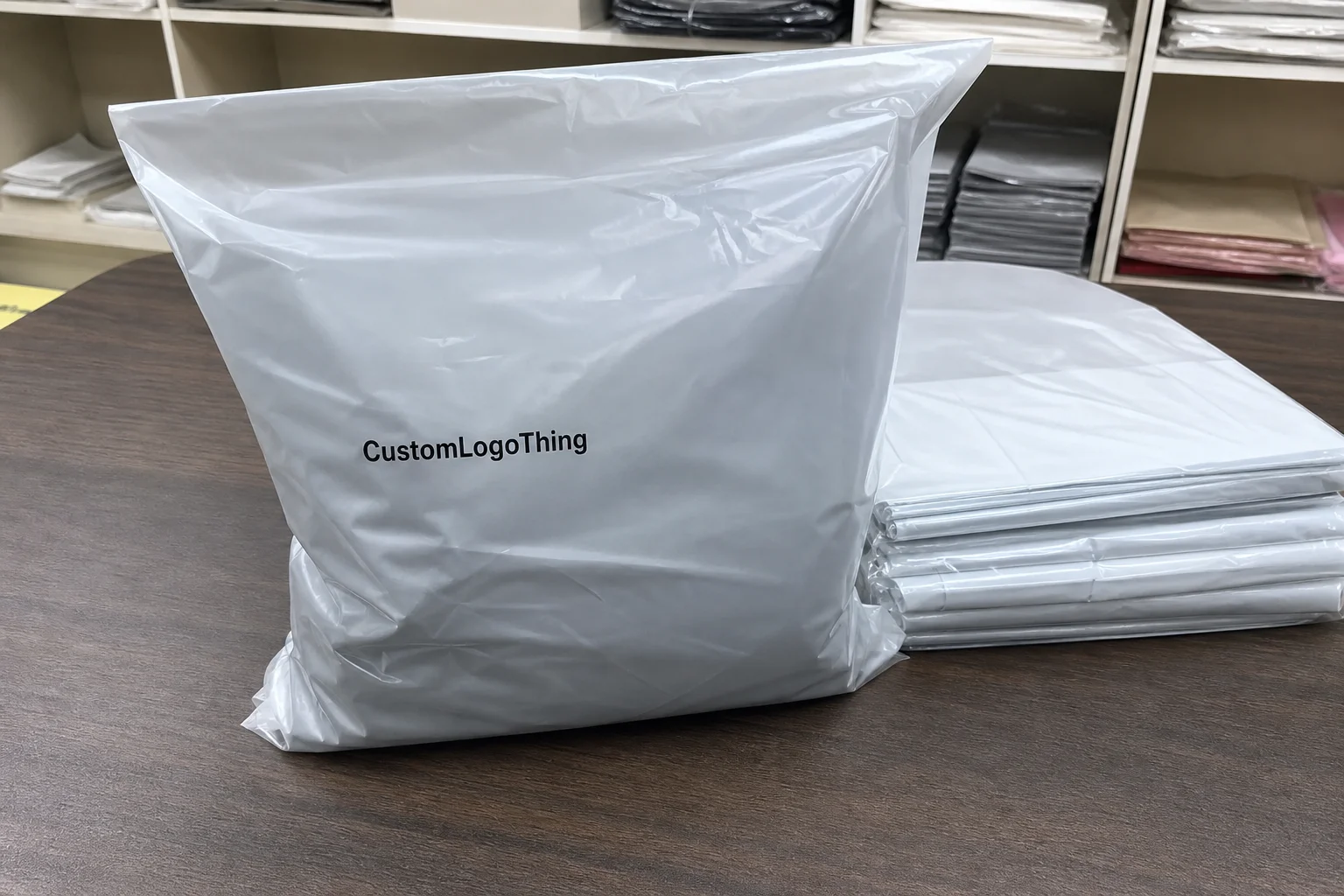
Many buyers default to heavier packaging because it feels safer. In practice, “more material” is not always better protection. A properly specified recyclable poly bag can shield garments, soft goods, accessories, printed inserts, and many non-breakable items at a fraction of the freight weight. Over thousands of units, that difference becomes visible on shipping invoices and warehouse labor reports.
Handling is another reason poly remains popular. Bags store flat, count cleanly, and feed well into packing workflows. That translates into fewer interruptions on the line. A packaging choice that saves even a few seconds per carton becomes meaningful at scale, especially in facilities running multiple shifts or frequent replenishment cycles.
Compared with paper-based alternatives, recyclable poly is often chosen for flexibility and moisture resistance. Paper has its place, especially for applications where rigidity or a natural look is part of the brand story. But if the product can scuff, crease, or absorb humidity, poly still solves more problems than it creates. For buyers sourcing from a Recyclable Poly Bags Wholesale manufacturer, the real comparison is performance per dollar, not packaging philosophy.
Buyers typically want four things: consistent film, dependable seal performance, clean print, and repeatable output from one order to the next. Variation is expensive. A first run that looks good but shifts in gauge, clarity, or seal behavior on the reorder creates rework, rejects, and a lot of unnecessary explaining between purchasing, production, and receiving.
“The cheapest bag is not the cheapest packaging if it fails on the line, slows packing, or forces a reprint.”
That is why the spec sheet matters so much. You are not buying a generic bag. You are buying a bag structure, a resin mix, a closure method, and a production process that all have to work together. If any one of those is underdefined, the order becomes unpredictable.
Product Types, Film Options, and Print Features
A capable Recyclable Poly Bags Wholesale manufacturer should offer more than one format, because the product and the packing method often decide the bag style. Flat poly bags are common for simple storage and insert packs. Side-seal bags are better when the buyer wants a cleaner finished edge or a neater retail presentation. Zipper bags are useful for repeated opening. Garment bags protect apparel from dust and scuffing. Mailer-style formats support lightweight shipping applications where weight matters more than rigidity.
Film choice is where the technical discussion starts. Recyclable polyethylene bags are typically made from clear or tinted film, with a selected gauge and additives that influence slip, anti-blocking, or static behavior. Buyers often focus only on thickness, but thickness alone does not tell the full story. A 2.0 mil film with the right resin blend may outperform a thicker film that seals poorly or clouds too easily.
Print features matter for both brand presentation and warehouse function. A good custom print supplier should be able to handle one-color branding, multi-color graphics, warning copy, and barcodes with clean registration. For some buyers, scan readability is more critical than design flourishes. A bag that looks sharp but does not scan cleanly creates hidden labor costs and avoidable delays in fulfillment.
Functional options are where packaging becomes more useful in practice:
- Resealable closures for repeated access or customer convenience
- Hang holes for retail display
- Tear notches for clean opening
- Tamper-evident strips for fulfillment and returns control
- Anti-static or venting options for sensitive products
Buyers should also define the end use before artwork is approved. A bag intended for internal distribution is not the same as a retail display pack. A shipping bag is not the same as a storage sleeve. The application should drive the film, closure, and print decisions, not the other way around.
In many programs, the best result comes from keeping the design simple and the specs tight. One or two print colors, a standard closure, and a film thickness matched to product weight often outperform a more complicated build that looks impressive on paper but creates higher scrap or slower packing. Packaging departments learn this quickly: complexity tends to travel downstream as waste.
| Bag type | Best use | Typical strengths | Watch-outs |
|---|---|---|---|
| Flat poly bag | Storage, inserts, simple retail packing | Low cost, light weight, easy to pack | Limited structure for heavier goods |
| Side-seal bag | Retail presentation, apparel, folded goods | Cleaner edges, neat appearance | Requires precise sizing |
| Zipper bag | Reusable packaging, accessory kits | Convenience, repeat opening | Higher unit cost than flat bags |
| Garment bag | Apparel protection and presentation | Dust protection, visual clarity | May need hang-hole and hanger compatibility |
| Mailer-style poly bag | Lightweight shipping | Freight savings, fast packing | Must verify puncture and seal performance |
Specifications Buyers Should Confirm Before Ordering
The fastest way to slow a packaging program is to send a vague brief. A serious Recyclable Poly Bags Wholesale manufacturer will ask for dimensions, gauge, artwork, and intended use before quoting. That is not a hurdle. It is the only realistic way to avoid expensive changes later.
At minimum, buyers should confirm:
- Width, length, and gusset depth
- Film thickness, often expressed in mil or micron
- Seal width and opening size
- Closure style such as zip, adhesive, or heat seal
- Print area and artwork placement
- Carton pack count and pallet preference
Performance specs deserve equal attention. Tensile strength, puncture resistance, clarity, seal integrity, and temperature sensitivity should be part of the discussion. A film that behaves properly in a climate-controlled warehouse may behave differently on a hot dock or during summer transit. That is not a defect so much as polymer reality.
Artwork instructions matter too. Ask how files should be delivered, whether the supplier wants vector art, and how color matching is handled. If spot colors are critical, confirm the proofing method before production begins. Digital proofs help, but they do not always represent the final film surface exactly. Gloss level, film transparency, and ink laydown can change the appearance more than buyers expect.
Packaging buyers should also ask how goods will arrive. Are bags packed loose in cartons, banded in small counts, or pre-packed for line efficiency? That detail can matter more than it seems. A carton count that matches the packing line reduces handling time and limits open-carton exposure. In bulk programs, small operational choices often save more than a small price reduction ever will.
There is a reason spec sheets keep coming up. The more precise the input, the fewer the delays, reproofs, and pricing surprises. Clear documentation also helps purchasing, quality, warehouse, and design teams stay aligned on the same target.
For broader packaging standards and transport testing context, the industry often references groups such as ISTA and material guidance from EPA recycling resources. Those references do not replace supplier testing, but they help frame expectations.
Cost, Pricing, MOQ, and What Affects Your Quote
Pricing for recyclable poly bags is driven by a few variables, but those variables move the number quickly. Material grade, film thickness, bag size, print coverage, closure type, and total quantity all affect the quote. If one of them changes, unit cost can shift more than a buyer expects.
MOQ is usually practical rather than arbitrary. Simple stock-style custom bags can sometimes start lower than highly customized printed programs, while specialty closures or unusual dimensions often require larger runs to justify setup. A buyer asking for a custom printed recyclable poly bag in a nonstandard size should expect a different minimum than someone ordering plain transparent bags.
For planning, the market usually separates into a few broad bands. Plain recyclable poly bags sit at the lower end of the cost curve. Printed custom bags add setup, proofing, and print costs. Thicker film, larger sizes, and closures such as zippers or adhesive strips raise the unit price further. A 5,000-piece order can look very different from a 50,000-piece order because setup costs are spread across far fewer units in the smaller run. Freight, cartons, and any special pallet requirements add another layer.
| Cost factor | How it affects price | Buyer takeaway |
|---|---|---|
| Material grade | Higher-resin-quality film generally costs more | Better consistency can reduce waste |
| Film thickness | Thicker gauge raises material use | Choose only the thickness you need |
| Print colors | More colors usually mean higher setup cost | Limit colors where possible |
| Closure type | Zippers and adhesives add cost | Use functional features only if they solve a real problem |
| Order quantity | Higher volume spreads setup cost | Consolidate SKUs when you can |
There are sensible ways to lower cost without weakening the pack. Standard sizes are cheaper than odd dimensions. Fewer print colors reduce setup. A consolidated reorder schedule is usually better than a series of urgent small orders. Freight matters too. A low unit price can become a poor landed cost once cartons, pallets, and surcharge fees are added.
Hidden variables deserve attention: tooling, proofing, plate charges, special carton requirements, and rush handling can all affect the final number. A transparent supplier should be willing to itemize those costs or explain them clearly. That kind of clarity usually tells you more about the supplier than the quote itself.
Process and Lead Time: From Spec Sheet to Shipment
A dependable recyclable poly bags wholesale manufacturer should follow a disciplined process. Inquiry comes first, then specification review, artwork confirmation, quote approval, proofing, production, quality inspection, and shipment booking. If any of those steps is vague, the schedule tends to drift.
Lead time depends on complexity. Simple stock-style custom runs are usually faster than fully printed bags with specialty finishes or nonstandard dimensions. A straightforward order may move in roughly 12 to 15 business days from proof approval, while more complex builds can take longer, especially if material sourcing or color matching needs extra review. Freight scheduling adds another layer, and international transit can stretch the timeline further than the production schedule suggests.
What delays orders most often? Late artwork changes. Unclear measurements. Color corrections after proof approval. Approval gaps where one internal stakeholder has not signed off. Those issues are common, and they are avoidable with a tighter pre-production checklist. Production time is rarely the whole story; approval time is usually where the calendar slips.
Quality checkpoints should not be optional. Incoming material inspection, print alignment review, seal testing, and carton verification should happen before goods leave the factory. If a supplier cannot explain those checkpoints, that is a warning sign. Buyers do not need perfection rhetoric. They need evidence of control.
Ask for milestones, not just a delivery date. A milestone-based timeline lets you see where the order stands if something shifts. It also helps receiving teams plan labor and storage. That is especially useful for bulk packaging buyers managing multiple SKUs and tight intake windows.
Why Buyers Source Directly from a Manufacturer
Factory-direct sourcing is mostly about control. Fewer middle layers can mean clearer accountability, faster revision cycles, and better cost visibility. If a drawing changes or a seal requirement needs adjustment, the buyer is closer to the people actually making the bag.
Customization depth is another advantage. A manufacturer can usually adjust dimensions, print layout, film thickness, and carton configuration more precisely than a reseller. That matters when the order has line-specific requirements. If the bag needs to match an auto-bagger, a folding process, or a fulfillment workflow, small dimensional changes can make a real difference.
Consistency at scale is where direct production often earns its keep. Mixed batches, mismatched finishes, and uncertain substitutions happen more often when there are too many handoffs between buyer and production. When the supplier owns the process, that risk generally drops.
Support quality matters too. A strong manufacturing partner will tell you when a cheaper film is enough and when it is not. That kind of honesty builds trust. It also prevents buyers from buying the wrong thing just because it quotes lower on paper.
Look for evidence, not claims. Certifications, sample approval, production photos, documented quality checks, and clear product data sheets all help. If the supplier says a bag is recyclable, ask what that means in material terms and what recycling guidance applies locally. General claims are not enough, and local acceptance rules can vary widely.
For buyers comparing packaging programs, it can help to review broader product options through Custom Packaging Products and, where shipping formats are part of the strategy, Custom Poly Mailers. If you want to understand the company behind the offer, see About Custom Logo Things or the current Wholesale Programs.
Next Steps to Place a Bulk Order with Confidence
Before requesting quotes, prepare the essentials: size, gauge, closure style, print file, target quantity, and delivery window. That one step alone can reduce back-and-forth and produce cleaner pricing. A recyclable poly bags wholesale manufacturer can work faster when the brief is complete.
If the bag will carry branded retail goods or needs a precise fit, order a sample or pre-production proof. That is not overcautious. It is smart buying. One sample can prevent a costly mismatch across thousands of units.
When comparing suppliers, focus on three things only: quoted specs, confirmed lead time, and total landed cost. Everything else is secondary until those three line up. A low unit price with vague specs is not a real win if freight, rework, or delays erase the savings.
A short internal checklist helps too:
- Confirm the recycling claim and material structure
- Approve artwork and barcode readability
- Verify carton pack counts and pallet needs
- Align receiving dates with inventory plans
- Document reorder specs so the next run matches the first
For bulk packaging buyers, the right supplier is the one that keeps specs stable, pricing understandable, and lead times credible. That is the standard worth holding. If the first quote looks attractive but the details are thin, keep asking. Packaging is one of those categories where the hidden cost is often larger than the visible one.
What should I ask a recyclable poly bags wholesale manufacturer before placing an order?
Ask for the exact film type, thickness, bag dimensions, closure style, and print method. Also confirm MOQ, unit pricing tiers, lead time, and whether samples or proofs are included. Those answers tell you whether the supplier can actually support your order, not just quote it.
How do recyclable poly bag prices change with order quantity?
Unit cost usually drops as quantity increases because setup and production costs are spread across more bags. Printed bags, thicker film, and specialty features can raise the quote even at higher volumes, so always compare like for like.
Can I get custom printed recyclable poly bags in bulk?
Yes, most manufacturers can print logos, barcodes, warnings, and product information on bulk orders. Artwork approval and color matching should be finalized before production starts to avoid delays and reproofing.
What is a typical lead time for wholesale recyclable poly bags?
Lead time depends on whether the bags are stock-sized or fully custom, and whether printing is required. Proof approval, material availability, and freight scheduling can all affect the final delivery window.
How do I know if a poly bag is truly recyclable?
Request material details and recycling guidance from the supplier rather than relying on generic marketing language. Check whether the bag is made from a recyclable polyethylene structure and whether local recycling programs accept it.


