A stationery ribbon handle paper bags Unit Cost Review saves money only if the buyer looks beyond the handle itself. The ribbon is usually not the big cost driver. Paper grade, board thickness, reinforcement, print coverage, finishing, and packing method tend to move the quote more than a length of satin tied to the top.
That matters because stationery packaging sits in a weird middle zone. It needs to look polished enough for gifting, but it also has to survive handling at the counter, in transit, and sometimes in a customer’s tote after the purchase. A bag that looks elegant but collapses under a notebook set is a bad buy. A bag that is overbuilt for a slim journal is just expensive paper.
The useful question is simple: what build gives the right presentation, the right strength, and the lowest workable landed cost? That is the right lens for boutiques, museum shops, paper goods brands, and seasonal programs that need a controlled budget without a cheap-looking result.
A good bag does three jobs at once: it carries cleanly, it holds its shape, and it does not eat the margin.
Why a ribbon handle can cost less than a heavier board upgrade
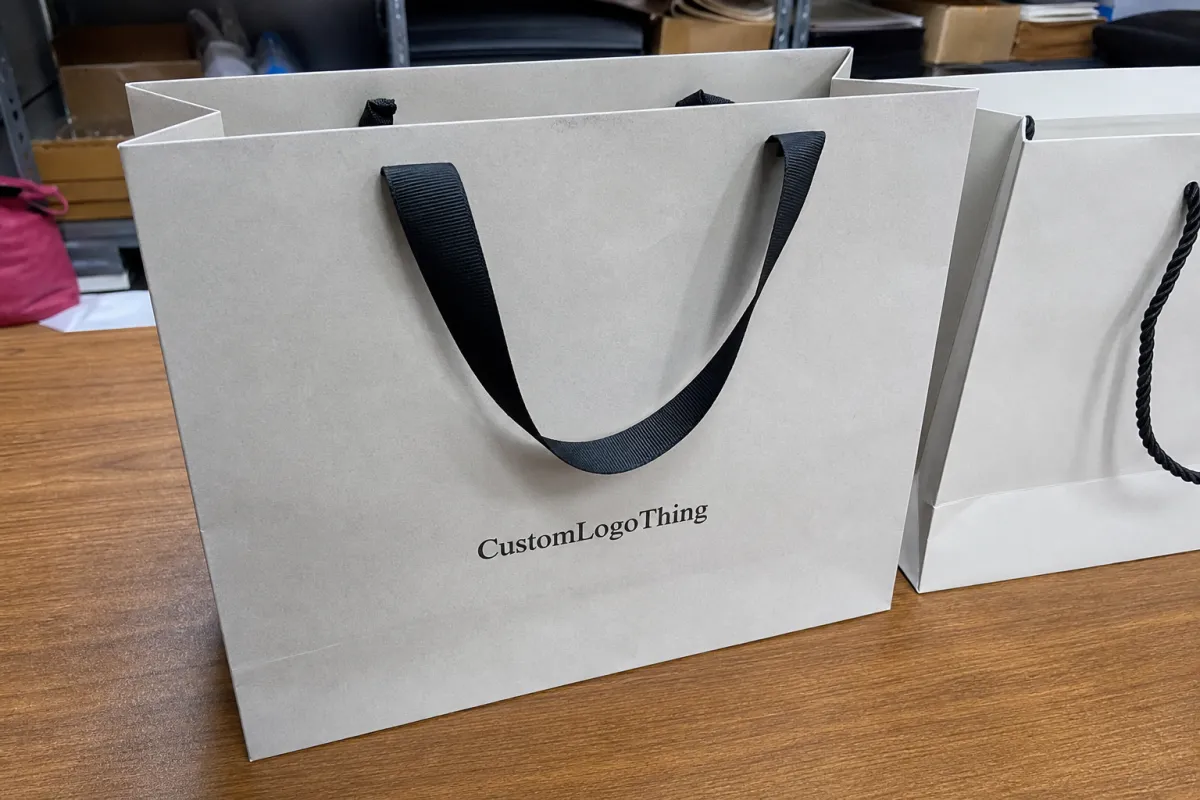
Buyers often assume the premium detail is the expensive one. Sometimes that is true. Not here. A ribbon handle can be a relatively small added cost, especially if the base structure is already well planned. A heavier board upgrade, by contrast, affects the whole bag: paper consumption, die cutting, folding pressure, glue usage, and sometimes shipping weight.
For stationery packaging, that difference shows up fast. A well-built bag using 250-300 gsm paper, a reinforced mouth, and a clean ribbon attachment can look refined without moving into a much heavier board class. Once the board jumps up, the supplier is no longer pricing a small decoration upgrade. They are pricing a different construction.
That does not mean thinner is better. It means the bag should match the product. A hardback notebook set or boxed pen kit may need more structure than a slim memo pad. A lightweight journal bag should not be priced as if it has to carry bricks. A sensible spec keeps the quote honest.
Ribbon handles also help with presentation. They feel softer in hand than twisted paper cord and usually read as more giftable. That matters in stationery retail, where the packaging is part of the product story. Customers notice the hand feel, the way the bag sits upright, and whether the handle looks deliberate or improvised.
The hidden win is usually efficiency. A clean structure built around the actual item size often costs less than a “premium” version that was padded with extra board just to look stronger. If the bag already performs, paying for more material is just buying waste.
How ribbon handles, bag structure, and stationery use shape the build
A ribbon-handle bag sounds simple, but the structure underneath decides whether the bag feels polished or awkward. The body carries the product. The top edge reinforcement keeps the mouth crisp. The handle attachment has to resist pull-through. Some builds also need a bottom insert or extra board at the base to help the bag stand up during packing and display.
Stationery is a forgiving category in some ways and a picky one in others. A notebook bag does not need the same gusset depth as a mixed gift set, but it does need enough width that the contents do not scrape the sides. If the gusset is too narrow, the bag bulges. If it is too wide, material yield drops and the unit cost rises for no useful gain.
Handle width is another detail that gets under-specified. A 10 mm ribbon and a 15 mm ribbon do not feel the same in the hand, and they are not priced the same either. Wider ribbon usually looks more premium, but it can change folding behavior and add a little to the quote. Small change, real impact.
Attachment style matters too. Some suppliers anchor the ribbon through the top fold and reinforce the inside. Others use different glue or board inserts. The cheapest method is not always the safest. If the bag will carry boxed stationery or heavier gift bundles, ask how the handle is secured and whether the top edge has enough support to resist tearing after repeated handling.
For point-of-sale use, the opening should stay neat after packing. That means the mouth reinforcement, gusset depth, and handle placement need to work together. If the handle sits too close to the edge, the top wrinkles. If it sits too wide, the bag can tilt when loaded. Small geometry issue, big visual difference.
There is also a practical retail detail that gets missed in spec sheets: how the bag behaves when stacked flat. Some ribbon styles add bulk. Some board weights hold a flatter profile. If the bags need to be packed tightly into cartons or stored behind a counter, that matters as much as how they look on a shelf.
Paper, print, and finishing specifications buyers should lock in
Before asking for a quote, lock the spec sheet. Otherwise the numbers are mostly theater. A supplier cannot price accurately if the paper stock is vague, the ribbon color is “something close to black,” or the print method is still open. The more precise the brief, the cleaner the comparison.
Start with paper type and board weight. Coated stock usually gives sharper print and better scuff resistance. Uncoated stock feels warmer and more natural. Matte lamination softens the look and gives better handling. Gloss creates a brighter retail finish. Soft-touch feels premium, but it also changes the way the surface catches light and can hide or exaggerate print detail depending on the artwork.
For stationery brands, the finish should support the product, not fight it. A minimal logo with a tight color palette can look strong on a matte build. A more decorative program with foil or full-coverage art needs careful control so the bag does not turn busy. The point is not to pile on decoration. The point is to make the bag look designed, not decorated by committee.
Print coverage drives cost faster than many buyers expect. A single-color mark on one panel is efficient. Full-wrap artwork, multiple print positions, and precise registration all add setup time and labor. Foil stamping can be worth it, but only if the artwork is clean enough to justify the extra step. If the design is already busy, foil just adds another thing to manage.
If the brief includes sustainability requirements, ask for paperwork. FSC chain-of-custody documentation is a useful starting point for certified paper claims. It does not answer every sourcing question, but it does give the buyer something concrete to verify instead of relying on a verbal assurance that may never show up in the file.
- Paper grade and board weight shape stiffness, feel, and yield.
- Bag size and gusset depth control fit for the actual product.
- Ribbon width and color affect visual finish and handling.
- Print coverage changes setup time and material consumption.
- Lamination or coating affects scuff resistance and presentation.
- Bottom and mouth reinforcement affect carry strength and shape retention.
Approve the ribbon dye lot, paper tone, and print proof together. If one element drifts, the finished bag can look assembled instead of designed. That is the sort of mismatch buyers only notice after the cartons arrive.
Stationery Ribbon Handle Paper Bags Unit Cost Review: MOQ and Quote Drivers
The smartest way to read a quote is to split fixed costs from variable ones. In a stationery Ribbon Handle Paper Bags Unit Cost Review, the MOQ tells you how far the supplier has to spread setup work across the run. Paper weight, print coverage, ribbon width, and finish determine how much material and labor each bag consumes. If the spec stays stable, bigger quantities usually reduce unit cost. If the spec keeps shifting, the quote loses meaning fast.
One-time charges deserve their own line. Setup fees may cover press preparation, color matching, or packing instructions. Tooling fees may appear if the job needs a new cutting die, foil plate, or custom insert. Some suppliers show those charges clearly. Others bury them in sampling or shipping. That is how cheap quotes stop being cheap.
Illustrative pricing below reflects the kind of spread buyers often see for retail-style stationery packaging. Region, labor market, paper source, and freight lane can move the final number a lot, so treat these as directional only.
| Build Example | Typical MOQ | Illustrative Cost Per Piece | Best Fit | Main Cost Driver |
|---|---|---|---|---|
| Simple paper bag, single-color logo, standard ribbon | 1,000-3,000 | $0.38-$0.62 | Small boutiques, launch tests, lighter stationery items | Lower print coverage and simpler finishing |
| Mid-tier retail bag, matte lamination, fuller artwork | 2,000-5,000 | $0.62-$0.95 | Seasonal collections, notebook sets, gift bundles | More board, more finishing, more handling |
| Premium build, soft-touch finish, foil, custom ribbon color | 3,000-5,000 | $0.95-$1.45 | High-end stationery, gift retail, presentation packaging | Decoration complexity and tighter color matching |
Those ranges are not a promise. They are a sanity check. A job with a low MOQ and heavy decoration can cost more per bag than a larger run with a cleaner spec. That is normal. Suppliers are not trying to punish small buyers; the setup math is just less forgiving when the run is short.
Quantity discounts also have a ceiling. Moving from 3,000 to 10,000 pieces with the same spec often improves unit cost by 10% to 20%, sometimes more if the production line can run continuously. But once the order gets large enough, savings flatten. Paying for extra units you do not need just to chase a slightly lower price is a poor trade.
Freight belongs in the review from the start. A bag that ships flat is better than one that ships bulky. Custom inserts, oversized cartons, or tight pack-outs can push the landed cost up even if the ex-factory number looks attractive. On small orders, freight can dwarf the margin difference between two suppliers. On larger orders, packing efficiency still matters because it affects container load and warehouse handling.
The cleanest quote shows sample charges, production price, tooling, packing method, and shipping assumptions separately. If all those items are bundled, comparison becomes guesswork. Buyers who ask for line-by-line clarity usually get better numbers and fewer surprises later.
Proofing, production steps, and lead time checkpoints
A smooth run starts before production starts. First comes artwork review. Then specification confirmation. Then a digital proof or physical sample. After that, materials are sourced, the job is scheduled, production begins, bags are packed, and cartons are shipped. The order sounds linear. It rarely is.
The usual delay points are boring ones: incomplete artwork, a ribbon color that was never formally approved, or a bag size that changes after the first proof. Nothing dramatic. Just loose process. The fastest projects are usually the ones that freeze size, print, ribbon, and finish before the line is booked.
For a straightforward build, 12-15 business days after proof approval is a reasonable production window. That can stretch if the job needs custom ribbon matching, special paper sourcing, or more complex decoration. Buyers should plan for that instead of assuming every supplier can run at the speed of a plain paper bag.
Lead time often gets lost in approvals, not in manufacturing. A supplier can move quickly once the brief is stable. What slows the order is back-and-forth over details that should have been settled before the proof was issued. If the calendar is tight, lock the decisions first. Chasing perfection after the schedule is already fixed is a good way to miss the ship date.
Shipping and carton packing should be treated as part of production planning. If the order is going into regional distribution or retail replenishment, ask how the pack-out performs under handling and stack pressure. Methods referenced by ISTA are useful when you want to think through vibration, compression, and transit damage. That matters more than most buyers want to admit, especially for bags with inserts or dense pack counts.
If the proof keeps changing, the schedule is fiction. Freeze the size, finish, and ribbon before the run starts.
Complex finishes need honest timing. Foil stamping, soft-touch coatings, and custom ribbon sourcing can each add a few days. That is fine if the launch calendar accounts for it. It becomes a problem only when the buyer builds the timeline on optimistic assumptions and then acts surprised when the factory needs the time it said it needed.
What to compare before choosing a packaging supplier
Price matters. So does repeatability. A useful supplier comparison looks at material consistency, handle attachment strength, print accuracy, carton packing, and whether the quote actually says what is included. If the supplier cannot explain the reinforcement method or the effect of a spec change, the quote is not finished yet.
Samples are where theory meets reality. A sample shows how the ribbon sits at the shoulder, whether the bag opens cleanly, and how the finish behaves under retail lighting. It also shows the actual hand feel of the board, which is hard to judge from a PDF or a flat swatch. A good sample is not just a nice object. It is a test of whether the supplier can build what it says it can build.
Quote discipline separates strong suppliers from sloppy ones. If you switch from 10 mm ribbon to 15 mm ribbon, or from a one-color logo to full-coverage art, the price difference should be obvious. If not, the quote is too vague to trust. That kind of clarity saves time on both sides and avoids those awkward “extra charge” emails after the order is already moving.
Production support matters more than many buyers expect. The better suppliers flag bleed issues, safe zones, barcode placement if needed, and carton counts before production begins. That is not glamorous, but it prevents correction loops. The unglamorous answer is often the expensive one to skip.
- Request full spec confirmation before comparing final numbers.
- Ask for a physical sample if the bag will support a real retail program.
- Check carton packing so the quote reflects the actual shipment load.
- Confirm what is included and what is extra.
- Verify repeatability if the bag will be reordered later.
The best supplier is not the one with the slickest pitch. It is the one that can reproduce the same look, feel, and carry performance across the whole run without surprises.
How to request samples, compare landed cost, and place the order
Start with a real brief, not a wish list. Size, quantity, paper stock, ribbon color, print file, ship date, and any retail or gift requirements should be written down before the quote request goes out. If the bag needs to hold notebooks, boxed pens, or planner sets, include the actual product dimensions. Guessing wastes time and usually produces a sample that looks right but fits badly.
Then ask for a sample or prototype that matches the intended build as closely as possible. The sample should use the same board weight, ribbon feel, and finish you expect in production. A substitute sample can be useful for a first look, but it should not be used as final approval if the program has any real volume behind it.
Test the sample under normal conditions. Load it with the real products. Check handle comfort. Look at the print under the lighting customers will actually see. A bag that looks strong in a studio photo may show scuffing, warping, or color shift under retail lighting. Better to catch that early.
Compare quotes on a like-for-like basis. The lowest ex-factory number is not always the best value if it excludes tooling, sample charges, packing, or freight. A fair comparison includes MOQ, cost per piece, carton count, freight assumptions, and any one-time setup charges. That is the only way to see the real landed cost instead of a vanity price.
Here is the shortest workable decision path:
- Confirm the product size and bag dimensions.
- Choose the paper weight and finish level.
- Lock the ribbon width, color, and attachment style.
- Approve the artwork and proof.
- Compare landed cost, not just the base unit cost.
- Place the order only after the sample passes a real-use check.
If the program is more presentation-driven, a stronger paper, a wider ribbon, or a slightly larger run can be better value than a thin spec trimmed too aggressively. That trade-off makes sense when the bag is part of the customer experience and not just a carrier.
Once the proof is approved and the delivery address is confirmed, the order can move with far less friction. That is the point of a disciplined review: it keeps the purchase grounded in real performance, real MOQ, and real landed cost, so the final decision is controlled instead of guessed.
FAQ
What drives the unit cost of stationery ribbon handle paper bags the most?
Paper grade and board weight usually have the biggest impact, followed by print coverage and any special finish. Handle style, bag size, and reinforcement details also affect yield and assembly time. Higher quantities often lower the cost per piece because setup costs are spread across more bags.
What MOQ should I expect for ribbon handle paper bags?
MOQ varies by size, print complexity, and whether custom ribbon colors or finishes are needed. Simpler builds can usually support lower minimums than highly decorated bags. A good supplier should show the MOQ alongside each price break so you can compare the options clearly.
How do I compare quotes for stationery bag packaging fairly?
Make sure every quote uses the same size, paper stock, ribbon width, and print method. Check whether sampling, tooling, packing, and freight are included or excluded. Compare landed cost, not only the ex-factory number, so the full budget is visible.
Can I approve a sample before full production starts?
Yes, a pre-production sample or digital proof is the safest way to verify size, color, and finishing. Use the sample to test load strength, handle feel, and visual presentation under real conditions. Approval should happen before mass production so corrections do not create delay or waste.
How long does production usually take after artwork approval?
Lead time depends on stock availability, finishing requirements, and order size. Simple builds often move through in 12-15 business days from proof approval, while special papers, ribbon matching, or complex print can add time. A reliable schedule should include proof approval, production, packing, and shipping milestones.

