Performance Golf Caps Logo Placement Guide: What Actually Shows Up on the Course
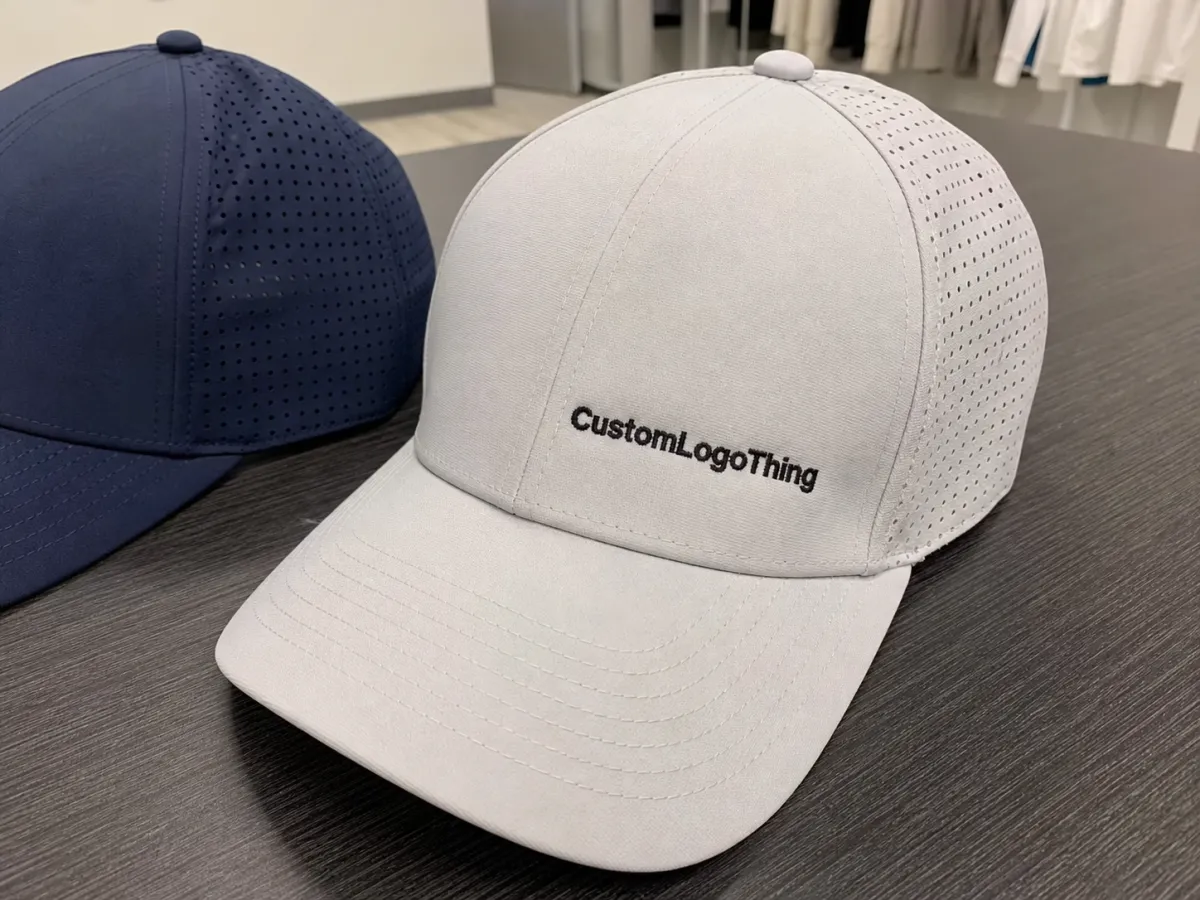
The logo that fills a flat PDF can look strangely small once it bends around a crown. Golf caps are not billboards. Shocking, I know.
A useful performance golf Caps Logo Placement guide has to deal with the real product: curved panels, sweat-wicking fabric, seams, closures, head movement, sunlight, and the fact that most people will only wear the cap again if it feels like something they chose rather than something handed to them at registration.
Performance Golf Caps are lightweight caps built for sun, sweat, and long wear. They may be structured, semi-structured, unstructured, low-profile, five-panel, rope-front, perforated, mesh-backed, or athletic in shape. Buyers use them for tournaments, resort retail, corporate golf outings, employee uniforms, club programs, league prizes, sponsor packages, and pro shop drops.
Logo placement matters more on these caps than on a basic cotton twill hat because the materials behave differently. Stretch polyester, bonded seams, perforated panels, moisture-wicking finishes, curved visors, and thin crown fabrics can all affect how a mark sits. A logo that looks clean on a paper label or screen mockup may pucker, sink, shine, or distort once it is stitched or applied to a curved cap panel.
The strongest placement is not always the largest one. A crisp 2.25-inch front mark often looks better than a 4-inch logo that pulls the fabric, crowds the crown, or gives the cap that unfortunate “free booth giveaway” energy. Bigger can be louder. It can also look cheaper.
This guide covers front center, offset front, side panel, back arch, closure-area branding, undervisor details, embroidery, heat transfer, woven patches, and PVC or rubber patches. The goal is practical: choose branding that decorates well, prices cleanly, and gives people a cap they will actually wear after the event ends.
How Logo Placement Works on Performance Golf Caps
A cap is a three-dimensional product, not a flat canvas. The crown curves away from the viewer. Panels meet at seams. The front height changes from one style to another. A structured performance cap may hold front embroidery beautifully, while a soft unstructured cap may pucker under the same stitch count.
Front center is the classic visibility position. It gives the primary logo the strongest read in photos, group shots, sponsor tables, and first impressions. For most buyer orders, front center works best at roughly 2 to 2.75 inches wide, depending on logo shape, crown height, and decoration method. Tall crests need vertical room; wide wordmarks need enough panel width without running into the side curve.
Offset front placement sits slightly left or right of center. It feels more retail and less corporate, especially when the logo is a small icon, monogram, or simplified mark. Typical sizing falls around 1.5 to 2.25 inches wide. The tradeoff is distance visibility. Subtle branding can look excellent up close, but it will not shout from the cart path.
Side placements work best as secondary zones. They are useful for sponsor marks, tournament names, small icons, location marks, team numbers, or a short program identifier when the front belongs to the main brand. Keep most side logos around 1 to 1.75 inches wide. Past that point, seams, panel curvature, and ventilation details start creating production trouble.
Back placements usually sit above the closure, across the back arch, or beside a strap, snap, buckle, or hook-and-loop closure. Good uses include club initials, a short URL, an event name, or a simple tagline. Poor uses include six-word mission statements. Nobody wants to read a corporate manifesto off the back of a sweaty cap.
Undervisor branding is a premium detail, not a primary visibility play. It can make sense for limited releases, retail drops, influencer kits, or caps people will handle up close. For a basic tournament giveaway, it rarely earns its cost unless the budget is healthy and the rest of the cap already feels considered.
The decoration method should match both the logo and the placement. Embroidery suits structured fronts and simple marks. Heat transfer can be useful on performance fabric, especially for fine detail and flatter decoration. Woven patches add a retail feel and handle small detail better than embroidered patches. PVC or rubber patches feel modern, but they need the right cap structure and a placement zone that can support the patch weight without sagging.
Key Factors Before You Choose Front, Side, or Back Branding
Start with the job the cap needs to do. A tournament giveaway, pro shop resale item, employee uniform, resort merch cap, league prize, corporate gift, and sponsor package should not all use the same placement plan. That would be convenient. It would also be lazy.
For a tournament cap, front center branding usually makes sense because photos, sponsor exposure, and easy recognition matter. For resort merch, a smaller offset mark or woven patch may feel more wearable and less promotional. For employee uniforms, clarity, consistency, and repeat ordering usually matter more than clever decoration.
Cap structure is the next filter. Structured caps support front embroidery and patches better because the crown has firmness behind it. Unstructured performance caps usually need smaller marks, softer transfers, or low-stitch embroidery to avoid puckering. A thin, stretchy crown and dense embroidery are not best friends.
Logo complexity is where many projects begin to wobble. Tiny text, thin outlines, gradients, detailed crests, and complicated sponsor marks do not become readable just because someone sent a vector file. Vector art helps production. It does not cancel physics.
Use these practical size ranges as a starting point:
- Front logo: usually 2 to 2.75 inches wide, with taller crests limited by crown height.
- Offset logo: usually 1.5 to 2.25 inches wide, especially for icons, initials, or simplified marks.
- Side logo: usually 1 to 1.75 inches wide, particularly near seams, mesh, or perforation.
- Back text: short and bold, often 2.5 to 3.5 inches wide across the arch if the cap allows it.
- Small patch: commonly 1.75 to 2.5 inches wide, depending on patch shape and cap profile.
Color contrast changes the whole read. White on navy has clear distance visibility. Black on khaki feels traditional. Tonal charcoal on black can look refined, but it will not pop from 20 feet away in sunlight. Golf happens outdoors, under glare, shade, cloud cover, and sweat. Design for actual light, not just the glow of a mockup on a laptop.
Brand tone matters as much as the technical limits. A private club may want traditional front-center embroidery with restrained sizing. A performance apparel brand may prefer an offset icon, tonal transfer, or small patch. A sponsor-heavy outing may need a hierarchy map before artwork begins, because everyone wants the forehead. Of course they do.
For material and sustainability claims, stay precise. If a buyer requests recycled polyester, FSC-certified hangtags, reduced polybags, or lower-impact packaging, ask the supplier what can be documented. The Forest Stewardship Council is a useful reference for paper-based packaging and labeling claims, but it does not certify a cap unless the specific product and chain of custody support that claim.
Buyer reality check: Decide which logo gets the front before artwork starts. If three sponsors all expect prime placement, the cap becomes a negotiation wearing a sweatband.
Process and Timeline: From Artwork to Finished Golf Caps
A clean production process is boring in the best possible way. Cap selection comes first, followed by logo review, placement recommendation, decoration method choice, digital proof, optional physical sample, production approval, bulk decoration, quality check, packing, and shipping.
Artwork review should happen before anyone promises a placement. A wide horizontal logo behaves differently from a stacked crest, monogram, shield, or long sponsor name. A 3.25-inch wordmark may look fine on paper and still feel cramped on a low-profile crown.
Digital proofing confirms position, approximate size, decoration method, cap color, and thread or print colors. It is not a guarantee that a tiny serif tagline will suddenly become readable in thread. If the proof shows small text at 0.12 inches tall, expect trouble.
Typical timelines vary by stock, decoration, and approvals. Simple repeat orders on in-stock caps may move in roughly 7 to 12 business days after proof approval. New logo setups often need 10 to 15 business days. Custom patches, PMS color matching, physical samples, multi-location branding, private label trims, or special packaging can push the process to 18 to 30 business days, sometimes longer during peak golf and event seasons.
Ask for a physical sample when the stakes justify it. Retail launches, high-value gifts, complex multi-location branding, unfamiliar cap styles, and orders where surprises would be expensive all deserve a sample. It adds time and cost, but it can save a full production run from looking “almost right,” which is buyer language for “not right.”
Approval responsibility should be written down. Production should not start until placement, logo size, decoration method, thread or transfer colors, cap color, quantity breakdowns, and shipping details are approved. A casual “looks good” buried in a thread with four file versions is how mistakes breed.
Timeline pressure affects the placement plan. If the event date is close, choose in-stock caps, standard colors, fewer decoration locations, and a decoration method already proven on that fabric. The International Safe Transit Association is better known for transport testing standards, but the practical mindset applies here too: caps still need to survive handling, packing, and delivery without last-minute chaos.
Quality control should include more than a quick glance at the front. Check logo position from cap to cap, thread tension, transfer edges, patch alignment, loose threads, skipped stitches, color consistency, sweatband cleanliness, closure function, and carton counts. On multi-location orders, inspect every decoration zone, not just the hero logo.
Cost, Pricing, and MOQ Impact of Logo Placement Choices
Logo placement affects price because every decoration location requires setup, handling, machine time, alignment, and inspection. A second logo is not free because it is small. Cute theory, though.
The main cost drivers are cap blank quality, decoration method, number of logo locations, stitch count for embroidery, patch type, artwork cleanup, sample requirements, and order quantity. A stock polyester cap with one front embroidery is a different animal from a rope performance cap with a woven patch, side embroidery, back text, and custom packaging.
| Branding Option | Typical Use | Common Size Range | Cost Impact | Best Buyer Fit |
|---|---|---|---|---|
| Front embroidery | Classic primary logo placement | 2 to 2.75 inches wide | Lowest to moderate, depending on stitch count | Tournaments, uniforms, club caps |
| Front heat transfer | Fine detail on performance fabric | 2 to 3 inches wide | Moderate, with setup and transfer costs | Athletic brands, detailed logos, lightweight caps |
| Woven patch | Retail-style branding | 1.75 to 2.75 inches wide | Moderate to high due to patch production | Resort merch, pro shop resale, premium gifts |
| Side embroidery | Sponsor or event mark | 1 to 1.75 inches wide | Adds a second setup and handling step | Golf outings, sponsor packages, team events |
| Back arch text | Short URL, club name, or tagline | 2.5 to 3.5 inches wide | Adds setup, alignment, and decoration time | Programs needing secondary identification |
For stock performance caps, minimums may start around 48 to 144 pieces, depending on supplier and decoration. Custom colors, private label trims, custom patches, special fabric, unique closures, or retail packaging may push minimum order quantities into the 300 to 1,000 piece range. Not always, but often enough that buyers should ask early rather than build a full concept around a 72-piece run that cannot be produced at that spec.
Unit cost usually drops as quantity increases because setup spreads across more caps. Still, complexity can keep pricing higher. A 5,000-stitch embroidery is not priced like a 12,000-stitch embroidery, and a small patch still needs to be made, checked, positioned, applied, and inspected.
If the budget is tight, spend money on a better cap and one excellent logo placement before adding three mediocre locations. A comfortable cap with a sharp front mark gets worn. A scratchy cap with five logos gets abandoned in a trunk by Tuesday.
For quote accuracy, send the cap style, quantity, logo file, decoration locations, cap colors, deadline, shipping destination, and sample requirements. A supplier can price placement recommendations properly only when the spec is real, not “just need some hats, maybe navy.”
Step-by-Step Placement Plan for a Clean Branded Cap
Use a simple sequence. It keeps the project out of the swamp.
- Choose the cap style first. A structured performance rope cap, low-profile dad cap, five-panel cap, athletic visor, and perforated running cap all have different usable branding zones.
- Rank logos by importance. Primary brand gets the most visible position. Sponsor marks get secondary positions. Taglines survive only if they are readable.
- Simplify the artwork. Remove tiny text, reduce unnecessary detail, convert gradients where needed, and create a version built for embroidery, heat transfer, woven patch, or rubber patch production.
- Select the main placement. Most buyers should start with front center unless the brand style clearly calls for a quieter offset mark or retail-inspired patch placement.
- Add secondary placements only if they earn their keep. A side sponsor logo can make sense for tournaments. Back text can work for club names, short URLs, or internal program names.
- Confirm size in inches. A logo that fills 70 percent of a PDF preview means nothing once it hits a curved cap panel.
- Approve the proof carefully. Check spelling, orientation, contrast, placement height, decoration method, and whether seams or ventilation interfere.
For embroidery, ask about stitch count, thread colors, backing, and minimum letter height. Many small text details need at least 0.20 to 0.25 inches in height to stay legible, depending on font, fabric, and stitch direction. Fine serif lettering, tight counters, and thin outlines often need to be removed or enlarged.
For heat transfer, confirm fabric compatibility, stretch, wash durability, finish, and whether the cap surface has coatings that affect bonding. Performance fabrics can vary widely. A transfer that works on one polyester crown may not behave the same way on a textured, perforated, or water-resistant surface.
For patches, clarify the patch type before approving art. Woven patches handle detail better than embroidered patches. PVC or rubber patches suit bold shapes and clean icons, but may feel too heavy on thin caps. Leatherette patches can look strong on casual silhouettes, yet they may fight the technical look of a sleek performance crown.
Also confirm placement height, not just left-to-right location. A front logo set too low can crowd the visor seam. A logo set too high may look like it is floating above the forehead. On low-profile caps, that vertical space disappears quickly.
Common Logo Placement Mistakes That Make Caps Look Cheap
The biggest mistake is oversized front logos. Golf caps need balance. If the logo dominates the whole crown, it starts looking like a promo freebie instead of something people would choose to wear.
Another common mistake is placing artwork too close to seams. Seams can distort embroidery, interrupt patches, and make heat transfers harder to align cleanly. Keep breathing room around panel breaks, especially on five-panel, low-profile, and perforated styles.
Detailed corporate seals and sponsor logos also cause problems at small sizes. If the audience needs binoculars to read the text, the placement failed. Simplify the mark, use initials, or move the full detail to packaging, an insert card, signage, or a printed tournament program.
Poor contrast is sneakier. Light gray on white performance fabric may look elegant in a proof and nearly disappear outdoors. Navy on black can look expensive in a studio photo and muddy on a cloudy morning. Ask for thread or transfer color callouts, not vague color names.
Over-branding is another trap. Front logo, side logo, back slogan, undervisor print, closure tag, and custom label can work for a retail collectible or carefully tiered sponsor package. On a basic outing cap, it can look like the cap lost a fight with a decal sheet.
Material mismatch can ruin an otherwise good idea. Heavy embroidery on thin, stretchy performance fabric can pucker. Some transfers may not bond well to coated or textured fabrics. Raised rubber patches can look modern but awkward if the crown is too soft.
Do not approve high-stakes orders from a flat mockup alone. A digital proof is necessary, but it hides crown curve, thread texture, panel tension, patch thickness, and real-world contrast. For large orders, retail programs, or VIP gifts, sample the cap.
Finally, avoid changing the art after proof approval unless the supplier confirms the impact on schedule and cost. A small wording change can trigger a new digitizing file, revised patch art, new color setup, or delayed production slot. Small changes are not always small in the factory workflow.
Simple rule: If the cap needs to look retail, treat the placement like product design. If it only needs to check a sponsor box, fine, but do not pretend those are the same brief.
Build a Cap Spec Your Supplier Can Actually Quote
A supplier cannot quote cleanly from vibes. Send a real spec and you will get better pricing, better advice, and fewer “just confirming” emails that eat three days.
Prepare the core cap specs first: cap style, structure, fabric preference, color, closure type, quantity by color, target delivery date, shipping destination, and intended use. If sustainability matters, mention recycled polyester, FSC-certified paper packaging, reduced polybags, or retail hangtag needs at the start.
Prepare the artwork details next: vector logo file, preferred logo version, decoration method if known, placement location, approximate size in inches, thread or print colors, and sponsor hierarchy rules. If there are brand guidelines, send them. If there are forbidden colors, minimum clear-space rules, or required logo lockups, send those too.
Create a simple placement map. For example: front center for the primary logo, right side panel for sponsor mark, back arch for short club text, and optional undervisor print only if the budget supports it. The map does not need to be fancy. It needs to be clear.
Ask for quote tradeoffs instead of one mystery price. Request a best-value option, premium retail-style option, fastest production option, and lowest-MOQ option. Those four answers tell you more than one number with no context.
Use this performance golf caps logo placement guide before requesting quotes so the cap looks intentional, prices accurately, and arrives without forehead-branding regret. A good performance golf cap should feel like something people picked on purpose, not something they accepted because it was free.
FAQs
What is the best logo placement for performance golf caps?
Front center is the safest choice for visibility and classic golf styling. Offset front placement feels more retail and understated, but it reduces distance visibility. Side and back placements work best as secondary branding, sponsor marks, event details, or short supporting text.
How large should a logo be on a performance golf cap?
Most front logos work best around 2 to 2.75 inches wide, depending on the cap profile and logo shape. Side logos usually work around 1 to 1.75 inches wide. Small text, thin lines, gradients, and detailed crests often need simplification before production.
Is embroidery or heat transfer better for golf cap logo placement?
Embroidery works well for structured caps, simple logos, and a traditional premium look. Heat transfer can be better for lightweight performance fabrics, gradients, fine detail, or flatter decoration. Patches are a strong option when the buyer wants a retail-style cap with higher perceived value.
Does adding side or back logos increase the cost of custom golf caps?
Yes. Each decoration location adds setup, handling, alignment, and production time. A second small logo can still affect unit cost because the cap goes through another decoration step. For tighter budgets, one strong front placement usually beats several weak branding locations.
How early should I finalize logo placement before a golf event?
Finalize placement before proofing so the supplier can confirm sizing, decoration method, and production feasibility. Allow extra time for new artwork setups, custom patches, physical samples, or multi-location branding. If the event is close, choose in-stock caps, simpler placement, and fewer decoration locations to protect the timeline.


