Poly Mailer Bags Unit Cost Breakdown for Bulk Buyers
Two suppliers quote the same custom mailer. One comes in at $0.092 per bag. The other is $0.107. The cheaper number looks great until the cartons arrive short, the adhesive fails in a humid packing room, or freight adds another $380. A useful poly mailer Bags Unit Cost Breakdown measures the full cost per piece, not just the number beside "price per thousand."
Custom Logo Things works with buyers who need packaging to protect shipments, move quickly through packing, and arrive looking intentional. Pricing has to be read like a production spec sheet. Film, print, adhesive, setup charges, carton packout, MOQ, freight terms, and rework risk all belong in the calculation.
Why the Cheapest Quote Often Costs More in the Cart
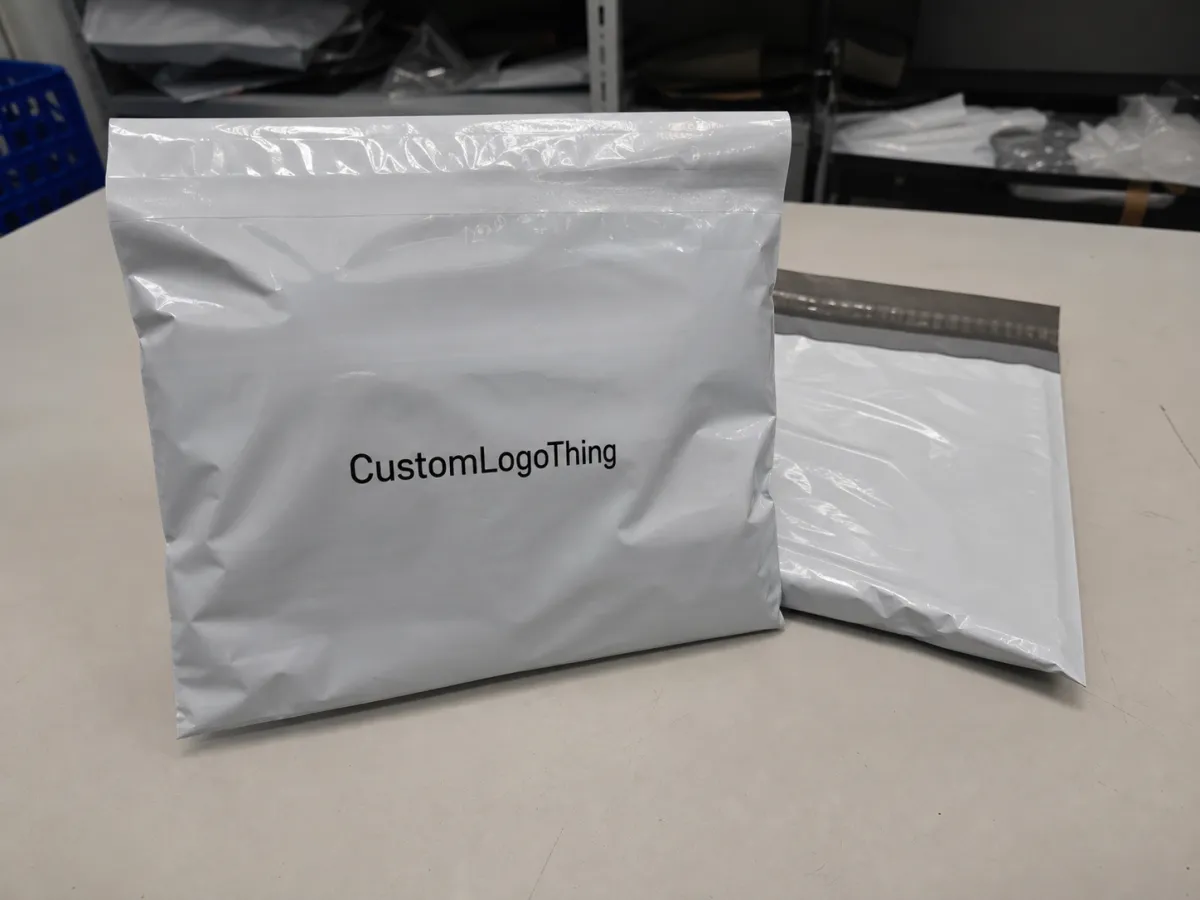
A three-cent difference sounds small. On 20,000 bags, it is $600. But if the lower quote excludes freight, uses a thinner gauge, or adds tooling fees after artwork approval, the savings can disappear before the first carton reaches your warehouse.
Most buyers compare bag price before they compare bag construction. A 10 x 13 inch white poly mailer in 2.5 mil film is not the same product as a 10 x 13 inch bag in 3.0 mil film with stronger hot-melt adhesive, wider side seams, and two-color print coverage. The difference may be only $0.015-$0.04 per unit at 10,000 pieces, but the performance gap can show up in split seams, slow packing, or customer complaints.
The buyer pays for more than polyethylene resin. A quote can include film extrusion, printing plates or digital setup, ink, adhesive strip application, converting, carton packing, inner bundling, sampling, and outbound delivery. Some quotes show these lines clearly. Others bury costs in "additional charges apply."
Cost discipline does not mean choosing the lowest invoice. It means knowing which bag spec produces the lowest landed cost after freight, waste, packing speed, returns, and reorder stability are counted.
What Buyers Need in a Mailer, Not Just a Price
A poly mailer is a shipping tool first. It has to seal fast, resist abrasion, hide the product inside, and keep the brand presentation clean after conveyors, bins, van floors, and doorstep handling.
Define the bag by use case before price. A warehouse shipping replacement parts may care most about opacity and puncture resistance. A DTC apparel brand may care about matte texture, logo placement, and a tear strip for returns. A marketplace seller may prioritize low unit cost and fast reorder speed.
Common mailer choices include:
- Self-seal adhesive: Hot-melt or pressure-sensitive glue; wider strips can improve closure on thicker folded contents.
- Tamper evidence: A permanent seal that tears or distorts when opened helps protect higher-value shipments.
- Film color: White, black, gray, or co-extruded opaque film affects privacy and print contrast.
- Finish: Matte can feel more retail-ready; gloss can make color appear sharper but may show scuffs more easily.
- Tear strip: A return-friendly feature that may add cost but saves labor and improves customer handling.
For many soft goods, a 2.5 mil bag may work well. For heavier apparel bundles, boxed cosmetics, or items with hard corners, 3.0-3.5 mil is often safer. Over-specifying also wastes money. A small lightweight accessory does not need the same gauge as a bulky hoodie.
Brand visibility has a measurable side. A clean custom bag can reduce the need for outer labels, inserts, or secondary sleeves. If packers close 600-900 bags per shift, a stronger adhesive liner and easy-peel tab can matter as much as ink coverage. Buyers reviewing Custom Poly Mailers should consider packer speed, returns handling, and customer arrival experience together.
Specs That Change Performance and Reorder Risk
Before requesting bulk pricing, lock the core spec set. One supplier may price a 9 x 12 inch bag while another prices 10 x 13. One may assume one-side black print while another assumes two-side full coverage. The unit cost comparison is already broken.
The essentials are finished outside size, usable inside size, film thickness, seam width, flap length, adhesive strip width, print area, print colors, finish, quantity tier, and destination. Size is especially important because film consumption rises with both width and length.
Gauge is the second big lever. Thinner film lowers resin use and carton weight, but it can raise defect risk if the product has corners, zippers, hardware, or tight fills. Wider seams can reduce splitting, yet they may slightly reduce usable internal space.
Print has its own cost logic. One-color logo printing on one side is usually the cleanest value. Add a second color, reverse-out artwork, two-side printing, or 70%-100% ink coverage and the economics change. Registration tolerance matters too. A simple repeating mark can tolerate slight movement; a border near the edge cannot.
| Spec Choice | Typical Cost Impact | Operational Risk if Underspecified |
|---|---|---|
| 2.5 mil vs. 3.0 mil film | Often adds about $0.01-$0.035 per bag depending on size and volume | Split seams, punctures, poor feel for heavier shipments |
| One-color vs. two-color print | May add setup charges plus higher ink and print time | Brand color mismatch if artwork is simplified too far |
| Standard seal vs. tear-strip return seal | Can add several cents per unit on lower MOQs | Messy returns, slow customer opening, repack labor |
| Basic opacity vs. high-opacity coextruded film | Moderate increase tied to film structure | Product visibility, privacy concerns, lower perceived quality |
Sustainability claims need documentation. If recycled content, recyclable film, or retailer compliance is part of the requirement, ask for supporting paperwork before approval. The U.S. EPA recycling resources are useful for understanding claim complexity, and buyers selling into larger accounts may need chain-of-custody or material declarations.
Poly Mailer Bags Unit Cost Breakdown: What Changes the Price
A clear cost breakdown starts with five drivers: resin, size, gauge, print coverage, and adhesive choice. MOQ comes next because setup costs behave differently at 5,000 pieces than at 100,000 pieces.
Resin and film structure set the base. Larger dimensions consume more material. Heavier gauge adds weight. Ink coverage increases print cost and can slow production. Adhesive choice affects material and converting. Then come setup charges: plates, cylinders, artwork prep, proofing, color matching, and machine changeover. These costs are relatively fixed, so volume changes the unit math.
For example, if setup and tooling fees total $450, that equals $0.09 per bag across 5,000 units. At 20,000 units, it drops to $0.0225. At 100,000 units, it becomes less than half a cent per bag. Same artwork, very different unit cost.
| Order Quantity | Example Factory Range | Setup Absorption | Buyer Read |
|---|---|---|---|
| 5,000 bags | $0.16-$0.28 per unit | High | Good for testing, expensive for mature SKUs |
| 20,000 bags | $0.09-$0.17 per unit | Moderate | Common balance of cash flow and bulk pricing |
| 100,000 bags | $0.055-$0.12 per unit | Low | Best for stable specs and predictable demand |
Those ranges are not universal. A small one-color 6 x 9 inch bag can price below them at volume. A large 14.5 x 19 inch two-side printed mailer with high-opacity film and a return strip can sit above them. The honest answer depends on the spec.
Factory price is only one number. Landed price adds freight, duties if applicable, carton packaging, inspection, sampling, and testing fees. A quote that reads $0.085 factory can become $0.105 landed after freight and handling. Another quote at $0.098 landed may be the better deal because it is complete.
Testing can also be worth the fee. For shipping performance, standards from groups such as ISTA help buyers think about distribution stress, compression, drops, and vibration. A poly mailer is flexible packaging, but it still lives in a parcel network that punishes weak seals.
Production Steps and Timeline From Proof to Delivery
Production is a chain, and the slowest link controls the delivery date. A typical Custom Poly Mailer order moves through quote, artwork file check, digital proof, sample approval if needed, film production or allocation, printing, converting, carton packing, quality review, and shipment booking.
For new custom mailers, a realistic planning window is often 12-20 business days from proof approval for production, depending on order size, print complexity, and factory queue. Transit is separate. Domestic freight may take several business days. Ocean freight can add weeks. Air freight saves time but can raise landed cost because poly mailers ship light but take space.
Delays often start before production. Artwork files arrive in low resolution. A logo uses RGB instead of Pantone or CMYK references. A buyer asks for matte black print on a black bag and expects high contrast. Proofs bounce between marketing and operations for a week. None of that is a machine problem, but it affects delivery.
Color matching also needs practical tolerance. Poly film does not behave like coated paper. Ink sits on a flexible surface, and opacity changes the final read. A Pantone target can guide the result, but strict brand standards may require extra sampling and approval time.
Rush orders are possible in limited cases: repeat artwork, available film, standard adhesive, open machine capacity, and a quantity that does not disrupt scheduled runs. Rush production becomes risky when the bag needs new tooling, complex color matching, unusual size, or two-side registration.
Quality Checks That Protect Shipping Performance
A mailer defect is small until it reaches the customer. Then it becomes a refund request, a reshipment, or a photo in a review.
The highest-value checks are practical: seal integrity, side seam strength, tear resistance, print adhesion, opacity, adhesive performance, size tolerance, and carton count accuracy. A carton marked 1,000 bags but packed with 930 creates inventory errors. A seal that works in a cool office but fails in a warm packing area becomes a labor problem.
Sample approval should test fill behavior, not just artwork. Put the real product inside. Fold it the way packers fold it. Seal it with normal pressure. Let it sit. Pull at the flap. Rub the print. If the bag is for apparel, test the largest SKU. If the product has corners, test abrasion against the film.
Marketplace, retail, and regulated-category sellers may need additional checks. Suffocation warnings, barcode placement, country-of-origin rules, material documentation, or retailer packaging guidelines can apply. ASTM standards may be relevant for certain film and labeling tests, while FSC is more relevant to paper-based packaging than poly mailers. Compliance depends on product, channel, and claim.
A low defect rate saves money quietly. If a stronger spec adds $0.012 per bag but prevents 150 repacks on a 20,000-unit run, labor savings alone can justify it. Add avoided reships, fewer damaged arrivals, and less customer service time, and the cheaper mailer may no longer be cheaper.
Why Buyers Reorder From a Stable Supplier, Not a Flash Quote
A flash quote wins attention. A stable supplier wins reorders. The difference shows up after the first run: whether the supplier can repeat the same film gauge, seal placement, print position, carton count, and color target.
Consistency has value because packaging downtime is expensive. If a warehouse runs out of mailers, staff may substitute oversized boxes, plain bags, or emergency stock at two to four times the normal cost per piece. That creates higher shipping charges, weaker brand presentation, and more packing variation.
The best supplier is not always the one with the lowest first quote. It is the one that can explain landed cost, keep order history clear, respond to revisions, and repeat a custom spec without quiet substitutions. If a 3.0 mil bag becomes 2.6 mil on reorder, your cost did not go down. Your risk moved up.
Custom Logo Things keeps the buying process grounded in repeatable specifications across Custom Packaging Products, including mailers, boxes, bags, and branded accessories. That matters for growing brands because packaging systems rarely stay static. A buyer may start with one apparel mailer, then add a return-ready size, a holiday print, or a lower-cost warehouse version.
What to Send for an Accurate Quote and Fast Reorder
A supplier can only price what you define. Vague requests produce padded quotes or missing charges. Tight requests produce cleaner math.
Send the basics first: bag width and length, flap size if specified, film gauge, quantity tiers, print colors, print location, one-side or two-side printing, finish, adhesive style, tear-strip requirement, artwork file, shipping destination, and desired delivery window. If you have an existing bag, share photos and measurements. Send a physical sample when fit is critical.
Ask for both factory pricing and landed pricing. Factory pricing helps you understand production cost. Landed pricing helps you compare vendors on the same basis. If one supplier includes freight and another does not, you are not comparing unit cost; you are comparing quote formats.
Confirm these items before approval:
- MOQ: Minimum order quantity by size, print method, and material.
- Overrun or underrun policy: Many custom runs allow a small percentage variance.
- Sample cost: Digital proof, blank sample, printed sample, or pre-production sample.
- Production lead time: Counted from proof approval, not from the first email.
- Freight terms: Destination, service level, duties, and delivery responsibility.
Then compare quotes line by line. Match the same size, gauge, print coverage, quantity, carton packout, and freight basis. A disciplined review turns supplier emails into a buying decision: what you are paying per bag, what risk remains, and which vendor can repeat the result without surprise changes.
FAQ
What drives poly mailer bag unit cost up the fastest?
Heavy gauge film, larger bag dimensions, and high ink coverage usually move the price first. Small orders also raise unit cost because setup charges are spread across fewer bags. Freight and duties can change landed cost more than the factory quote suggests.
How does MOQ affect poly mailer bag pricing?
Higher MOQ usually lowers unit cost because setup, plates, proofing, and prep are distributed over more units. Lower MOQ is useful for testing a new design or SKU, but buyers often pay more per bag and per carton. A good quote should show several quantity tiers so you can see the break point before you commit.
Which specs should I lock before requesting a quote?
Lock size, thickness, print colors, finish, adhesive style, and any tear-strip or security features. Confirm whether you need one-side or two-side printing and what opacity level matters for privacy. Share shipping destination and delivery timing so the supplier can quote a true landed cost.
How long does custom poly mailer production usually take?
The timeline depends on artwork approval, print complexity, film availability, and order volume. Sampling and proof revisions often add more time than the actual factory run. Transit time is separate from production time, so ask for both dates before you commit.
What should I compare across supplier quotes?
Compare landed cost, MOQ, sample charges, setup charges, and the overrun or underrun policy. Check whether the quote includes freight, duties, carton packaging, and inspection or only factory pricing. Review lead time, color tolerance, and quality checks so each offer reflects the same scope.

