Why a Tiny Label Can Change the Whole Beanie Budget
A clean sample gets approved. Then the final quote lands higher because the label grew, the sewing placement got awkward, the packaging changed, and the order quantity dropped from 500 to 250. Not magic. Just details that were never priced properly in the woven label beanies Unit Cost Breakdown.
From the buyer side, the job looks simple: choose a beanie, add a logo, ship the order. Production is less tidy. That small woven trim can affect loom setup, cutting, folding, backing, stitch time, inspection speed, packing method, and carton volume. A 1.25-inch side tab and a 3-inch front patch are not interchangeable just because both look small in a mockup.
The appeal is real. Woven labels give beanies a retail-ready finish without forcing the buyer into fully custom knit patterns, jacquard artwork, special yarn dyeing, or private-label development from the ground up. For many brands, that is the practical middle lane: better than plain stock merch, less risky than building a beanie from scratch.
Buyers often choose woven labels over embroidery because woven detail handles small text, sharp edges, and repeatable logo shapes better. Embroidery can look excellent on bold marks. Fine lettering, tiny icons, legal copy, and tight badges? Woven usually behaves better, especially across ribbed cuffs, fisherman beanies, slouch styles, and classic folded silhouettes.
This is a cost map, not a mood board. The goal is to show what changes the unit price, which specs deserve attention, and what information a supplier needs before giving a quote that still makes sense after production starts.
Beanie and Label Details That Affect the Final Quote
The beanie body carries a large share of the cost. Material, knit gauge, cuff height, weight, sizing, construction, color count, and stock-versus-custom production all matter. A basic 100% acrylic stock cuff beanie will not price like a wool-blend custom color beanie with a heavier knit and private-label interior tag. It should not.
Acrylic is usually the budget-friendly option for promotional orders, employee gifts, school programs, event merchandise, and giveaways. Cotton has a softer, less synthetic hand, which can suit lifestyle brands or lighter seasonal assortments. Wool blends make sense for cold-weather retail programs, but they raise material cost and may require more careful care labeling. Recycled yarns can support sustainability goals, but buyers should ask for documentation instead of accepting vague environmental claims. If FSC-certified paper hangtags or belly bands are part of the packout, confirm chain-of-custody requirements through FSC before printing.
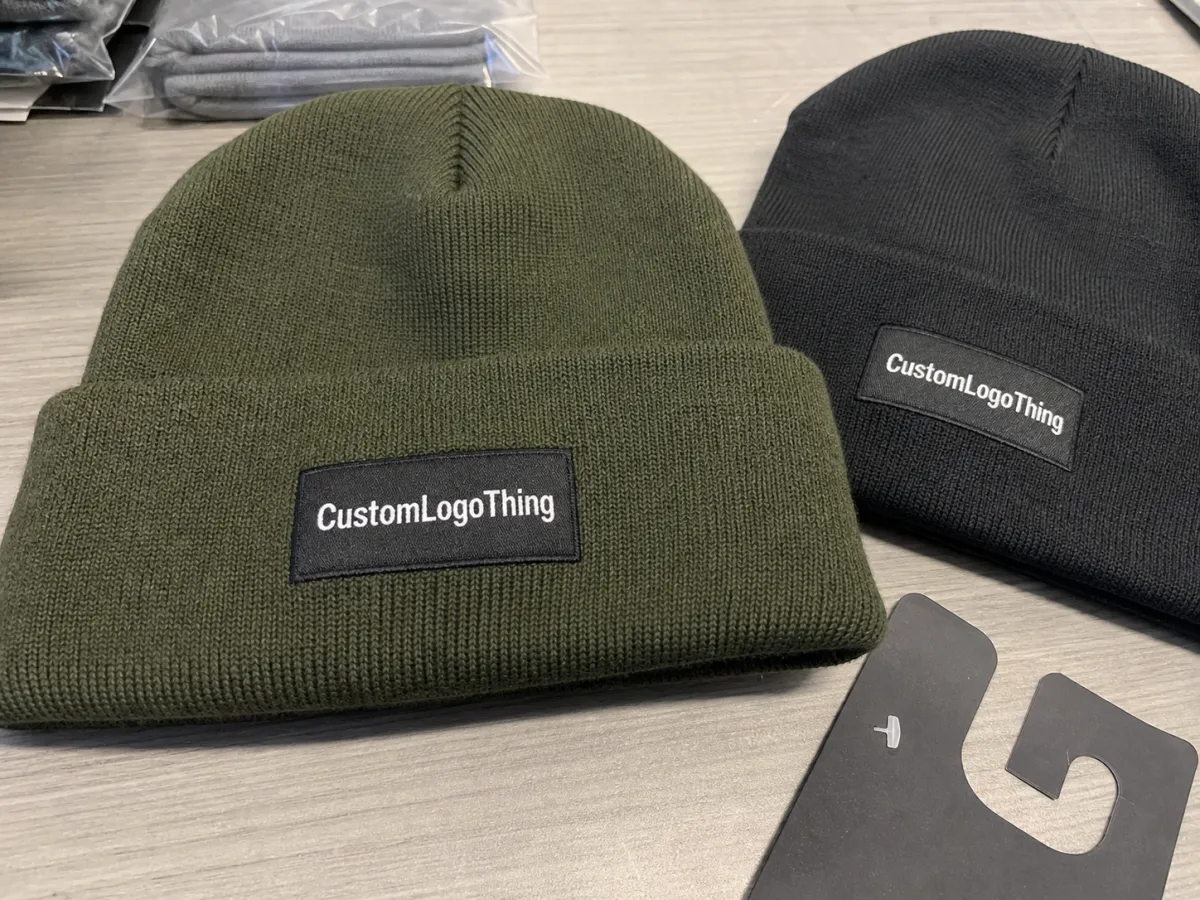
Label construction changes pricing too. Common options include flat woven labels, folded-end labels, center-fold labels, loop-fold labels, hem tags, patch-style woven labels, and sewn-on brand tabs. A small folded side tab may be quick to attach. A large front patch usually needs more alignment time, more visible stitching, and more inspection.
Placement is not just a design decision. It changes labor. Front cuff placement is common and easy to merchandise. Side seam labels feel quieter and more premium. Back cuff labels work for secondary branding. Inside labels support private-label programs. Hem-edge placement can look sharp, but only if the beanie construction supports it without curling, twisting, or swallowing the trim.
Artwork is where buyers often get optimistic. Thin outlines, gradients, distressed mascots, tiny taglines, and over-detailed badges do not become legible because someone exported a PNG at 300 DPI. Woven labels are built with thread. Vector artwork, Pantone references, and realistic label dimensions save quoting time and prevent ugly surprises.
Buyer tip: decide whether the label should shout from a retail wall or sit quietly as premium branding. That choice affects size, placement, stitch color, inspection standards, and cost per piece.
Woven Label Beanies Unit Cost Breakdown: What You Actually Pay For
A useful woven label Beanies Unit Cost Breakdown includes more than a blank beanie plus a logo. The quote normally pulls from these buckets: beanie body, woven label production, sewing labor, setup charges, proofing or sampling, packaging, inspection, freight, duties if applicable, and supplier margin. Yes, margin. Businesses are annoying that way. They need to survive.
Stock blank beanies with sewn woven labels usually have lower minimums and faster timelines than made-to-order knitted beanies with custom yarn colors. For a simple stock-base order, the blank beanie may be the largest line item. For a fully custom knit order, yarn sourcing, knitting setup, color matching, and production planning can move the project into a different cost range.
| Cost Bucket | Typical Impact | Buyer Control |
|---|---|---|
| Stock beanie body | Usually lower cost and faster availability | Choose acrylic, cotton, wool blend, or recycled yarn based on use |
| Custom knit beanie body | Higher MOQ and longer lead time | Control yarn color, knit pattern, size, and private-label details |
| Woven label | Changes with size, color count, fold, backing, and edge finish | Keep one label size and simplify fine artwork |
| Sewing labor | Rises with awkward placement, oversized patches, or tight alignment tolerances | Use standard front cuff or side tab placement where possible |
| Packaging | Bulk pack is cheapest; retail pack adds handling | Decide early on polybags, hangtags, barcodes, cartons, or mailers |
| Freight | Air freight can wipe out savings on bulky orders | Plan enough time for cheaper shipping methods |
Label size is one of the quickest ways to move the price. A 0.75 x 1.25-inch side tab uses less woven material and may attach faster than a 2.5 x 2.5-inch front patch. The larger patch can look strong, especially for retail, but it needs clean alignment. On a ribbed cuff, every crooked label looks louder than the logo.
Setup charges may include artwork cleanup, loom setup, thread color matching, label cutting, folding, backing, and sewing line preparation. Some suppliers roll these costs into the unit price. Others show them separately as tooling fees or setup line items. One format is not automatically better. Clear assumptions matter more than pretty formatting.
Hidden cost drivers show up fast: low quantities, rush timing, too many beanie colors, multiple label versions, oversized patches, individual polybags, hangtags, custom mailers, exact carton ratios, special barcode placement, and air freight. At 100 units, setup and freight hit hard. At 500 units, labor and material choices carry more weight. At 1,000 or more, small spec changes can save real money across the run.
The cleanest way to control cost is boring, which is probably why people resist it. Consolidate beanie colors. Use one label size. Approve standard placements. Avoid midstream artwork changes. Confirm packaging before production. Ask for realistic Custom Labels & Tags options before falling in love with a label concept that does not fit the budget.
MOQ, Pricing Tiers, and Where the Real Savings Start
MOQ is not a punishment. It is the point where material ordering, machine setup, label weaving, sewing labor, inspection, and carton handling stop being wildly inefficient. A 50-piece run may be possible with stock beanies, but the cost per piece can look rude.
Ask for useful quantity tiers instead of one lonely number. Common quote tiers include 100, 250, 500, 1,000, 2,500, and 5,000 units. A 100-piece order may suit a staff gift or small event. A 500-piece run often makes more sense for a retail test. A 1,000-piece order can open stronger bulk pricing, especially if the specs stay controlled.
Lower MOQs are usually easier with stock beanies and standard woven label sizes. Fully custom yarn colors, special knit patterns, private-label interiors, or Custom Retail Packaging typically push minimums higher because materials and production time have to be planned around the order.
Price breaks happen because fixed work gets spread over more units. Label loom setup, sewing preparation, artwork proofing, carton handling, and freight coordination do not double just because the order doubles. That is why the gap between a 250-piece quote and a 500-piece quote can be surprisingly large.
Do not chase the lowest MOQ if a reorder is likely in six weeks. Splitting one 1,000-piece need into four tiny orders is a reliable way to overpay for freight, setup, and admin time. Quote multiple tiers. The numbers usually make the decision obvious.
A stock-base beanie with a sharp woven side tab may ship faster and cost less. A custom knit beanie gives more control over yarn, fit, color, and branding, but it asks for time, volume, and cleaner planning. Neither route is automatically better. The right one depends on deadline, brand standards, budget, and how much inventory risk the buyer can tolerate.
Specifications Buyers Should Lock Before Requesting a Quote
Vague requests create vague pricing. “Nice quality beanie with logo” is not a spec. It is a wish wearing a deadline.
For an accurate woven label Beanies Unit Cost Breakdown, prepare the actual details: beanie style, yarn or material target, color count, size, cuff height, label type, label dimensions, label fold, label placement, stitch color, quantity, packaging, and delivery address. If the beanie is for resale, include retail compliance needs, barcode format, carton marks, hangtag requirements, and any folding standards.
Artwork should be cleaned up before quoting. Vector files are preferred. Pantone references help with thread color planning. The label size must match the amount of detail in the artwork. A 1-inch label cannot carry a mascot, a slogan, a website, a care symbol, and three social icons. Well, it can. It just will not look good.
Color planning also affects price. Each beanie color can change inventory, sewing setup, sorting, and packing complexity. Each label colorway can add loom planning and handling time. If the assortment is 40% black, 30% gray, 20% navy, and 10% olive, say that early. Exact assortments take more labor than a simple mixed pack.
Packaging should be priced before the quote is treated as final. Bulk pack is usually cheapest. Individual polybags add labor and material. Belly bands, hangtags, barcode labels, retail cartons, and custom mailers add more handling time. If the goods are going into a fulfillment center, confirm carton count rules, label placement, SKU sorting, and receiving requirements before production. For transit testing expectations on heavier retail shipments, ISTA standards are a useful reference point.
Use this pre-quote checklist to cut down the back-and-forth:
- Beanie style: cuffed, fisherman, slouch, pom, or another construction
- Material target: acrylic, cotton, wool blend, recycled yarn, or custom blend
- Quantity tiers: 100, 250, 500, 1,000, or larger
- Label spec: size, fold, color count, backing, placement, and stitch color
- Artwork: vector logo, Pantone references, and required small text
- Packaging: bulk pack, polybag, hangtag, barcode, carton, or custom mailer
- Delivery details: address, deadline, shipping preference, and compliance needs
Process and Timeline From Artwork to Delivered Beanies
The process moves cleanly when the specs are clean. First comes quote review. Then artwork cleanup, digital proofing, sample or pre-production approval, bulk label weaving, beanie production or sourcing, sewing, quality control, packing, and shipping.
Simple stock beanie plus woven label orders can move quickly, often around 10 to 20 business days after final proof approval if materials are available and the production schedule is open. Custom-knit beanies, special yarns, custom packaging, and overseas freight can add several weeks. Ocean freight saves money on larger orders, but it has no emotional interest in your launch date.
Digital proofs are useful. They are not the same as physical samples. If exact label texture, fold behavior, thread color, stitch placement, or cuff proportion matters, approve a real sample before bulk production. For a small internal giveaway, a digital proof may be enough. For retail, brand launches, influencer kits, or paid merchandise, skipping the sample to save money can get expensive. Funny how that works.
Approval delays are the quiet schedule killer. Every revised logo, added colorway, changed label placement, and new packing instruction pushes the calendar. Production teams work from approved specs, not committee energy. Seven people giving seven rounds of feedback is how a basic beanie order becomes a problem with meetings.
Rush production may be possible if blank inventory, label capacity, and sewing labor are available. Rush freight is usually the painful part. Beanies are soft, but they still take carton space. Air freight can erase the savings gained from negotiating a lower unit cost.
Quality control should check label alignment, stitch security, logo legibility, color consistency, beanie sizing, cuff height, packing accuracy, carton counts, and assortment ratios. If the order has barcodes or retail stickers, those need inspection too. A good beanie packed under the wrong SKU is not good news for the receiving team.
The best timeline control is simple: send final artwork, approve one spec sheet, confirm shipping details early, and keep feedback tight. A cost breakdown only helps if the approved specs stay approved.
Costly Mistakes That Make Custom Beanies Look Cheap
Low cost and cheap-looking are not the same thing. A simple woven side tab on a solid blank can look more premium than a giant front label slapped onto a weak cuff. Buyers get into trouble when they expect one small label to carry the entire brand story.
Oversized labels are a common offender. A large patch can work on the right beanie, but it needs proportion, stable placement, and clean stitching. On a narrow cuff, it can look like a billboard taped to a sock. Subtle branding can sell. Loud branding only works when it is intentional.
View artwork at actual label size before approval. A 6-inch screen mockup lies politely. A 1.25-inch woven tab tells the truth. Tiny taglines, distressed textures, micro icons, and thin outlines often disappear in thread. If small copy must be readable, increase the label size or simplify the art.
Fabric and label compatibility matters. Thick ribbed knits may need a different stitch approach than smoother cuffs. A stiff folded label can curl if the fold type and placement are wrong. Stitch color should either match the beanie or support the design. Random contrast stitching is rarely the bold brand move people think it is.
Packing mistakes also make orders feel cheap. Loose bulk packing may be fine for internal giveaways. Retail programs often need consistent folding, size labeling, barcode stickers, hangtags, carton organization, and accurate counts by color. If the beanies go straight to stores or fulfillment, packing is part of the product experience.
Sampling is cheap insurance. If the order is high value, retail-facing, or tied to a launch, approve a physical sample. A supplier should flag artwork, sizing, placement, and packaging risks before production, not politely produce a bad idea and pretend nobody saw it coming.
How to Get an Accurate Beanie Quote Faster
Send the facts first: logo artwork, target quantity, deadline, delivery location, beanie style, label size, label placement, packaging needs, and retail compliance requirements. If the request is only “how much for beanies,” the first response will be questions. Many questions.
Ask for two or three quantity tiers so the cost per piece is easy to compare. A 250-piece run may fit today’s budget, but a 500-piece run might reduce the unit cost enough to justify holding extra inventory. The quote should make that tradeoff visible.
Include the intended use. Employee gifts, retail merch, outdoor events, school fundraisers, brand launches, cold-weather workwear, and resale programs do not need the same beanie, label, or packaging. A staff appreciation gift can ship bulk packed. A retail beanie may need hangtags, barcodes, SKU sorting, and tighter folding.
If the timeline or budget has room, compare stock-base and custom-production options. Stock beanies with sewn woven labels are usually faster and can support lower minimums. Custom knit production gives more brand control but usually requires stronger quantities, cleaner planning, and more lead time.
Custom Logo Things can help with spec review, practical material recommendations, artwork proofing, woven label production, beanie sourcing or manufacturing, sewing, packing, and freight coordination. If labels beyond beanies are part of the program, review Custom Labels & Tags before locking the beanie spec.
Ask for a real woven label Beanies Unit Cost Breakdown, not a vague unit price with missing assumptions. That is how you get a quote you can actually buy from, not a pretty estimate that collapses the moment label size, packing, freight, or MOQ enters the conversation.
FAQ
What is included in a woven label beanies unit cost estimate?
A proper estimate should include the beanie body, woven label, sewing labor, setup charges, proofing or sampling, packaging, quality control, freight, and any duties or delivery charges. If the quote only shows one unit price with no assumptions, ask what is included before comparing it to another supplier.
How much do woven label beanies usually cost per unit?
Pricing depends on quantity, beanie quality, label size, sewing method, packaging, and shipping method. Small orders usually have higher unit costs because setup, label production, and freight are spread across fewer pieces. Request pricing at multiple tiers, such as 100, 250, 500, and 1,000 units, to see where the useful price break starts.
What MOQ should I expect for custom beanies with woven labels?
Stock beanies with Custom Woven Labels can often support lower MOQs than fully custom knit beanies. Custom yarn colors, special knit patterns, private-label interiors, or custom packaging usually push the MOQ higher. The practical MOQ depends on whether the buyer prioritizes speed, lower unit cost, or full brand control.
Are woven labels cheaper than embroidery on beanies?
Not always. Woven labels can be more cost-effective when the logo has small text, fine lines, or needs consistent detail across many units. Embroidery may work well for bold simple marks, while woven labels are usually better for clean retail branding and repeatable logo detail. The better option depends on artwork complexity, placement, quantity, and finish.
How can I lower the unit cost for woven label beanies?
Use one label size, limit colorways, choose a standard placement, order at a stronger quantity tier, and avoid rush freight when possible. Provide final vector artwork and complete specs before quoting so the manufacturer does not have to price in uncertainty. If budget is tight, compare stock beanies with sewn labels against fully custom knit production before deciding.