A $0.42 paper bag can become a $0.79 landed bag very quickly. That is the shock inside a Small Retail Paper Bags unit cost breakdown: paper is the visible product, but setup, print preparation, finishing, cartons, and freight often decide the number buyers actually pay.
For a retailer ordering 500, 1,000, or 3,000 branded bags, the economics are not the same as commodity packaging bought by the pallet. A short run carries fixed work. Artwork must be checked. Print plates, screens, or digital setup may be prepared. Machines are set up. Handles are attached. Cartons are packed. Then the order ships, often by parcel or LTL freight rather than a full truckload.
Those costs do not shrink just because the bag is small. Annoying, but true.
Why Small Retail Orders Reveal the Real Unit Cost
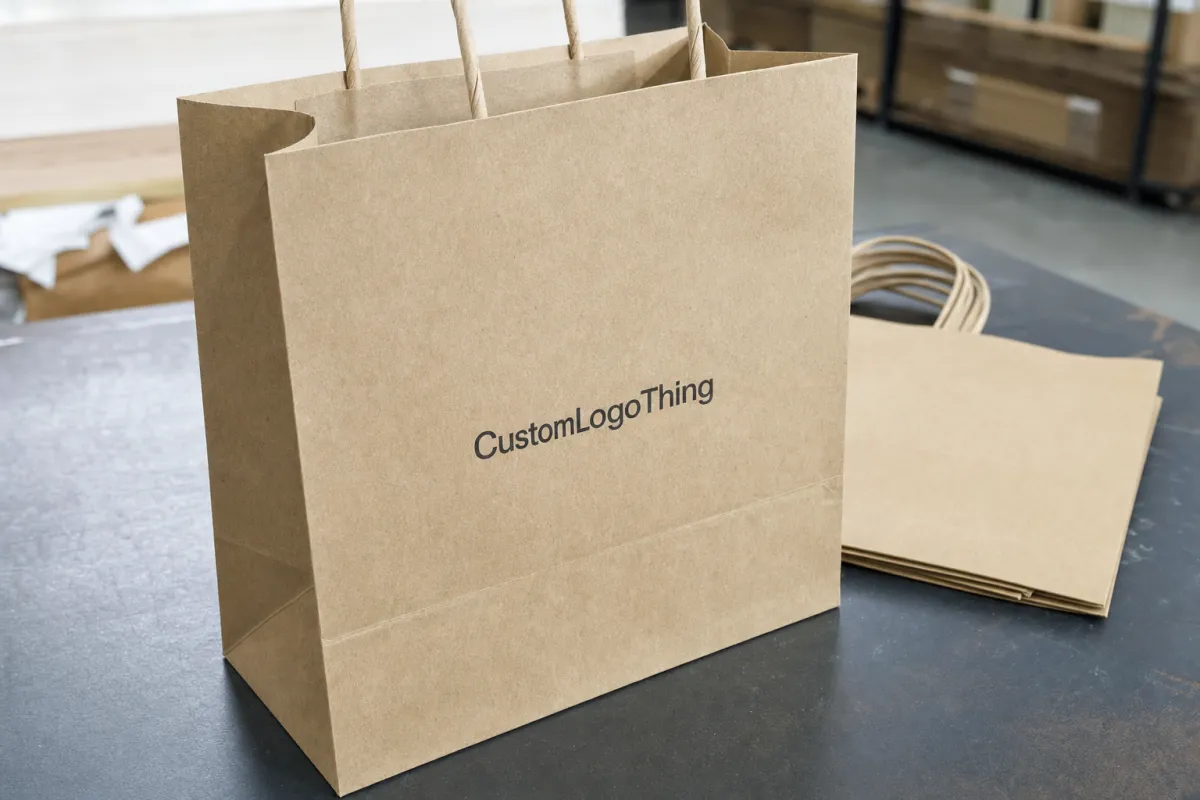
Small retail orders expose cost honestly. A national chain ordering 100,000 bags can spread setup charges across a huge volume. A boutique, salon, bakery, gift shop, event retailer, or pop-up brand ordering 1,000 pieces cannot. The same $150 artwork, plate, or setup line might add less than a penny to a very large run, but $0.15 per bag to a 1,000-piece order.
That is why two quotes can look wildly different even when the final bags seem similar. One supplier may include freight, artwork checking, packing, and basic prepress work. Another may show only the manufacturing price. The cheaper quote can lose its shine once shipping, tooling fees, or rush handling appear later.
From a packaging buyer's point of view, the goal is not always the cheapest bag. It is the bag that supports the sale without wasting budget. A $35 candle, a $90 scarf, and a $14 pastry box do not need the same paper bag spec. Overspecify, and the cost per piece climbs for no commercial reason. Underspecify, and handles tear, corners buckle, or the brand feels weaker in the customer's hand.
Buyer rule: compare landed cost, not headline unit cost. A useful quote shows manufacturing, setup, freight, and any optional finish charges before production is approved.
Good packaging pricing is dull in the best way. It tells you what you are paying for, where the fixed costs sit, and which changes reduce the total without damaging the bag's retail purpose.
Paper Stock, Handles, and Print Details That Change Price
Three variables move most quotes: paper stock, handle style, and print complexity. Bag size matters, obviously. Still, buyers often obsess over dimensions while missing the more expensive choices buried in the specification.
Kraft paper is usually the practical baseline. Brown kraft has a natural retail look and good tear resistance for the price. White kraft often costs more because of its brighter surface and cleaner print presentation. Coated papers, including C1S paper or laminated art paper, push the bag into a more polished category. They can look sharper at the counter, but they add material cost and may affect recyclability depending on coatings, inks, adhesives, and films.
Paper weight is usually expressed in GSM. For Small Retail Paper Bags, common ranges often sit around 120-180gsm for many kraft styles. Premium laminated bags may use 180-250gsm or more depending on structure. Heavier is not automatically better. It is just heavier. If the bag carries jewelry, cosmetics, socks, stationery, or a small bakery item, moderate paper weight may be enough. If it carries boxed glassware, jars, candles, or multiple products, handle attachment and bottom reinforcement deserve as much attention as GSM.
Handles change both material cost and labor. Twisted paper handles are common, economical, and retail-friendly. Flat paper handles suit lighter promotional bags and some food-service uses. Rope handles feel more premium, but they usually require reinforced holes or patches and more finishing labor. Ribbon handles push cost further and make sense mainly for gift, luxury, or event packaging.
Die-cut handles can look clean, but they are not always the budget shortcut buyers expect. The cutout affects strength, and the bag may need heavier paper or reinforcement depending on the product load. No-handle bags can be economical for small merchandise, but only if the customer can carry them comfortably. Cheap packaging that irritates the customer is not cheap. It is just a tiny brand tax.
Print is the quiet budget mover. One-color logo printing on kraft can be efficient. Two or three colors require tighter registration and more press work. Heavy ink coverage, flood backgrounds, metallic ink, spot UV, embossing, foil stamping, and soft-touch lamination can move a quote more than a half-inch change in width. In a real retail paper bag cost review, print and finishing often explain the gap between an everyday store bag and a premium branded carrier.
Specifications Buyers Must Lock Before Quoting
A dependable quote starts with complete specifications. Missing details create assumptions, and assumptions create revisions. That costs time. Sometimes it costs money too, because the first price may be based on lighter paper, a simpler handle, or lower ink coverage than the buyer expected.
Before asking for pricing, lock the basics:
- Finished size: width, height, and gusset depth, such as 8 x 10 x 4 inches.
- Paper stock: brown kraft, white kraft, coated paper, recycled-content paper, or FSC-certified paper preference.
- Paper weight: target GSM or a supplier-recommended range based on product weight.
- Handle style: twisted paper, flat paper, rope, ribbon, die-cut, or no handle.
- Print details: number of colors, sides printed, approximate coverage, and finish.
- Quantity: one target quantity plus two optional tiers if budget matters.
- Delivery location: postcode or ZIP code for freight calculation.
- Timing: required in-hand date, not just the desired production start date.
Retail use matters. A bag for a soap bar has different requirements than a bag for ceramic mugs. A premium cosmetics launch may need high color accuracy and a smooth white surface. A farmers market brand may care more about recycled kraft, a simple black logo, and low landed cost. A bakery might need grease resistance in the primary pack but only moderate strength in the carry bag.
Certifications can guide the conversation, but they should not be used as decoration. Forest certification from FSC may be relevant if responsible sourcing is part of the brand promise. Distribution testing concepts from ISTA can help when bags are part of a wider shipper or retail fulfillment pack, though a store carry bag is not tested like an e-commerce parcel.
Most quote frustration starts before the supplier sees the file. A buyer sends a logo and asks for "small bags." The supplier guesses. The buyer compares that guess with another supplier's different guess. Nobody is pricing the same product.
Small Retail Paper Bags Unit Cost Breakdown: What Drives Price
A practical small retail Paper Bags Unit Cost Breakdown separates the quote into visible cost buckets. The exact numbers depend on bag size, market conditions, freight lane, printing method, and order quantity, but the structure is usually consistent.
| Cost Driver | Typical Impact on Short Runs | Buyer Control |
|---|---|---|
| Paper material | Often $0.10-$0.35 per bag for many small retail specs; higher for premium coated or laminated stocks | Choose correct GSM, standard stock, and realistic strength level |
| Printing | Can add $0.05-$0.25+ per bag depending on colors, coverage, sides printed, and method | Limit colors, reduce flood coverage, simplify artwork |
| Setup charges | May add $75-$300 or more as fixed cost before unit production | Approve clean artwork, repeat proven specs, avoid avoidable changes |
| Handles and finishing | Twisted paper is usually lower cost; rope, ribbon, foil, embossing, and lamination raise price | Match finish to retail value, not personal preference alone |
| Packing and cartons | Small but real, especially for low quantities and parcel shipping | Confirm carton count and storage needs before ordering |
| Freight | Can add $0.04-$0.20+ per bag on short runs depending on distance, carton size, and service level | Provide delivery postcode early and compare landed cost |
Consider a simplified example. A 1,000-piece order might show $0.38 per bag for manufacturing, $150 in setup charges, and $95 in freight. The headline bag price looks like $0.38. The landed cost is $0.625 per bag. At 3,000 pieces, the same setup charge drops to $0.05 per bag, and freight may become more efficient per carton. The unit cost could fall to the $0.42-$0.50 range even if the physical bag barely changes.
That math makes bulk pricing tempting, but only if inventory makes sense. Bags take storage space. Retail branding can change. Seasonal graphics age quickly. A larger order is smart when the spec will be reused for six to twelve months, not when the artwork is tied to a short promotion.
Savings usually come fastest from standard sizing, fewer print colors, and simpler finishing. Reducing a bag by a quarter inch rarely transforms the price. Removing a full-coverage second-side print might.
Watch quotes that hide shipping, plates, artwork preparation, or revision charges. A clean breakdown should make those items visible or state clearly that they are included. If the quote only says "Custom Paper Bags: $0.39 each," ask what is missing. Something probably is.
MOQ, Setup Fees, and Volume Tradeoffs
MOQ is not only a supplier rule. It is a pricing lever. Minimum order quantity exists because machines, materials, labor scheduling, and print preparation all require a baseline volume to make production workable. On a very low quantity, fixed costs crowd the unit cost.
Here is the pattern buyers should expect. At 500 pieces, the quote may feel high because setup charges are spread thinly. At 1,000 or 2,500 pieces, the cost per piece often improves. At 5,000 pieces, paper purchasing and production efficiency may improve again. After that, the next break may be less dramatic unless the job shifts into a more efficient production method or freight class.
Ask for tiers. Not ten tiers. Two or three usually do the job: 1,000, 2,500, and 5,000 pieces, for example. Then compare the total spend against expected usage. If a boutique uses 350 bags per month, 2,500 bags represent about seven months of inventory. That may be reasonable. If branding is changing in eight weeks, it is not.
A slightly larger order can reduce the landed unit cost enough to justify the extra cartons. Example: 1,000 bags at $0.68 landed equals $680. A 2,500-piece tier at $0.49 landed equals $1,225. The second option costs more cash upfront but saves $0.19 per use. If the store will use the bags before the design changes, the larger order may be the better buy.
Storage deserves a boring but necessary mention. Paper bags are bulky, and cartons should stay dry, clean, and reasonably flat. Humidity can affect paper feel. Crushed cartons can bend handles or crease bag panels. If the stockroom is already packed with fixtures, displays, and the seasonal stuff nobody wants to admit is still there, a lower quantity may be worth the higher unit cost.
Plan around retail calendars. Seasonal launches, store openings, market weekends, and gift-heavy periods can support a higher order quantity. A rush reorder during peak season is usually more expensive than a planned order six weeks earlier.
Production Steps, Proofing, and Lead Time to Delivery
Lead time does not begin with the first email. It begins after the specification, artwork, pricing, and proof are approved. That distinction matters. Many small orders miss their target date because three days disappear in logo file hunting, Pantone questions, address confirmation, or delayed proof approval.
A typical process looks like this:
- Quote request: buyer sends size, stock, handle, print, quantity, and delivery postcode.
- Spec review: supplier checks whether the bag suits the product weight and retail use.
- Artwork check: logo file, print area, color references, and bleed requirements are reviewed.
- Proof approval: digital proof, pre-production sample, or physical sample plan is confirmed.
- Production: paper conversion, printing, handle application, finishing, and quality checks.
- Packing: bags are counted, carton-packed, labeled, and prepared for shipment.
- Transit: parcel, LTL, or freight delivery moves the cartons to the store or warehouse.
Simple jobs move faster. A one-color logo on a standard kraft twisted-handle bag is usually less complicated than a multi-color laminated bag with rope handles and foil stamping. Same size, completely different production path.
As a practical planning range, many custom retail paper bag jobs require roughly 10-20 business days after proof approval, plus transit. Some repeat orders or simple specs can move faster. Specialty finishes, imported materials, complex color matching, or sample rounds can extend the schedule. Not always. Often enough that buyers should build a cushion.
Approval delays are the silent killer. If the supplier sends a proof on Tuesday and approval arrives Friday, the production clock did not run for those three days. Retail launch dates do not care. Cartons either arrive before the opening event or they do not.
A useful quote should also identify any rush charges. Speed has a cost because it can disrupt scheduling, require expedited freight, or limit production options. Sometimes rush production is available but rush freight destroys the savings. Sometimes the reverse is true. Ask before assuming.
Quality Checks That Protect Retail Orders
Small retail bags do not need laboratory drama, but they do need basic quality checks. The bag should open cleanly. The bottom should sit correctly. Handles should be centered and firmly attached. Print should land in the approved position, with acceptable color variation for the chosen print method and paper surface.
Kraft paper will not show color the same way coated white paper does. Brown stock mutes ink. Fine type can fill in. Reversed-out details can disappear if the lines are too thin. Metallic ink and foil are different finishes, not interchangeable magic. A supplier should say that before production, not after the boxes arrive.
For retail use, the most practical check is load suitability. The bag should carry the expected product weight with a reasonable margin. That does not mean testing it with a dumbbell because someone on the internet likes overkill. It means matching GSM, handle type, adhesive, bottom structure, and reinforcement to the actual product.
Common pre-production checks include:
- Artwork resolution: vector files for logos and clean outlines for text or icons.
- Color references: Pantone, CMYK, or agreed print targets with realistic expectations by stock.
- Safe print area: artwork placed away from folds, gussets, handle holes, and creases.
- Handle attachment: suitable reinforcement for the expected carry weight.
- Carton packing: reasonable count per carton so bags do not arrive crushed or overpacked.
Color tolerance deserves plain language. A digital proof checks layout, scale, and content. It does not guarantee exact color on paper. A physical sample gives better confidence, especially for premium packaging, but it adds time and cost. For a simple black logo on brown kraft, a digital proof may be enough. For a color-critical cosmetics bag, skipping a sample is optimistic. And optimism is not a quality-control process.
Supplier Fit for Small Retail Bag Orders
A useful supplier for Small Retail Paper Bags does more than list a price per thousand. The job is often connected to a specific commercial moment: a new shop counter, a product launch, a trade show, a holiday gift set, or a test run for a growing brand. The order may be small, but the deadline and presentation still matter.
The right supplier explains why one spec costs more than another, where setup charges sit, and how quantity changes the landed unit cost. That kind of quoting helps buyers avoid the classic trap: approving a premium finish that looks good on screen but adds $0.18 per bag to a product that sells for $12.
Spec review is not hand-holding. It is risk control. A buyer may ask for 250gsm laminated paper because it sounds premium, then discover that 180gsm white kraft with a strong twisted paper handle is more suitable for the product and much better for the budget. Another buyer may request a tiny bag for a boxed item, then realize the gusset is too narrow once the product dimensions are checked properly.
Artwork checking matters too. Low-resolution logos, thin reversed-out type, unassigned colors, and print coverage that runs too close to a crease can all create problems. Catching those issues before production protects both the look of the bag and the delivery schedule.
Repeat-order stability is another retail concern. Once a store finds the right spec, the next order should match. Stored specifications, clear reorder references, and consistent communication reduce friction. Not glamorous. Very useful.
Next Steps to Get an Accurate Quote
Send the full request in one message if you want pricing that can be trusted. Include finished size, gusset depth, paper choice, handle style, print colors, quantity, delivery postcode, and target in-hand date. If you have artwork, attach a vector file such as AI, EPS, or print-ready PDF. If you do not, say so early.
Ask for two or three quantity tiers. A retailer might request 1,000, 2,500, and 5,000 pieces. That makes MOQ, setup charges, and the bulk pricing effect visible. It also helps you decide whether the lower unit cost is worth the extra inventory.
Request a proof or sample plan before approval, especially for branded retail packaging. A digital proof checks layout and position. A physical sample can confirm paper feel, handle strength, and scale, but it may add time and cost. The right choice depends on risk. A simple black logo on kraft may not need the same review as a premium gift bag with foil and rope handles.
Before approving, compare landed cost, not only manufacturing cost. Confirm what is included. Check the lead time after proof approval. Then choose the specification that balances shelf impact, product protection, budget, and the unit cost you can defend.
Frequently Asked Questions
What affects small retail paper bag unit cost the most?
Paper grade and bag size set the material base cost, but print colors, ink coverage, handle style, and finishing often shift the quote more than buyers expect. On short runs, freight and setup charges can matter more than the printed unit price. A proper small retail Paper Bags Unit Cost breakdown should show those costs clearly.
How does MOQ change retail paper bag pricing?
Lower MOQ usually means a higher unit cost because setup is spread across fewer bags. Higher quantities often improve material buying, labor efficiency, and freight efficiency. Ask for tiered pricing before ordering so you can see the real break point rather than guessing from one quantity.
Can I lower retail paper bag unit cost without weakening the bag?
Yes. Use a standard size where possible, limit print colors, avoid unnecessary specialty finishes, and match the paper weight to the product load. Do not pay for 250gsm premium construction if a 150-180gsm kraft or white kraft bag will safely carry the product and present the brand well.
What information is needed for an accurate paper bag quote?
Send dimensions, gusset depth, paper stock or GSM, handle type, print colors, artwork status, quantity, and delivery postcode. Add the retail use case too. A bag for boxed jewelry, folded apparel, candles, or bakery items may need different strength, finish, and handle recommendations.
How long does small retail paper bag production usually take?
Lead time starts after artwork and proof approval, not after the first inquiry. Many straightforward custom jobs take about 10-20 business days after approval, plus transit, though repeat orders can be faster and specialty finishes can take longer. Add shipping time to the production schedule so store launches do not slip.

