Buyer Fit Snapshot
| Best fit | Poly Mailers Quote Request projects where brand print, material claims, artwork control, MOQ, and repeat-order consistency need to be specified before quoting. |
|---|---|
| Quote inputs | Share finished size, material target, print colors, finish, packing count, annual reorder estimate, ship-to region, and any compliance wording. |
| Proofing check | Approve dieline scale, logo placement, barcode or warning zones, color tolerance, closure strength, and carton packing before bulk production. |
| Main risk | Vague material claims, crowded artwork, missing packing details, or unclear freight terms can make a low unit price expensive after revisions. |
Fast answer: Poly Mailers Quote Request: Pricing, Specs, and Timing should be specified like a repeatable production item. The safest quote records material, print method, finish, artwork proof, packing count, and reorder notes in one written spec.
Production checks before approval
Compare the actual filled-product size with the drawing, then confirm tolerance on folds, seals, hang holes, label areas, and retail display edges. Reserve space for logos, QR codes, warning copy, and material claims before decorative graphics fill the panel.
Quote comparison points
Review material grade, print process, finish, sampling route, tooling charges, carton quantity, and freight assumptions side by side. A quote is only useful when the supplier can repeat the same color, closure quality, and packing count on the next order.
Poly Mailers Quote Request: Pricing, Specs, and Timing
A Poly Mailers Quote request without size, thickness, print details, or a shipping ZIP is basically a blindfolded guess with a price tag. I've watched otherwise smart buyers do this, then wonder why every revised quote looks different. The number was never stable in the first place.
From a packaging buyer's point of view, a clean poly mailers quote request saves time because the supplier can price the film, the print method, and the freight in one pass. Fewer follow-up emails. Fewer assumptions. Fewer chances for somebody to say, "Oh, I thought you meant something else."
This is a buying checklist, not packaging theater. The goal stays simple: send a better poly mailers quote request, get a tighter quote, and stop the usual back-and-forth that burns a day on both sides.
Poly Mailers Quote Request: Why Specifics Lower the Real Cost
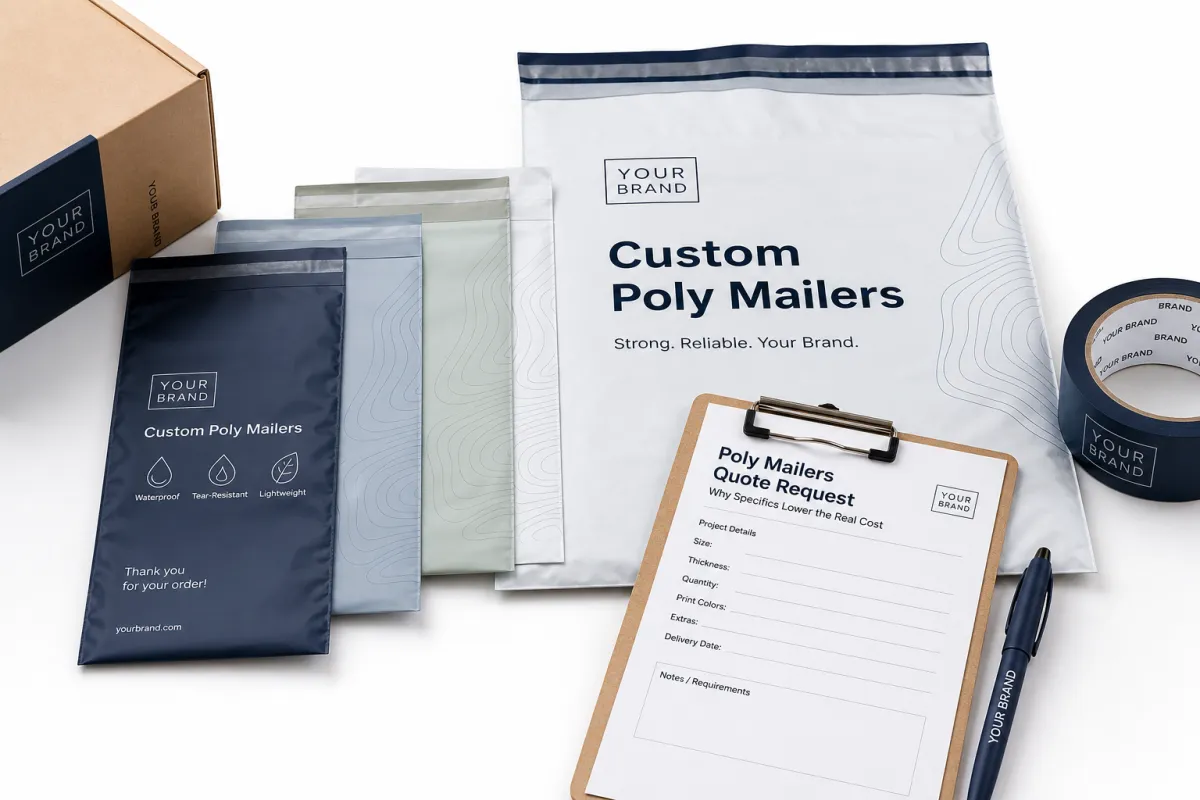
The awkward truth is that most bad quotes do not come from sudden price increases. They come from missing details. A poly mailers quote request without size, print colors, and shipping destination forces the supplier to make assumptions, and assumptions always crawl back later as revisions.
Picture a buyer asking for a quote on custom mailers and sending one line: "Need poly Bags with Logo." Efficient? Sure. Useful? Not even close. Are they for hoodies, jewelry, books, or boxed kits? Is the ship-to address in a freight-friendly metro, or a remote zone that turns a cheap unit price into an expensive landed cost? A supplier can only guess so much before the estimate stops being worth much.
A good poly mailers quote request is specific enough that the first reply can be compared against another supplier without a translation job.
The cleanest requests name the product, the usage, the dimensions, the film thickness, the closure style, and the destination ZIP in one message. That lets the supplier match material, print method, carton pack, and freight on the first pass. In practice, a complete poly mailers quote request usually comes back faster and with fewer surprises because nobody has to stop and ask what the buyer actually meant.
That does not mean every quote should look identical. It means the quote is built on the same facts. If you want to compare multiple vendors, that matters. One supplier may quote a lower unit price and bury freight. Another may be honest on shipping but high on print setup. A useful poly mailers quote request gives you the same baseline everywhere, which is the only sane way to compare anything.
For buyers who want a broader packaging view, the Custom Packaging Products page is a practical place to compare mailers with other formats before you lock in the spec. If the product choice is still open, that conversation should happen before the quote, not after it.
Poly Mailers Quote Request Product Details That Affect Your Quote
Not all mailers are priced the same, and pretending they are is how bad purchases happen. A poly mailers quote request should clearly identify the product type, because the material and build drive most of the cost difference before print ever enters the picture.
Here is the practical breakdown. Standard shipping poly mailers are the baseline: lightweight, self-seal, and good for apparel or non-fragile goods. Printed mailers add branding and usually add setup time. Recycled-content mailers can be a smart option if you need sustainability claims, but they are not always the cheapest choice. Specialty versions with extra opacity, higher tear resistance, or a return strip cost more because the film and converting work are better, and better costs money. That is normal.
The features buyers actually pay for are pretty consistent:
- Self-seal adhesive for quick packing and fewer labor minutes per unit.
- Dual adhesive strip for returns or re-seal use, which adds value but also adds cost.
- Reinforced seams if the contents are heavy or have sharp corners.
- Tear strip for easy opening, especially useful in retail fulfillment.
- Interior opacity when privacy matters and contents should not show through.
Print format is another big price lever. One-color logo work is not the same as full coverage art. Edge-to-edge graphics need more setup, more registration control, and more waste to get the print aligned. A poly mailers quote request that says "logo on front" is helpful. A request that says "full front and back coverage with gradient background and reverse printing" is a different project entirely.
Stock color versus custom color matters too. A plain white or gray stock mailer is usually quicker and cheaper to produce. A custom color film can push lead times out and raise the unit price because it changes the material run. Custom sizing does the same thing. If you are asking for a bag that is neither standard nor widely stocked, your poly mailers quote request should expect a different answer than a commodity mailer order.
For buyers comparing a printed mailer against a different packaging format, keep the decision practical. If the product is over-specified, you pay for branding where plain protection would have been enough. If the product is under-specified, you pay later in damage, returns, or rework. There is no magic trick here. There is only the right spec for the job.
Poly Mailers Quote Request Specifications Buyers Need to Confirm
A useful poly mailers quote request should confirm the core specs up front. If these are missing, every quote becomes a follow-up exercise, and nobody enjoys that.
The first item is size. Width and length should be listed clearly, and if the bag needs extra depth for bulky apparel, say so. A bag that works for a folded tee is not the same bag that needs to hold a hoodie, a catalog, and a thank-you insert. The second item is thickness, usually shown in mil or micron. Use the number, not a vague promise. A thinner film may save a few cents, but if the mailer is handling rough parcel networks or heavier contents, that small saving gets erased fast.
There is a reason the better suppliers ask detailed questions. They are trying to prevent failures before they happen. A poly mailers quote request should include:
- Width x length of the finished mailer.
- Film thickness in mil or micron.
- Closure type, such as permanent seal or dual adhesive strip.
- Print side, one side or both sides.
- Print area, full coverage, centered logo, or limited panels.
- Quantity, with tiered counts if you want pricing breakpoints.
- Usage, such as apparel, books, accessories, or mixed ecommerce orders.
Quantity matters more than people like to admit. A poly mailers quote request for 1,000 pieces is a different animal from 10,000 pieces. Setup costs are spread over fewer bags on the small run, so the unit price usually climbs. That is not a markup trick. That is math.
If you are sourcing for ecommerce, tell the supplier how the mailer will be used. Apparel tends to tolerate a lighter film than hard goods. Books can create stress on the seams. Multi-item orders with boxes or rigid inserts need more structure than a soft garment shipment. If the mailer is gonna survive a rough regional parcel lane, the supplier needs to know that. A supplier who knows the use case can suggest the right thickness, which is more useful than being cheap in the wrong way.
Compliance and sourcing requirements belong in the request too. If recycled content matters, say whether you need post-consumer recycled content, a supplier declaration, or a specific percentage. The EPA has useful background on recycled-content claims and terminology at epa.gov, and that kind of reference can help buyers avoid vague sustainability language that sounds nice and proves nothing. If you are comparing standards or shipping-test language, packaging.org also remains a useful industry reference at packaging.org.
For buyers with retailer requirements, marketplace packaging rules, or internal sourcing policies, a poly mailers quote request should mention those constraints before the quote is issued. That is the difference between a usable estimate and a pretty PDF that cannot be approved.
| Option | Typical Unit Price at 5,000 | Best For | Tradeoff |
|---|---|---|---|
| Plain stock poly mailers | $0.05-$0.12 | Generic ecommerce shipments, low branding need | Lowest cost, no logo presence |
| Single-color printed mailers | $0.18-$0.28 | Brand recognition without heavy art coverage | Print setup and proofing add time |
| Full-coverage custom printed mailers | $0.25-$0.45 | Retail presentation, stronger brand impact | More waste, tighter registration, higher MOQ pressure |
| Recycled-content or specialty mailers | $0.22-$0.40 | Sourcing requirements, sustainability goals | Not always the cheapest, sometimes longer lead time |
Poly Mailers Quote Request Pricing, MOQ, and Freight
If you only look at unit price, you are not buying intelligently. You are just collecting numbers. A good poly mailers quote request should split the order into unit cost, setup cost, and freight so the landed cost is clear.
The main price drivers are simple, even if the final quote has a lot of line items. Quantity, print complexity, material grade, bag size, and whether the order is plain or custom printed all affect the number. A smaller order usually pays more per unit because the setup cost is spread across fewer bags. A larger order usually brings the unit price down, but only if the supplier can run the quantity efficiently. That is why breakpoints matter.
MOQ reality is usually less glamorous than buyers hope. For plain stock mailers, lower minimums are common. For printed mailers, the minimum order often rises because artwork setup and press preparation need enough volume to make sense. That can mean 1,000 pieces, 3,000 pieces, or 5,000 pieces depending on the bag size, print method, and film choice. A poly mailers quote request that asks for three quantity tiers can save a lot of time because it shows the real price curve instead of a single number that hides the threshold.
Freight is where many buyers get annoyed. Cheap bags are not cheap if they ship badly. Carton count, package weight, and destination ZIP can swing the total a lot. A domestic parcel shipment may be fine for a small run, but larger orders often move by freight, and a cross-country lane can add far more than the buyer expected. For a simple mental model, many small to mid-size orders land anywhere from $35 to $250 in freight, depending on packaging, zone, and service level. Larger palletized orders move the number higher. A poly mailers quote request without a shipping ZIP is only half a request.
There are also hidden movers that deserve attention. Artwork revisions create delay and sometimes extra prepress cost. Color matching can require additional proofing. Special packaging, such as inner cartons, master carton labels, or pallet wrap requirements, can change handling charges. Rush service is another one. If the in-hand date is aggressive, say it early. The supplier can often plan around it. They cannot plan around what they do not know.
Here is the practical rule: separate the quote into these buckets before you compare anything.
- Unit price for the bag itself.
- Setup or print charges for artwork and plate or press preparation.
- Freight to your destination.
- Extras like rush service, special cartons, or proofs.
That breakdown keeps a poly mailers quote request honest. It also makes it easier to compare a plain mailer option against a branded one without fooling yourself into thinking a lower front-end price is the cheaper order. A lower quote with higher shipping is still a higher cost. Amazing how that works.
Poly Mailers Quote Request Process and Timeline
The quote process should be boring in a good way. A clean poly mailers quote request goes in, the supplier asks only the necessary questions, pricing comes back, the proof gets approved, and production starts. That is the path. Anything else adds friction.
Here is what usually happens. First, you send the specs. Second, the supplier checks for missing data and confirms the material, size, print method, and freight destination. Third, you review the pricing. Fourth, if the project is moving forward, you approve the proof. Fifth, the order goes into production and then into shipping. If the request is complete, the quote can come back quickly. If the artwork is messy or the dimensions are vague, it slows down immediately.
Timing expectations should be realistic. A plain stock mailer quote can often be turned around quickly because there is less to calculate. A printed order takes longer because proofing matters. Once proof approval happens, production often runs in roughly 10-15 business days for straightforward printed work, though larger volumes, custom sizing, or specialty film can push that longer. Freight adds its own timeline depending on the distance and service method. A poly mailers quote request should include the target in-hand date if timing is tight, because nobody can manage a deadline they never saw.
Proofing is the point where many timelines get wrecked. Buyers approve art too quickly, then discover the logo is too small, the print sits in the wrong area, or the colors are off from brand standards. That is not a production problem. It is a proofing problem. A smart poly mailers quote request should ask for a proof type in advance, because digital proofs and physical proofs do not give the same confidence level. If color matters a lot, ask what the proof actually represents before you sign off.
There is also a sensible way to handle samples. If you need a sample before committing, say so. That is especially true for new brands, seasonal launches, or anything with a higher damage risk. A sample can confirm feel, opacity, seal strength, and actual bag size. It is much cheaper to catch a fit issue on one sample than on a full order. That is not glamorous, but it is smart buying.
If you want help moving faster, the easiest path is to send the quote and the art at the same time. If you need live support on the spec, use Contact Us and include the full poly mailers quote request details in one message. That is how you get a useful response instead of a thread full of clarifications.
Why Choose Us for Poly Mailers Quotes
Most buyers do not need a pitch. They need a straight answer. A solid poly mailers quote request should get a clear, practical reply that tells you what the product is, what it costs, what the freight looks like, and what could move the number. That is the bar.
We keep the process direct because fake low quotes help nobody. Some suppliers shave the unit price, then recover the margin with freight, proof changes, or vague add-ons that show up after the fact. That approach wastes time and annoys everyone involved. A better quote is the one that makes sense on day one. If the numbers are clear and the specs are right, the decision is easier.
Packaging buyers also benefit from someone who can tell the difference between a product that needs a printed mailer and one that only needs a decent stock bag. That sounds kinda obvious, but it is where a lot of money gets burned. Not every order needs premium print coverage. Not every order should use the thinnest film available. A practical supplier should be able to explain that without turning it into a lecture.
Good support also means catching issues early. If the artwork is too fine for the film, say it. If the order quantity is too small for a particular print setup, say that too. If the requested size is awkward and will create a poor yield, that should be explained before the quote goes out. A useful poly mailers quote request is not just about speed; it is about getting flagged for the things that matter before they cost money.
For teams that want to compare packaging options across products, the Custom Poly Mailers page is the place to start. If your order may need another format altogether, the broader Custom Packaging Products catalog is worth reviewing before the spec gets locked. That saves time and prevents the classic mistake of forcing the wrong package to do the right job.
Trust also comes from consistency. Repeat orders should not feel like starting from zero every time. If the bag spec stays the same, the proof should stay familiar, and the reorder should be easy to confirm. That is how a poly mailers quote request turns into a cleaner repeat buying process instead of a new project every quarter.
What to Send in Your Poly Mailers Quote Request
If you want a fast, usable number, send the full poly mailers quote request in one message. The supplier should not need to build the order from scratch. Give the facts up front and the response gets better.
Use this checklist before you send it:
- Size: width x length, plus any special fit notes.
- Quantity: single count or multiple tiers for comparison.
- Material preference: standard, recycled-content, or specialty film.
- Thickness: mil or micron target.
- Print colors: one-color, multi-color, or full coverage.
- Shipping ZIP: needed for accurate freight.
- Target in-hand date: so timing is quoted honestly.
- Artwork files: preferably in a usable format.
- Proof request: digital, physical, or both.
There are a few smart extras that make a poly mailers quote request even stronger. Ask for an apples-to-apples comparison between plain and printed mailers if you are deciding whether branding is worth the spend. Ask for separate pricing on different quantity tiers so the breakpoints are visible. If you are still unsure about the right construction, mention the contents you are shipping. Apparel, books, accessories, and mixed ecommerce kits do not all need the same film or seal strength.
If you care about sourcing proof, say so plainly. If you need recycled content documentation, note it. If your company requires a specific proof format before sign-off, mention that too. The more complete the request, the less room there is for cleanup later. A poly mailers quote request is most effective when it reads like a production brief, not a shopping list.
My advice is simple: do not split the request into five partial messages if you can avoid it. Send one complete note, attach the artwork, include the shipping ZIP, and ask for the quantity options you actually want to compare. That gives you a useful answer on the first pass and keeps the project moving. If you are ready to start, send the full poly mailers quote request now, and use Contact Us if you want help checking the specs before the quote goes out.
What should I include in a poly mailers quote request?
Include bag size, quantity, thickness, closure type, print colors, and shipping ZIP so the quote is based on real requirements. Add artwork files if you have them, plus whether you want plain, printed, or recycled-content mailers. If you are comparing options, ask for separate pricing on different quantities so the breakpoints are clear.
How much do custom poly mailers usually cost?
Pricing depends on size, film thickness, print count, and order volume, so one flat price is rarely honest. Plain stock mailers usually cost less than Custom Printed Mailers because there is no print setup or color work. Freight can change the landed cost a lot, so always compare the total delivered price, not just the unit rate.
What is the minimum order quantity for printed poly mailers?
MOQ varies by print method, bag size, and whether the mailer is stock or fully custom. Smaller quantities are possible, but the per-unit price usually rises because setup costs are spread across fewer bags. If your volume is uncertain, ask for two or three quantity tiers so you can see where the better break lands.
How long does a custom poly mailers quote request take?
A complete request can often be quoted quickly, but missing specs or unclear artwork always slows the response. After approval, production time depends on print complexity, quantity, and whether the order needs a special material or finish. If timing is tight, say it up front. Rush jobs are easier to plan when the supplier knows the deadline before quoting.
Can I get a proof before placing the order?
Yes, and you should ask for one. Proofs catch layout mistakes, logo placement issues, and bad color assumptions before production starts. A proof is especially useful for printed mailers with edge-to-edge art or multiple print areas. If color matters, ask whether the proof is digital or physical so you know how closely it reflects the final result.