Buyer Fit Snapshot
| Best fit | Poly Mailers vs Plastic Envelopes projects where brand print, material claims, artwork control, MOQ, and repeat-order consistency need to be specified before quoting. |
|---|---|
| Quote inputs | Share finished size, material target, print colors, finish, packing count, annual reorder estimate, ship-to region, and any compliance wording. |
| Proofing check | Approve dieline scale, logo placement, barcode or warning zones, color tolerance, closure strength, and carton packing before bulk production. |
| Main risk | Vague material claims, crowded artwork, missing packing details, or unclear freight terms can make a low unit price expensive after revisions. |
Fast answer: Poly Mailers vs Plastic Envelopes: Film, Print, MOQ, and Carton Packing should be specified like a repeatable production item. The safest quote records material, print method, finish, artwork proof, packing count, and reorder notes in one written spec.
Production checks before approval
Compare the actual filled-product size with the drawing, then confirm tolerance on folds, seals, hang holes, label areas, and retail display edges. Reserve space for logos, QR codes, warning copy, and material claims before decorative graphics fill the panel.
Quote comparison points
Review material grade, print process, finish, sampling route, tooling charges, carton quantity, and freight assumptions side by side. A quote is only useful when the supplier can repeat the same color, closure quality, and packing count on the next order.
Poly Mailers vs plastic envelopes sounds like a tiny sourcing decision. It usually is not. Pick the wrong one and the damage shows up later as repacks, higher postage, slower packing, and customer complaints that somehow become your problem. I have watched a few cents on the buy sheet turn into real money once the returns started rolling in and the warehouse had to clean up the mess.
The short version is blunt: poly mailers usually fit lightweight, flexible, non-fragile products. Plastic envelopes make more sense when the item needs a little structure, a cleaner presentation, or extra surface protection. The trap is assuming the cheapest unit price is the cheapest outcome. If the package adds labor or looks cheap in the customer’s hand, it stops being cheap pretty fast.
So the real question is not material names or sales copy. It is which shipper works better in your actual fulfillment flow, with your product, your crew, and your carrier routes. That is the lens here for poly mailers vs plastic envelopes.
Poly Mailers vs Plastic Envelopes: Quick Answer
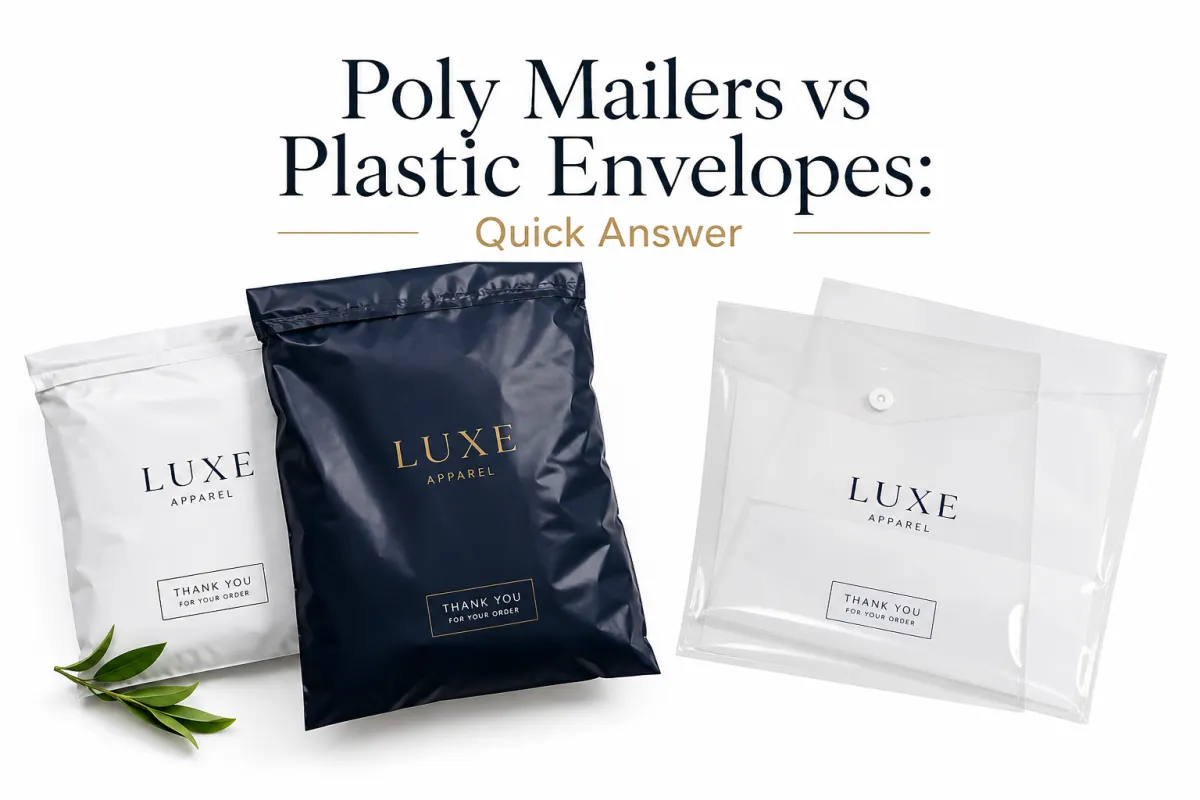
If the shipment is soft, flat, and not easy to crush, poly mailers vs plastic envelopes usually lands on the poly mailer. Apparel, leggings, socks, soft accessories, and plenty of subscription items move faster in a simple polyethylene mailer because the bag is light, forgiving, and easy to seal. Most stock poly mailers use co-extruded polyethylene film, often around 2.5 to 3.5 mil, which is enough for normal parcel handling without adding dead weight.
Plastic envelopes fit better when the item needs a bit more shape retention, better presentation, or light padding. That can be a bubble-lined envelope for a small device accessory, a clear sleeve for a folded garment set, or a heavier document-style mailer for samples and inserts. So no, poly mailers vs plastic envelopes is not a clean good-versus-bad split. It is a match-the-container-to-the-risk problem.
Most packaging fails quietly. One extra relabel. One bent corner. One seam that gives up on a rough route. One customer who thinks the order looks cheaper than it should. That is how the bill shows up.
That is the part buyers miss. A package can look inexpensive and still become the costly choice if it creates damage claims, repack labor, or a weak unboxing moment that hurts repeat orders. A package that looks a little more polished can pay for itself if it keeps the product safe and the warehouse moving. For poly mailers vs plastic envelopes, the right way to judge is to follow the shipment all the way to the doorstep, not stop at the purchase order.
My rule is simple: use the lightest package that survives your roughest realistic route. If the item can flex, slide, and take normal surface contact without a problem, a poly mailer is usually the starting point. If it needs cushioning, visibility, or a more refined hand-feel, a plastic envelope with more structure earns its keep.
Top Options Compared: What You Actually Get
One reason poly mailers vs plastic envelopes gets muddy is that “plastic envelope” covers a lot of different products. Some people mean a clear polyethylene sleeve. Others mean a bubble-lined envelope. Others mean a heavier tamper-evident bag with a tear strip and pressure-sensitive closure. Those are not the same thing in a real shipping operation, even if the product photos all look tidy.
The simplest split is this. A plain poly mailer is the lean option: flexible, opaque, light, and built for speed. A Printed Poly Mailer keeps that handling profile but adds brand presence. A bubble-lined plastic envelope gives you cushioning, which helps with small items that scuff or chip. Clear sleeves and glossy envelopes shift the visual feel toward retail display. Heavier plastic mailer bags with tamper-evident seals sit closer to security and document use.
In a busy packout, the best package is the one the staff can grab without thinking. If an operator has to stop and decide whether the item needs a bubble liner or a flat mailer, packing speed drops. That is why poly mailers vs plastic envelopes should be judged by the people packing the orders, not just by procurement or design.
- Plain poly mailers - Best for apparel, soft goods, and routine parcels where fast sealing and low weight matter most.
- Printed poly mailers - Best when brand impact matters and you want the outer package to carry the logo, colors, or a short message.
- Bubble-lined plastic envelopes - Best for small items that need moderate impact protection, such as cosmetics, cables, accessories, or samples.
- Clear plastic sleeves - Best when the product itself is part of the presentation and you want visibility without a full carton.
- Heavier mailer bags with seals - Best for documents, returns, or shipments where tamper evidence and closure confidence matter.
| Format | Typical Protection | Packing Speed | Typical Unit Cost Range | Best Fit |
|---|---|---|---|---|
| Plain poly mailer | Low to moderate surface protection | Very fast | $0.09-$0.18 at volume | Apparel, soft goods, flat non-fragile items |
| Printed poly mailer | Low to moderate surface protection | Very fast | $0.18-$0.40 at volume | Branded DTC shipments, subscriptions, repeat orders |
| Bubble-lined plastic envelope | Moderate cushioning | Fast | $0.20-$0.55 at volume | Small accessories, light fragile items, samples |
| Clear plastic envelope | Low to moderate | Fast | $0.16-$0.45 at volume | Presentation-driven items, visible product packs |
| Heavy-duty tamper-evident mailer bag | Moderate to high closure confidence | Fast to moderate | $0.14-$0.32 at volume | Returns, documents, controlled distribution |
The package is only one part of the bill. Freight, minimum order quantity, print setup, and storage all matter. A supplier can quote a low unit price on a bubble-lined envelope and still cost more once pallet space, longer lead times, and extra handling time get added in. That is why serious buyers compare poly mailers vs plastic envelopes on total landed cost, not just what the product page says.
Brand presentation changes the moment the package hits the customer’s hand. Opaque mailers look clean and direct. Clear or glossy plastic envelopes feel more retail-like. Bubble-lined formats make protection obvious, which is useful when the buyer expects the item to arrive guarded against scuffing. The right choice depends on whether your brand wants to fade into the shipping process or stay visible through it.
For broader packaging sourcing, it often helps to compare the outer bag with inserts, labels, and secondary materials at the same time. That is where a broader catalog such as Custom Packaging Products can be useful, especially if your team wants to standardize more than one shipper style across the operation.
Detailed Reviews: Performance, Feel, and Failure Points
Performance is about what happens after the package leaves the packing table. The real test is not how it looks in a staged photo. It is what happens during sorting, conveyor handling, truck vibration, stacking, and final delivery. A good outer shipper should keep its seam intact, resist puncture from corners or edges, and block incidental moisture long enough to arrive cleanly.
Poly mailers usually do well on tear resistance when they are spec’d correctly. A good polyethylene film bends instead of cracking, which helps when the package gets squeezed or rubbed. That flexibility matters for soft goods because the product can shift without making a hard pressure point. The downside shows up fast when the film is too thin. It feels flimsy, and a weak adhesive closure can fail if the bag is overfilled or the contents push against the seal line.
Plastic envelopes feel different. Bubble-lined versions add a little spring, which helps with small hardware, cosmetics, cables, or branded sample kits. Clear envelopes feel cleaner and more presentation-driven, but they also show scuffs, fingerprints, and internal movement faster than opaque films do. In a customer’s hand, that can read as premium or disposable depending on print quality and thickness. Small difference, big reaction.
Here is the annoying truth: a lot of failures are not material failures at all. They are application failures. Overstuffing shows up more than film defects. Poor seal engagement shows up more than seam blowouts. Thin glossy packages get used on routes that need more puncture resistance. So yes, poly mailers vs plastic envelopes matters, but the pack method matters just as much.
Failure points usually show up in the same places:
- Overstuffed gussets that force the adhesive to work harder than it should.
- Weak closures where the seal strip is narrow, dusty, or poorly aligned.
- Thin film that wrinkles badly, tears at the corner, or splits when snagged on rough carton board.
- Bad sizing that leaves too much empty space or squeezes the product so tightly that the package deforms.
- Rough carrier routes where even a decent bag needs more abrasion resistance than expected.
The packing experience matters too. Staff usually prefer a bag that opens cleanly, takes the product without a fight, and seals in one motion. A package that slips around the bench wastes seconds on every unit, and those seconds add up. If your line is moving hundreds of orders per shift, a tiny change in closure behavior turns into a real labor cost by the end of the week.
That is where a real test plan pays off. If a supplier can support an ISTA test procedure, that is far more useful than a glossy durability claim. For parcel shipments, an ISTA-style transit test tells you more about vibration, drop, and compression than a static sample ever will. Buyers who test poly mailers vs plastic envelopes that way tend to avoid expensive mistakes later.
Branding is the other performance piece people underestimate. A printed poly mailer can look polished when the artwork is balanced, the film thickness is right, and the registration is clean. A flimsy plastic envelope can look disposable even if it protects the item fine. That does not mean thicker is always better. It means ink coverage, film finish, and the way the package hangs in the hand all matter.
From a packaging buyer’s view, the strongest package is the one that feels ordinary to the warehouse and reassuring to the customer. Judged that way, poly mailers vs plastic envelopes stops being a category debate and turns into a simple question: does it survive the route without drama?
Price Comparison and Total Cost
Sticker price is where people start. It is not where the answer lives. In poly mailers vs plastic envelopes, the cheaper item can lose once labor, freight, and damage replacement get counted. A bag that costs two cents less but adds five seconds of handling time is not cheaper if you ship at volume. Same problem if a better-looking envelope pushes the parcel into a bigger carton, heavier freight, or a worse dimensional weight class.
Pricing shifts with thickness, print coverage, closure style, and quantity. At 5,000 pieces or more, plain stock poly mailers often land in the low double-digit cents per unit, while custom Printed Poly Mailers run higher depending on color count, coverage, and whether the design is one-sided or full-wrap. Bubble-lined plastic envelopes usually cost more than plain film because the cushioning layer adds material and converting time. Freight can swing the numbers more than buyers expect, especially when the order moves by pallet instead of parcel.
Labor is the hidden line item. If the bag loads faster, seals faster, and labels more cleanly, that savings shows up every shift. One package style may only shave a few seconds off each order, but across 1,000 orders a day that is a real number. The same is true for mispacks. If the wrong package drives even a small rework rate, the cheap unit price starts looking expensive very quickly.
Here is a practical way to think about total cost in poly mailers vs plastic envelopes:
- Unit cost - What the bag itself costs at the order volume you actually buy.
- Freight - What it takes to move the cartons or pallets to your facility.
- Labor - How many seconds the package adds or removes from each pack cycle.
- Damage replacement - What you pay when the shipper fails and the item must be resent.
- Customer service time - The soft cost of complaints, refunds, and manual follow-up.
The rough math often surprises people. A package that costs $0.03 more per unit can still save money if it cuts damage claims or keeps postage down. A package that looks cheaper can raise costs if it nudges the shipment into a thicker, less efficient profile. That gets especially ugly when the product sits near a carrier threshold and every extra ounce matters.
Postage and dimensional efficiency deserve attention. Poly mailers usually stay compact, which helps with weight and volume. Plastic envelopes can be equally efficient, but some styles add enough bulk to change the parcel class. If your product is already light, the outer package should not be the thing that makes the shipment more expensive. That is one reason many apparel sellers stay with poly mailers vs plastic envelopes in plain film unless presentation forces a different call.
If sustainability is part of the brief, the same total-cost thinking still applies. A thinner package is not automatically greener if it fails more often or triggers more returns. The EPA’s waste hierarchy is a decent reminder that source reduction and damage prevention matter before recycling ever enters the picture; see EPA packaging and materials guidance for the broader context. Less waste at the start usually beats trying to recover value later. And yes, the paperwork can get fuzzy fast, so do not pretend every pouch or film layer is magically recyclable just because a sales sheet says so.
For buyers comparing poly mailers vs plastic envelopes, the smartest price conversation includes repack labor, shipping class, and the cost of a bad first impression. Those hidden lines are where the real story lives.
Production Process and Timeline
Production gets messy when the buyer assumes every shipper has the same lead time. Poly mailers vs plastic envelopes is also a timeline decision. Stock items move fast because the film, size, and closure already exist. Custom printed versions take longer because artwork, proofing, ink setup, and inspection all need to happen before the first carton leaves the line.
A stock order may ship in a few business days if inventory is sitting there. Custom Printed Poly Mailers usually need proof approval, then production, then packing and freight booking. A simple one-color design is typically faster than a full-coverage print with multiple revisions. If the artwork is already built to spec and the color target is clear, the schedule can be predictable. If the logo keeps changing size, the timeline stretches. Fast. Annoying, but fast in the wrong direction if nobody freezes the spec.
For many runs, the real delay is not machine time. It is the back-and-forth. Samples go to one team, comments come back from another, and approved artwork sits waiting while somebody debates two shades of black. That happens constantly in poly mailers vs plastic envelopes projects, and it is why the cleanest schedules lock specs early.
A practical testing sequence helps prevent expensive reorders:
- Order samples in the exact size and closure style you plan to buy.
- Check seal strength by packing your heaviest realistic unit, not just an average one.
- Run a small ship test through your normal carrier path.
- Inspect scuff resistance after handling, sorting, and delivery.
- Scale only after the package survives your real process with room to spare.
That test sequence should include your own warehouse habits. A package that survives one careful sample pack can still fail when a busy team is moving fast at the end of a shift. Seal pressure, product orientation, and label placement all matter. If multiple pickers are touching the package or the floor is less than perfect, test it that way.
Lead time risk also comes from print complexity. Full-bleed art needs more care than a simple logo and return message. Metallic inks, special finishes, and fine type can add review time. If the shipment needs to start quickly, the safest path is usually a simple printed design or a stock bag with branded labels. The point is to get the package into production without breaking the parts that actually affect performance.
For buyers already narrowing down a format, Custom Poly Mailers are usually the quickest route from sample to production when the product is soft and the packout is straightforward. If the packout is still evolving, a broader review of Custom Packaging Products can keep the decision anchored in the whole shipping system instead of one item.
The short version: the manufacturing step is not usually where poly mailers vs plastic envelopes gets difficult. Artwork changes, sample approvals, and freight planning create more schedule risk than the actual converting process.
How to Choose Poly Mailers vs Plastic Envelopes
The cleanest way to choose between poly mailers vs plastic envelopes is to start with the product, not the package. Ask what the item needs after it leaves your hand. Does it need flexibility, basic moisture resistance, and fast pack speed? A poly mailer is probably the right answer. Does it need more surface protection, a cleaner retail feel, or a clearer view of the contents? A plastic envelope may fit better.
Product behavior comes first. Soft goods, folded apparel, scarves, and most non-fragile flat items usually fit well in poly mailers because the film conforms without fighting the contents. Products with sharp corners, delicate finishes, or parts that shift inside the package often do better with bubble-lined or more structured envelope styles. That is where poly mailers vs plastic envelopes turns into a useful sorting tool instead of a generic category label.
Order profile comes next. High-volume, repeatable shipments reward speed and consistency. Low-volume premium shipments can justify a package that looks more polished or offers extra protection. If the team packs the same item hundreds of times a day, a simple bag with a strong seal and clear label placement is a real advantage. If the package is part of a curated unboxing moment, a clearer or more refined envelope can make sense even if it costs more.
Brand goals matter, but they should not bully operations. A package that looks great and slows the line is a bottleneck wearing makeup. A package that is fast but forgettable may be fine for commodity goods, but it can underserve a brand built on repeat purchases and social sharing. The right answer in poly mailers vs plastic envelopes sits where presentation and throughput overlap, not where one side steamrolls the other.
Sustainability needs a careful read. Buyers love chasing the thinnest film available, then act surprised when the package fails or gets replaced. Fewer returns, less void space, and right-sized packaging usually matter more than raw material reduction alone. If you want a broader framework for material use and source reduction, the EPA guidance is a solid reference point. It is also worth asking whether the package can actually be recycled in the market you ship into, because theoretical recyclability and real recovery are not the same thing.
Here is the decision shortcut I give buyers:
- Choose a poly mailer if the item is soft, light, non-fragile, and packed at high volume.
- Choose a plastic envelope if the item needs more structure, visibility, or surface protection.
- Choose bubble lining if the item can scuff, chip, or rattle inside the package.
- Choose a printed finish if the outer bag is part of the brand story and the budget supports it.
- Choose the simpler format if warehouse speed and damage rate both improve with less complexity.
From a packaging buyer’s point of view, the cleanest decision is usually the one that cuts exceptions. If the team can pack it the same way every time, the operation gets easier. That is why so many buyers come back to poly mailers vs plastic envelopes after testing: the winner is the one that behaves on the floor.
Our Recommendation and Next Steps
My recommendation is straightforward. For most light, flexible, non-fragile items, poly mailers vs plastic envelopes should end with the poly mailer as the default. For shipments that need more presentation, more surface protection, or a little padding, a plastic envelope earns the upgrade. The goal is not to pick the fanciest option. The goal is to ship better, with fewer surprises.
I would not sign off on a final package choice on paper alone. Run a pilot. Measure damage rate, packing speed, customer feedback, and landed cost on a small batch before you commit to the full order. A format that looks perfect in a sample tray can still fail once the packout gets busy or the carrier route gets rough. A small test is a lot cheaper than finding out after a full pallet is already gone.
The best packaging decision is the one that still works after the sample phase, the packing phase, and the first ugly week of real shipping.
Here are the next steps I would take:
- Request two or three samples in the exact size you plan to ship.
- Test sealing, puncture resistance, and scuff resistance with your real product.
- Compare printed and unprinted versions to see whether the branding premium is worth it.
- Ask the warehouse team which package loads faster and feels easier to close.
- Confirm storage space, carton count, and freight assumptions before placing the full order.
If you are still deciding, start with the simplest version that can survive the route. Add structure, print, or cushioning only if the product and brand story really need it. That keeps the project honest and usually saves money. It also keeps poly mailers vs plastic envelopes grounded in actual shipping performance instead of a catalog description.
Honestly, that is the point: choose the package that lowers damage and keeps fulfillment moving. If a poly mailer does that best, use it. If a plastic envelope does it better, use that instead. The smartest answer to poly mailers vs plastic envelopes is the one that performs best in your real shipping line.
For clothing, are poly mailers better than plastic envelopes?
For most clothing, yes. Poly mailers are usually the better everyday choice because they are light, flexible, and fast to pack. A plastic envelope makes more sense when the garment needs to stay especially neat for presentation or when the shipment needs a cleaner, more rigid feel. For simple apparel, poly mailers vs plastic envelopes usually favors the poly mailer.
Which is cheaper in practice: poly mailers vs plastic envelopes?
The lower unit price is not always the lower total cost. Freight, labor, setup, and damage replacement can change the math fast. For high-volume soft goods, poly mailers often win because they pack quickly and keep postage efficient, while a more structured plastic envelope may cost more to buy and handle even if the sticker price looks close.
Can poly mailers replace plastic envelopes for fragile items?
Usually not by themselves. If the item can crack, bend, scratch, or shift during transit, it needs more protection than a basic mailer can offer. For fragile goods, add internal protection or use a more structured envelope style before you decide on the outer shipper. That is where the difference between poly mailers vs plastic envelopes becomes critical.
How long does custom printing take for poly mailers?
Lead time depends on artwork approval, print method, and whether the order is a stock run or a custom run. A simple design can move faster, while revisions, color matching, and sample sign-off add time. The quickest path is to approve artwork early and keep the spec clean so production can start without stop-and-go delays.
What thickness should I choose for poly mailers vs plastic envelopes?
Choose thickness based on product weight, sharp edges, and how rough the shipment route tends to be. If the package will be squeezed, stacked, or handled many times, a heavier film is usually worth the small cost increase. The right thickness is the one that survives your real distribution path, not the lightest number on the spec sheet.


