Buyer Fit Snapshot
| Best fit | Poly Mailers vs Shipping Bags projects where brand print, material claims, artwork control, MOQ, and repeat-order consistency need to be specified before quoting. |
|---|---|
| Quote inputs | Share finished size, material target, print colors, finish, packing count, annual reorder estimate, ship-to region, and any compliance wording. |
| Proofing check | Approve dieline scale, logo placement, barcode or warning zones, color tolerance, closure strength, and carton packing before bulk production. |
| Main risk | Vague material claims, crowded artwork, missing packing details, or unclear freight terms can make a low unit price expensive after revisions. |
Fast answer: Poly Mailers vs Shipping Bags: Film, Print, MOQ, and Carton Packing should be specified like a repeatable production item. The safest quote records material, print method, finish, artwork proof, packing count, and reorder notes in one written spec.
Production checks before approval
Compare the actual filled-product size with the drawing, then confirm tolerance on folds, seals, hang holes, label areas, and retail display edges. Reserve space for logos, QR codes, warning copy, and material claims before decorative graphics fill the panel.
Quote comparison points
Review material grade, print process, finish, sampling route, tooling charges, carton quantity, and freight assumptions side by side. A quote is only useful when the supplier can repeat the same color, closure quality, and packing count on the next order.
Poly Mailers vs Shipping Bags: Which Wins for Brands?
For apparel and soft goods brands, the real packaging decision is often not box versus bag. It is Poly Mailers vs shipping bags, because that choice can quietly change freight, labor, customer experience, and damage rates all at once. I have watched teams focus on print color and forget that a half-inch of extra width can raise postage, or that a slightly weak seam can turn into a stack of refunds a month later. Packaging sounds simple until the order volume starts climbing.
The short answer is pretty clear. Poly Mailers vs shipping bags usually turns into a cost-and-speed call for light, low-fragility goods, while shipping bags tend to earn the nod more often than people expect once presentation, repeat handling, or a premium opening moment matter. A folded tee in a basic DTC launch may fit a poly mailer perfectly. A subscription bundle, a giftable set, or a return-prone item may feel better in a shipping bag. The winner changes with the product, not with the label on the front.
Custom Logo Things works with brands that need packaging to earn its keep in fulfillment, not just sit pretty in a sample photo. So this comparison stays practical. I am looking at protection, unit cost, postage impact, branding, and the operational details that actually slow a warehouse line down. No fluff, no brochure language, just the tradeoffs that show up in real shipping lanes.
Poly Mailers vs Shipping Bags: Quick Answer for Real Orders
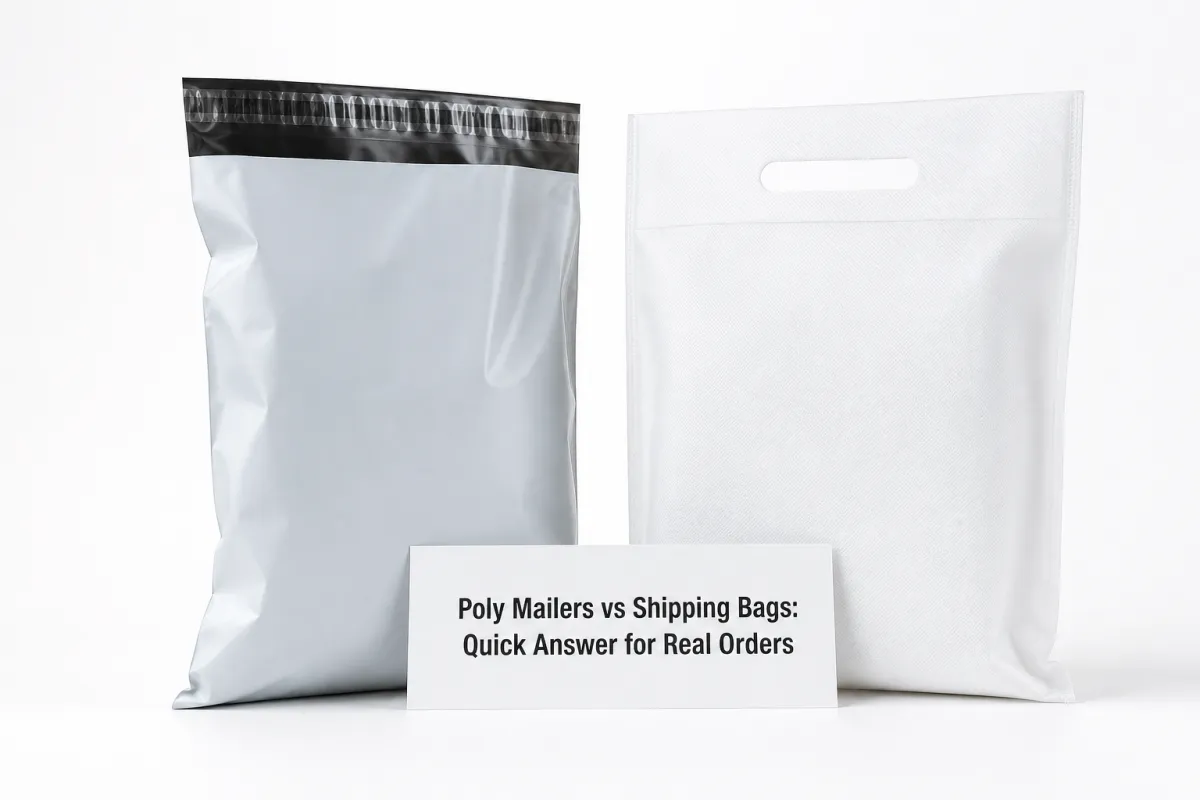
The first mistake I see is treating poly mailers vs shipping bags as if the only question is “which one is cheaper?” That is too narrow. For a 3-ounce tee, a light poly mailer can be the best answer because it keeps the shipment compact, low-cost to store, and fast to seal. For a 2- or 3-item bundle, the extra structure of a shipping bag may reduce wrinkles, creasing, and customer complaints even if the sticker price is higher.
Most brands should think in scenarios. A single folded tee or tank top? Poly mailers often win because they are simple, light, and easy to print. A return-heavy accessory program or a small subscription box substitute? Shipping bags may be better if the package has to survive multiple touches and still look presentable. A soft good that compresses badly, like knitwear or lightweight outerwear, can go either way depending on thickness, seal strength, and how much the item shifts inside the package.
There is also a financial twist that catches teams off guard. The package can change the shipping cost more than the product itself. Carrier pricing is ruthless about dimensional weight, and a slightly wider format can trigger a higher bill even when the actual item weighs almost nothing. That is why the comparison between poly mailers vs shipping bags is never just about material; it is about total landed cost, including freight, labor, and the cost of replacing damaged goods.
For buyers who want the shortest possible answer, it looks like this:
- Choose poly mailers for light, low-fragility items, fast pack-out, and the lowest practical unit cost.
- Choose shipping bags for better structure, cleaner presentation, and tougher handling during ecommerce shipping.
- Test both if the product wrinkles, scuffs, or returns often, because the cheaper option on paper is not always the cheaper option in practice.
That is the debate in one clean pass, but the details matter. The packaging choice affects order fulfillment speed, storage footprint, label application, tamper evidence, and customer perception. If a brand wants help selecting a spec, Custom Poly Mailers are a strong starting point, while a broader packaging mix can be found in Custom Packaging Products.
Poly Mailers vs Shipping Bags Compared Side by Side
Side by side, poly mailers vs shipping bags comes down to four real-world questions: how well the package resists punctures, how much moisture it blocks, how fast it moves through the packing line, and how polished it looks when the customer opens it. I have seen brands obsess over artwork while ignoring those basics, and that usually leads to a boring but expensive lesson later. The package may look great in a mockup and still behave badly on a conveyor.
On durability, both can be solid if the film is right. A typical poly mailer may use about 2.5 to 3.5 mil film for everyday apparel, while a heavier shipping bag can move into the 3.5 to 4.5 mil range depending on the application. That extra thickness often gives the shipping bag a more substantial feel and better resistance to tearing at the corners, especially when the order has sharp folds, paper inserts, or hard accessory edges.
On the warehouse line, the difference is just as important. Poly mailers are usually lighter and easier to stack in high volume, which helps during peak order fulfillment. Shipping bags can add a little friction if they are bulkier or need a more careful seal, but they can also reduce the number of rejected packs because the form is more stable. In a busy line, that matters. A five-second delay repeated 2,000 times a day becomes a real payroll line item. Nobody wants to find that out the hard way, but it happens.
Customer-facing presentation is where the market splits. Poly mailers often read as utilitarian: clean, efficient, and honest about the fact that the product is shipping in a protective sleeve. Shipping bags often look more intentional, especially in matte finishes or custom printed builds. They can feel more retail-ready, which matters for brands selling premium basics, activewear, beauty accessories, or kits where the outer package is part of the brand story.
Carrier handling deserves its own mention. A flat package that is too soft can get bent, shoved, or pushed awkwardly in transit. A package that is too large can push postage up and create stacking problems. That is why poly mailers vs shipping bags should be judged using both package size and parcel behavior, not just artwork. If the outer dimensions creep by even a small amount, dimensional weight can quietly erase whatever savings you thought you had.
| Comparison Point | Poly Mailers | Shipping Bags |
|---|---|---|
| Typical unit cost at scale | $0.12-$0.28 for plain or lightly printed runs | $0.18-$0.40 depending on thickness and print coverage |
| Best use case | Folded apparel, lightweight soft goods, low-fragility orders | Premium apparel, bundles, return-prone items, structured presentation |
| Warehouse speed | Very fast, low training burden | Fast, but often a little more controlled |
| Moisture resistance | Good when film and seams are sound | Good to very good, depending on construction |
| Brand perception | Efficient and practical | More polished and premium |
| Postage risk | Lower when dimensions stay tight | Can creep if the bag is oversized or overfilled |
One thing buyers miss is the opening experience. A package that opens cleanly without tearing into the product creates trust. A package that fights the customer creates friction. That is why the best answer in poly mailers vs shipping bags is often not “the stronger one” or “the cheaper one,” but the one that lands in the middle of protection, speed, and perception.
For a useful standard on package testing, look at the International Safe Transit Association’s work on transit simulation and handling profiles at ISTA. The point is not to chase a perfect score. The point is to see how a package behaves under realistic handling, compression, and drop conditions before it goes into full production.
Detailed Reviews: Material, Protection, and Brand Fit
If you buy packaging often, the material conversation matters more than the category name. In poly mailers vs shipping bags, the film structure, seal quality, and finish tell you far more than the marketing copy. Standard poly film is usually the lightest and cheapest path. Co-extruded film gives more strength and often better tear resistance. Padded versions add cushioning, but once you add padding you are partly in another category and need to re-check cost, postage, and storage. That last point gets missed a lot.
Protection should be read in layers. Moisture resistance is not the same as puncture resistance. Tear resistance is not the same as seam strength. A mailer can survive rain but split at the fold line if the adhesive strip is weak. A shipping bag can feel sturdy in hand and still fail if the seal area is too narrow or the film around the edges is thin. This is where packaging buyers get burned: one spec looks better on paper, but another spec performs better under real transit packaging conditions.
Brand fit is just as practical. A glossy printed exterior can make a low-cost shipment look more energetic and retail-friendly. A matte finish can feel cleaner and more premium, especially for minimalist apparel brands that do not want a loud outer wrapper. Honestly, the packaging should match the promise. If the product is entry-level, the outer bag should not pretend otherwise. If the product sits in a premium price band, the outside should not feel like a commodity sack.
That is why the argument over poly mailers vs shipping bags is often about honesty as much as design. A poly mailer can be the right choice when the customer just needs a lightweight, protected parcel. A shipping bag can be the better choice when the brand wants the package to feel more finished the moment it leaves the sorter. Neither is automatically better. The right answer depends on what the customer expects before they ever cut the seal.
Sustainability claims need care. A lot of teams blur the line between “recyclable,” “contains recycled content,” and “widely recycled.” Those are not the same thing, and customers rarely know the difference until a complaint arrives. For paper components, FSC certification is a credible signal for responsible sourcing; for plastics and film, recycling guidance varies by local collection systems and the format of the package. If you need a general reference on recycling behavior and public guidance, the EPA’s recycling resources at EPA recycling basics are a useful starting point. Do not overpromise in the artwork. That is the quickest way to damage trust.
“The strongest package is not the one that sounds strongest in a sales deck. It is the one that survives the carrier, keeps the product presentable, and does not force the warehouse to slow down.”
Testing is where the theory gets exposed. Ask for a sample run and check seam strength, seal integrity, and how the package behaves after a drop test or compression test. If you can, run a small pilot through actual ecommerce shipping lanes, not just a lab bench. A package that looks fine after hand inspection may fail once it gets stacked under cartons, ride-share bundles, and sortation pressure.
For a brand shopping across formats, the broader product mix at Custom Packaging Products can be useful because a bag is not always the right answer. Some SKUs belong in boxes, some in mailers, and some in a hybrid setup that balances protection and cost. The point is to match the shipping materials to the actual risk profile, not to force every item into one packaging family.
Cost, Pricing, MOQ, and Unit Cost Breakdown
Pricing for poly mailers vs shipping bags is rarely a single number. It is a stack of choices: plain or printed, stock size or custom size, light-duty or heavy-duty film, and one-color art or full-coverage branding. The unit cost can swing a lot. A basic plain poly mailer in volume may sit near the low teens in cents per unit, while a custom printed heavy-duty shipping bag can move into the upper 30-cent to 40-cent range or beyond depending on size, finish, and order quantity.
The MOQ changes the math more than many brands expect. A 1,000-piece order and a 5,000-piece order do not just differ by volume; they often differ in setup efficiency, freight allocation, and the per-unit cost of sampling. If the printer has to make plates, match color, or adjust a custom gusset, the setup cost gets spread across the run. That is why a slightly higher MOQ can drop the unit cost enough to matter, while a too-small order can make a “cheap” package absurdly expensive on a per-unit basis.
Hidden costs are where the real budget story lives. A bag that saves $0.04 per unit but increases damage claims by 1% is not really cheaper. A package that takes longer to seal can add labor. A format that ships a half-inch wider can trigger higher postage. A weak adhesive can create rework when labels peel or bags reopen in transit. So the comparison between poly mailers vs shipping bags should always include the cost of the mistakes, not just the cost of the empty package.
Here is a practical way to compare quotes without getting lost in sales language:
- Compare the exact size, not a “similar” size.
- Check thickness in mils, not just “heavy-duty.”
- Confirm print coverage, ink count, and finish.
- Ask whether sampling is included, credited, or billed separately.
- Factor freight, lead time, and pallet count into landed cost.
It also helps to look at business impact, not just packaging cost. A brand that ships 20,000 orders a month can save meaningful money with a lighter mailer if the products are stable. A brand that ships 2,000 premium bundles may be better off spending a little more per unit on shipping bags if the format reduces complaints, returns, and warehouse touch time. In that sense, poly mailers vs shipping bags is a margin decision, not a materials decision.
If you are comparing quote structures, ask for a side-by-side that shows the effect of print coverage, MOQ, and freight. For example:
| Quote Factor | Poly Mailers | Shipping Bags | Why It Matters |
|---|---|---|---|
| Material thickness | 2.5-3.5 mil common | 3.5-4.5 mil common | Affects puncture resistance and feel |
| Print setup | Lower on simple art | Can rise with larger coverage | Impacts setup and proofing time |
| MOQ | Often flexible on stock sizes | Sometimes higher for custom builds | Changes per-unit economics |
| Freight | Usually lighter and denser | May take more cube if bulkier | Can move landed cost materially |
| Sampling | Usually fast and inexpensive | May need more review if custom | Influences launch timing |
The final lesson is simple. Do not pick the lowest sticker price and call it a win. In poly mailers vs shipping bags, the better deal is usually the one that keeps postage tight, reduces rework, and matches the customer experience you are trying to sell.
Process and Timeline: From Quote to Warehouse Arrival
A lot of delays in poly mailers vs shipping bags projects have nothing to do with the factory. They happen because the spec is fuzzy. The workflow is straightforward, but each step can slow down if the buyer is unclear about size, finish, artwork, or delivery target. A clean project usually goes inquiry, quote, spec review, proofing, sampling, production, and shipping. A messy project goes inquiry, vague back-and-forth, surprise changes, then panic.
Timelines depend on customization. Stock poly mailers with light printing can move fast, while Custom Shipping Bags with new dimensions, color matching, or multi-color art can take more time. In practice, a simple order may move from proof approval to production in roughly 12-15 business days, while a more customized run can stretch longer if sampling or revisions are needed. Transit time then adds another layer, especially if the inventory is crossing borders or heading to a fulfillment center that wants advance appointment scheduling.
The most common delay is artwork. Files that are low resolution, missing bleed, or built in the wrong color mode cost days. Another delay is dimension creep. A brand decides the product needs an extra half-inch, then learns that the new size changes carton packing, label placement, or carrier pricing. A third delay is sample approval. If the sample sits on someone’s desk for a week, the whole launch shifts. That is where the poly mailers vs shipping bags decision becomes operational, not academic.
Good buyers map the timeline to the launch date, not to the supplier’s comfort. If the package is needed for a seasonal drop, every day of delay matters. If the order is tied to a retail launch, the warehouse may need time to receive, inspect, and stage the product before the first order hits. The faster the go-live, the more important it is to simplify the specification and avoid needless revisions.
For a packaging program that may later expand into boxes or mixed formats, Custom Shipping Boxes can be useful as a parallel benchmark. Sometimes the real question is not whether poly mailers vs shipping bags is better in the abstract, but which format best fits the broader shipping system the brand is building.
Planning rule of thumb: the more customized the packaging, the earlier you need to lock the spec. That is especially true if the brand wants a branded finish, custom dimensions, and a target delivery window that cannot move. Packaging is not the place to assume extra time will magically appear.
How to Choose Between Poly Mailers vs Shipping Bags
The cleanest way to choose between poly mailers vs shipping bags is to start with the product, not the packaging catalog. What is the weight? Does the item crease easily? Does it shift inside the package? Is there a hard edge, a zipper pull, or a tag that could puncture the film? If the answer suggests low risk and low fragility, a poly mailer is often enough. If the answer suggests repeated handling or a need for stronger presentation, shipping bags deserve a closer look.
Then look at customer expectations. A premium brand cannot always use the cheapest outer package without sending a mixed message. A discount seller may value speed and lower postage more than a polished opening moment. That is not a moral issue. It is a positioning issue. Poly mailers vs shipping bags should track the brand promise, because the customer reads the package before they read the insert card.
Order patterns matter too. Single-item orders tend to favor the lightest workable format. Bundles, returns, and subscription shipments often need more structure because the contents shift, rub, or stack differently. If return volume is high, the package also has to survive a second trip or at least a return label application. That is where shipping bags often outperform plain mailers, even if the bag costs more up front.
Operations may decide the issue before design does. A warehouse with tight storage space might prefer the format that stacks flat and packs quickly. A line using semi-automated equipment may care about consistent seam position and label placement. If staff is sorting 1,500 to 3,000 orders a day, a few extra seconds per pack can turn into a measurable labor cost. So the right answer in poly mailers vs shipping bags is usually a mix of product fit and line efficiency, not just brand taste.
I would also ask for a simple pilot test. Pick two or three top SKUs. Pack them both ways. Measure pack-out time, postage, and visible damage after transit. Then review customer feedback and returns for a few weeks. That is a much better guide than arguing about packaging in the abstract. One slightly more expensive bag can pay for itself if it cuts complaints and reduces replacements. One cheaper mailer can be a false economy if the product arrives bent, scuffed, or looking rushed.
Test checklist:
- Compare actual shipping weight and dimensional weight.
- Check seal strength after repeated handling.
- Open samples to see whether the package tears cleanly or fights the customer.
- Track damage, return reasons, and pack-out speed for the first launch batch.
Honestly, this is where most people get it wrong. They ask which package is better overall. The better question is which package is better for this SKU, this margin, this warehouse, and this promise. That is the practical way to evaluate poly mailers vs shipping bags.
Our Recommendation and Next Steps
My recommendation is direct. Use poly mailers vs shipping bags as a decision tool, not a brand identity test. Choose poly mailers for light, durable, low-friction shipments where cost and speed matter most. Choose shipping bags when you want more structure, a more polished opening moment, or better confidence in handling. If the item is fragile, oddly shaped, or frequently returned, test the stronger option first.
There is no universal winner. A folded tee in a simple launch often belongs in a poly mailer. A premium athleisure set, a giftable accessory bundle, or a subscription program with repeat touch points may justify a shipping bag. The right call is the one that protects margin without weakening the customer experience. That is the center of the poly mailers vs shipping bags conversation, and it should stay there.
Next steps should be boring in the best way. Request samples. Confirm exact dimensions. Compare landed cost, not just base unit price. Ask for lead time on proof approval, production, and transit separately. Then run a pilot order before you commit the whole line. If the numbers hold and the package survives the trip, scale it. If not, adjust the spec before it turns into a warehouse problem.
A short internal scorecard helps a lot:
- Cost: unit price, freight, and postage impact.
- Protection: seam strength, moisture resistance, and drop behavior.
- Branding: finish, print quality, and opening experience.
- Timeline: proofing, sampling, production, and delivery window.
That kind of scorecard keeps the decision grounded. It also makes vendor quotes easier to compare because every supplier can be measured against the same criteria. If your team wants packaging that supports growth instead of fighting it, start with the product mix, compare the real costs, and choose the format that best fits the order profile. In most cases, poly mailers vs shipping bags is not about which one wins forever. It is about which one wins for this brand, this season, and this set of orders.
The practical takeaway is simple: match the package to the SKU and the shipping path, then test it on a small run before committing volume. That one step catches the annoying stuff early, and it saves a lot of backtracking later.
Are poly mailers vs shipping bags better for apparel orders?
Poly mailers usually make more sense for light folded apparel that does not need much structure. Shipping bags are a stronger fit when the brand wants a more premium feel or is shipping mixed-item bundles. If the garment wrinkles easily, test both with a sample pack-out before choosing.
Which is cheaper: poly mailers vs shipping bags in bulk?
Poly mailers are often cheaper at the unit level, especially for plain or lightly printed orders. Shipping bags can cost more per piece, but the total landed cost may be similar if they reduce damage or speed packing. Always compare MOQ, print setup, and freight before deciding.
Do shipping bags protect better than poly mailers?
Not always, but many shipping bags feel sturdier and can handle rougher packing environments. A thicker poly mailer can outperform a weak bag if the seal, film, and seam construction are better. Protection depends on film quality, thickness, and how the product sits inside the package.
How do I compare lead time for custom poly mailers vs shipping bags?
Start with quote turnaround, then ask for sample timing, production time, and transit time separately. Custom artwork, new sizes, and color matching usually extend the timeline more than the packaging type itself. Ask whether proof approval or sampling is on the critical path so you can avoid launch delays.
What should I test before switching from shipping bags to poly mailers?
Run a small pilot on your top-selling SKUs and measure pack-out speed, postage, and damage rates. Check whether the package seals cleanly, survives drop handling, and still looks acceptable on arrival. Review return reasons after the test to see if customers notice a quality difference.


