Premium Cuffed Beanies With Logo Patch Cost: Order Smart, Not Loud
Pricing Premium Cuffed Beanies with logo patch cost usually starts with the wrong suspect. People blame the patch first because it is the visible part, the branded part, the part everyone points at in a sample photo. But the patch is rarely the whole story. The real cost driver is the stack behind it: yarn quality, cuff construction, artwork cleanup, sampling, packaging, and the number of times the spec changes after someone says, "Can we just tweak one thing?" That one thing is often where budgets quietly start to drift.
The good news is that this style can still be surprisingly efficient. A clean patch on a solid cuffed knit often lands below the price of fully knitted artwork or dense all-over embroidery, especially if the logo is simple and the order quantity is large enough to dilute setup work. You can make a beanie look premium without making it fussy. The trick is choosing where the money belongs and where it does not.
I have seen this play out more than once on winter merch programs. The order that looked modest on paper turned into a headache because the buyer kept adding "just one more" detail - a second label, then a different patch material, then an alternate fold height for the cuff. The production side was not being dramatic; the spec was simply getting heavier. A hat can be small and still be expensive.
The cuff matters more than casual shoppers expect. It changes the display area for the logo, the visible scale of the branding, and how much knit structure the factory needs to control. That affects both appearance and unit cost. For retail merch, employee uniforms, club drops, and cold-weather promo kits, cuffed beanies sit in a useful middle lane between plain basics and overbuilt custom headwear.
Premium Cuffed Beanies With Logo Patch Cost: What Actually Moves It
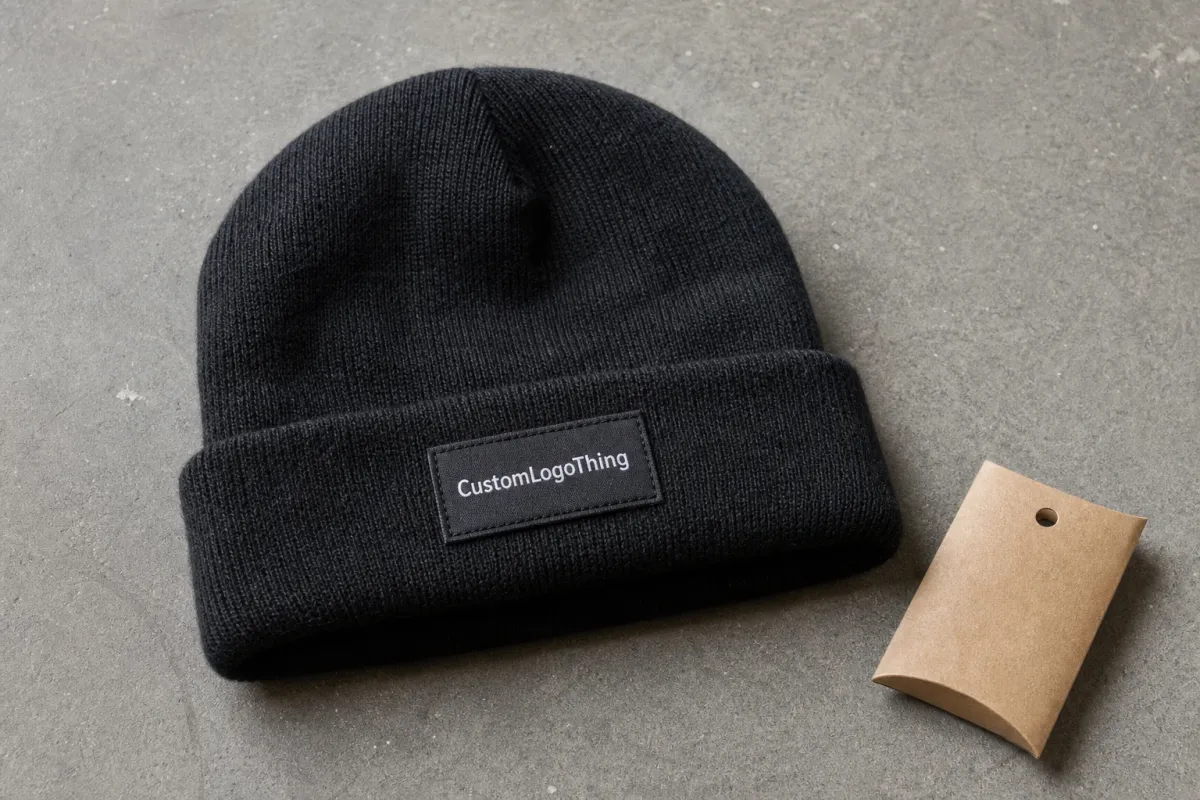
The first price lever is the base knit. Standard acrylic usually sits at the lower end because it is predictable, widely available, and easy to pair with woven, faux leather, or rubber patches. Acrylic-wool blends feel richer in the hand and can lift the perceived value, but they usually cost more because the raw material is pricier and the knit is less forgiving. Recycled yarns can be a smart choice for sustainability goals, though the premium depends on supply, certification, and dye lot availability. A factory cannot read a brand promise from a mood board, no matter how polished the deck looks.
The second lever is the patch itself. Woven patches are often the best value when the artwork needs crisp edges and small type. Faux leather and genuine leather can look sharp and tactile, though they usually add material cost and sometimes extra approval time if embossing or debossing has to match a brand standard. Rubber and PVC-style patches carry more dimension and work well for bold graphics, but they can require additional tooling and a higher minimum. Embroidered patches sit in the middle: familiar, textured, and sensible when the logo stays simple. Printed patches can be economical for full-color art, but they need enough area to hold detail without going muddy.
The cuff shape is a hidden cost driver. A taller cuff gives you more decoration space and a stronger retail profile, but it changes knit balance and adds material. A shorter cuff can trim cost a little, yet it can also make the logo look cramped. A structured fit often needs tighter ribbing and better yarn control. A slouchier profile asks for a different crown shape and body length. Those are not cosmetic tweaks; they affect labor, consistency, and cost per piece.
"The cheapest quote is often the one that moves the pain somewhere else. Clean artwork, a predictable knit, and a standard patch format usually hold the real value."
This is why premium cuffed Beanies with Logo patch cost can undercut fully knitted or heavily embroidered styles when the artwork is straightforward and the patch format stays standard. The savings are not magic. They come from fewer stitch decisions, simpler file prep, and less risk of knit distortion. I once watched a winter rollout shave two approval rounds simply because the brand switched from a tiny embroidered mark to a woven patch with cleaner edges. Same logo, fewer headaches, lower total spend.
Volume matters in a way that buyers often underestimate. A 1,000-piece run of the same black beanie with a centered woven patch can move through production far faster than a small batch of multi-color jacquard with detail scattered across the crown. Quantity is not just quantity; it changes how much friction the factory has to absorb. Bigger runs are easier to schedule, easier to repeat, and usually easier to price.
The practical use cases tell the story. Retail merch needs a premium look without a premium disaster. Employee kits need one consistent beanie across roles and departments. Club drops need a style that photographs well and arrives without drama. Promo programs need repeatability, because the second reorder should resemble the first instead of showing up like a cousin with the same last name but different habits.
- Best value profile: acrylic cuffed beanie + woven patch + one shell color + simple logo.
- Higher-end profile: wool blend + faux leather or rubber patch + custom label + retail bag.
- Cost control profile: keep the base color consistent, reduce logo colors, and skip special packaging unless it serves a real purpose.
Product Details That Shape Premium Cuffed Beanies With Logo Patch Cost
If you want a quote that means something, do not ask for "a nice beanie." Ask for the build. Start with fiber content. A 100% acrylic shell is usually the easiest place to keep unit cost in check. Acrylic-wool blends bring a softer hand feel and stronger perceived value, but they usually raise the price and narrow the list of factories willing to make them. Recycled yarns are a solid choice when sustainability matters, though the premium varies with yarn source and certification. A supplier should be able to explain the difference plainly, not hide behind buzzwords.
Patch choice is the next lever. Woven patches handle tight logos and small type better than most alternatives. Faux leather works well for minimal branding and can look more premium than it costs, as long as the design does not rely on hairline detail. Rubber patches fit bold identity systems and add a tactile feel. Embroidered patches are dependable, but they start to struggle when the art gets tiny or overly detailed. Printed patches are useful for gradients or many colors, though they need a strong file and enough size to keep the logo from turning blurry.
Decoration placement is not decoration trivia. A centered patch feels traditional and retail-friendly. An off-center patch can look more designed, but it asks for tighter alignment control during sewing. Repeated patches across colorways increase setup work. If the same logo needs to sit on navy, charcoal, and oatmeal shells, someone has to check how thread or print reads on each one. That is minor when the spec stays fixed and expensive when it changes after approval.
Finishing choices move the number too. Custom Woven Labels, hang tags, size tabs, polybags, tissue wrap, and paired packaging all add up. A simple individual polybag might add only a little per piece, yet retail-ready presentation can stack costs faster than many buyers expect. If the order is going to retail or ecommerce fulfillment, decide whether the package is plain bulk, individually bagged, barcode labeled, or gift-ready before the quote is finalized. Otherwise you end up paying to correct a decision that should have been made on day one.
For anyone comparing premium cuffed beanies with logo patch cost across materials, the basic rule is simple: the tighter the spec and the cleaner the artwork, the easier it is to hold pricing. When the logo is simple, a woven patch on a standard cuffed knit is usually the sweet spot. When the artwork is more complex, a fuller knit build or a larger patch may make more sense, but only if the order volume supports it.
Specifications Buyers Should Lock Before They Request a Quote
Good quotes come from boring detail. That is not glamorous, but it saves money. Before you ask for pricing, lock the fiber content, knit gauge, cuff height, beanie length, patch dimensions, patch material, and logo file type. Leave those open and the supplier has to guess, which is where setup charges and revision loops begin to creep in.
Artwork readiness matters more than most buyers expect. A clean vector file, limited colors, and clear edge lines keep production simple. If your logo is a jagged bitmap, tiny serif type, or a gradient that needs hand-holding, expect a more expensive process. The same applies to patch size. A 2.5-inch patch is usually easier to execute than a tiny 1.5-inch patch packed with text. Clean art saves time, and time sits inside premium cuffed beanies with logo patch cost.
Fit should be specified by audience, not by optimism. Retail customers often expect a tidier fit. Promo audiences may want something more forgiving. Youth sizing deserves its own category and should not be treated like a smaller adult hat. Skip this step and you can end up with a beanie that looks right on the sample but lands wrong in bulk. That is the expensive surprise nobody prints on a sales sheet.
Color planning matters too. One shell color is usually cheaper than several. Matching yarn and patch tones can be straightforward in some cases and frustrating in others, especially if you are trying to match a Pantone-like shade across different materials. Simplifying is not a compromise by default. Most of the time it is the smartest move if you want better bulk pricing without giving up the final look.
Ask for the quote on a complete spec sheet. Include target quantity, delivery location, packaging expectations, and whether the order needs individual names, retail labels, or no-label branding. If the order will ship in cartons to a warehouse or fulfillment center, think about transit early. The guidance on ISTA is useful for understanding how packed goods handle drops, compression, and shipping stress. If you are using printed cartons or hang tags, the packaging basics on packaging.org are worth a quick look as well.
- Confirm first: shell material, cuff height, patch type, patch size, and logo file format.
- Confirm next: color count, label style, bagging, and delivery address.
- Confirm last: whether the order needs retail presentation or just clean bulk packing.
Premium Cuffed Beanies With Logo Patch Cost, MOQ, and Unit Pricing
MOQ changes the conversation quickly. A lower minimum order quantity works well for a pilot program, seasonal test, or limited merch drop. The tradeoff is straightforward: the smaller the run, the more setup gets spread across each hat. A 100-piece order can feel expensive even when the product is simple because the factory still has to prep yarn, confirm the patch, review the file, sample the decoration, and get the line ready. Small quantity does not mean small effort.
For planning, I like to break premium cuffed beanies with logo patch cost into tiers rather than pretending there is one universal price. The ranges below assume a standard acrylic cuffed beanie with a woven patch or a similarly simple decoration. Leather, rubber, embroidery, or extra retail packaging can push the number up.
| Order tier | Typical MOQ | Planning cost per piece | What usually changes |
|---|---|---|---|
| Test run | 100-150 pcs | $5.50-$8.50 | Higher setup charges, limited finishing, more sample overhead |
| Small production | 300-499 pcs | $3.80-$6.20 | Better balance of unit cost and flexibility, fewer surprises |
| Core bulk order | 1,000-2,999 pcs | $2.40-$4.20 | Tooling fees spread out, stronger bulk pricing, more packaging options |
| Large rollout | 3,000+ pcs | $1.95-$3.50 | Lowest cost per piece, but color changes and custom finishing add complexity |
Those numbers are planning ranges, not promises. They move with yarn cost, factory region, labor availability, shipping terms, and decoration complexity. Still, the pattern is dependable. As quantity rises, fixed work gets diluted across more pieces. That is why small runs feel expensive and larger runs start to look sensible. Ask for a special patch shape, multiple logo colors, custom labels, and gift packaging on a low-MOQ order, and the quote climbs fast. Not because the supplier is being dramatic. Because the process really is more expensive.
One useful rule of thumb: a simple woven patch on an acrylic shell is usually the most affordable path. Add leather or rubber and the price can rise by roughly $0.30-$1.20 per unit depending on order size and tooling. Add embroidery on the patch and pricing depends on stitch density and detail. Add a custom box, insert card, or paired hang tag and the order starts to look like a retail program instead of a basic headwear order.
Do not ignore what is usually missing from the first quote. Freight is often separate. Duties are often separate. Rush charges are often separate. Artwork revisions can be separate. Specialty packaging almost always gets added later if nobody asks about it upfront. If you want a realistic budget, ask for production, shipping estimate, and likely extras in the same conversation. That is how you protect the budget and avoid fake savings.
For buyers comparing premium cuffed beanies with logo patch cost across vendors, the smart move is to request two quote versions side by side. One with the standard spec. One with the upgraded patch or finish. That makes the price jump visible instead of burying it inside a vague "premium" line item.
Process, Timeline, and Production Steps from Quote to Delivery
The process should be boring. If it is not, somebody is probably making things up as they go. A solid workflow starts with inquiry and spec confirmation, moves to artwork review, then sample or mockup approval, production, quality control, and shipment. When that sequence is clean, the order usually stays on budget. When it gets messy, everything slows down and the cost starts to drift.
Most delays come from predictable places. Missing vector files are a classic. So are unclear patch placements, late approvals, color changes after sampling, and rushed delivery windows that leave no room for planning. If a supplier has to stop production to ask what your logo should do, you will pay for the interruption one way or another. Production schedules do not absorb confusion for free.
Timing is usually decided by sampling and approval. A simple digital mockup can move quickly, but a physical sample or decorated proof adds time. Once approved, production speed depends on quantity, color count, and factory capacity. For many orders, a practical timeline is about 12-15 business days from final approval to shipment for a straightforward run, with more time needed for bigger quantities, complex patches, or seasonal congestion. Faster turnaround usually means either a rush fee, a reduced spec, or both.
If the order ships in cartons to a warehouse, store, or fulfillment center, transit handling should be part of the plan early. Basic carton expectations and shipping stress are not glamorous, but they matter. The testing guidance on ISTA is a useful reference point if you care whether packed goods arrive intact. If you are adding branded boxes, mailers, or hang tags, keep the packaging spec simple enough that the factory can quote it clearly.
There is a straightforward way to speed things up without paying for chaos. Send final artwork first. Pick one or two shell colors, not five. Decide on packaging before the quote is approved. Keep logo colors limited. Avoid maybe-language. Every unresolved detail turns into another email, and every extra email becomes a small delay hiding in plain sight. For premium cuffed beanies with logo patch cost, that delay often matters more than a minor material upgrade.
Quality control should not be an afterthought. A quote that looks cheap means very little if patch alignment drifts, stitches are inconsistent, or cuff sizing varies too much from piece to piece. Ask how the factory checks patch placement, how many pieces are inspected, and what happens if a batch misses the approved spec. If the answer is vague, keep asking. Trust is good; proof is better.
What To Do Next
If the goal is to keep premium cuffed beanies with logo patch cost under control, the first move is not negotiation. It is specification. Lock the shell material, patch type, patch size, cuff height, quantity, and packaging before asking for a quote. That gives you a real comparison instead of a pile of apples, oranges, and one beanie that somehow became a scarf during the conversation.
Then ask for two versions: a clean baseline spec and an upgraded spec. The difference between them usually reveals where the money actually lives. In most orders, the cheapest path is not the most stripped-down one; it is the one with the fewest moving parts. A simple woven patch, one shell color, and a controlled approval flow will usually beat a "premium" spec that keeps growing in the margins.
My blunt take is this: the best savings usually come from simplifying the build, not from making the hat feel disposable. If you want the strongest result for the money, focus on clean artwork, a standard patch format, and a quantity that actually earns meaningful bulk pricing. That is how the final product keeps its polish while the budget stays in check.
And if the spec is already tight, do not get cute with it. Sometimes the smartest move is to keep the design steady, approve it once, and let the factory do what it does best. That is the least glamorous answer, kind of, but it is usually the one that ships well.
FAQ
What is the typical premium cuffed beanies with logo patch cost per piece?
A workable planning range is usually higher at low quantities and lower at scale. Sample pricing sits above bulk pricing because setup is not spread across enough pieces yet. For a standard acrylic beanie with a simple patch, small runs can land around $5.50-$8.50 per piece, while larger orders may drop closer to $2.40-$4.20 depending on the spec and shipping terms.
What affects premium cuffed beanies with logo patch cost the most?
Patch material and artwork complexity usually drive the biggest swing. Multiple logo colors, special textures, custom patch shapes, and extra finishing details can all raise the price quickly. Order quantity matters almost as much, because setup costs hit small runs much harder than larger ones.
What MOQ should I expect for premium cuffed beanies with logo patch orders?
MOQ depends on the factory and patch method, but lower minimums usually come with a higher unit price and fewer customization options. If you need a test run, ask for the lowest viable quantity plus a price break at the next tier so you can compare the real savings instead of guessing.
How long does production usually take after approval?
The fastest orders are the ones with final artwork, clear specs, and no revision loops. Sampling and approval are usually the steps that slow everything down. After approval, a straightforward run often takes about 12-15 business days, though color changes, packaging, and peak season can add time.
Can I lower premium cuffed beanies with logo patch cost without making the product look cheap?
Yes. Keep one shell color, use a clean patch shape, reduce logo colors, and avoid unnecessary packaging extras. The smartest savings usually come from simplifying specs, not from cutting the base quality so far that the beanie feels disposable.


