Buyer Fit Snapshot
| Best fit | Printed Barcode Labels with Logo projects where brand print, material claims, artwork control, MOQ, and repeat-order consistency need to be specified before quoting. |
|---|---|
| Quote inputs | Share finished size, material target, print colors, finish, packing count, annual reorder estimate, ship-to region, and any compliance wording. |
| Proofing check | Approve dieline scale, logo placement, barcode or warning zones, color tolerance, closure strength, and carton packing before bulk production. |
| Main risk | Vague material claims, crowded artwork, missing packing details, or unclear freight terms can make a low unit price expensive after revisions. |
Fast answer: Printed Barcode Labels with Logo: Material, Adhesive, Artwork, and MOQ should be specified like a repeatable production item. The safest quote records material, print method, finish, artwork proof, packing count, and reorder notes in one written spec.
Production checks before approval
Compare the actual filled-product size with the drawing, then confirm tolerance on folds, seals, hang holes, label areas, and retail display edges. Reserve space for logos, QR codes, warning copy, and material claims before decorative graphics fill the panel.
Quote comparison points
Review material grade, print process, finish, sampling route, tooling charges, carton quantity, and freight assumptions side by side. A quote is only useful when the supplier can repeat the same color, closure quality, and packing count on the next order.
Printed Barcode Labels with logo do a job that sounds simple until you watch a shipping line get backed up because the wrong carton got pulled, scanned twice, or set aside for a hand check. The barcode is there for the system, sure, but the logo gives the label a second layer of meaning. It tells the eye, almost immediately, that the box belongs to a specific operation, brand, or product family. That kind of visual certainty can save time in a warehouse, and time is usually the thing nobody has enough of.
I have seen plenty of Labels That Looked fine in a proof and then turned awkward once they hit actual boxes, actual tape seams, and actual handling. That is usually where the theory ends. A label is not decoration. It is a working surface. The best printed barcode labels with logo keep the scan field clear, keep the brand mark legible, and leave enough structure that the team does not have to guess where to read, where to peel, or whether a carton belongs in outbound, returns, or receiving.
Buyers often ask whether a logo can sit beside a barcode without causing problems. Yes, it can. The real question is whether the label still performs after it is pressed onto corrugated cartons, poly mailers, totes, or cold-chain packaging and then rubbed, stacked, and scanned all day long. That is the difference between something that looks polished and something that actually earns its keep.
Printed Barcode Labels with Logo: What They Solve
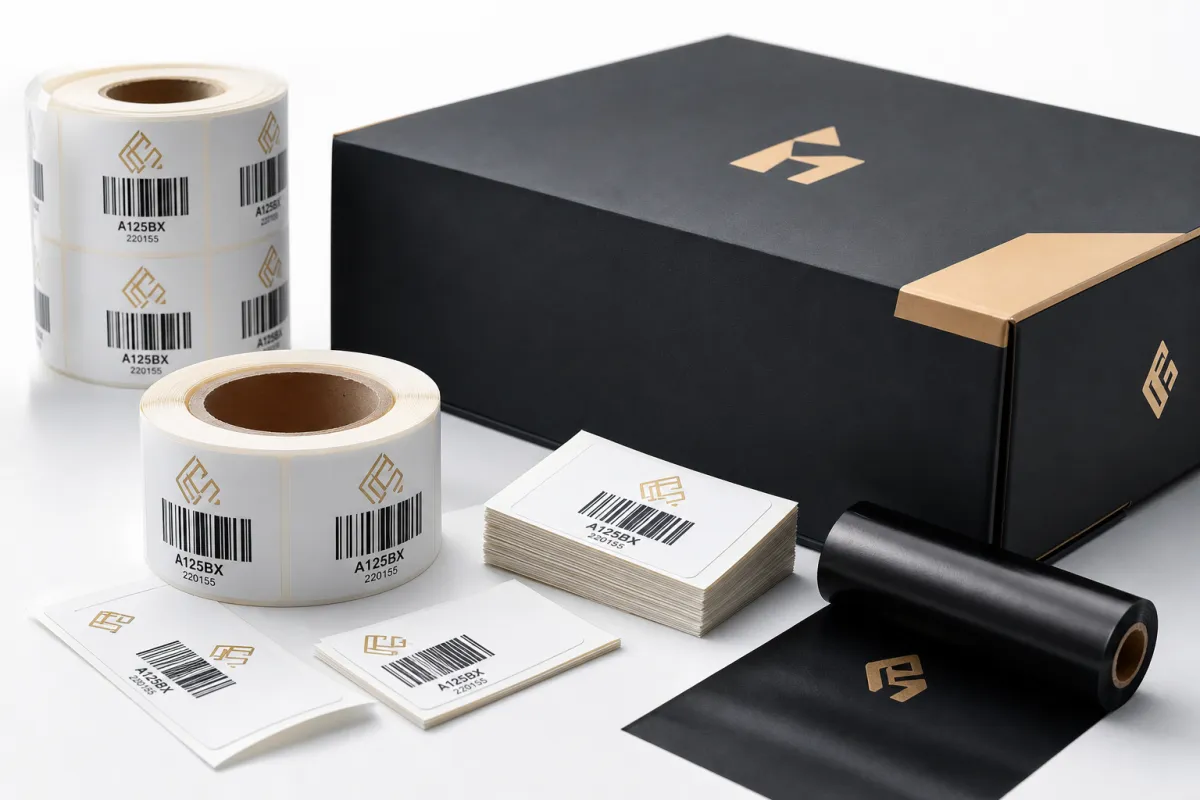
Shipping teams usually care about one thing first: getting the right product out the door without slowing down the line. A barcode does the machine-readable work. A logo makes the package easier to recognize at a glance. Put them together, and printed barcode labels with logo solve two problems at once: data capture and fast visual identification.
That matters more than people sometimes admit. A carton with a logo is quicker to sort than a generic brown box with a plain code slapped on the corner. A receiving clerk can spot the right brand family from a few feet away. A picker can tell, without opening anything, which box belongs to which customer or product set. Those little moments add up.
One label carrying two kinds of information is the point. The barcode carries the data. The logo carries identity. Many teams also use the same label for lot numbers, ship-to details, warehouse codes, or handling notes such as fragile, keep dry, or refrigerated. The important thing is that the barcode stays in charge. The logo supports the workflow, but it should never crowd the quiet zone or sit so close to the bars that the scanner starts missing reads.
These labels fit neatly into a few common operations:
- E-commerce shipping where branded cartons help the order feel intentional instead of generic.
- Warehouse pick-and-pack where staff need fast visual checks before scan and sort.
- Retail fulfillment where product families and store-ready cartons need consistent ID.
- Returns processing where a logo helps teams separate your inventory from someone else’s mess.
- Product identification where internal labels need both control numbers and brand consistency.
For many buyers, that brand detail does more than make the carton look nice. It helps separate your boxes from third-party freight, outside vendor material, and mixed stacks that can blur together on a dock. A branded label makes ownership obvious. Ownership brings clarity, and clarity reduces mistakes. Printed barcode labels with logo are not about making packaging fancy. They are about making the package obvious.
If your operation also needs matching SKU labels, shipping tags, or case labels, the label system matters as much as the individual sticker. That is why many buyers end up looking at Custom Labels & Tags as a connected set of tools rather than a one-off purchase. Once the workflow expands beyond a single carton size, consistency starts paying back in fewer corrections and fewer late-day fixes.
A label that looks branded but misses a scan is not a branding win. It is a slow-down wrapped in nice artwork.
How Printed Barcode Labels with Logo Work in the Warehouse
The mechanics are straightforward, which is exactly why people can overcomplicate them. The barcode holds the data. The logo adds identity. The layout protects scanability. That is the core of printed barcode labels with logo. Whether the code uses Code 128, GS1-128, QR, or another common format, the reader still needs clean contrast, the correct bar width, and enough white space around the symbol. Decoration does not rescue a poor barcode. It only gives the poor barcode a nicer frame.
Size and contrast matter more than styling in shipping and logistics. A barcode that is too small, too dense, or printed on a weak background can fail at odd angles, under fluorescent lights, or after the label gets scuffed. That is why experienced buyers ask about printer resolution, usually 203 dpi or 300 dpi, and about the scanner hardware already in use. A label that reads on a phone camera is not the same thing as one that scans reliably with a warehouse gun at arm’s length.
Print method matters too. Thermal transfer is often the practical choice for durable printed barcode labels with logo because it holds up better against handling, rubbing, and a wide range of shipping conditions. Digital printing works well for shorter runs, more color flexibility, or quicker artwork changes. Flexographic printing fits larger volumes where setup cost can be spread over many labels. Different suppliers may point in different directions, and that is normal. The right method depends on volume, surface, and how much wear the label needs to survive.
Packaging and transit-testing guidance from groups such as packaging.org and the ISTA test-method framework can help ground those decisions in actual handling standards. That sort of reference moves the conversation away from loose claims and toward repeatable testing. If a supplier says a label will survive shipment, ask what was tested, on which surface, and under what conditions.
The usual workflow looks like this:
- The order or case data gets generated in the system.
- Printed barcode labels with logo are printed with the correct SKU, lot, or destination information.
- The label is applied to the case, carton, mailer, or tote.
- The code gets scanned at pack, dock, or receiving.
- The carton moves through sort, load, and ship with a visual brand marker attached.
What matters most is not a flashy logo. It is a label that stays legible after handling, stacking, and transit. If the team can spot the right carton quickly and the scanner reads it on the first pass, the label is doing its work. That is the standard for printed barcode labels with logo, not whether the artwork looks good on a monitor.
What Drives the Cost of Printed Barcode Labels with Logo
People often ask for one price as if there were a single number waiting in the wings. There is not. The cost of printed barcode labels with logo depends on size, stock, adhesive, number of colors, barcode format, and quantity. A 2 x 4 shipping label on paper with a simple logo is a very different product from a freezer-grade polypropylene label with variable data, serialized numbering, and a glossy finish. Same category, very different price.
The logic behind pricing is usually pretty simple. Small runs cost more per label because setup gets spread across fewer pieces. Larger volumes lower the unit price, but only after the supplier has enough quantity to justify press setup, die cutting, proofing, and inspection work. That is why 500 labels can look expensive on a per-piece basis while 10,000 labels look a lot more manageable. Printed barcode labels with logo reward planning, not rushed ordering.
There are also costs that do not always show up clearly in the first quote. Artwork cleanup can take extra time when the logo file arrives as a blurry JPEG lifted from an old email signature. Proofing can take longer if the barcode needs correction or the layout needs a shift. Custom Die Cuts, special adhesives, and variable data handling all add labor. Rush production usually adds more. A line-item quote makes those details visible, and that usually makes comparison easier too.
| Label Option | Typical Use | Approx. Cost at 5,000 Labels | Notes |
|---|---|---|---|
| Paper label with standard adhesive | General shipping cartons, dry environments | $0.04-$0.08 per label | Good for clean warehouse conditions and short transit cycles. |
| Polypropylene film | Moisture-prone cartons, light abrasion | $0.08-$0.16 per label | Better resistance to scuffing and damp handling. |
| Polyester stock | Durable asset tags, harsh handling | $0.14-$0.28 per label | Tougher surface; useful where labels get scraped or cleaned. |
| Special adhesive or freezer-grade stock | Cold chain, rough surfaces, demanding environments | $0.16-$0.32 per label | Adhesive choice can matter more than print method here. |
Those ranges are buying guides, not promises. A larger logo, heavy ink coverage, or a special finish can push the price upward. A simpler layout can lower it. Suppliers should be able to tell you whether the quote includes proofing, plate fees, setup, tooling, and shipping. Some quotes look attractive until the details show up later.
There is also a value argument that gets overlooked. A label that costs two cents more but prevents relabeling, mis-sorts, or failed scans often pays for itself quickly. That is the part buyers miss when they chase the lowest sticker price. The cheapest printed barcode labels with logo can become the most expensive once the rework starts.
How to Order Them: Process and Timeline
The cleanest orders follow the same path each time. Start with the barcode data and confirm whether the format should be Code 128, GS1-128, QR, or another type. Lock the label dimensions, material, and adhesive next. Send the artwork and request a proof. Once the proof gets approved, production can begin. That simple flow keeps printed barcode labels with logo from turning into a scheduling headache.
Delays usually come from missing information. Bad artwork files are common. So are labels with no final size, no barcode standard, or no clear answer about the scanner the warehouse uses. A supplier can still work with that, but only after asking questions, and every question adds time. If the layout changes three times after proof approval, the schedule stretches. The label does not care that the internal meeting ran long.
Typical lead times vary by complexity:
- Standard artwork and materials: often 5-10 business days after proof approval.
- Custom sizes or special adhesives: often 7-12 business days.
- Variable data or serialized labels: often 10-15 business days.
- Rush jobs: possible in some cases, but the schedule and price both tighten.
Planning ahead makes a real difference. New product launches, warehouse lane changes, and seasonal surges all need buffer time before the first shipment has to move. Printed barcode labels with logo are not the place to gamble on a Friday approval and a Monday pickup. That kind of rush usually turns into extra charges and a proof that somebody still needs to fix.
When comparing vendors, ask for three things: a digital proof, a physical sample, and confirmation of the print method. If the supplier can explain how the label will behave on your actual carton, mailer, or tote surface, that is a useful sign. If the answer sounds generic, keep looking.
Many buyers get better results by starting small. Pick one SKU family, one shipping lane, or one warehouse location first. Test it. Measure scan speed. Check adhesive performance. Then scale. That approach works far better than placing a huge order and learning that the logo crowds the barcode after 8,000 labels are already sitting on the dock.
Key Material and Design Factors That Affect Scanability
Scanability is not a mystery. It is mostly a materials-and-layout problem. Start with the substrate. Paper is economical and usually fine for dry, indoor shipping. Polypropylene handles moisture better and gives more confidence on cartons that may face condensation or colder rooms. Polyester is the tougher choice when abrasion, cleaning, or rough treatment is part of the day. The wrong substrate can make a strong design act like a weak label.
Adhesive choice matters just as much. A permanent adhesive is standard for most boxes. A removable adhesive fits temporary IDs or returnable containers. Freezer-grade adhesive is the obvious choice for cold storage. High-tack adhesive helps on rough corrugated surfaces or packaging that resists bonding. If you are labeling slick poly mailers, chilled cartons, or recycled boxes with a coarse finish, the adhesive is not a small detail. It is the decision that makes the label stay put.
Layout rules are where many printed barcode labels with logo go wrong. The barcode needs white space around it, stable contrast, and enough clear margin to keep scanners from misreading the bars. The logo should support the label, not dominate it. A huge logo turns the barcode into an afterthought. A barcode squeezed into a corner with too much text around it slows scanning and invites mistakes. That is a poor trade for any operation moving volume.
Placement adds another layer of reality. A label on a curved mailer, a textured corrugated box, or a damp carton can behave differently even when the artwork is identical. The better test is not a screenshot. It is the actual package, the actual scanner, and the actual warehouse lighting. In practice, printed barcode labels with logo perform best when they are tested on the same surfaces and devices used every day, not under ideal conditions on a polished sample sheet.
For buyers focused on sourcing, paper certification can matter too. If your supplier offers FSC-certified paper, ask for the claim to be specific rather than vague. Certification basics are available through FSC. If the label is part of a program that values recycled content or responsible sourcing, that detail can matter to purchasing teams and end customers alike.
The short version is simple: the best printed barcode labels with logo are boring in the right way. They print cleanly, survive handling, and scan without drama. That is what a label is supposed to do.
Common Mistakes to Avoid With Printed Barcode Labels
The worst label mistakes are usually easy to spot after someone points them out. The trouble is that they often get approved before that moment. One of the biggest errors with printed barcode labels with logo is making the logo too large or placing it too close to the barcode. The label may look polished, but the scanner does not care about brand polish. It cares about clean bars, white space, and readable contrast. If the logo crowds the code, the label becomes a decorative problem.
Choosing the wrong stock is another frequent issue. Paper labels can work well on dry cartons that move quickly. They are less reliable on cold, damp, rough, or high-abrasion surfaces. If your boxes sit in a cooler, move through humid docks, or rub against one another during transit, film stock often makes more sense. A cheaper material that fails early does not save money. It creates relabeling, delays, and doubt, and once the warehouse starts doubting the sticker, confidence is hard to get back.
Skipping scanner tests is another classic mistake. Teams sometimes approve printed barcode labels with logo after checking only a digital proof. That proves nothing about real scan behavior. Test across different devices, distances, and lighting conditions. If more than one team handles the package, test the way each team sees it. A packing bench, a pick station, and a receiving dock can each expose different problems.
Here are the mistakes I would watch first:
- Logo placed too close to the barcode.
- Insufficient white space around the code.
- Choosing paper when the surface needs film.
- Ignoring adhesive strength on rough or cold surfaces.
- Approving artwork without a physical scan test.
- Ordering a full run before checking a small sample order.
There is a quieter mistake that can cost plenty: chasing the lowest quote without asking what happens if a label fails. A cheap batch of printed barcode labels with logo can trigger mis-sorts, reprints, and customer service noise that costs far more than the original order. The real budget problem is not the label line item. It is the mess that starts after the label starts failing.
If your operation follows outside shipping rules or works across mixed carriers, ask the supplier to match the label size to the packing process, not just the artwork. A label that fits the box but slows the scan line is still a problem. Good packaging work is practical. It does not need applause. It needs to move.
Expert Tips and Next Steps
The smartest way to buy printed barcode labels with logo is to treat them like part of the workflow, not like a graphic accessory. Start with one product family or one shipping lane. That gives you a cleaner test. If the label works on the cartons that move most often, you can expand with more confidence. If it fails there, you only have one section to fix instead of an entire operation full of sticker problems.
Ask for both a proof and a physical sample. Then test the sample on the exact scanners, surfaces, and labels your team uses. Check it under warehouse lighting, at the distance your staff actually scans from, and after the label has seen some handling. A design can look fine in a PDF and still become troublesome once it is in motion. Printed barcode labels with logo live or die in the real environment.
Keep a simple checklist ready before requesting quotes:
- Label dimensions, including any bleed or margin requirements.
- Substrate choice: paper, polypropylene, polyester, or another film.
- Adhesive type: permanent, removable, freezer-grade, or high-tack.
- Barcode format and whether the data changes from label to label.
- Logo file type, preferably clean vector artwork.
- Desired finish: matte, semi-gloss, or another surface treatment.
- Order quantity and target delivery date.
That checklist does two useful things. First, it keeps quote comparisons honest. Second, it helps the supplier give you a tighter answer instead of a vague one. If you are still mapping out your options, comparing a few label configurations through a supplier page like Custom Labels & Tags can help you see how size, stock, and finish shift the result.
My blunt advice is simple: do not start with the fanciest option. Start with the one that fits the job. If a plain paper label with a small logo works, use it. If the environment needs film or freezer adhesive, pay for that and stop pretending paper will act like a tougher material. The right printed barcode labels with logo should make operations easier, not add another problem for the team to solve.
If you are comparing suppliers, request two or three samples, run scan tests, and place a small pilot order before scaling. That is the least dramatic way to learn whether the label actually works. In packaging, boring is usually good. Boring means it printed, scanned, and shipped without making everyone stay late. That is the finish line.
Do printed barcode labels with logo still scan reliably?
Yes, if the barcode stays high-contrast and the logo does not crowd the quiet zone or the bars. The label should be tested on the actual scanners and lighting used in the warehouse, not just on a screen or a phone camera. Keep the logo secondary; readability always beats decoration for printed barcode labels with logo.
What affects the cost of barcode labels with logo?
The biggest drivers are quantity, label size, material, adhesive, number of colors, and whether the data changes from label to label. Short runs usually cost more per label because setup is spread across fewer pieces. Special finishes, custom cuts, and rush orders can add cost quickly, so ask for a line-item quote before you compare suppliers.
Can printed barcode labels with logo be used on corrugated boxes and mailers?
Yes, but the adhesive and stock need to match the surface. Rough corrugate, slick poly mailers, and coated boxes all behave differently. For moving or cold environments, choose a stronger adhesive or a tougher film stock. Always test peel strength and scanability on the actual packaging, not on a sample sheet.
How long does the process take for custom barcode labels with logo?
Clean artwork and standard materials can move quickly once the proof is approved. Custom sizes, special adhesives, and variable data usually need extra time for proofing and production. Build in a buffer before launches so the label schedule does not hold up shipping.
What is the best way to test a barcode label design before a full order?
Ask for a physical proof or short sample run and scan it with the same equipment your team actually uses. Check the label on multiple surfaces, under different lighting, and at normal handling distances. If the logo, contrast, or placement causes any hesitation, fix it before you place the full order. That is the cleanest way to buy printed barcode labels with logo without guessing.


