Buyer Fit Snapshot
| Best fit | Printed Compostable Poly Mailers Cost projects where brand print, material claims, artwork control, MOQ, and repeat-order consistency need to be specified before quoting. |
|---|---|
| Quote inputs | Share finished size, material target, print colors, finish, packing count, annual reorder estimate, ship-to region, and any compliance wording. |
| Proofing check | Approve dieline scale, logo placement, barcode or warning zones, color tolerance, closure strength, and carton packing before bulk production. |
| Main risk | Vague material claims, crowded artwork, missing packing details, or unclear freight terms can make a low unit price expensive after revisions. |
Fast answer: Printed Compostable Poly Mailers Cost: What Affects Pricing should be specified like a repeatable production item. The safest quote records material, print method, finish, artwork proof, packing count, and reorder notes in one written spec.
Production checks before approval
Compare the actual filled-product size with the drawing, then confirm tolerance on folds, seals, hang holes, label areas, and retail display edges. Reserve space for logos, QR codes, warning copy, and material claims before decorative graphics fill the panel.
Quote comparison points
Review material grade, print process, finish, sampling route, tooling charges, carton quantity, and freight assumptions side by side. A quote is only useful when the supplier can repeat the same color, closure quality, and packing count on the next order.
Printed Compostable Poly Mailers Cost: What Affects Pricing
A brand can cut shipping weight, reduce visible waste, and still annoy customers if the mailer tears, the print comes out muddy, or the compostability claim does not match the film in the roll. That is why printed Compostable Poly Mailers cost should be treated like an operations decision, a branding decision, and a risk decision all at once. Not just a line on a quote.
The cheapest-looking option often turns into the most expensive one once you count reprints, damaged product, rejected cartons, and the time spent fixing mistakes that should never have happened. From a packaging buyer’s point of view, the real question is pretty simple: does the mailer protect the product, present the brand properly, and support the sustainability story without slowing down fulfillment? For teams building a broader packaging program, it also helps to review the full range of Custom Packaging Products before locking into one format.
Printed Compostable Poly Mailers Cost: The Real Value Picture
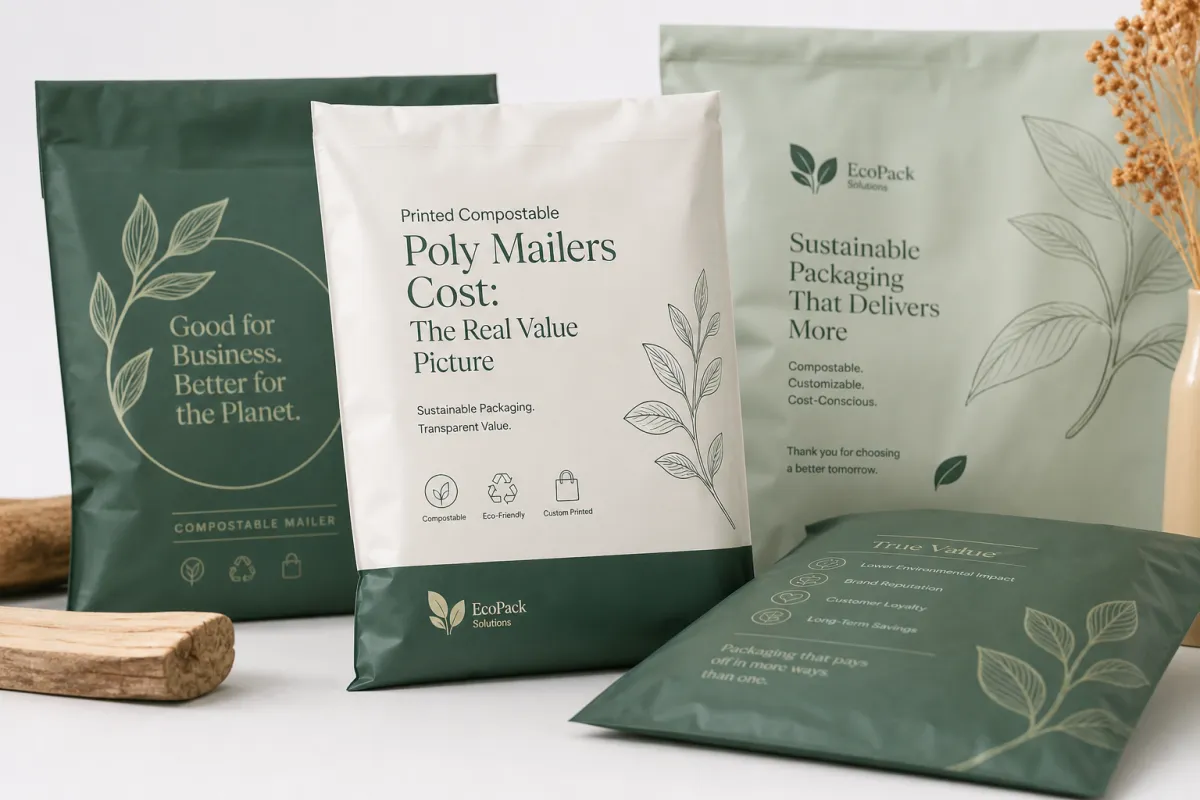
Printed Compostable Poly Mailers cost starts with a basic reality many buyers learn the hard way: the number on the quote is only part of the spend. A mailer that looks inexpensive can become a headache if the seal fails under load, if the print setup cannot hold fine detail, or if the film stretches enough to make the logo look warped after packing. In practice, the bag has to do three jobs at once. It has to protect the product, carry the brand, and support the sustainability claim with the right material structure.
That last part matters more than many sourcing teams expect. A mailer that is simply labeled as green packaging, without a clear material basis, can create more risk than value. Buyers should ask what the film is made from, what standard it has been tested against, and what disposal environment the claim assumes. The EPA’s composting guidance is useful here because compostable packaging only works as intended when the disposal stream can actually handle it; see the agency’s guidance at epa.gov.
I usually tell customers to judge the purchase around three outcomes. First, package integrity, because a bag that splits in transit can wipe out every savings line on the quote. Second, brand presentation, because print quality is part of the customer experience and part of the unboxing story. Third, compliance with compostability expectations, because a claim that cannot be supported is not a value proposition. When those three pieces line up, printed compostable poly mailers cost more than plain stock mailers, but they can still be the smarter business choice.
The lowest unit price is not always the lowest landed cost. A cleaner print, a stronger seal, and fewer damaged returns often save more than a tiny discount ever will.
Another useful way to think about printed compostable poly mailers cost is to compare it against the cost of brand work you do not have to repeat. If the mailer arrives preprinted, you may cut down on labels, stickers, or separate inserts. If the artwork is set up well, fulfillment stays faster and cleaner. If the film matches the product weight, you avoid the hidden cost of replacement shipments. That is why I push buyers to treat the package as part of the shipping system, not as a decorative layer added at the end.
For teams that already know their product mix, the decision usually comes down to one blunt business question: does the mailer protect the shipment and communicate the brand at a unit cost that still leaves room for freight, storage, and margin? If the answer is yes, printed compostable poly mailers cost becomes a manageable procurement item instead of a fuzzy sustainability expense.
What Printed Compostable Poly Mailers Are Made Of
Printed compostable poly mailers cost is tied directly to the materials inside the bag, not just the graphic on the outside. A real compostable mailer usually includes a compostable film, a seal structure that holds under shipping stress, a closure adhesive that closes reliably, and a print surface that accepts ink without smearing or turning the design dull. Each part changes how the mailer feels in hand and how it performs during packing, sorting, and last-mile delivery.
Buyers sometimes confuse compostable-looking bags with truly compostable construction, and that distinction matters. A bag can look earth-friendly because of its color or matte finish and still fail to meet a meaningful compostability standard. Ask for the actual substrate details and the exact standard the material has been tested to meet, such as ASTM D6400 or EN 13432 where applicable. If the supplier cannot explain the difference in plain language, the risk usually shows up later as confusion, claims issues, or product returns. That is one reason printed compostable poly mailers cost should never be compared only against a visual sample.
Print method changes the final bill too. Light coverage with one or two colors is easier to run than a design with heavy solids, full-bleed backgrounds, or tight registration between multiple colors. More visual coverage usually means more setup attention, more ink, and a higher chance of adjustment on press. A clean logo on a pale film may be simple. A full-panel design with sharp color blocking is a different job altogether, and the pricing will show it. In other words, printed compostable poly mailers cost rises with design complexity for a reason.
For apparel, soft goods, and lightweight non-fragile items, compostable poly mailers are often a smart fit. They keep weight low, they pack quickly, and they give the brand a cleaner presentation than a plain pouch or generic mailing bag. For fragile goods, high-value items, or products with sharp corners, I usually suggest looking at a padded mailer or a corrugated format instead. Green packaging should still be honest packaging. If the format is too light for the product, the carbon footprint may look better on a spreadsheet while the return rate quietly climbs.
There is also a practical difference between a mailer that feels thin and one that behaves thin. A film can be lightweight and still have enough tear resistance for routine handling if the structure is designed well. A poor structure may not fail in the warehouse, but it can fail after a conveyor drop, a corner rub, or a rough sort. That is why the material spec matters so much in printed compostable poly mailers cost analysis. You are not only buying appearance; you are buying shipping reliability.
One more reality check: most compostable mailers are designed for industrial composting, not backyard bins. That sounds a little less romantic, sure, but it is the actual disposal pathway for many certified materials. If your team is making a compostability claim, the wording should match the certification and the real end-of-life route. Vague green language is how brands get themselves into trouble.
Key Specifications That Affect Strength and Print Quality
When buyers ask why printed compostable poly mailers cost more from one supplier than another, the answer is usually buried in the specs. Thickness, dimensions, seal strength, tear resistance, closure type, and usable print area all matter. A mailer with a wider format uses more film. A bag with a stronger seal may require tighter production control. A larger printable panel gives the design team room to work, but it also changes how the bag is nested and cut in production. Small differences add up fast.
Size is one of the easiest examples. Move from a compact apparel mailer to a slightly larger format and the material yield changes, the shipping cube changes, and freight can change too. That means printed compostable poly mailers cost can rise in three places at once: raw material, manufacturing yield, and transportation. Buyers often fixate on the bag price and forget that a bigger mailer may also take more pallet space or need a different carton count. A smart quote review looks at the whole chain, not just the film price.
Artwork quality has its own rules. The same logo can look sharp on one film and soft on another depending on print method, line weight, color count, and registration tolerance. Fine serif type, thin outlines, and small QR codes are more sensitive than bold shapes and large blocks of color. If you want the mailer to support premium branding, send art that is sized and spaced for the actual print window. That helps control printed compostable poly mailers cost because it cuts down on proof revisions and production delays.
For buyers reviewing samples, I recommend a simple checklist:
- Test the seam and closure under normal fill weight.
- Check opacity so contents do not show through in transit.
- Confirm barcode and address readability on the chosen print area.
- Inspect the edges for consistent cutting and clean sealing.
- Compare the sample against the actual product weight and packing method.
That checklist sounds basic, but it prevents expensive surprises. A sample that looks excellent on a desk may fail on a packing line if the seal is too narrow, the opening is awkward for gloved hands, or the print placement gets in the way of shipping labels. The best suppliers help you test all of that before you commit to the full run, which is exactly how printed compostable poly mailers cost stays under control.
For transit validation, many teams still rely on ISTA-style handling tests because real shipping environments are rougher than most internal assumptions. Drop, vibration, and compression testing help catch weak points early. The point is not paperwork for its own sake; the point is making sure the mailer can survive the route it is meant to travel. You can review the general testing framework at ista.org.
Strong specs also support better sustainability claims. A well-designed compostable mailer can fit into a broader circular economy story only if it reduces waste without shifting the burden somewhere else. That means thinking about damage rates, shipping efficiency, and the role the mailer plays in a larger low-waste packaging strategy. If the package is too fragile or too large, the sustainability story gets weaker, not stronger.
Printed Compostable Poly Mailers Cost, MOQ, and Price Breaks
Printed compostable poly mailers cost is usually most sensitive to order quantity. The reason is simple: setup work has to be spread across the run, and the lower the MOQ, the more each bag has to absorb in setup, proofing, and machine time. A 2,500-piece order can make perfect sense for a launch or test run, but the unit cost will usually sit higher than a 10,000-piece or 25,000-piece order. That does not mean the smaller run is wrong. It means the math is different.
Material grade and print coverage are the first two variables I would compare. After that come bag size, number of sides printed, and whether the artwork needs special prep. A one-color logo on one side is simpler than a full-coverage design printed on both sides with multiple color transitions. The supplier may also need plate work, setup adjustments, or a more involved proofing cycle. All of that affects printed compostable poly mailers cost before the first bag reaches your dock.
Here is a practical planning view that many buyers find useful. These are not quotes; they are typical ranges to help you budget and compare. Actual pricing depends on size, print coverage, film spec, and freight destination.
| Order Tier | Typical Unit Cost Range | What Usually Drives It | Best Use Case |
|---|---|---|---|
| 2,500 pcs | $0.38-$0.72 | Setup spread over fewer bags, higher proofing effort, smaller production efficiencies | Launches, limited drops, test programs |
| 5,000 pcs | $0.24-$0.45 | Better run balance, still some setup pressure, moderate freight impact | Stable DTC programs, seasonal offers |
| 10,000 pcs | $0.17-$0.32 | Improved production efficiency, better material buying, lower per-unit setup burden | Repeat SKUs, steady shipping volume |
| 25,000 pcs+ | $0.11-$0.24 | Highest efficiency, best spread on setup, more inventory commitment | Established brands, multi-month demand |
The most useful lesson in that table is not the low end. It is the pattern. As quantity rises, printed compostable poly mailers cost usually drops, but inventory exposure rises. A lower unit cost is attractive only if the order does not sit too long in storage or force you to tie up cash that could be used elsewhere. That is why procurement teams should compare more than one tier and look at landed cost, not just the quote line.
Land all the pieces together: unit cost, freight, duties if relevant, cartons, and any storage or handling fees. If you are buying a smaller quantity, freight can make up a surprisingly large share of the total. On larger orders, the bag price usually takes the lead, but you still want to ask whether the quotation includes packaging, palletization, and export-ready documentation. A quote that looks lower can still produce higher printed compostable poly mailers cost once the missing pieces are added back in.
Another detail buyers should confirm is whether reorders stay locked to the same spec. If the film thickness, ink formula, or print layout changes, the supplier may need to reset tooling or reapprove artwork. Ask whether color matching remains consistent from run to run and whether a small change in logo placement creates a new setup charge. Those details are easy to overlook, and they can move printed compostable poly mailers cost more than a minor price negotiation ever will.
Printed compostable poly mailers cost also reflects how much risk the supplier carries in the job. A clean, simple spec with stable dimensions, straightforward artwork, and a realistic quantity is easier to run. A rushed order with unclear files, uncertain measurements, and several revisions is slower and usually more expensive. That is not a penalty; it is the normal cost of uncertainty.
Artwork, Sampling, and Production Timeline
One of the most common mistakes in planning printed compostable poly mailers cost is ignoring the timeline. A quote can look good on price and still miss the launch window if the artwork needs several revisions, if the sample is not approved quickly, or if the dimensions are not locked before production starts. Packaging is a physical process. Time is part of the cost.
A normal sequence usually looks like this: quote review, artwork check, proof approval, sample confirmation if needed, production, finishing, packing, and shipment. If the files are clean and the dimensions are final, the process moves faster. If the art needs resizing, if the logo is not set up for the printable area, or if the buyer wants a color tweak after proofing, the schedule stretches. In many cases, the difference between a smooth order and a slow one is simply how complete the incoming information is. Clear specs help control printed compostable poly mailers cost because they reduce back-and-forth.
From a planning standpoint, I usually tell buyers to think in business days rather than vague promises. A realistic production window is often around 12-15 business days from proof approval for a straightforward order, while more complex artwork, larger runs, or sampling needs can push that longer. Rush work is possible in some cases, but it is not magic. It usually costs more and carries more risk. If your packaging is tied to a launch date, a seasonal promotion, or a retail delivery window, build buffer time into the plan.
Sampling deserves special attention. A sample is not a formality. It is the chance to confirm that the bag opens the way you want, seals correctly, carries the art cleanly, and fits the product with enough headroom for packing. Buyers who skip this step sometimes pay for it later with freight damage or a weak presentation. That is another place where printed compostable poly mailers cost gets shaped by process discipline, not just materials.
If sustainability claims are part of the artwork, I suggest confirming the language before the final proof is released. The claim should match the actual film, seal, and closure construction, and it should reflect the disposal environment the material is designed for. The more exact the claim, the less likely you are to create confusion for customer service or the fulfillment team. Strong green packaging is specific, not vague.
When the print-ready file is complete, the final dimensions are locked, and the quantity is confirmed, production tends to move with much less friction. That is one of the simplest ways to keep printed compostable poly mailers cost within the expected range. A job that starts clean usually finishes clean.
Why Choose Us for Printed Compostable Poly Mailers
At Custom Logo Things, the value is not in flashy language. It is in clear communication, dependable specs, and practical guidance that helps you Choose the Right package the first time. Buyers do not need vague promises. They need a supplier who can explain why one film runs better than another, what the print limits are, and how to balance appearance with shipping performance. That approach keeps printed compostable poly mailers cost grounded in facts.
Our work usually starts with the product itself. What does it weigh? Is it soft, sharp-edged, or compressible? Does it ship in a single item or in sets? How fast does the fulfillment line need to move? Those answers tell you whether compostable film is the right choice, whether the size should be tightened, and whether the print should stay simple or take up more of the bag. If you are comparing formats, our Custom Poly Mailers page is a good place to start the conversation.
We also look at the things that are easy to ignore when everyone is focused on price. Is the artwork readable on the actual print area? Does the design support the brand without crowding the address space? Will the closure hold after the bag is overfilled by a careful but rushed packer? Those details are not decorative. They affect damage rates, labor efficiency, and customer satisfaction. In other words, they affect printed compostable poly mailers cost in a way that shows up long after the invoice is paid.
A good packaging partner should tell you where the hidden cost is before production starts, not after the shipment lands and the first problem shows up.
We also pay attention to consistency across reorders. A package program is only useful if the second run looks and performs like the first. If you are scaling from a test batch into a recurring program, that consistency matters even more. Procurement teams want repeatability. Operations teams want predictable packing behavior. Marketing teams want the same brand color every time. A supplier that understands those needs can help keep printed compostable poly mailers cost steady from one run to the next.
If your packaging strategy includes more than mailers, you can build a better system by reviewing Custom Packaging Products alongside the mailer spec. Sometimes a carton, insert, or label change lowers the total spend more than a bag upgrade ever could. That broader view is especially useful for brands trying to improve eco-friendly packaging without creating unnecessary waste in other parts of the fulfillment flow.
From a sourcing perspective, the biggest value is plain: a clear quote, a clear proof, and a clear delivery expectation. That is how printed compostable poly mailers cost becomes predictable instead of reactive.
Next Steps: Quote, Specs, and Order Confirmation
If you want a quote that actually helps you buy well, gather the basics before you ask. Bag size, quantity range, number of print colors, artwork file, target delivery date, and any compostability requirement should all be ready at the same time. That one step does more to stabilize printed compostable poly mailers cost than almost anything else.
It also helps to request pricing at two or three quantity tiers. A single quote gives you one number. Tiered pricing shows where the break points sit and how much extra volume you need to reduce unit cost in a meaningful way. For many teams, that comparison is the difference between a reactive purchase and a planned packaging program. If the order will be part of a larger launch, compare the mailer pricing against the rest of the packout, then decide whether the bag should be simplified or whether the whole system should be rebalanced.
Before you approve production, ask for a proof or sample review if the artwork matters to the brand. Confirm the approval window, because a delayed sign-off can push the whole order back. Ask whether any changes after approval create a new setup charge. Ask whether the reorder spec will be archived exactly as approved. Those are the small questions that prevent big surprises later. They also keep printed compostable poly mailers cost tied to real production conditions instead of assumptions.
If you are building a launch calendar, keep in mind that packaging should arrive before the inventory does. That sounds obvious, but it is one of the most common scheduling mistakes. Once the artwork is approved and the order is released, the smoother the process will be if the supplier has everything needed on day one. Clear files, final dimensions, and a definite quantity move faster than a rough estimate every time.
One final thought from the buyer’s side: ask for the spec that best matches the product, not the lowest-looking quote that happens to fit the dimensions on paper. A well-matched bag protects margin by reducing damage, improving presentation, and supporting the brand story cleanly. That is the real job of packaging. If you are ready to compare options, use complete specs and ask for a quote that reflects the full picture of printed compostable poly mailers cost, not just a hopeful estimate.
What drives printed compostable poly mailers cost the most?
Material grade, bag size, print coverage, and order quantity usually have the biggest impact on price. Setup work, proofing, and any special color matching can add cost before production even starts. Freight and packaging method also matter, especially on smaller orders where shipping becomes a larger share of the landed cost.
Are printed compostable poly mailers more expensive than plain mailers?
Yes, custom printed versions usually cost more than stock unprinted mailers because of setup, ink, and production time. The tradeoff is stronger brand presentation and a more complete packaging program, which can reduce the need for labels or inserts. At higher quantities, the per-unit difference often narrows enough to make printing the better long-term value.
What is a typical MOQ for printed compostable poly mailers?
MOQ depends on the supplier, the print method, and the size of the mailer. Smaller runs are possible, but they often carry a higher unit cost because setup is spread over fewer bags. Ask for pricing at multiple quantity tiers so you can see where the best price break starts.
How long do printed compostable poly mailers take to produce?
Timing depends on artwork approval, sampling needs, and current production load. Clean files and a confirmed spec usually move faster than orders that need multiple revisions. A reliable supplier should give you a realistic schedule before you approve the order.
How can I tell if the mailer is really compostable and not just marketing copy?
Ask what material is being used and what standard or certification it has been tested to meet. Request documentation and confirm the statement matches the actual film, seal, and closure construction. Make sure the compostability claim fits the intended disposal environment, since not every compostable material performs the same way everywhere.
Do I need industrial composting for these mailers?
In most cases, yes. Many compostable mailers are certified for industrial composting, not home composting, and that distinction matters a lot. If a supplier says “compostable” without specifying the end-of-life route, ask for the certification and the exact disposal conditions before you build that message into your packaging.
Takeaway: if you want printed compostable poly mailers cost to make sense, line up the spec, the artwork, the quantity tier, and the disposal claim before you approve production. That is the difference between a package that looks good in a mockup and one That Holds Up in real fulfillment. Kinda obvious, but people still skip it and then act surprised.