Buyer Fit Snapshot
| Best fit | Printed Corner Boards for Pallets projects where brand print, material claims, artwork control, MOQ, and repeat-order consistency need to be specified before quoting. |
|---|---|
| Quote inputs | Share finished size, material target, print colors, finish, packing count, annual reorder estimate, ship-to region, and any compliance wording. |
| Proofing check | Approve dieline scale, logo placement, barcode or warning zones, color tolerance, closure strength, and carton packing before bulk production. |
| Main risk | Vague material claims, crowded artwork, missing packing details, or unclear freight terms can make a low unit price expensive after revisions. |
Fast answer: Printed Corner Boards for Pallets: Material, Print, Proofing, and Reorder Risk should be specified like a repeatable production item. The safest quote records material, print method, finish, artwork proof, packing count, and reorder notes in one written spec.
Production checks before approval
Compare the actual filled-product size with the drawing, then confirm tolerance on folds, seals, hang holes, label areas, and retail display edges. Reserve space for logos, QR codes, warning copy, and material claims before decorative graphics fill the panel.
Quote comparison points
Review material grade, print process, finish, sampling route, tooling charges, carton quantity, and freight assumptions side by side. A quote is only useful when the supplier can repeat the same color, closure quality, and packing count on the next order.
Printed Corner Boards for pallets do something that is easy to underestimate until you watch a dock crew work. They clean up the look of a load before anyone breaks down a pallet. A stack of cartons can read as temporary and a little rough around the edges; a load framed with printed corner boards for pallets looks more deliberate, more controlled, and frankly more expensive. That first impression matters more than most branding teams admit, especially in warehouses where people make snap judgments in seconds.
They are not just a cosmetic add-on. Printed Corner Boards for pallets protect edges, spread strap pressure, and help a load stay square while it moves through handling, storage, and transport. That makes them a rare packaging component that sits between operations and presentation. One part has to survive compression. Another part has to carry a logo that still reads through wrap film and warehouse glare. Not trivial. Not all that glamorous either, but definitely useful.
Printed Corner Boards for Pallets: Why They Matter
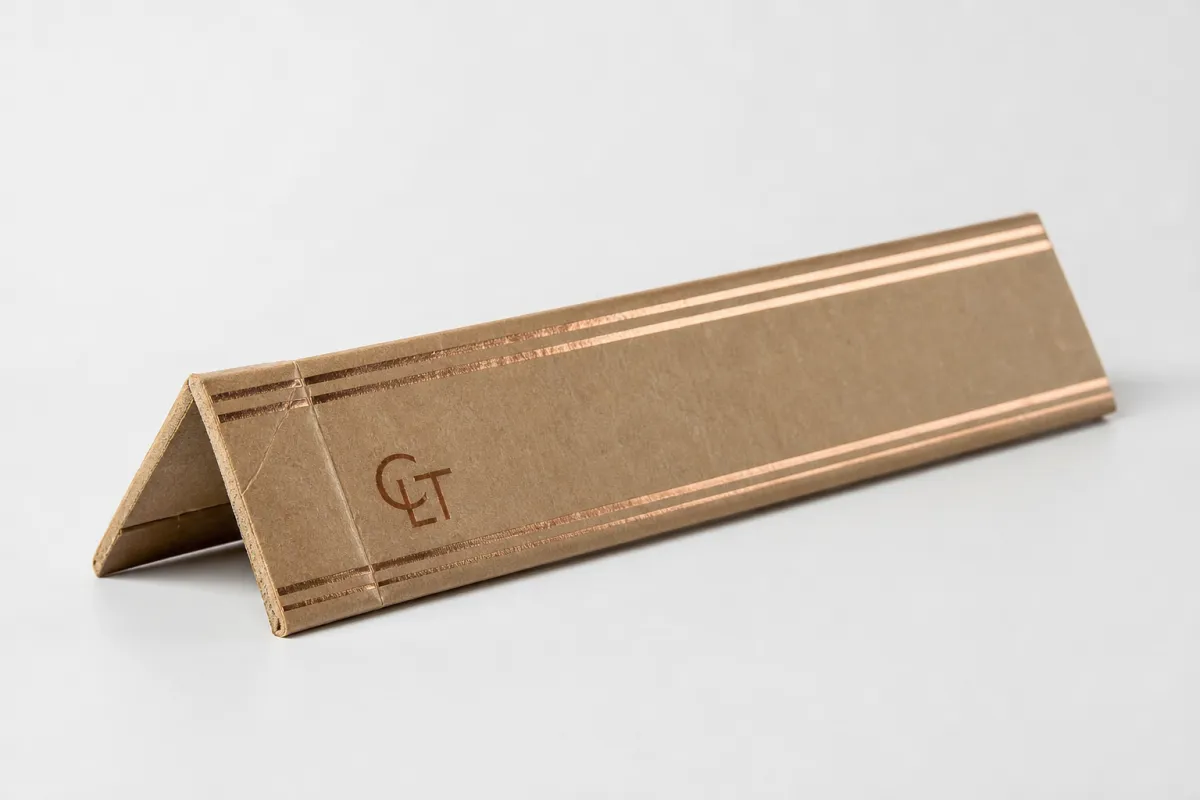
Spend ten minutes near a receiving bay and the pattern becomes obvious. Nobody walks up to a pallet and admires the carton artwork first. They look at corners, labels, wrap integrity, and whether the load appears stable. Printed corner boards for pallets help in that exact moment. They create a visible frame around the shipment while also shielding the vulnerable edges that get dinged by strapping, handling, and stacking.
A corner board is typically an L-shaped paper-based protector made from recycled paperboard, kraft layers, or a composite structure. It sits on the vertical edges of a palletized load and helps distribute force across a wider surface so straps do not cut straight into the carton edges. Add print, and the same part becomes a communication surface. Printed corner boards for pallets can carry a logo, a handling cue, a product family name, or even a lane identifier. That is a pretty efficient use of real estate.
The outside of a pallet often gets more attention than the cartons inside. A receiving team may not see the primary packaging until the pallet is staged. A distributor may spot the brand from the aisle before the cases are touched. A retail back room may sort by visual cue first and paperwork second. Printed corner boards for pallets can shape that read before the first box is opened.
That is why the decision should not live in only one department. If procurement treats these boards as a commodity, branding loses a visible surface. If marketing treats them like a billboard, operations may end up with a part that crushes too easily or interferes with wrap. The smarter view is more balanced: printed corner boards for pallets are part protection, part handling aid, part brand signal.
If the outside of the pallet is the first surface people see, then printed corner boards for pallets are not decoration. They are the packaging version of a tidy storefront window.
There is also a trust angle. A shipment with consistent printed corner boards for pallets tends to look controlled, even before a single case is scanned. That does not fix a weak distribution process, of course. But it does change the impression. In B2B packaging, structure often reads as competence, and people notice that more than they say out loud.
For teams juggling multiple SKUs, these boards can also simplify identification without adding another label system. A bold color band, a short handling message, or a clear logo can help distinguish lanes quickly. Tiny detail, big effect. Warehouse efficiency is often won in those small visual cues, not in some dramatic system overhaul.
How Printed Corner Boards for Pallets Work
The construction is straightforward. Most printed corner boards for pallets are made from recycled paperboard, layered kraft, or a composite board formed into a rigid angle. The board sits on the corner of the load and spreads force over a larger area, so strap tension and stretch-wrap pressure do not bite directly into the carton edge. In practical terms, that usually means fewer dented corners, fewer compression marks, and a more stable stack.
The print method varies by supplier. Some print the flat sheet before forming it. Others print after forming so color and registration are easier to control on the finished L-shape. Printed corner boards for pallets can carry a one-color logo, a two-color mark, handling symbols, a QR code, or a batch identifier. The strongest version is the one that still reads clearly once the pallet is wrapped, stacked, and pushed under warehouse lights.
Picture a real line for a second. Product goes onto the pallet. Corner boards are placed. Stretch wrap follows. Straps may be added. In some facilities, the board also helps the wrap slide over the edges without snagging or tearing. That is one reason printed corner boards for pallets are popular with teams that care about both damage reduction and presentation. You are not gonna get that effect from a label stuck on a random carton.
They serve multiple audiences at once. Warehouse staff can identify a lane faster. Receiving teams can spot instructions from across the dock. Sales and brand teams get a cleaner presentation. Even if nobody says it that way, printed corner boards for pallets make the load look like it belongs to the brand rather than the carrier. That distinction matters more than many buyers expect.
Fit matters more than people think. A board that is too light will buckle. A board that is too heavy may be unnecessary for a short domestic route and just add cost. A graphic that looks crisp on screen may disappear once glare from wrap film enters the picture. Printed corner boards for pallets should be specified for structure and visibility together, not one at the expense of the other.
For teams that want a standards-based way to think about shipping performance, adjacent guidance from groups like the ISTA and the Packaging Machinery Manufacturers Institute is useful. The details change by product and lane, but the logic stays steady: packaging should be tested under the conditions it will actually face, not just praised on a spec sheet.
Key Design Factors That Change Performance
The physical spec comes first. Thickness, leg width, length, angle, and crush resistance all affect how printed corner boards for pallets behave under pressure. A 35 mm by 35 mm board does not perform like a 50 mm by 50 mm board. A 2 mm wall is not the same as a 4 mm wall. Tall pallets, heavy loads, and export lanes make those differences impossible to ignore.
Board grade is not a side note. Recycled paperboard works well for many domestic shipments, but higher compression loads or rough freight lanes may need a denser composite build. Printed corner boards for pallets should match the load profile: carton weight, stacking height, clamp handling, humidity, and dwell time all matter. Two hours in a dock and two weeks in storage are not remotely the same test.
Print design needs discipline, not decoration. Bold marks usually read best. Short copy usually reads best. High contrast usually reads best. Dense text, thin type, and fine line art often disappear once the pallet is wrapped, scuffed, or photographed under warehouse lighting. Printed corner boards for pallets are seen from a distance, so the graphic has to work fast.
Good design choices tend to be plain and effective:
- Large logo placement near the upper third of the board
- One strong accent color instead of several weak ones
- Short handling language such as “This Side Up” or a brief product family name
- Clear contrast between print and kraft or white board stock
- Simple QR placement if scanning is part of the workflow
Printed corner boards for pallets also need to survive their environment. Humid warehouses can soften paper-based materials over time. Cold storage can change how coatings behave. Export lanes bring vibration, temperature swings, and longer dwell times. If the load is moving through multiple handoffs, the board should be chosen for the worst mile, not the cleanest photo.
Print coverage matters too. Heavy ink coverage can increase cost, but it can also affect moisture response and how well the graphic holds up against abrasion. If the branding only needs a logo and a product family name, a restrained print scheme may be the better move. Printed corner boards for pallets are one of those packaging parts where less visual noise usually means more clarity.
A useful comparison is between visual hierarchy and physical hierarchy. The print should tell the eye what matters first. The board structure should keep the pallet square and protected first. Once branding takes priority over fit, the order is wrong. A load that looks polished but collapses under strap tension is not a good outcome, and nobody in operations is gonna call that a win.
For teams working with recycled-content goals or FSC claims, material sourcing matters as well. If that is part of the brief, ask whether the substrate or finished board can align with FSC-certified sourcing. Public guidance is available at fsc.org. That does not make a board right for every lane, but it can matter for reporting and customer requirements.
Printed Corner Boards for Pallets: Cost, Pricing, and MOQ
Cost gets interesting fast, because the board itself is only one piece of the spend. Material grade, dimensions, print coverage, number of colors, finishing steps, and whether the order needs custom tooling or a nonstandard size all affect the quote. Freight, proofing, and artwork revisions can move the landed price more than buyers expect. It is one of those packaging categories where the invoice and the real cost are not the same thing.
For many standard runs, a plain board sits in a lower price band, while printed corner boards for pallets usually cost more because the setup and print steps have to be recovered across the order. As a planning range, buyers often see something like $0.18 to $0.28 per unit on larger runs with modest print coverage, and $0.30 to $0.60 or more for smaller quantities, heavier board, or more complex artwork. Those are not universal prices. They shift with board grade, geography, and market conditions.
MOQ changes the math. If a supplier wants 5,000 pieces and the need is only 1,000, the per-unit cost rises because make-ready time, plates, and setup are spread over fewer boards. That is why printed corner boards for pallets can look expensive in a pilot and much more reasonable in a repeat order. The gap is usually fixed-cost math, not pricing inconsistency.
A small test run can still be the right choice. A new brand color, a check on whether the logo reads through wrap, or a new pallet size all justify a pilot. If the artwork is settled and the board spec is already known, going straight into production may be more efficient. The right choice depends on risk, not ego, and yes, that can save a headache later.
| Option | Typical Unit Price | Best For | Notes |
|---|---|---|---|
| Plain corner board | $0.10-$0.20 | Basic edge protection | Lowest setup burden, no branding value |
| One-color printed board | $0.18-$0.35 | Simple brand mark or handling note | Often the best balance of cost and visibility |
| Two- to three-color print | $0.28-$0.50 | Retail-facing shipments or premium presentation | Better for stronger brand recognition, higher setup complexity |
| Full-coverage print or special finish | $0.40-$0.80+ | High-visibility campaigns or controlled lanes | Can raise costs quickly if artwork is dense or coatings are added |
Hidden costs matter just as much as unit price. Freight can be meaningful because corner boards are bulky. Artwork revisions can burn time and money if the supplier needs a new proof. Storage fees show up when a large run arrives before the receiving team is ready. Rush charges can turn a sensible project into an annoying one. Printed corner boards for pallets should be bought with landed cost in view, not just the ex-factory number.
There is also a comparison buyers often miss: a branded board can cost more than an unprinted one, yet save money if it reduces misroutes, improves product identification, or cuts damage claims. That is not a blanket promise. Still, from a procurement angle, printed corner boards for pallets deserve a cost discussion that includes operations, not just the invoice.
Production Process and Timeline for Printed Corner Boards
The production path is usually simple, which is exactly why rushed approvals cause trouble. A brief goes out. Artwork is prepared. Proofs are reviewed. The supplier confirms materials, print method, and dimensions. Production starts. Delivery follows. Printed corner boards for pallets are not complex parts, but a last-minute change to the logo, board weight, or handling note can throw the schedule off in a hurry.
Lead time depends on format and complexity. Simple repeat orders may be ready in about 10 to 15 business days after approval. New artwork, a custom size, or multi-color printing can push the timeline into the 2 to 4 week range, especially if a specific board grade has to be sourced. If the order needs a special die or structural change, the schedule stretches further. Printed corner boards for pallets usually move faster than many custom pack parts, but they are not instant.
Color matching can add time as well. A brand team may want a precise Pantone match, but recycled kraft board will not behave like a coated marketing sheet. That is not an error. Paperboard texture, ink absorption, and surface finish all change appearance. Good suppliers show a proof or sample so the buyer can judge the real result instead of guessing from a screen.
Approval cycles are often the slowest step. Packaging, marketing, operations, and sometimes customer service all want a say. That is understandable. It also turns a five-day production job into a two-week wait. A tighter approval path makes printed corner boards for pallets much easier to source. Less back-and-forth usually means a cleaner schedule and fewer missed ship dates.
Teams that test packaging formally should compare the board against the loading and transit conditions it will actually face. ISTA guidance helps move the discussion from assumption to evidence. The official site at ista.org is a useful starting point, even if the internal spec stays fairly simple.
A practical lead-time checklist keeps procurement ahead of surprises:
- Final dimensions and load height
- Expected pallet weight and stacking pattern
- Artwork files in the correct format
- Color references or brand standards
- Quantity by SKU or lane
- Delivery destination and receiving hours
- Target ship date and approval owner
If any of those items is missing, printed corner boards for pallets tend to slip. That is not really a supplier flaw. It is a clarity problem. A tight brief almost always shortens the path to a good result, and honestly, that is the boring advantage that saves the week.
Step-by-Step Guide to Ordering Printed Corner Boards
Start with the use case. Are printed corner boards for pallets meant mainly to protect, mainly to brand, or to do both equally well? That answer changes the spec. A heavy export load may need stronger board and less print coverage. A retail-facing domestic pallet may allow lighter construction but need a stronger graphic signal. The lane tells you what matters.
Gather the technical inputs before asking for quotes. Too many buyers skip this step and then spend a week chasing missing details. You need the pallet size, product weight, stacking height, and shipping environment. You also need artwork files, brand colors, compliance marks if any, and any handling instructions the warehouse uses. The more complete the request, the better the estimate for printed corner boards for pallets will be.
Ask for a proof or sample next. Review it under realistic conditions, not just on a laptop. Stand back several feet. Check it under warehouse lighting. Place it under wrap if possible. See whether the logo still reads through glare and whether the board fits the corner tightly enough to stay put. Printed corner boards for pallets should be judged in context, because that is where they either work or fail.
A straightforward workflow often looks like this:
- Define the load and lane
- Choose board strength and size
- Set the print rules and brand colors
- Review digital proof
- Approve a physical sample if needed
- Run a pilot on one SKU or one distribution center
- Document what changed in handling, visibility, and damage
That pilot is not busywork. It is the cheapest way to catch fit issues, edge crush problems, or branding problems before a full rollout. If the board slides during wrap, the graphic sits too low, or the size gets in the way of a strap path, those are useful discoveries. Printed corner boards for pallets should save time later, not create rework now.
One practical move: photograph the board on a real pallet at the receiving dock before scaling up. That gives the team a record of how the print looks under operational lighting. It also creates a baseline for future comparisons if the supplier changes stock, ink, or forming method. It sounds small. It is not.
Another useful rule is to keep the message short. A logo, a product family, a handling cue, and maybe a QR code are enough for most applications. Crowded copy tends to get lost. Printed corner boards for pallets are visual signals attached to a load, not brochures. Nobody wants to read a paragraph while a pallet jack is moving.
Common Mistakes Buyers Make With Printed Corner Boards
The first mistake is treating printed corner boards for pallets as graphics only. A beautiful print does nothing if the board is too weak for the lane or too loose for the load. Structural fit is the base layer. Branding sits on top of that, not the other way around. That sounds obvious. It still gets missed constantly.
The second mistake is weak contrast. Dark gray on brown kraft can look refined in a mockup, then vanish under warehouse light and wrap reflection. Tiny text fails the same way. If the board needs to be read from several feet away, simplicity wins. Printed corner boards for pallets should be legible fast, because nobody on the dock is stopping to decode them.
The third mistake is ignoring the environment. A board made for a dry, short-haul domestic route may not hold up in a humid cross-dock or a cold-storage transfer. If the pallet will be handled with clamp trucks, sit in staging, or travel export lanes, those conditions need to be in the brief. Printed corner boards for pallets should match the real route, not the ideal one.
The fourth mistake is poor coordination with straps, wrap, and pallet height. If the board sits where a strap bites too hard, it can crease. If it is too short, the branding may sit below the most visible part of the load. If it is too tall, it may interfere with covers or top caps. The layout matters as much as the artwork. Kinda annoying, but that is the reality.
The fifth mistake is skipping validation when the shipment deserves it. A high-value product, a fragile lane, or an export load may need more testing than a routine stock order. Even a basic compression or transit check can reveal whether the board behaves as expected. Printed corner boards for pallets are simple, but simple parts still deserve proof.
There is also a management mistake that shows up often: leaving departments out of alignment. Marketing wants a striking logo. Operations wants easy handling. Procurement wants the lowest landed cost. If those groups are not aligned early, the final result can satisfy none of them fully. Printed corner boards for pallets work best when the brief is shared before the quote is requested.
Expert Tips and Next Steps for a Smarter Rollout
One of the smartest moves a packaging team can make is to build a one-page specification sheet for printed corner boards for pallets. Keep it plain on purpose: dimensions, board grade, color rules, target quantity, approved artwork, packaging lane, and contact names for signoff. That sheet becomes the reference point when a second quote comes in or when a reorder is needed months later.
It also helps to define success before the order ships. Is the goal fewer edge-damage claims? Faster picking? Cleaner brand presentation? Better identification on the dock? If the team measures only purchase price, it can miss the actual value. Printed corner boards for pallets should be judged against operational results, not just line item cost.
Useful pass-fail checks are simple and visible:
- Can the board be seen clearly from 6 to 10 feet away?
- Does it stay flat against the load after wrap?
- Does it reduce visible edge crush at the corners?
- Does the pallet still stack properly?
- Can the receiving team identify the lane without extra labels?
If the answer is no on more than one of those points, the spec probably needs adjustment. That is not failure. It is part of getting the part right. Printed corner boards for pallets are often easy to improve once the team sees them on a live pallet rather than on a proof.
Another practical move is to standardize a small family of versions. One board for export, one for retail-facing domestic loads, and one for internal transfers keeps purchasing from reinventing the spec every time. It also makes volume pricing easier to negotiate. Printed corner boards for pallets become far easier to manage when they are part of a system instead of one-off requests.
If you want a purchasing rule that usually works, compare at least two suppliers, request a sample or mockup, and run the board on the highest-volume lane first. That sequence exposes the real issues quickly. It also gives you a clear basis for comparing structure, print quality, lead time, and freight terms.
For buyers who need more help shaping the brief, it helps to think like a warehouse manager for ten minutes and like a brand manager for ten minutes. The warehouse manager asks whether the board stays in place, handles straps, and fits the load. The brand manager asks whether the mark is visible, consistent, and credible. Printed corner boards for pallets only earn their keep if they answer both sets of questions.
From a procurement standpoint, that is the final lesson: the board is not a decoration, and it is not a sacrificial protector either. It is both. Choose the Right substrate, the right print load, and the right approval path, and printed corner boards for pallets can improve handling while sharpening the outer face of the shipment. That combination is uncommon, and it is worth getting right.
What are printed corner boards for pallets used for?
They protect pallet edges from strap pressure, crushing, and scuffing during storage and transport. They also turn a shipping load into a branded surface that helps with identification, handling, and presentation.
How much do printed corner boards for pallets cost?
Price depends on size, board grade, print coverage, color count, and whether the order needs special setup or tooling. MOQ, freight, and proofing can affect the landed cost as much as the board price itself.
What artwork works best on printed corner boards for pallets?
Bold logos, short messages, and high-contrast colors usually read best once the pallet is wrapped and moved through a warehouse. Avoid crowded layouts and tiny type; the design should still be clear from several feet away.
How long is the lead time for printed corner boards for pallets?
Lead time depends on artwork approval, material availability, print complexity, and whether a custom size or die is needed. Fast approvals and simple designs usually shorten turnaround, while revisions and rush requests can add days or weeks.
Do printed corner boards for pallets need a pilot run first?
A pilot run is smart when you are testing a new size, color, or branding layout, because it exposes fit and legibility issues early. Testing on a real pallet lane helps confirm handling, wrap performance, and whether the boards support both protection and branding goals.
Printed corner boards for pallets sit where branding, damage control, and warehouse reality meet. If you treat them that way from the start, the order becomes easier to specify, easier to defend internally, and more useful on the dock. That is the kind of packaging decision that pays off quietly, shipment after shipment, and it is exactly why printed corner boards for pallets deserve serious attention before the first run is ordered.