Printed Custom Plastic Garment Bags Quote for Food Buyers
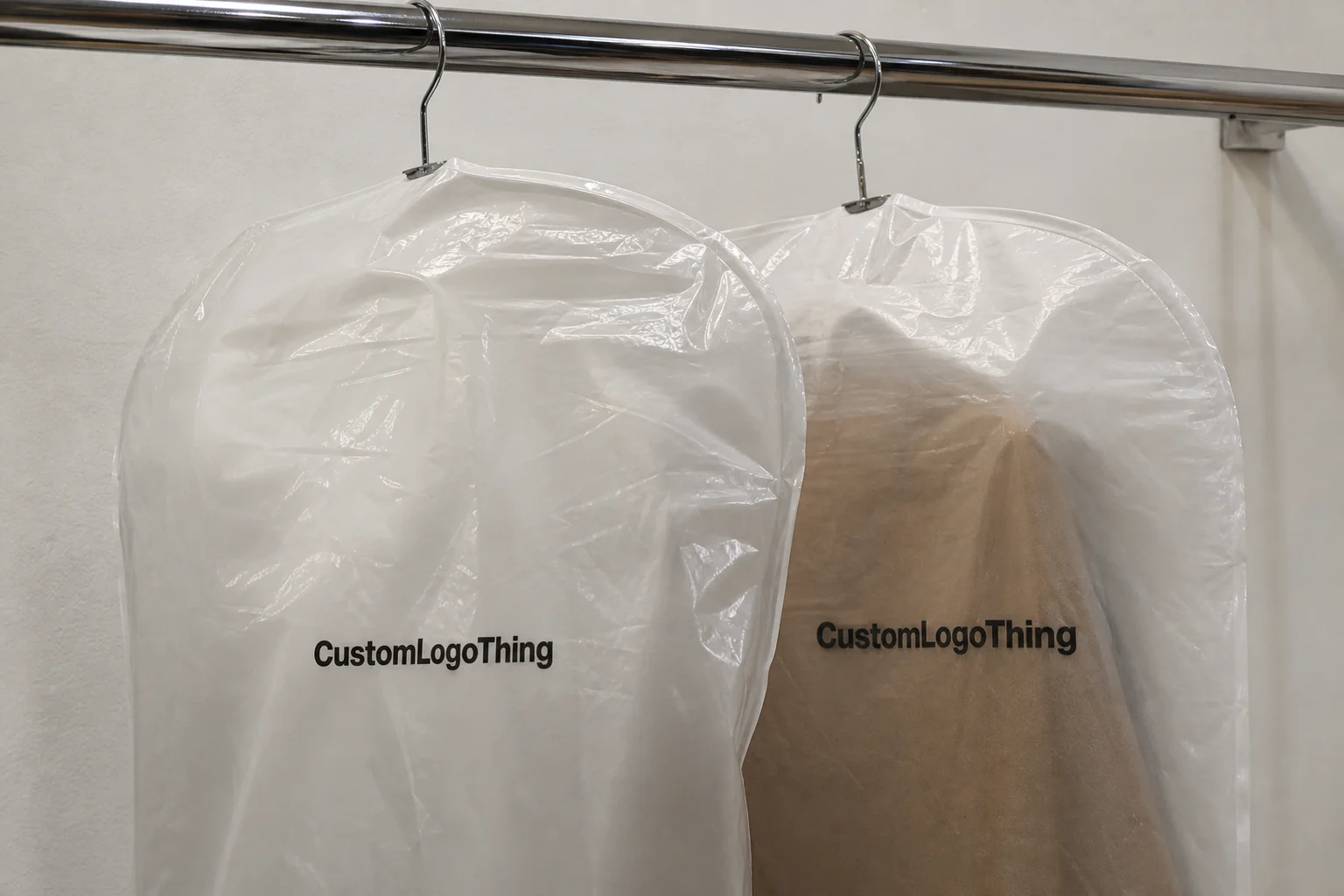
A simple-looking bag can become a complicated purchase once it is tied to food, retail compliance, and production timing. Buyers asking for a printed Custom Plastic Garment Bags quote for food need to define the use clearly: direct food contact, indirect food-adjacent packaging, or apparel and promotional packaging for a food brand. Those three paths can require different resin choices, print controls, warnings, and handling assumptions.
The shape may look like a garment bag, but the buying context is usually broader. A food company might need a hanging bag for aprons, chef coats, staff uniforms, meal-kit textile inserts, retail merchandise, or event apparel tied to a restaurant launch. The bag may never touch edible product, yet it still sits inside a food-driven supply chain where odor, clarity, contamination risk, and shelf presentation all matter.
That is why a quote should be built around measurable details rather than a product name alone. A printed bag can help with brand visibility, product identification, carton handling, and barcode placement. It can also create problems if the film is too thin, the hanger hole is weak, the print is too dense, or the spec leaves too much room for interpretation.
Small changes add up fast. Across a run of 10,000 bags, a 0.5 mil gauge increase, an extra two inches of film, or a full flood-print layout can change resin usage, freight weight, carton count, and reject risk enough to matter in procurement.
The goal of a useful quote is not to make the bag sound impressive. It is to make the numbers trustworthy enough that a buyer can compare options without guessing where the cost is coming from.
Where Garment-Style Plastic Bags Fit in Food Packaging
Garment-style plastic bags are long-format bags typically used to protect apparel and textile products. In food-related programs, they are often used for branded uniforms, aprons, catering apparel, promotional clothing, employee kits, or non-edible inserts packaged with a food brand. In some cases, the bag is packed inside a carton or mailer. In others, it is the visible outer package.
The first distinction is direct versus indirect use. If the bag touches edible product, the buyer needs to confirm food-contact-suitable resin, ink considerations, and any documentation required by the end customer or retailer. If the bag is holding uniforms or merchandise, the focus shifts toward print clarity, hang presentation, durability, and storage behavior. Even then, the food context is still relevant, because a bag stored near ingredients or in a kitchen environment can still raise questions about odor, dust, and contamination control.
Different formats solve different handling problems. Wicketed bags support faster loading on packing lines. Header bags work for peg display and retail merchandising. Side-gusset bags create room for thicker folded items. Hanger-hole bags, adhesive flap bags, and perforated tear-off styles help back-of-house teams move product without tearing film or damaging the contents.
| Bag Format | Typical Food-Sector Use | Key Quote Detail | Common Risk |
|---|---|---|---|
| Hanger-hole garment bag | Aprons, chef coats, restaurant uniforms | Hole size, reinforcement area, film gauge | Tearing near the hanging point |
| Adhesive flap bag | Retail merchandise or packed apparel kits | Flap depth, adhesive type, closure direction | Weak closure after repeated handling |
| Header bag | Promotional food-brand merchandise | Header lip, peg hole, barcode position | Misaligned display graphics |
| Side-gusset plastic bag | Bulkier textile kits or insulated inserts | Gusset depth, packed item thickness | Under-sizing after the product is folded |
Branding can do real work here, but only if the structure supports it. A printed surface can carry inventory data, compliance warnings, logo placement, and brand marks on the same bag. That is useful. Still, ink coverage should be kept in balance with film choice and recycling expectations. Heavy printing can increase cost, reduce visual clarity, and complicate downstream handling. Vent holes can release trapped air, but poor placement can invite dust or moisture. Thin film can look economical until it starts failing during carton loading.
Film, Print, and Closure Specifications That Change Performance
Film selection is usually the first technical decision that affects both cost and performance. LDPE is common because it has a soft hand feel, good clarity, and good sealability. HDPE brings more stiffness and can deliver strength at lower gauges, although the look and feel are different. LLDPE blends improve puncture resistance, which helps when the packed item has sharper seams, snaps, zippers, or folded edges. Recycled-content films may be acceptable for some indirect uses, but they need closer review if the buyer has odor, appearance, or food-contact requirements.
Gauge needs to be discussed in plain terms. A 1.0 mil bag may be fine for lightweight textile inserts or single apparel pieces. For folded aprons, restaurant uniforms, or multi-piece kits, 1.5 to 2.0 mil is often a better starting point. Heavier film increases resin weight and price, but it can reduce tearing, repacking labor, and damage claims. Thin material is not automatically efficient.
Print method matters just as much as film. Flexographic printing is usually the practical choice for repeat plastic bag orders because it handles logos, warnings, simple brand panels, and spot colors efficiently at scale. One or two spot colors usually keep plate and ink costs under control. Four-color process or heavy coverage can improve shelf presence, but it also raises the bar for artwork accuracy, registration control, and quote accuracy.
For a printed Custom Plastic Garment Bags quote for food, the artwork should be built for production, not just for presentation. Vector files are preferred. So are Pantone references, clear print placement notes, barcode quiet zones, warning text, and the target logo scale. Tiny reversed-out text can fill in during flexographic printing. Dense ink blocks can crack on folds or across gusset transitions if the film is too stiff or the layout is too busy.
Closure and finishing details determine whether the bag works on the line or becomes a handling problem. Common options include adhesive flaps, open-end bags, perforated tear-off sections, bottom seals, side welds, hanger holes, header lips, vent holes, suffocation warnings, and case packing by count. A 100-count case may suit warehouse control, while a 500-count master carton can reduce handling time for higher-volume replenishment. For food-related applications, buyers should ask early about resin information, food-contact suitability statements where applicable, ink system details, and any declarations required by the retailer or end customer.
The best quote requests are specific enough to remove guesswork: dimensions, gauge, resin, print colors, ink coverage, closure style, packing count, destination, and food-use status. If those variables are missing, the estimate will be broad for a reason.
Cost, Pricing, MOQ, and Unit Cost Drivers
Custom plastic bag pricing is built from a set of inputs, not a single number. Resin weight, bag dimensions, film gauge, print colors, plate costs, order quantity, finishing steps, cartons, and freight all feed the final unit price. A larger bag in a thin film can cost more than a smaller bag in a heavier film because square inches drive material use. Print coverage can push pricing up even when the bag size stays the same.
As a working planning range, simple custom printed plastic garment-style bags often land around $0.10 to $0.25 per unit at moderate volumes, while heavier-gauge, larger, or multi-color versions can move into the $0.25 to $0.60 range or higher depending on the spec and market conditions. Setup or plate charges may be modest for a simple one-color job and several hundred dollars for more complex print work. Those are budgeting ranges, not promises. Resin pricing moves, freight changes, and packaging specs tend to expose that quickly.
MOQ usually reflects production efficiency. Minimums can be driven by film extrusion runs, print setup, plate making, converting speed, and the availability of standard film widths. A small trial order often carries a higher unit cost because setup time is spread across fewer bags. Larger repeat orders usually improve the per-unit price because the press and converting line stay productive longer.
| Cost Driver | Buyer Control | Typical Effect on Quote |
|---|---|---|
| Bag dimensions | Reduce unused length and width while keeping fit tolerance | Lowers resin use and carton cube |
| Film gauge | Match thickness to packed weight and handling risk | Changes unit cost, tear resistance, and shipping weight |
| Print colors | Limit to essential logo, barcode, and compliance text | Reduces plate and ink complexity |
| Order quantity | Quote two or three tiers | Shows where unit cost drops enough to justify storage |
| Freight | Provide ZIP code, port, or delivery instructions early | Prevents landed-cost surprises |
Comparing quotes is where buyers can get misled. A lower price can reflect thinner film, non-food-grade material, fewer print colors, weaker seals, excluded freight, or a carton pack that creates more warehouse labor later. The cheapest quote is often useful only as a diagnostic. Ask why it is cheaper, then check whether that difference matters in use.
For a dependable quote, send the first request with enough detail to support landed cost: flat bag size, packed item dimensions, thickness target, quantity, number of print colors, artwork file, food-contact status, closure style, packing method, destination ZIP or port, and desired delivery date. Ask for tiered pricing at 5,000, 10,000, and 25,000 pieces if the storage plan allows it. The cost curve tells procurement more than a single number does.
Process and Timeline From Artwork to Delivery
The typical production path starts with quote review, spec confirmation, artwork check, digital proof, plate production if needed, film extrusion or film sourcing, printing, converting, quality control, packing, and shipment. Each step has a point where a small omission turns into delay. Missing artwork slows proofing. Unclear closure direction leads to rework. Food-contact questions that appear late can stop approval altogether.
Repeat orders move faster because the artwork, film, plates, and pack-out are already known. New custom sizes, multi-color graphics, special resin requests, food-contact documentation, and freight constraints add time. A practical planning window is often 12 to 20 business days after proof approval for straightforward custom runs. New structures, larger volumes, imported components, or multiple approval rounds can push that longer.
Artwork should be prepared for production. Send vector logo files, Pantone color references, exact print placement, barcode position, suffocation warning copy if required, registration tolerance expectations, and any acceptable color variation. If the logo needs to align with a hanger hole or header lip, mark that on the dieline. A half-inch placement error may not break the bag, but it can make the package look careless.
Proofing deserves real attention. Before approval, verify flat dimensions, open-end orientation, closure direction, print side, logo scale, case pack, compliance text, and shipping labels. For brands that also buy Custom Packaging Products such as custom printed boxes, it helps to align logo colors and barcode conventions across the full packaging system. Buyers often notice inconsistent branding only after the bags and cartons are sitting on the same packing bench.
Samples are worth the extra time. Stock film samples help confirm hand feel, clarity, stiffness, and odor. Full custom printed samples may require extra cost and lead time, especially if plates or press setup are involved. For a new food-adjacent program, physical material approval is often more useful than a mockup on screen.
Transport validation may also matter depending on the shipping route and the customer. The International Safe Transit Association publishes package testing procedures used by many shippers, while broader packaging recovery and recycling guidance is commonly checked through the U.S. Environmental Protection Agency. A garment-style plastic bag may not need formal transit testing on its own, but the master carton and pack-out often do.
Quality Checks Food-Sector Buyers Should Not Skip
Food-sector buyers usually have less tolerance for ambiguity. A bag used by a food brand may sit near kitchens, commissaries, distribution centers, retail shelves, or promotional kits where odor, dust, and contamination concerns are visible to staff quickly. Even if the bag never touches edible product, the brand context raises the standard.
Start with physical checks. Review seal strength, film gauge tolerance, print adhesion, ink rub resistance, bag opening consistency, vent hole placement, hanger hole durability, and carton count accuracy. Pull bags from multiple areas of the shipment, not only the top carton. A 2 percent defect rate sounds small until 200 bags in a 10,000-piece order need repacking.
Storage and handling conditions matter more than many quote sheets suggest. Cold storage can make some films feel stiffer. Humidity can affect carton integrity and adhesive closures. Grease-adjacent environments can expose weaknesses in print and handling surfaces. Repeated warehouse handling can stress hanger holes and side welds in ways a desk review will never show.
Compliance checks belong in the same review. Confirm suffocation warning language, recycling marks where appropriate, lot traceability, material declarations, and any requested food-contact documentation. If the application involves direct food contact, the buyer should state the food type, contact duration, temperature exposure, and expected regulatory framework before production approval. That is the point where assumptions cause trouble.
Print inspection needs the same discipline. Dense ink zones can crack on folds or complicate recycling claims. Fine type can fill in. Barcodes can fail if contrast or quiet zones are too tight. The artwork that looks clean on a screen may be too fragile for the press, film, and handling conditions selected.
A physical sample is especially useful for premium retail packaging, food-service apparel kits, or any bag used close to food products. Touch tells you things a PDF does not. Clarity, stiffness, opening behavior, odor, and fold recovery all affect whether the bag feels like competent branded packaging or a cost-cut compromise.
What Custom Logo Things Needs to Build an Accurate Quote
Custom Logo Things works best as a quoting partner when the inputs are concrete. The objective is not a dramatic pitch. It is manufacturing fit, clear assumptions, and a quote that procurement can compare without decoding hidden variables.
Send flat bag dimensions, packed item dimensions, quantity, film preference, thickness target, print colors, artwork, closure style, direct or indirect food use, delivery location, and timing requirements. Photos help a lot. A picture of the folded apron, current bag, or packed kit can reveal depth, seams, hangers, tags, or accessories that written dimensions miss.
The team can help refine the spec before production. That may mean adjusting gauge, recommending LDPE or an LLDPE blend, simplifying artwork for print efficiency, changing vent placement, or suggesting carton packs that reduce damage and freight waste. For some programs, a plastic garment bag may also sit alongside paperboard sleeves, mailers, or Custom Packaging Products as part of a broader packaging system.
Procurement teams should ask for tiered pricing, repeat-order planning, packaging samples, dieline review, and functional alternatives. Sometimes the best answer is a standard film with better sizing. Sometimes it is a heavier gauge. Sometimes it is less print, not more. The best order is not always the cheapest bag; it is the bag with the right film, print, compliance, and production assumptions for the use case.
Need a printed custom plastic garment bags quote for food with fewer revisions? Use the Contact Us page and include the production details already known. The cleaner the inputs, the easier it is to separate firm pricing from items that still need confirmation.
Next Steps Before You Request a Custom Bag Quote
Measure the packed product first. Include depth, folds, seams, tags, hangers, accessories, and any insert that changes the profile. A bag that fits only under ideal conditions will slow packing and increase rejects. Add tolerance for real handling, especially if staff will load hundreds of units per shift.
- Confirm whether the use is direct food contact, indirect food-adjacent packaging, or general promotional apparel packaging.
- Choose a target film thickness, such as 1.0 mil for light items or 1.5 to 2.0 mil for heavier folded garments and kits.
- Count print colors and decide whether full coverage is actually necessary.
- Gather vector artwork, Pantone references, barcode files, and warning text.
- Select the closure style: adhesive flap, open end, perforated tear-off, drawstring, header lip, or hanger hole.
- Estimate order quantity and request pricing at two or three volume tiers.
- Flag deadlines for events, seasonal food promotions, restaurant openings, or distributor launches.
Photos of the packed item or the current bag are often more useful than a written description alone. Visual evidence exposes fit and handling issues faster than most spec sheets do. A wrinkle pattern, stretched corner, or torn hanger hole can tell an experienced packaging estimator exactly which variable needs attention.
For transactional buyers, the path forward is straightforward: turn the use case into measurable specifications. A complete printed Custom Plastic Garment Bags quote for food should leave no uncertainty about Material, Print, MOQ, timeline, compliance, and delivered cost.
FAQ
What details are needed for a printed custom plastic garment bags quote for food?
Send bag dimensions, item dimensions, quantity, film type, gauge, print colors, artwork, closure style, destination, target delivery date, and whether the bag has direct food contact. Photos of the packed item or an existing bag can reduce sizing errors and quote revisions.
Can custom printed plastic garment bags be food safe?
They can be specified with food-contact-suitable materials when the application requires it. Buyers should state the exact food-use scenario so resin, ink, and documentation requirements are handled before production.
What affects the MOQ for printed plastic garment bags?
MOQ depends on film extrusion, bag size, print setup, number of colors, converting requirements, and whether the order uses standard or custom material. Higher quantities usually reduce unit cost because setup and plate costs are spread across more bags.
How long does production take for custom printed garment bags?
Timing depends on artwork approval, plate requirements, material availability, print complexity, converting workload, and shipping distance. Repeat orders with approved artwork usually move faster than new custom specifications.
How can buyers lower the unit cost of food-related custom plastic bags?
Buyers can reduce unnecessary film length, choose an efficient gauge, limit print colors, use standard materials, consolidate sizes, and request tiered pricing. Cost should be compared against performance because under-specified film can lead to tearing, repacking, or rejected shipments.


