Buyer Fit Snapshot
| Best fit | Printed Edge Protectors with Logo projects where brand print, material claims, artwork control, MOQ, and repeat-order consistency need to be specified before quoting. |
|---|---|
| Quote inputs | Share finished size, material target, print colors, finish, packing count, annual reorder estimate, ship-to region, and any compliance wording. |
| Proofing check | Approve dieline scale, logo placement, barcode or warning zones, color tolerance, closure strength, and carton packing before bulk production. |
| Main risk | Vague material claims, crowded artwork, missing packing details, or unclear freight terms can make a low unit price expensive after revisions. |
Fast answer: Printed Edge Protectors with Logo: Material, Print, Proofing, and Reorder Risk should be specified like a repeatable production item. The safest quote records material, print method, finish, artwork proof, packing count, and reorder notes in one written spec.
Production checks before approval
Compare the actual filled-product size with the drawing, then confirm tolerance on folds, seals, hang holes, label areas, and retail display edges. Reserve space for logos, QR codes, warning copy, and material claims before decorative graphics fill the panel.
Quote comparison points
Review material grade, print process, finish, sampling route, tooling charges, carton quantity, and freight assumptions side by side. A quote is only useful when the supplier can repeat the same color, closure quality, and packing count on the next order.
Printed Edge Protectors With Logo: Uses, Costs & Tips
Printed edge protectors with logo look simple. Then a pallet shows up with crushed corners, a shifted load, and a customer asking why the shipment arrived looking like it lost a fight. A recycled board angle with branding can hold the load together, reduce corner damage, and put your name in front of the handler before the carton is even opened. Small part. Big job. That is the whole point.
Packaging buyers usually care about them for practical reasons, not because they are pretty. These pieces sit in the secondary or tertiary packaging layer, working with stretch wrap, strapping, and properly sized cartons. They reduce corner crush, make pallets easier to identify, and give the load a cleaner, more deliberate look in the warehouse or at the dock. That matters more than people admit.
There is also a buyer psychology angle here. A plain angle board says, "This is here to stop damage." A printed one can say that and also tell the floor crew which program, site, or customer the load belongs to. That tiny bit of visibility can prevent mix-ups that cost far more than the board itself.
Printed edge protectors with logo: why they matter
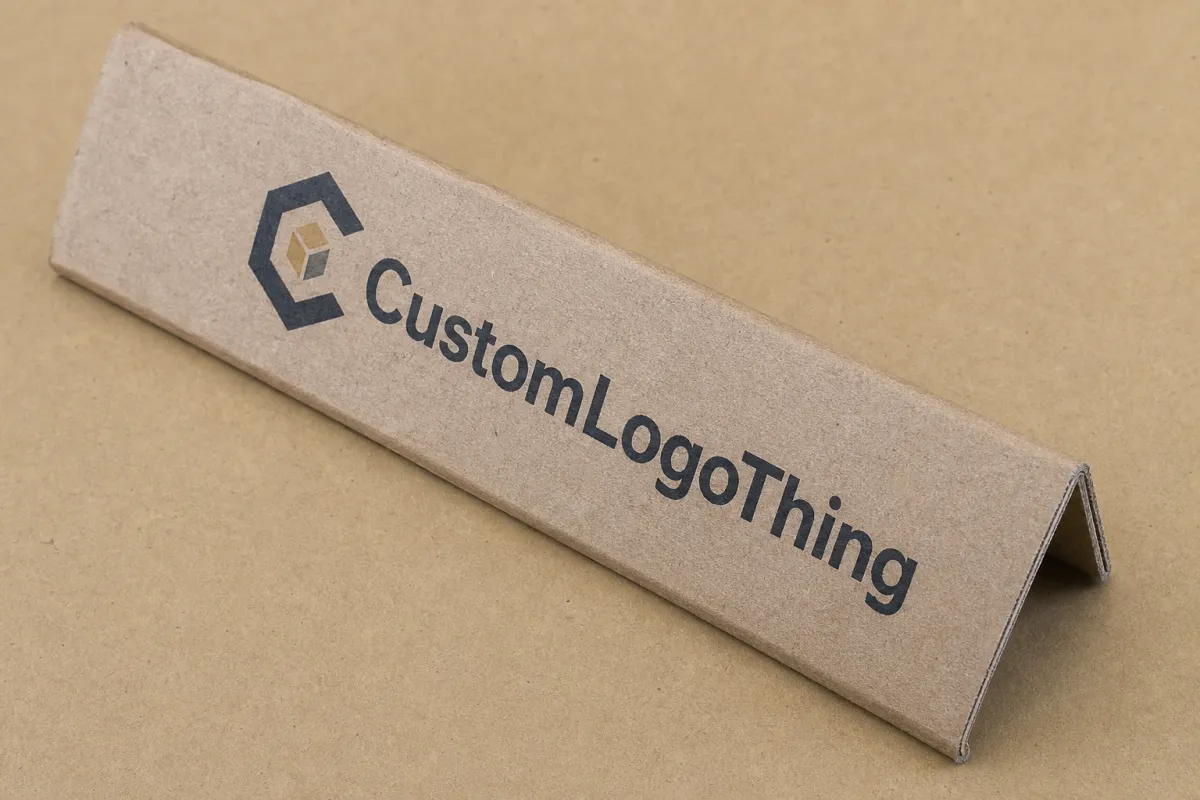
Picture a pallet moving through a cross-dock. The outer carton may be plain. The wrap may hide everything underneath. The first visible cue can be the edge protector. If that board angle carries a logo, a route code, or a handling message, it changes how the load is read before anyone touches it. That is the useful trick here: a protective part can also act like a visible quality signal.
Edge protectors are rigid paperboard or recycled fiber angles placed on pallet corners, carton edges, or wrapped bundles. Their job is to spread the force from straps, banding, and stack weight so the load does not collapse at its weak points. They also help prevent scuffing and strap cut-through. Good ones are boring in the best possible way. The dimensions fit the load, the board grade matches the weight, and nobody has to improvise on the floor because the spec was wishful thinking.
Printed edge protectors with logo add one more layer. The print can be a single-color mark, a route identifier, a recycling note, or a short handling cue. That sounds small until you see what happens in a busy warehouse. Visible branding helps teams separate programs, pull the right pallets faster, and confirm that the correct pack format is moving through the right lane. Less guesswork. Fewer mistakes. That alone is worth something.
For sustainability programs, the case gets stronger. Fiber-based angle boards can simplify material choices compared with plastic alternatives, and the printed surface can carry handling instructions that would otherwise need a separate label or insert. That does not make the part magically green. Nothing magical is happening here. It just means the supplier has a cleaner story to document if recycled content, print compatibility, and recovery pathways are handled properly.
"If the corners fail, the load is already in trouble. The logo helps the brand, but the board profile has to earn the right to be there."
There is also a procurement angle that gets ignored too often. Once the edge protector carries a logo, the component becomes more memorable, which helps standardize the pack spec across sites. People remember the visible piece. That makes it easier to keep plants, 3PLs, and regional distribution centers on the same page before packaging drift takes over and starts creating little disasters nobody asked for.
In practice, the branded protector can also help during audits and customer visits. A pallet with clear, repeatable graphics looks intentional, not improvised. That does not prove the load is engineered correctly, and nobody should pretend it does. But it does create a cleaner baseline for quality checks, which is helpful when the conversation turns to why a shipment arrived damaged or why two sites are using different pack builds for the same SKU.
How printed edge protectors with logo work on the line
The mechanics are straightforward. The rigid edge spreads force away from the weakest part of the load, so straps and stack weight press on the board angle instead of crushing cartons or tearing flaps. If the angle is tall enough and the board grade is right, it can also help maintain vertical compression strength during transit and storage. Pallets are not delicate things, but they do have weak spots. Corners are usually the first to complain.
Printing changes the role in a useful way. A logo can act as a placement cue. A route code can help staff confirm the correct product. A handling message can remind crews not to stack beyond a certain height or not to cut straps until the pallet is staged. In a rushed operation, that cue can be more effective than a separate label because it sits on the component people are already looking at during handling.
Common use cases tend to show up in a handful of sectors:
- Pallet corners for cartons, bottles, and mixed loads that need crush resistance.
- Boxed furniture and flat-pack goods, where long edges can get bruised in transit and storage.
- Sheet goods such as panels, boards, or printing substrates that need clean edges.
- Retail-ready bundles that need to arrive neat enough to go straight to shelf or display.
- E-commerce bulk packs that pass through multiple handoff points before reaching the final site.
- Warehouse-to-store shipments where quick recognition matters more than decorative presentation.
They work best as part of a system, not as a rescue plan for a bad pallet build. Poor stacking, the wrong carton, or inconsistent strap tension will beat a printed protector every time. Stretch wrap does not get a special pass either. Add more of it and the load still fails if the structure underneath is sloppy. Packaging is annoying like that. It punishes shortcuts.
Fiber-based angle boards fit neatly into current packaging thinking because they complement stretch wrap, strapping, and right-sized cartons rather than replacing them. That puts them squarely in the secondary or tertiary packaging conversation. They are a low-cost layer of load discipline, not a miracle fix for bad handling.
Teams comparing material pathways usually find the paper-based route easier to document. The ISTA test framework is widely used for transport package evaluation, and FSC-certified board can support chain-of-custody claims where fiber sourcing matters. Those references do not guarantee success. They do give buyers a shared language when comparing suppliers, spec sheets, and sustainability requirements without everyone speaking in circles.
Another practical point: handling conditions vary more than purchasing teams expect. A protector that works in a calm outbound lane may behave differently in a humid dock, a double-stacked trailer, or a route with multiple transfer points. That is why a sample on the table is not enough. The part has to prove itself in the real flow, under the real stress, with the real people who will apply it every day.
Key factors that shape performance and brand impact
Four variables usually matter more than the rest: material strength, print method, fit, and readability. Get one wrong and the rest start working harder than they should. A nice logo on a weak angle board is still a weak angle board. The graphics do not change physics.
Material thickness and board grade set the ceiling on performance. Heavier loads need stronger profiles and better crush resistance. Lighter loads may work fine with standard recycled board construction, especially when the pallet is tight and the route is short. Ask for board specs, not vague marketing language. A supplier should be able to state the profile type, flute style if relevant, and the load conditions the part is built for.
Print method and artwork complexity affect cost and turnaround. A single-color logo usually costs less than a full-color panel, and it is easier to keep clean on the line. Fine type, halftones, and heavy ink coverage can make print setup fussier and reduce clarity at warehouse distance. If a forklift driver is the main audience, a short handling cue in a strong, simple mark usually beats a busy layout trying to look clever.
Size, angle, and profile fit are non-negotiable. The protector has to match carton height, pallet dimensions, and strap placement. Too short, and the corner is exposed. Too long, and the part can shift during wrapping or create contact points that interfere with stacking. Dimensioning needs to happen before artwork starts, not after somebody falls in love with a logo that does not fit the board.
Brand message and readability are easy to underestimate. The edge protector is often seen from several feet away, in motion, and under messy warehouse lighting. The logo should be legible without being oversized or ornate. Warehouse visibility is the goal. Retail polish is optional. In a lot of cases, it is unnecessary baggage.
Sustainability credentials need documentation, not hope. Recycled content, recyclability, and low-ink print choices can support an ESG story, but only if the supplier can prove them. Ask whether the board is recyclable in your target market, whether coatings change recovery behavior, and whether the ink or adhesive creates a mixed-material problem. Claims are cheap. Documentation is what survives scrutiny.
Application speed matters too, even though it rarely gets enough attention on a spec sheet. A protector that saves a few seconds on the line can be worth more than one that looks better but slows packing. Scale makes that painfully obvious. Two extra seconds per pack does not sound dramatic until the monthly labor cost shows up and starts asking questions.
| Option | Typical use | Typical MOQ | Indicative unit cost | Main tradeoff |
|---|---|---|---|---|
| Plain recycled angle board | General pallet protection | 1,000-3,000 pcs | $0.12-$0.20 | Lowest cost, no branding or handling cue |
| One-color printed protector | Brand visibility and route ID | 2,500-5,000 pcs | $0.18-$0.32 | Higher setup effort, stronger visual control |
| Heavy-duty custom profile | High stack loads or long transit | 5,000-10,000 pcs | $0.28-$0.45 | Better protection, more inventory commitment |
| Full-color branded protector | Premium presentation or multi-use programs | 5,000+ pcs | $0.35-$0.55 | Best visual impact, usually the highest setup cost |
The table above is directional, not a quote. Board grade, print coverage, width, length, and freight all move pricing. The pattern stays consistent across suppliers, though: board spec and volume matter more than the logo itself. Buyers often obsess over decoration cost while the real swing comes from profile strength or low-volume production. That is where the money hides.
One more thing about cost: the cheapest unit price is not always the best deal if the part arrives in the wrong pack format. A protector that is awkward to bundle, store, or stage can create hidden labor. A slightly more expensive part that stacks neatly and applies fast may reduce total cost in ways that never show up in the purchase price column. Procurement sees the quote. Operations sees the day-to-day pain.
Printed edge protectors with logo: cost, pricing, and MOQ
Price usually comes down to five inputs: board thickness, protector length, ink coverage, customization, and order volume. The logo itself rarely dominates the quote. A simple one-color mark on a standard angle board often adds less cost than buyers expect. Heavy artwork coverage or special finishing can push the part into a different pricing bracket, and then everybody acts surprised like the supplier invented printing yesterday.
The usual mistake is comparing per-piece price in isolation. A slightly higher unit cost can still reduce total spend if it cuts damage claims, repacking labor, or separate labeling costs. Procurement and operations need to sit in the same room for this one. The cheapest board angle is not the cheapest program if it creates weak corners, extra scrap, or a chaotic line flow.
MOQ behavior depends on the supplier and the setup method. Custom printing usually needs a minimum run because the supplier must set up artwork, plates, or print parameters before production begins. That changes the decision from a simple yes-or-no purchase into a storage and volume question. Can you keep enough stock? Will the savings justify the commitment? Those are the questions that matter.
Ask for quotes at several volumes. A supplier should be able to show breakpoints at 2,500, 5,000, 10,000, and sometimes higher. Compare the per-unit change against warehouse space, reorder frequency, and freight. That comparison often shows that a slightly larger run produces cleaner economics, especially if the protector also replaces a separate label or insert.
Include these details in the brief when requesting pricing:
- Exact dimensions and angle profile.
- Board preference or minimum strength requirement.
- Load weight and stacking pattern.
- Print colors and approximate coverage.
- Artwork file type and number of versions.
- Annual volume and forecasted reorder cadence.
- Where the part is used: pallet corners, cartons, or bundled goods.
- Any recycled content, FSC, or recyclability requirements.
That kind of detail cuts down on back-and-forth and makes the quote useful. It also exposes hidden differences between suppliers. One may offer a lower piece price but demand a larger MOQ. Another may move faster but be less flexible on artwork. Another may look competitive until freight, tooling, or proofing fees show up and ruin the mood.
For buyers evaluating printed edge protectors with logo, the real question is not whether they cost money. Everything costs money. The question is whether they cost less than the damage they prevent and the labor they remove. A board angle that prevents one claim-heavy shipment can justify a meaningful slice of annual spend, especially on high-value goods or dense pallet programs.
There is also a budgeting trap around sampling. Some teams treat samples as a nuisance line item and skip them. That usually costs more later. A short test run can expose sizing issues, print legibility problems, or line-handling friction before the full order locks in. One failed pallet program can eat through the savings from a whole quarter of "good enough" purchasing.
Production process and timeline: from quote to delivery
Most launches follow the same basic path, even if the supplier uses different machines or different words for the same steps. Lead time, proofing discipline, and testing are where the differences show up. Rush one of those and the problem usually comes back wearing a delivery note.
- Specification - Define dimensions, load weight, stacking pattern, print area, color count, and sustainability requirements before asking for pricing. Decide whether the protector is for a pallet edge, a carton corner, or a bundled pack.
- Artwork and proofing - Send clean logo files, confirm placement, and review the digital proof carefully. Small components still need accurate brand presentation, and a tiny alignment error on a narrow board can make the whole run look sloppy.
- Sampling and testing - Validate fit, crush resistance, and line compatibility with a sample lot or short run. If the load faces humidity, temperature swings, or multiple handoffs, test under those conditions rather than in a comfortable office and pretending that counts.
- Production and conversion - The supplier runs the board, prints, cuts, and bundles the protectors for shipping. Consistency matters here because edge protectors are simple parts that expose process variation very quickly.
- Delivery and rollout - Leave time for freight transit, warehouse receiving, and line training. A launch can stall if the parts arrive on schedule but nobody knows where they fit in the packing sequence.
Timeline depends on complexity. A straightforward one-color job may move from approved art to shipment in roughly 10-15 business days, while a heavier custom spec, a new profile, or a multi-color design can take longer. Sampling adds time for proof review and rework. Freight transit adds another variable, especially during multi-site rollouts where one delayed pallet can hold up the whole plan.
Testing standards help here. ISTA transport package testing is a practical reference point when you want to see whether a protector holds up under real shipping stress, and ASTM compression and board-strength methods help align expectations with engineering language. Standards do not replace field testing. They do give the conversation shape, which is handy when operations, quality, and procurement all need to agree without circling the same argument for a week.
One rule saves pain later: do not launch the custom run until the sample proves three things at once - fit, line speed, and readability. If the edge protector fits but is awkward to apply, the team will fight it. If it prints well but fails compression, it becomes a liability. If it protects but the logo is unreadable at handling distance, the branding value drops fast. All three need to work. Not one. Not two. Three.
There is a narrow but important distinction between approving art and approving performance. A design can look fine on screen and still fail on the line because the board folds poorly, the print lands too close to a crease, or the size forces handlers to twist it into place. A clean approval process checks both the visual and the physical sides before the PO is released.
Common mistakes when ordering printed edge protectors with logo
The most common mistake is choosing the wrong size or angle. That sounds basic because it is basic, yet it happens all the time. A protector that is too short leaves corners exposed. One that is too wide or too loose shifts during wrapping. In both cases, the load looks protected on paper and vulnerable in transit. Paper specs have a bad habit of pretending to be reality.
A second mistake is overdesigning the artwork. Buyers try to cram too much onto a narrow board: multiple colors, tiny compliance text, several contact details, and a logo that was already too detailed to print well at warehouse distance. The result is cluttered, expensive, and hard to read. Simpler usually wins because simple is legible. No mystery there.
Third, some teams skip load testing because the protector is "just an angle board." That attitude gets expensive fast. The protector may start as board, but once it meets straps, pallets, humidity, and stack weight, it becomes part of the load-bearing system. If it has not been tested under realistic conditions, nobody knows how it will behave when the shipping lane gets rough.
Fourth, buyers order around price alone and only find out later that a cheaper board grade increases damage, scrap, or rework. A small unit saving can disappear after one rewrap cycle or one rejected pallet. The purchase order looks prettier. The total cost does not.
Fifth, the internal spec stays vague. Operations thinks the part is for pallet corners. Branding thinks it is a presentation item. Procurement thinks it is a commodity. Those assumptions point in different directions, which is a great way to buy the wrong thing. If nobody writes down the actual use case, the final order misses the need and everyone spends time cleaning up a mistake that should never have been made.
Use this short list to pressure-test the brief before it goes out:
- Can the protector be applied in the current line flow without slowing packing?
- Does the size match the actual pallet and carton dimensions?
- Will the logo remain legible at handling distance?
- Has the board grade been matched to the load weight?
- Are recycling and recovery expectations documented?
If the answer to any of those is unclear, the quote may still look attractive, but the rollout will probably turn messy. In packaging, messy usually costs more than it first appears to. That bill always shows up eventually.
Another easy-to-miss mistake is assuming the same spec works everywhere. It may not. A route with mild climate and short transit can tolerate a lighter board than a lane with long dwell times, warehouse humidity, or repeated pallet transfers. If the same printed edge protectors with logo are going to multiple sites, the specification needs to reflect the toughest lane, not the easiest one.
Expert tips and next steps for a smarter rollout
Start small. One SKU, one lane, one distribution center, or one repeat customer program is enough to prove the case. Measure damage rates, pack time, and handler feedback before and after the change. If the numbers improve, expand. If they do not, the pilot will tell you why before the problem spreads to every site with an order form and a bad idea.
Keep the design disciplined. A strong logo, a clear handling cue, and maybe a route identifier are usually enough. A narrow board angle is not a billboard. It is a structural part that happens to carry branding. Treating it like a poster board invites clutter and cost inflation, which is a weird way to spend money on a load-protection item.
Ask for a side-by-side sample comparison. Put the printed protector next to a plain version and look at them in warehouse light, not under perfect office lighting that flatters everything. Check visibility from a few steps away. Check whether the print distracts from the handling cue or makes the component harder to sort. Then compare fit and strength, not just appearance. Packaging should survive the dock, not just the review meeting.
Document the spec so future reorders stay consistent. That spec should live with procurement, operations, and sustainability teams, not in one person's inbox where it can vanish the second somebody changes roles. Include dimensions, board grade, print colors, acceptable artwork version, and any recovery requirements. If the supplier changes, the spec should still hold.
For teams with a sustainability target, ask for material evidence up front. If the board is FSC-certified, keep the documentation. If recycled content matters, specify whether post-consumer or total recycled content is required. If coating or ink coverage changes recyclability in your market, ask the supplier to explain that plainly. Vague environmental claims are easy to print and hard to defend. The buyer gets stuck cleaning up the confusion later.
Best next-step checklist:
- Define the load and its weak points.
- Set the protector size to the actual pallet or carton dimensions.
- Choose a simple print plan that is visible at warehouse distance.
- Request quotes at multiple quantities to see the real MOQ effect.
- Test on a short run before approving a full rollout.
- Review claims, rework, and line speed after implementation.
That sequence keeps the decision tied to shipping reality instead of presentation alone. The payoff is not just a cleaner look. It is fewer crushed corners, fewer handling errors, and a packaging format that actually earns its place in the stack. That is the job.
If the rollout has one decision point to get right, it is this: specify the load first, then print to match the handling need. That order keeps printed edge protectors with logo useful instead of decorative. And decorative board is a waste of ink.
For printed edge protector specs, dielines, and pallet load questions, contact CustomLogoThing before finalizing board thickness, print coverage, and packing method.
Frequently asked questions
Are printed edge protectors with logo suitable for recyclable packaging programs?
Yes, if they are made from recyclable fiber-based board and kept free of non-recyclable laminates or mixed-material add-ons. The details matter. Ink coverage, coatings, and adhesives can all affect how easily a component fits into a recycling stream, so ask for the material spec instead of assuming the answer. If the part will be used across multiple lanes, confirm the recovery guidance in each target market before you scale.
What is the usual MOQ for printed edge protectors with logo?
MOQ depends on board grade, print complexity, and supplier setup, but custom runs usually need more volume than plain stock parts. A one-color logo on a standard profile may accept a smaller run than a full-color version or a heavy-duty custom angle. The smarter move is to request quotes at several quantities so you can compare unit cost against storage space, reorder frequency, and freight. If you are testing a new design, ask whether the supplier can offer a pilot run or sample lot first.
How long does it take to produce custom edge protectors with logo?
Timeline usually includes quoting, artwork approval, proofing, sampling, production, and freight delivery. Simple jobs move faster than complex ones, especially if you need a sample sign-off or a multi-color design. As a practical range, a straightforward one-color run may take around 10-15 business days after proof approval, while a more customized spec can take longer. Leave extra time in the plan if the protectors need to coordinate with a packaging changeover or a seasonal shipment.
Do printed edge protectors with logo actually reduce damage claims?
They can, but only when the protector size, strength, and pallet pattern match the load. The logo helps with visibility and handling discipline, while the structural part reduces corner crush and strap damage. If the load is unstable before the protector goes on, the claims problem will probably keep showing up. Measure damage before and after the rollout so you know whether the change is working instead of guessing from a few anecdotal comments.
What should I send for a quote on printed edge protectors with logo?
Send dimensions, board preference, load weight, print colors, artwork files, and expected annual volume. Also include where the protectors will be used, such as pallet corners, cartons, or bundled goods, because that changes the spec. If sustainability is a priority, state recycled content, recyclability, or certification requirements up front. The more complete the brief, the more accurate the quote and the less likely it is that the first sample misses the mark.
Is there a point where printed edge protectors with logo are not worth the spend?
Yes. If the shipment is short-haul, the load is light, the corners are already well protected, and the brand is never visible in transit, the added branding may not justify the setup cost. On the other hand, if damage claims, warehouse clarity, or customer-facing presentation matter, printed edge protectors with logo can pay back faster than their unit price suggests. For most buyers, the right answer comes from a pilot, not a guess.
Do printed edge protectors with logo need special handling during storage?
Usually no, but they should be stored dry, flat, and away from heavy compression before use. Moisture can soften the board and reduce performance, especially on recycled fiber grades. If the warehouse has temperature swings or a damp dock, keep the cartons sealed until they are needed. Simple storage discipline protects the part before it even reaches the line.
Related packaging resources
Use these related guides to compare specs, costs, quality checks, and buyer decisions before making the final call.


