Buyer Fit Snapshot
| Best fit | Printed Folding Cartons with Logo projects where brand print, material claims, artwork control, MOQ, and repeat-order consistency need to be specified before quoting. |
|---|---|
| Quote inputs | Share finished size, material target, print colors, finish, packing count, annual reorder estimate, ship-to region, and any compliance wording. |
| Proofing check | Approve dieline scale, logo placement, barcode or warning zones, color tolerance, closure strength, and carton packing before bulk production. |
| Main risk | Vague material claims, crowded artwork, missing packing details, or unclear freight terms can make a low unit price expensive after revisions. |
Fast answer: Printed Folding Cartons with Logo: Board, Finish, Dieline, and Unit Cost should be specified like a repeatable production item. The safest quote records material, print method, finish, artwork proof, packing count, and reorder notes in one written spec.
Production checks before approval
Compare the actual filled-product size with the drawing, then confirm tolerance on folds, seals, hang holes, label areas, and retail display edges. Reserve space for logos, QR codes, warning copy, and material claims before decorative graphics fill the panel.
Quote comparison points
Review material grade, print process, finish, sampling route, tooling charges, carton quantity, and freight assumptions side by side. A quote is only useful when the supplier can repeat the same color, closure quality, and packing count on the next order.
Printed Folding Cartons With Logo: A Practical Guide
Watch a shopper stand in front of two nearly identical products and the package starts doing the talking before anyone lifts a lid or reads the fine print. Printed Folding Cartons with logo can make a product feel intentional, credible, and ready for retail in just a few seconds, which is why the structure, board choice, and print finish matter so much. A carton that is sized correctly, built from the right paperboard, and finished with restraint can carry a surprising amount of selling power without looking loud or trying too hard.
They are more than decoration. Printed Folding Cartons with logo are flat-packed paperboard boxes that can be engineered to fit a product tightly, move efficiently through shipping, and present brand information with order and clarity. That mix is why buyers rely on them for cosmetics, supplements, candles, confectionery, small electronics, accessories, and promotional kits. A well-made carton supports shelf appeal and everyday handling at the same time, which is a pretty useful combination if you ask anyone who has had to fix a bad packaging decision after launch.
From a packaging buyer's standpoint, the strongest Printed Folding Cartons with logo solve three jobs in one move: they protect the product, they reinforce the brand, and they keep production realistic. That means starting with board grade, panel layout, coating, and carton style before getting carried away with foil or embossing. Those details can elevate the package, but they only work when the structure underneath is sound. If the structure is off, the carton is gonna feel off no matter how nice the logo looks.
Why Printed Folding Cartons With Logo Stand Out on the Shelf
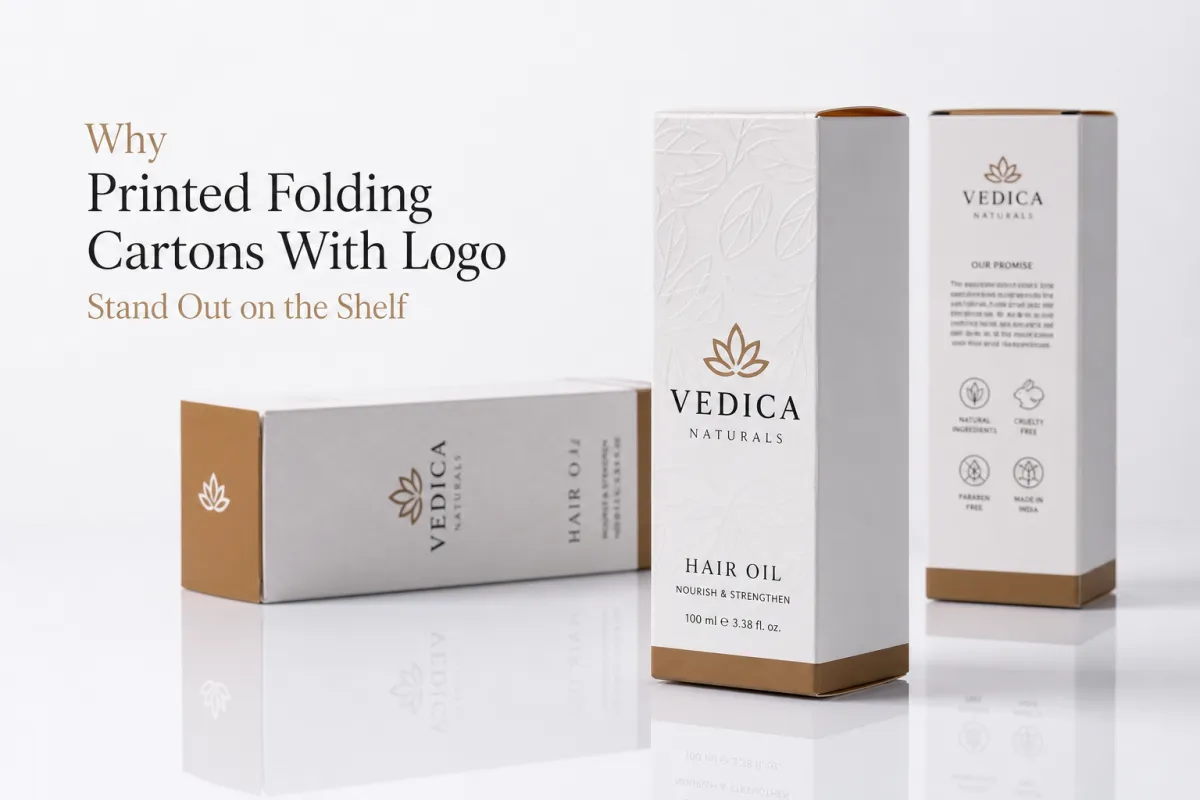
Retail shelves are crowded, and most shoppers only give each item a quick glance. That is where printed folding cartons with logo earn their place. A strong logo lockup, a clear product name, and disciplined color use can make a carton feel premium even when the product itself is straightforward. A modest product often looks more intentional the moment the carton tells a cleaner visual story.
Printed folding cartons are usually made from paperboard, so they can be cut, folded, and glued into a package that ships flat and builds quickly on the filling line. That practical detail matters more than it gets credit for. The box can be sized to the product, printed with retail graphics, and finished to suit a brand voice that feels clinical, natural, elegant, playful, or high-end. Printed folding cartons with logo turn a commodity-shaped item into something that looks like a deliberate brand choice instead of a hurried afterthought.
Recognition counts too. A customer who has seen your carton before can spot it faster because the logo placement, color palette, and layout stay familiar. The same effect helps in a stock room, a subscription box, or a trade show kit. A carton does not need to shout to work. It needs to stay clear, balanced, and consistent. The best printed folding cartons with logo support that consistency wherever the product appears.
Common uses include:
- Cosmetics and skincare, where presentation and color accuracy matter.
- Dietary supplements, where label copy and compliance text need room.
- Candles and home fragrance, where texture and finish can reinforce scent cues.
- Small electronics and accessories, where fit and protection are critical.
- Confectionery and specialty food, where freshness cues and shelf appeal matter.
- Promotional items, where branding may be the whole point of the package.
Many buyers put design first and structure second, then wonder why the carton looks fine in renderings but fails in the hand. I have seen that happen more than once. A beautiful carton that bulges, crushes, or leaves dead space around the product will disappoint fast, and usually for reasons that could have been caught early. Good printed folding cartons with logo begin with dimensions, closure style, and handling needs, then layer the graphics over that foundation. That is how the package ends up polished instead of improvised.
If you want to think in standards, that helps as well. FSC certification is worth asking about if responsibly sourced fiber matters to your brand, and shipping-related test methods from groups like ISTA can keep distribution stress in view. Those references do not replace packaging judgment, but they do keep the conversation grounded in real-world performance rather than guesswork.
How Printed Folding Cartons With Logo Are Made
Everything starts with structure. A dieline defines the flat size of the carton, the fold lines, the tuck flaps, the glue flap, and any extras such as windows, lock bottoms, or inserts. If the dieline is off, the rest of the job gets harder very quickly. That is why printed folding cartons with logo should never begin as a design-only exercise; they need a structural plan that matches the product size and the way the carton will be packed.
Artwork comes next. The logo needs a safe area, type has to stay clear of folds and trims, and the design should allow enough bleed so nothing gets clipped. Barcode placement deserves the same care. A scanner needs contrast and a clean quiet zone, and a barcode that crosses a fold or lands in a busy field can create unnecessary trouble. For printed folding cartons with logo, prepress discipline is not glamorous, but it protects both time and budget.
Printing method shapes the result. Digital printing is a strong fit for shorter runs and quicker setup, especially when a brand is testing a concept or ordering a modest quantity. Offset printing usually makes better sense when the order is larger and color consistency matters across a long run. It can produce crisp type and smoother solids, which is why many buyers still prefer it for retail cartons. Either way, the files need to be clean and the approval path needs to be clear if the final printed folding cartons with logo are going to match the original intent.
Board choice changes the look and feel more than many teams expect. SBS, or solid bleached sulfate, gives a bright presentation that works well for cosmetics and premium retail items. C1S, coated one side, can be useful when the front face needs stronger print impact and the inside face does not need to be shown. Kraft board creates a natural, earthy look, though bright color may read a little more muted on that surface. Many folding cartons are specified in the 14 pt to 24 pt range, depending on product weight and stiffness needs. Matching the board to the product is what makes printed folding cartons with logo feel sturdy without being overbuilt.
Once printed, the sheets move into converting: coating, die cutting, stripping, folding, gluing, and packing. That is the stage where the package stops being a flat sheet and becomes a usable box. Coatings may be aqueous, matte, gloss, or soft-touch, and each one changes the feel of the carton. Specialty effects such as foil stamping, embossing, debossing, spot UV, and window patching can be added, though every one of them adds cost and extra steps. If a carton already has a strong logo, too many effects can dilute the design rather than improve it. The best printed folding cartons with logo usually rely on one or two deliberate details, not a pile of competing finishes.
That conversion sequence is also where tolerances matter. A carton can look correct in a mockup and still need adjustment once paperboard thickness changes the fold behavior. Glue coverage has to be right, scores need to crack cleanly, and the structure needs to open and close without fighting the packer. Good printed folding cartons with logo come from a chain of small decisions that all move in the same direction: better fit, better print, better handling, fewer surprises.
Key Factors That Affect Cost and Pricing
Price usually comes down to a handful of variables, and the sooner those are clear, the easier it is to compare quotes with confidence. The main drivers for printed folding cartons with logo are size, board grade, print coverage, number of colors, finish selection, and whether the structure calls for unusual tooling. A standard straight-tuck carton in a common board will almost always cost less than a highly customized structure with foil, embossing, and a window.
Quantity has a direct effect on unit cost. Setup, plates, dies, and prepress work get spread across more units as the run grows, so larger orders often bring down the price per carton. That is why a carton that costs one amount at 1,000 pieces may land somewhere very different at 10,000 pieces. With printed folding cartons with logo, the economics shift quickly once setup charges are diluted across volume.
Minimum order quantity matters as well. Some printers can support lower MOQs through digital production, while offset and specialty finishing often need higher quantities to stay efficient. If you are still testing a product, ask about MOQ early instead of assuming the printer can scale to any number you want. A quote that looks attractive can turn expensive if the MOQ leaves you with more inventory than you can use. That is a common trap with printed folding cartons with logo.
Below is a practical comparison of common options and how they tend to affect pricing for printed folding cartons with logo:
| Option | Best For | Typical Cost Impact | Notes |
|---|---|---|---|
| 14 pt C1S, 4-color offset, aqueous coat | Standard retail cartons | Baseline | Good balance of print quality and value for many printed folding cartons with logo projects. |
| 18 pt SBS, 4-color offset, matte coat | Premium cosmetics or supplements | About 8% to 18% higher than baseline | Heavier board and a more refined feel make this a common choice for printed folding cartons with logo that need stronger shelf presence. |
| Kraft board, 1-2 color print | Natural, earthy branding | Can be similar to baseline or slightly lower | Ink reads more muted here; the look works best when the brand wants something raw or organic. |
| Soft-touch coating | Premium tactile feel | Adds about $0.04-$0.10 per unit at mid volumes | Feels refined, though it can show scuffing if the supply chain is rough. |
| Foil stamping or embossing | Accent logos and premium cues | Adds about $0.03-$0.12 per unit, depending on coverage | Use sparingly; a small logo hit usually looks better than a full-panel effect. |
| Window patching | Products that benefit from visibility | Adds tooling and conversion cost | Useful for candles, confectionery, and certain beauty items where the product itself helps sell the package. |
Quote details deserve a close read. Does the price include prepress? Are plates and dies separate? Is freight included? Are proofs printed or digital? Will you get a sample run or a structure mockup? With printed folding cartons with logo, the lowest quote is not always the best quote if it leaves out costs that will show up later.
Savings usually come from a few sensible choices. Reduce print coverage. Skip a few special effects. Pick a standard structure instead of a custom engineering job. Keep the board spec consistent across SKUs where possible. Those decisions often create better value than shaving pennies off the finish and ending up with a carton that feels thin. Good printed folding cartons with logo are cost-managed, not cost-starved.
Rushed timelines are expensive too. Artwork changes after proof approval, or a sizing issue discovered after tooling is already in motion, can drive costs up very fast. Rework is rarely cheap in packaging. Buyers who plan printed folding cartons with logo carefully tend to get better pricing and far fewer surprises.
Printed Folding Cartons With Logo Process and Timeline
The workflow usually starts with discovery and specification review. The printer needs product dimensions, weight, fill style, retail requirements, finish preferences, and the target quantity. Once those details are clear, they can recommend a structure and board grade rather than guessing. That early clarity is one of the best ways to keep printed folding cartons with logo on schedule.
Next comes dieline creation and artwork development. The structural file should show the correct panel order, bleed, score lines, and glue flap placement. From there, the design team can place the logo, copy, imagery, barcode, and any legal text. During prepress, the file is checked for color mode, font handling, image resolution, overprint issues, and alignment. It is careful work, and it prevents a lot of expensive mistakes in printed folding cartons with logo jobs.
Sampling is often worth the time. A plain structural sample can confirm fit, while a printed proof can show color, logo placement, and panel balance. If the product is visually sensitive or high value, a press proof may be the right call. That extra step usually costs less than discovering a problem after the run is finished. For printed folding cartons with logo, a good sample can settle arguments that would otherwise drag on until production day.
Typical turnaround depends on complexity, but this is a realistic range:
- Simple digital runs with ready artwork: often 5 to 10 business days after approval.
- Offset runs with standard finishing: often 10 to 15 business days after approval.
- Custom structures, foil, embossing, or window work: often 15 to 25 business days, depending on tooling and schedule.
Those timelines can move up or down based on materials, queue position, and freight distance. If the board is in stock and approvals move quickly, the job often moves faster. If the carton needs specialty stock or several proof rounds, the schedule stretches. That is why buyers should build a little breathing room into printed folding cartons with logo timelines, especially for launches and seasonal programs.
Shipping matters too. Cartons are light, but they still need protection from crush and moisture during transit. Humidity exposure can affect board behavior and glue performance, depending on the route. For tougher distribution environments, it makes sense to keep sourcing questions tied to FSC and pack-out confidence tied to shipping test logic from groups like ISTA. A carton moving through long distribution should be treated as both a branding item and a physical product.
Communication is the real timeline multiplier. Every revision, color change, or copy update can ripple through prepress and converting. The smoothest projects are the ones where the buyer, designer, and printer agree early on what is final. That discipline keeps printed folding cartons with logo moving in a straight line instead of bouncing between versions.
Step-by-Step Ordering for Printed Folding Cartons With Logo
Step 1 is to define the product, not the artwork. Measure the item carefully, including height, width, depth, closure behavior, and any insert or accessory that will ship with it. If the product has a fill weight, note that too. A carton needs to fit the product and the pack line, which is why the first conversation about printed folding cartons with logo should center on dimensions and handling instead of color choices.
Step 2 is to gather the brand materials. You will want the logo in vector format if possible, plus copy, claims, barcode data, legal text, and any mandatory symbols. If the brand uses specific color standards, share those as well. Pantone references, CMYK expectations, and finish preferences all help the printer quote accurately. The more complete the brief, the easier it is to price printed folding cartons with logo without guesswork.
Step 3 is to ask for a dieline and review it carefully. Look at the panel order, the tuck direction, the glue flap, and where the artwork breaks across folds. Check that the logo sits far enough from trim lines and that barcode placement leaves proper white space around it. A good dieline is boring in the best possible way. It gives the design room to work and keeps printed folding cartons with logo from turning into a correction exercise later.
Step 4 is proof review. This is where many people hurry, and that usually causes trouble. Inspect the proof at actual size if possible. Read every line of copy. Confirm ingredient or compliance text. Check logo placement, bleed, fold panels, and finish callouts. If the product is sensitive to color, ask how the proof was generated. The faster you catch a mismatch, the less likely it is to become a production issue on printed folding cartons with logo.
Step 5 is deciding whether you need a physical sample, a press proof, or both. For low-risk products, a digital proof may be enough. For expensive cosmetics, delicate finishes, or launch packaging, a physical sample often pays for itself quickly. A carton can look excellent on screen and still feel wrong in the hand. That is especially true with printed folding cartons with logo that rely on texture, soft-touch coatings, or narrow type.
Step 6 is final signoff. Once the proof is approved, lock the file and keep the approval notes clear. If there are special instructions, note them before production starts. That way the press team, converting team, and pack-out team are all working from the same instructions. Good printed folding cartons with logo jobs usually share one trait: nobody is guessing what the final version should be.
- Have dimensions ready before you request a quote.
- Keep logo files, copy, and barcodes organized in one folder.
- Review the dieline with structure and graphics in mind.
- Approve proofs only after checking every panel.
- Document your final choice so reorders stay consistent.
If you are working with a packaging supplier, this is the point where a spec-driven quote helps the most. The more closely your request describes the carton structure, board, finish, and quantity, the more useful the pricing will be. That is true for printed folding cartons with logo, and it holds for almost every packaging project I have seen handled well.
Common Mistakes With Printed Folding Cartons With Logo
The first mistake is choosing a carton that looks great in a mockup but fails in the real world. I have seen designs that sat beautifully on a screen and then bowed, crushed, or opened too easily once filled. That is a structural issue, not a graphic one. If the board is too light or the closure is wrong, no amount of artwork can rescue it. Good printed folding cartons with logo have to survive the filling line, the warehouse, and the shelf.
The second mistake is placing critical elements too close to folds and trims. Logos, legal copy, and barcodes all need safe space. When those items drift too close to an edge, small changes in cutting or scoring can make them look off-center or incomplete. That is especially painful on printed folding cartons with logo because the whole point is to look intentional and branded. A crooked logo on a luxury-style box is the kind of detail customers notice right away.
The third mistake is adding effects without a reason. Foil can be beautiful. Embossing can create depth. Spot UV can build contrast. Used together without a visual hierarchy, though, they can make the carton work against itself. More decoration does not always equal more value. Some of the strongest printed folding cartons with logo are restrained, with one sharp logo treatment and a clean layout doing the heavy lifting.
The fourth mistake is ignoring pack-out and warehouse realities. How many cartons fit in a case? How fast can the line erect them? Will the glue flap hold under humidity? Can the carton stack without scuffing? These are not side questions. They decide whether the packaging is practical at scale. A package that looks elegant but slows the line turns into a problem fast. That is why printed folding cartons with logo should always be judged as production objects, not just branding assets.
The fifth mistake is forgetting compliance text or directions until the end. Depending on the product category, you may need ingredients, warnings, usage instructions, or country-of-origin details. If the copy is added late, the layout may need to be rebuilt. That can cost time and money. A better habit is to lock the content before the artwork gets too far along. With printed folding cartons with logo, layout discipline prevents a lot of avoidable rework.
The sixth mistake is waiting too long to talk to the printer. Once a design has already been approved internally, people often assume production will be straightforward. Then the structure needs adjustment, the board stock is not ideal, or the finish choice adds too much cost. Early communication prevents those surprises. A practical printer can flag risks before they become expensive. That is one of the easiest ways to keep printed folding cartons with logo on track.
Expert Tips and Next Steps for Better Results
Choose finishes with purpose. Matte coatings can make a carton feel calmer and more refined. Gloss can push color and sharpen contrast. Soft-touch creates a premium tactile impression, though it should be used thoughtfully because it can scuff more easily under rough handling. For printed folding cartons with logo, finish is not just a style choice; it changes how the package feels in the hand and how it holds up through distribution.
Match the material to the product's behavior. A lightweight accessory may do fine in a standard board, while a heavier beauty item or bottle may need more stiffness or a tighter structure. If the product shifts inside the box, consider an insert or a different locking style. The carton should stabilize the item, not merely cover it. That is where printed folding cartons with logo become part of the product experience instead of a wrapper around it.
Place the logo where the shopper naturally looks first. That often means the upper third of the front panel, though not every product follows that rule. If the product name or benefit statement needs to lead, let the hierarchy do its job. A logo should support recognition, not compete with the rest of the information. Strong printed folding cartons with logo usually balance brand mark, product name, and key benefit in a clean visual rhythm.
Build a simple internal checklist before you request quotes:
- Product dimensions and weight.
- Board preference or required stiffness.
- Print method, color count, and finish.
- Quantity and likely reorder volume.
- Timeline and approval contact.
- Compliance copy and barcode data.
The checklist looks basic, yet it saves real time. When the buyer has the facts ready, the printer can return a spec-driven quote instead of a rough guess. In my experience, the best printed folding cartons with logo projects come from clear inputs and a willingness to keep the structure practical. That combination usually produces a better package and a calmer production schedule.
One final recommendation: ask for a test-fit when the product is sensitive to movement, crush, or surface scuffing. You do not need every project to turn into a science experiment, but it is wise to verify that the carton behaves the way you expect in the hand and on the shelf. If you are planning printed folding cartons with logo for a new launch, start with the product dimensions, gather the artwork, confirm the quantity, compare material options, and request a quote tied to the actual spec rather than a vague idea. That is the cleanest path to packaging that looks good, works hard, and stays predictable from approval through delivery.
What are printed folding cartons with logo used for?
They are used for retail products that need structure, branding, and shelf presentation in one package. Common examples include cosmetics, supplements, candles, small electronics, and specialty food items. They also ship flat before filling, which helps with storage, packing, and warehouse efficiency.
How do I choose the right material for printed folding cartons with logo?
Start with product weight, the amount of protection needed, and the look you want on shelf. Bright SBS board tends to give crisp graphics and a cleaner premium feel, while kraft board creates a more natural look. The printer should also confirm that the board works with your coating, finish, and folding style.
What affects the price of printed folding cartons with logo the most?
The biggest drivers are quantity, board grade, carton size, print coverage, and special finishes. Complex structures and rushed timelines can raise the price quickly. A detailed spec sheet usually leads to a more accurate quote and fewer surprises.
How long does the production process usually take?
Simple orders can move quickly if artwork is ready and approvals are fast. Custom structures, specialty finishes, and sampling usually add time to the schedule. The quickest way to avoid delays is to approve dielines and proofs promptly.
Can I order a small run of printed folding cartons with logo?
Yes, but the minimum order quantity depends on the printer, print method, and finishing requirements. Small runs are often easier with digital printing, while larger runs may benefit from offset economics. If you need a short run, ask about setup charges and unit cost before you commit.


