Buyer Fit Snapshot
| Best fit | Printed Kraft Bags with Handles projects where brand print, material claims, artwork control, MOQ, and repeat-order consistency need to be specified before quoting. |
|---|---|
| Quote inputs | Share finished size, material target, print colors, finish, packing count, annual reorder estimate, ship-to region, and any compliance wording. |
| Proofing check | Approve dieline scale, logo placement, barcode or warning zones, color tolerance, closure strength, and carton packing before bulk production. |
| Main risk | Vague material claims, crowded artwork, missing packing details, or unclear freight terms can make a low unit price expensive after revisions. |
Fast answer: Printed Kraft Bags with Handles: Film, Print, MOQ, and Carton Packing should be specified like a repeatable production item. The safest quote records material, print method, finish, artwork proof, packing count, and reorder notes in one written spec.
Production checks before approval
Compare the actual filled-product size with the drawing, then confirm tolerance on folds, seals, hang holes, label areas, and retail display edges. Reserve space for logos, QR codes, warning copy, and material claims before decorative graphics fill the panel.
Quote comparison points
Review material grade, print process, finish, sampling route, tooling charges, carton quantity, and freight assumptions side by side. A quote is only useful when the supplier can repeat the same color, closure quality, and packing count on the next order.
Printed Kraft Bags with handles do more than move a purchase from counter to car. They work like packaging, signage, and a small receipt for the brand all at once. That sounds modest until you count the exposure. A customer carries the bag past coworkers, through a lobby, into public transport, or straight into a photo they were never planning to take. One bag can keep speaking long after the sale is done.
That is why Printed Kraft Bags with handles keep showing up in retail, food service, events, and gifting. The structure is simple enough: kraft paper body, handle attachment, and print on one or both sides. The buying decision is not simple, though. Paper weight, handle style, print method, artwork coverage, order quantity, and lead time all tug in different directions. Miss one and the rest of the spec starts wobbling.
Buyers tend to like kraft because it feels natural without looking cheap. They like handles because they make the handoff easier. They like printed kraft bags with handles because the format usually feels more intentional than a flimsy plastic sack or a plain carton. The catch is that the same bag can look premium, plain, or weak depending on the stock, the ink, and the load it has to carry. That is the part people underestimate. Quite a lot, actually.
Think of printed kraft bags with handles as a compact asset with a surprisingly public life. It sits where customer experience, cost control, and brand presentation overlap. The sections that follow separate those pieces, then put them back together so the next quote request is sharper and the spec sheet is harder to fool.
Printed Kraft Bags with Handles: What They Are and Why They Sell
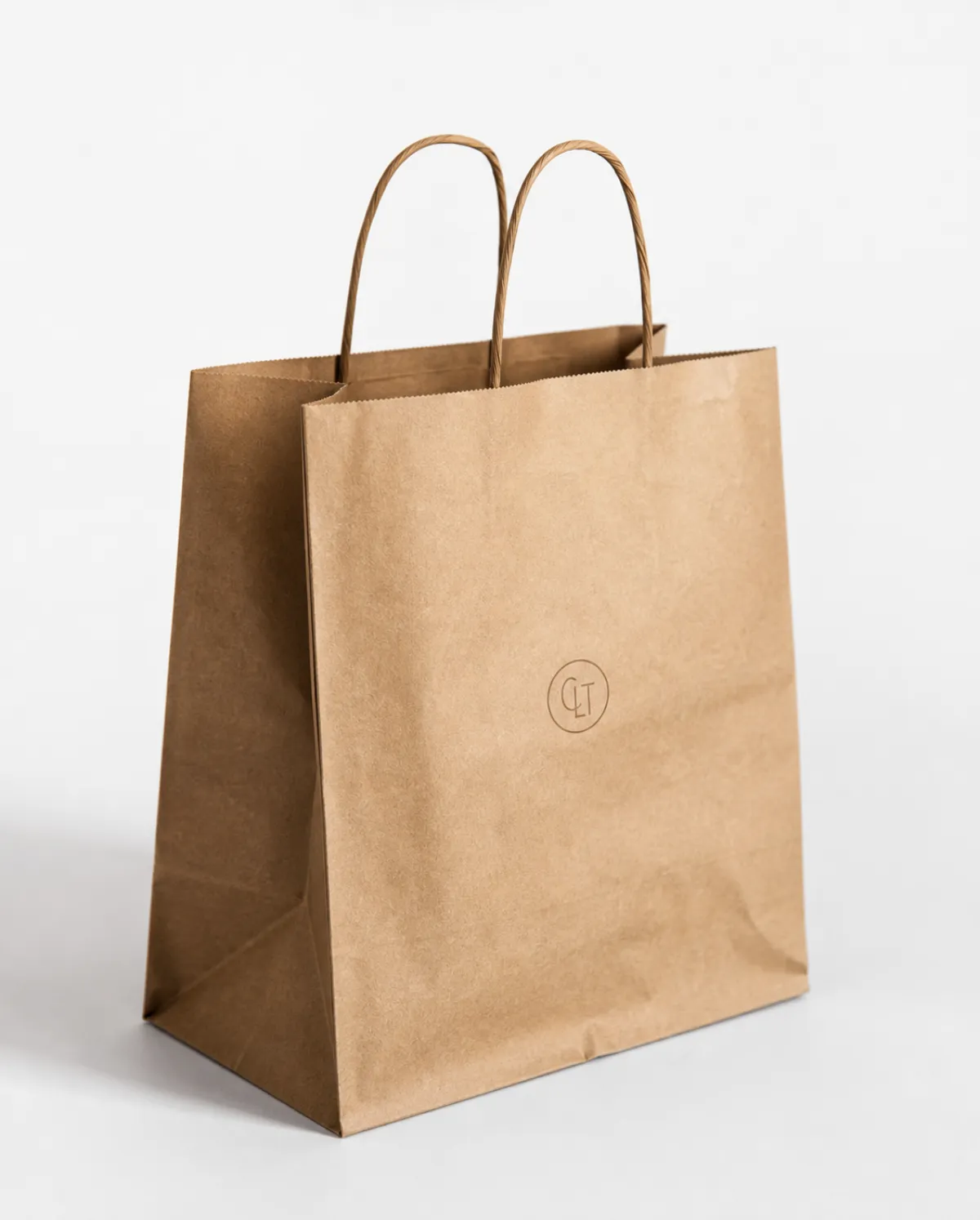
Printed kraft bags with handles are paper Carry Bags Made from kraft stock, usually brown or white, with handles that may be twisted, rope-based, flat, punched, or reinforced depending on the build. Kraft is chosen for its strength-to-weight ratio, its natural look, and its compatibility with branding. Many buyers land on this format because it hits a useful middle ground: practical enough for daily use, visible enough to carry a logo, campaign message, or seasonal design without feeling forced.
There is a behavior piece that gets missed in supplier conversations. No one buys a bag because they are emotionally attached to the bag. They buy it because the bag removes friction. It carries the purchase home, makes a gift feel finished, and keeps a customer’s hands free. After that, the bag keeps working. A shopper leaving with printed kraft bags with handles gives the brand another visible moment in public, and that often beats the raw paper cost by a mile.
Operators keep coming back to the format because it moves across categories without much drama. Boutique retail, bakeries, gift shops, trade shows, farmers markets, and hospitality counters all use the same basic packaging language. Seasonal promotions fit too. So do limited drops and private-label programs. The reason is simple: printed kraft bags with handles can change tone without changing the whole packaging system. Swap the artwork, change the size, adjust the handle, and the core format still holds.
There is also a visual middle ground here that matters. A glossy shopping bag can look too polished for some brands. A plain sack can look unfinished. Printed kraft bags with handles sit between those poles. Depending on the print treatment, they can read premium, eco-aware, utilitarian, or gift-ready. That flexibility explains why they sell across categories that would otherwise need very different packaging. It is a bit like a blazer that can pass in a boardroom and at dinner, if tailored properly.
A bag carried in public is not just packaging. It is a moving impression, and printed kraft bags with handles are one of the few formats that can carry product, message, and mood at the same time.
For buyers focused on sustainability claims, kraft gives the story a credible starting point, but the details still matter. Recycled content, FSC-certified paper, and ink selection all shape the final profile. So does the end-of-life path. A bag that looks recyclable on a spec sheet may be less straightforward in practice if it includes heavy coatings, specialty lamination, or non-paper handle components. The best procurement teams talk about performance and disposal in the same conversation instead of treating them like separate boxes to tick.
For a neutral benchmark on sustainable fiber sourcing, the FSC site is useful: fsc.org. If you are comparing transport, reuse, and waste claims, the EPA also has relevant packaging guidance here: epa.gov. Neither site tells you which bag to buy. Both help keep the discussion tied to standards instead of slogans.
How Printed Kraft Bags with Handles Are Made: Process and Timeline
The production path for printed kraft bags with handles usually starts with paper selection. Kraft stock comes in different weights, finishes, and colors, and that early choice shapes everything that follows. Once the paper is approved, the converter builds the dieline, the print layout, and the handle specification. The job then moves through printing, cutting, folding, gluing, handle attachment, inspection, and packing. Each step looks ordinary on paper. Each step can also stall if the file setup is sloppy or the spec is not clear.
The print method matters more than many buyers expect. Digital printing works well for short runs, multiple SKUs, and artwork that may still change. Flexographic printing tends to make more sense when volume is higher and unit economics matter most. Offset printing can produce strong color and detail, especially for larger runs with tighter brand control. If your order for printed kraft bags with handles includes heavy ink coverage or several colors, the chosen method can influence visual consistency and turnaround more than the bag structure itself.
Production does not begin the moment artwork is sent. It begins when the supplier gets a clean file set and a clear spec. That usually means dieline confirmation, bleed setup, spot color definitions, and proof approval. Sampling can add time. Revisions after proofing can add more. For standard jobs, the practical lead time often falls in the 12 to 20 business day range after approval, though the range shifts with complexity and factory load. If the factory is slammed, even a clean order can slide a few days. That is just how the line moves.
Printed kraft bags with handles also spend more time drying, curing, or cooling than many buyers expect. Heavy coverage and specialty inks extend that window. Handle attachment can create another bottleneck if the style is reinforced or mechanically installed rather than simply glued. A straightforward tote-style bag and a decorative retail bag may share a silhouette, but the process steps are not the same. Those extra steps affect quality control, pack-out speed, and shipping readiness.
If you want to think like a production planner, break the workflow into checkpoints:
- Artwork submission - files received in the right format, with the correct dieline and color references.
- Prepress review - font sizes, safe zones, and bleed checked before release.
- Proof approval - the last chance to catch spelling, sizing, and placement mistakes.
- Production - printing, converting, handle attachment, and bonding.
- Inspection - visual checks for color, registration, glue quality, and structural integrity.
- Packing and shipping - cartons, palletizing, and freight planning.
The delays usually show up in familiar places. Complex artwork slows prepress. Pantone matching adds setup time. Premium handles need more careful attachment. A late decision to add a special finish can push printed kraft bags with handles into a different production window entirely. That is not a sign that the supplier is moving slowly. It is a sign that several tradeoffs are being managed at once.
For teams comparing shipping durability and transit performance, a useful external reference is the International Safe Transit Association at ista.org. Their testing principles are not bag-specific in every case, but the logic carries over cleanly: if packaging is going to be stacked, moved, or handled repeatedly, the distribution path deserves the same attention as the spec sheet.
Cost and Pricing for Printed Kraft Bags with Handles
Pricing for printed kraft bags with handles comes from several variables at once. Bag size is one. Paper weight is one. After that, the list gets more specific: handle type, number of print colors, coverage area, coating or finishing, carton configuration, and total quantity all move the price. A small logo on one panel is a very different job from a full-wrap print with strong color and a custom rope handle.
Minimum order quantity changes the math quickly. Short runs usually carry a higher unit cost because setup expenses are spread across fewer bags. That does not make smaller orders bad. It means the buyer should understand the tradeoff. If you are testing a new store concept, a seasonal campaign, or a menu launch, a smaller run of printed kraft bags with handles may be the right choice even if the per-unit price looks less attractive on paper.
There are hidden costs that only appear near shipment. Plates, dies, sample fees, freight, rush charges, storage, customs handling, and reprint costs from artwork mistakes can all change the total. A quote that looks cheap at first can become expensive once freight and delays are added. That is where many packaging budgets go sideways. Base unit price alone is a thin way to judge a finished order.
Here is a practical way to compare printed kraft bags with handles across different production methods:
| Option | Typical Best Fit | Approximate Unit Cost | Typical Lead Time | Notes |
|---|---|---|---|---|
| Digital print | Short runs, artwork changes, multiple versions | $0.35-$0.85 | Fast to moderate | Good for flexibility; setup is lighter, but unit cost stays higher at scale. |
| Flexo print | Medium to large runs with repeat artwork | $0.18-$0.42 | Moderate | Efficient on volume; color matching and plate setup matter. |
| Offset print | Premium graphics, larger campaigns | $0.22-$0.55 | Moderate to longer | Excellent detail; can cost more if finishing or coating is added. |
| Custom handle upgrade | Premium retail or gifting | +$0.03-$0.18 | May add time | Comfort and appearance improve, but build complexity rises. |
Those numbers are broad ranges, not promises. Even so, the pattern is clear: the economics improve as quantity rises, then storage and inventory risk start pushing back. A buyer ordering printed kraft bags with handles for a seasonal launch has a different problem than a buyer stocking a year-round retail program. One is balancing launch timing. The other is balancing warehouse space and reorder cadence.
The landed-cost mindset helps here. Compare suppliers on the same basis: bag price, freight, handling, taxes, and any extra charges for samples or rush work. Ask for quotes at multiple quantities. A quote for 1,000 units, 3,000 units, and 10,000 units often reveals a pricing cliff where the per-unit rate drops hard. That cliff shows where the economics improve, and it also shows how much inventory you are taking on to get there.
There is a subtler cost factor too: brand risk. If the bag is too weak, too small, or too busy, it can create a poor customer experience. That cost is harder to line-item, but it is real. Printed kraft bags with handles are often inexpensive enough that teams stare at the unit price and ignore what a bag failure does to the customer’s impression. A broken handle in a parking lot costs more than the pennies saved on paper weight.
Key Factors That Affect Quality, Strength, and Branding
Printed kraft bags with handles are only as strong as the spec behind them. Paper weight and construction come first. A lighter sheet can work well for apparel, stationery, or light gifting. A heavier item may need thicker stock, a wider gusset, reinforced folds, or a stronger handle attachment. Underspec the base structure and the bag can bow, split, or fail at the top seam before the branding has any chance to matter.
Handle style changes the whole feel of the bag. Twisted paper handles are common, cost-conscious, and easy to recycle with the right paper stream. Flat handles feel practical and often work well for carryout. Rope handles read more premium, though they can raise cost and complicate assembly. Die-cut handles create a cleaner silhouette but can be less forgiving under load unless reinforcement is added. For printed kraft bags with handles, the best handle is not the prettiest one on the table. It is the one that matches the product weight, the customer’s grip, and the brand position.
Artwork behavior on kraft stock deserves attention. Kraft has a natural tone, which means pale colors can mute and thin type can lose clarity. Dark inks usually perform better. High-contrast logos read faster. Fine lines, tiny legal copy, and delicate gradients may look excellent on a monitor and disappointing on the finished bag. If your brand system depends on soft pastels, the layout may need to shift or the bag may need a white base to keep the design legible.
The following checklist is worth reviewing before you approve printed kraft bags with handles:
- Weight capacity - Does the bag match the actual fill weight, not the imagined one?
- Handle attachment - Is the handle glued, stitched, looped, or die-cut, and what load does it realistically support?
- Print contrast - Will the logo read cleanly against brown kraft, or does it need more contrast?
- Gusset size - Is there enough room for the product without forcing the sides apart?
- Brand alignment - Does the finish feel premium, practical, or eco-focused in a way that matches the brand?
Sustainability and compliance matter here too. A paper bag can include recycled content, FSC-certified fiber, and inks chosen for lower environmental impact. Food-contact use can trigger additional rules depending on jurisdiction and product type. If the bag will be used for food service, the supplier should be able to explain the ink system, coating, and any barrier layer clearly. Those details are not decoration. They decide whether the bag can be sold, stored, or used safely.
Strong branding usually comes from restraint. Not every inch needs to be filled. A clean logo on good kraft stock can outperform a crowded layout that tries to say too much. Printed kraft bags with handles work best when the print, the structure, and the customer use case all move in the same direction. The bag should feel like part of the product line, not a generic container wearing a logo.
Step-by-Step Ordering Process, Lead Time, and Approvals
The cleanest way to order printed kraft bags with handles is to begin with use case, not aesthetics. What will the bag carry? How heavy is it? How often will it be used? Will it be handed out at a retail counter, packed for food service, or distributed at an event? Those questions sound basic because they are basic, and they decide the dimensions, the handle choice, and the reinforcement level more reliably than a mood board does.
Size the bag around the product next. A bag that looks elegant on screen can feel awkward in the hand if the gusset is too narrow or the height is wrong. Bulky products need clearance. Tall, light products need careful handle placement. For printed kraft bags with handles, dimensions should follow the contents first and the design second. That order prevents a surprising amount of waste.
Artwork setup is where many lead-time problems start. Use the correct dieline. Build bleed. Keep important copy away from folds and seams. Make sure fonts are outlined or embedded. If the supplier asks for Pantone references, provide them cleanly. If you are printing on brown kraft, approve the artwork against a kraft simulation rather than a pure-white mockup. The difference can be dramatic, and it is easier to correct in prepress than in production.
A practical approval sequence looks like this:
- Spec confirmation - size, paper, handle, and print coverage are locked.
- Artwork submission - files arrive in the correct format.
- Prepress proof - layout, color, and copy are checked.
- Revision round - only if needed, and only before release.
- Sampling - useful for heavier items, premium finishes, or first-time orders.
- Production release - the clock starts once approval is final.
That is the point many teams miss: lead time usually starts after final approval, not when the first quote lands in your inbox. If you ask for changes after proofing, the timeline changes too. For printed kraft bags with handles, a clean approval process can save days. A messy one can turn a simple order into a chain of avoidable delays.
Sampling is not always necessary, but it is worth considering when the bag carries high-value goods, greasy items, or anything with unusual balance. A sample can reveal handle feel, board stiffness, and print clarity in a way a PDF never will. It can also show whether the finished bag sits comfortably in the customer’s hand. That detail is tiny until it is not. Once a customer struggles with the bag, the packaging starts to feel like a problem rather than support.
Receiving and reorder planning deserve space in the process too. Once the shipment arrives, inspect a few cartons for count accuracy, handle attachment, print registration, and shipping damage. Build a reorder calendar from actual burn rate, not optimism. If a promotion is coming, count backward from the launch date and add buffer time. Printed kraft bags with handles are not hard to reorder if the spec stays stable, but a last-minute rush order usually costs more and leaves less room for quality control.
Common Mistakes When Ordering Printed Kraft Bags with Handles
One of the most common mistakes with printed kraft bags with handles is sizing by appearance instead of product dimensions. A bag can look generous in a sample photo and still fail because the item inside is too wide, too tall, or too rigid. The result is a bag that bulges, tears at the fold, or forces the handle angle into an awkward position. That is not a print issue. It is a sizing issue, and it is usually avoidable.
Another frequent error is underestimating weight. A bag intended for light retail items may be fine with a standard handle and medium paper weight, but once the fill weight rises, the stress points move fast. The handle attachment, top fold, and side seam each take more strain. If the bag is expected to carry bottles, boxed goods, or multiple packed items, the spec should be tested with the actual load. With printed kraft bags with handles, the line between adequate and fragile is often a small change in construction, and that small change matters a lot.
Design can fail quietly too. Thin lines, low-contrast logos, tiny text, and subtle gradients often disappear on kraft stock. The more the artwork depends on delicate detail, the more likely it is to lose clarity after printing. That is especially true on brown kraft. A brand can still look polished on kraft, but the layout has to respect the material instead of fighting it.
Proofing mistakes are another budget drain. Missed bleeds, copy too close to a seam, unapproved color expectations, and incorrect art placement can all create rework. In some cases, the error only appears once the first production sample is made. That is why the proof stage should be treated as a real quality gate. For printed kraft bags with handles, a one-minute proof review can prevent a week-long delay.
Storage and transit are easy to overlook, yet they matter. Kraft paper can be sensitive to moisture and crushing. If cartons sit in a damp corner or get stacked badly in transit, the bags can lose shape or show handling marks before they reach the customer. A well-made bag can still disappoint if it is stored carelessly. Some buyers ask not only about bag strength, but also about carton count, pallet wrapping, and shipping method.
It helps to think of common mistakes in three buckets:
- Spec mistakes - wrong size, wrong paper weight, wrong handle style.
- Artwork mistakes - weak contrast, bad file setup, rushed proofing.
- Operational mistakes - poor storage, unrealistic timelines, weak reorder planning.
Once you see those buckets clearly, ordering printed kraft bags with handles becomes less mysterious. Most failures are not exotic. They come from skipping one ordinary step, then expecting the bag to compensate. Packaging rarely compensates. It reflects the quality of the decisions behind it.
Expert Tips and Next Steps for a Smarter Order
The fastest way to make a stronger buying decision is to request three quotes for printed kraft bags with handles: an economy spec, a balanced spec, and a premium spec. That comparison exposes the tradeoffs immediately. You can see what a lighter board does to price, what a stronger handle does to comfort, and what a cleaner print setup does to the final presentation. Without that comparison, teams often argue from preference instead of evidence.
Ask for a sample or a short test run if the bag will carry greasy, heavy, or high-value items. Real use reveals problems that proofs hide. A bag that looks excellent in photos may feel weak in hand. A handle that appears fine on paper may dig into fingers once the load is real. Printed kraft bags with handles should be judged the way customers will judge them: by feel, by balance, and by the confidence they create during carryout.
It also helps to create a simple receiving checklist. Keep it blunt and practical:
- Count - did the shipment match the order quantity?
- Print accuracy - does the logo, color, and copy match approval?
- Handle attachment - are the handles centered and secure?
- Color consistency - are the cartons consistent enough across the run?
- Carton condition - were the bags protected during transit?
After launch, track a few metrics instead of relying on vague feedback. Customer comments help, but so does a rough count of handle issues, return comments, bag reuse, and how often staff choose the bag for premium orders. Those signals tell you whether the spec is earning its keep. A bag that gets reused or complimented is doing more than carrying product; it is reinforcing the brand.
For teams that want a practical packaging standard, one more outside reference is worth using: the ISTA site for transit logic and the FSC site for fiber sourcing. Neither replaces supplier testing, but both help shape sharper questions. If a vendor cannot explain how printed kraft bags with handles perform in storage, in transit, and in the customer’s hand, that is a reason to slow down and ask for better data.
My honest view is that the best orders are rarely the cheapest or the flashiest. They are the ones that fit the actual use case with enough margin for error. A well-sized bag with the right handle and a clean print can beat a more expensive version built on assumptions. That is the value of treating printed kraft bags with handles as a packaging decision, not just a branding one.
If you are ready to move, gather four things before requesting quotes: the product size, the fill weight, the artwork files, and the target quantity. Those four inputs sharpen the quote more than any vague request for "something eco-friendly." Then ask suppliers to compare options against the real use case. That is the shortest path to printed kraft bags with handles that look good, carry well, and arrive on time.
Start there, and keep the spec tied to the product rather than the pitch. That is the practical takeaway: define the load, choose the handle for the hand, and approve the artwork on kraft, not in theory. Do that, and the bag is far more likely to do its job quietly, which is exactly what good packaging tends to do.
What is the minimum order quantity for printed kraft bags with handles?
MOQ depends on size, print method, color count, and handle type, so ask for breakpoints at 500, 1,000, and 5,000 units. Shorter runs of printed kraft bags with handles usually cost more per bag because setup is spread across fewer units. If you are testing a new design, compare MOQ against storage space and how quickly you expect to reorder.
How much do printed kraft bags with handles usually cost?
Price is driven by dimensions, paper weight, handle construction, ink coverage, finishing, and total quantity. For printed kraft bags with handles, the unit cost usually drops as volume rises, but freight and storage can change the real total. Ask for a landed-cost quote so you can compare suppliers on the same basis.
How long is the lead time for printed kraft bags with handles?
Lead time usually includes proofing, approvals, production, drying or curing, and shipping. Simple jobs move faster; custom colors, premium handles, and artwork revisions add time. Build in buffer time before launches, promotions, or seasonal spikes, especially if your printed kraft bags with handles need a sample approval first.
Are printed kraft bags with handles strong enough for heavier products?
They can be, but the bag has to match the weight, shape, and balance of the product inside. Paper weight, gusset size, and handle reinforcement matter more than decoration. Test the final printed kraft bags with handles with the actual product before placing a full order.
What artwork files work best for printed kraft bags with handles?
Vector files are ideal for logos and line art because they stay sharp at bag size. Include the correct dieline, bleed, and safe zone so print does not fall into folds or seams. For kraft stock, high-contrast artwork usually reads better than fine detail or pale colors, especially on printed kraft bags with handles.


