Buyer Fit Snapshot
| Best fit | Printed Kraft Shopping Bags projects where brand print, material claims, artwork control, MOQ, and repeat-order consistency need to be specified before quoting. |
|---|---|
| Quote inputs | Share finished size, material target, print colors, finish, packing count, annual reorder estimate, ship-to region, and any compliance wording. |
| Proofing check | Approve dieline scale, logo placement, barcode or warning zones, color tolerance, closure strength, and carton packing before bulk production. |
| Main risk | Vague material claims, crowded artwork, missing packing details, or unclear freight terms can make a low unit price expensive after revisions. |
Fast answer: Printed Kraft Shopping Bags: Design, Cost, and Process should be specified like a repeatable production item. The safest quote records material, print method, finish, artwork proof, packing count, and reorder notes in one written spec.
Production checks before approval
Compare the actual filled-product size with the drawing, then confirm tolerance on folds, seals, hang holes, label areas, and retail display edges. Reserve space for logos, QR codes, warning copy, and material claims before decorative graphics fill the panel.
Quote comparison points
Review material grade, print process, finish, sampling route, tooling charges, carton quantity, and freight assumptions side by side. A quote is only useful when the supplier can repeat the same color, closure quality, and packing count on the next order.
Printed kraft shopping bags can look more expensive than a bag covered in glossy graphics, foil, and a slogan nobody remembers by the time they reach the parking lot. That quiet contrast is part of the appeal: a natural kraft surface, a clean logo, and a bag shape that feels deliberate often do more for a brand than a louder design that strains for attention.
From a packaging buyer's point of view, printed kraft shopping bags sit in a very practical middle ground. They are sturdy enough for retail use, flexible enough for boutiques, cafes, and events, and simple enough to keep costs under control. Pick the right paper weight, handle style, and print method, and you get packaging that carries product weight, supports the brand image, and still leaves room in the margin.
The strongest shopping bag is usually not the one with the most decoration. It is the one that arrives on time, survives handling, prints clearly, and fits the product without wasting paper. That is the real value of printed kraft shopping bags, and it is where careful buyers usually get the best result.
Printed Kraft Shopping Bags: Why They Stand Out Fast
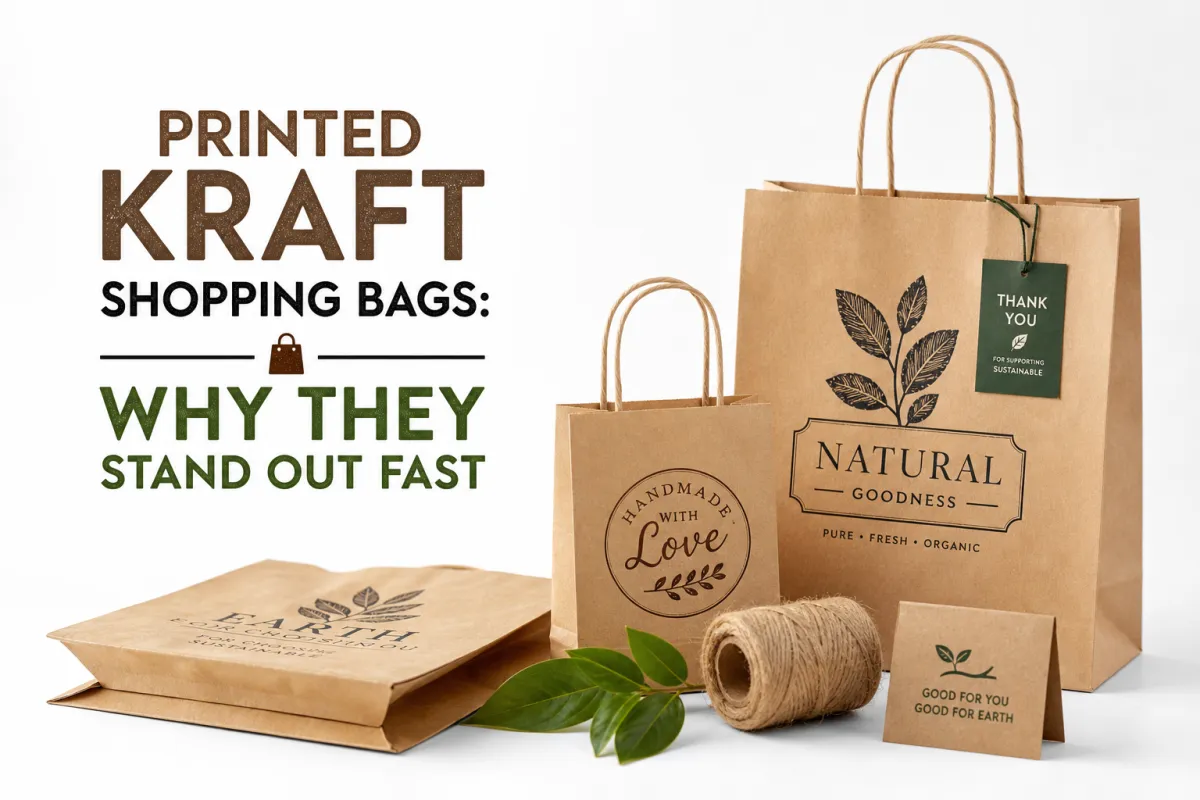
Printed kraft shopping bags are paper carrier bags made from kraft paper and customized with a brand logo, pattern, message, or full visual identity. The stock is usually brown kraft, which keeps the natural fiber look, or white-bleached kraft, which gives the printer a brighter base and a slightly cleaner color appearance. Both versions can work well, but they do not send the same signal.
Brown kraft feels grounded and handmade. White kraft looks sharper and more polished. The better choice depends on the brand story. A bakery, candle label, indie boutique, or farm shop often gets more mileage from natural brown stock. A cosmetics counter or gift retailer may prefer white kraft if the logo needs higher contrast and the artwork uses fine details.
Printed kraft shopping bags stand out because they look intentional without looking overworked. A single-color logo centered well on a properly sized bag often reads as more premium than a crowded layout with five fonts and every possible sales message fighting for space. That is not design snobbery. It is basic visual discipline.
They also fit a wide range of real use cases. Retail bags need to hold product, leave the store with the customer, and still look presentable at the office, at home, or on the street. Event bags need quick recognition and enough structure to carry samples, catalogs, or giveaways. Cafe bags need to survive pastries, bottled drinks, or retail add-ons. Gift packaging needs to feel thoughtful without inflating cost. Printed kraft shopping bags handle those jobs well if the spec matches the product.
Budget control is another reason buyers keep coming back to them. Unlike specialty rigid boxes or elaborate laminated pouches, printed kraft shopping bags scale nicely. A simple one- or two-color design on standard kraft stock usually keeps setup straightforward. That helps when you want branded packaging but still need a unit cost that makes sense for a retail margin.
There is also a perception advantage. Kraft paper sends a quiet sustainability signal, even before anyone talks about recycled content or FSC-certified sourcing. That does not mean every kraft bag is automatically eco-friendly. It does mean the material gives you a useful starting point. Keep the construction simple and avoid unnecessary coatings, and printed kraft shopping bags can support a cleaner packaging message without turning the whole thing into a marketing lecture.
Good packaging does not need to shout. In most retail categories, a clean bag with the right proportions and one strong brand mark does more work than a crowded design with too much ink and too much ego.
That is why printed kraft shopping bags keep turning up in boutiques, gift shops, bookstores, cafes, and seasonal pop-ups. They are familiar, practical, and easy to brand well. The real trick is keeping the bag from looking generic. The line between "just a paper bag" and "a branded package" usually comes down to detail: size, color contrast, handle choice, and print restraint.
How Printed Kraft Shopping Bags Are Printed and Built
A shopping bag is not just a rectangle with handles. The structure matters, and it changes both performance and appearance. Printed kraft shopping bags usually begin with kraft paper in a specific thickness, then move through converting steps that add gussets, bottom reinforcement, handles, and finally the printed artwork. If any one of those parts is underspecified, the bag can look fine in a mockup and disappoint in real use.
Paper grade and wall construction
Paper weight is one of the first decisions to make. Lighter bags may use roughly 100 to 120 gsm paper for low-load retail items or events. More common retail runs move into the 120 to 200 gsm range, depending on the bag size and what it has to carry. If the products are dense, sharp-edged, or especially valuable, a stronger build is usually worth the small cost increase.
The paper itself can be single-ply or multi-ply in certain constructions. Multi-ply options are less common in standard shopping bags, but reinforcement at the base and handles matters a great deal. A reinforced bottom board and properly anchored handles usually do more for real-world strength than a fancy print effect ever will. In plain terms, the bag should be designed from the inside out, not the other way around.
Handle styles that change the feel
Twisted paper handles are common because they are cost-effective and friendly to recycling streams. Flat paper handles are a good fit for lighter bags and shorter runs. Rope handles feel more premium, but they also change the cost and the visual language of the bag. Die-cut handles can look sleek, but they work best when the bag weight and intended use actually support that choice.
Handle style is not only a branding decision. It affects comfort, load distribution, and customer perception. A bag that cuts into the hand feels cheap even if the print looks beautiful. Buyers usually notice this faster than they notice the ink coverage, which is kinda annoying when you are the one trying to approve a proof on a deadline.
Printing methods in plain English
Flexographic printing is common for longer runs and simpler designs. It works well when the art uses one to three colors, bold shapes, and predictable placement. The setup cost is real, but once you spread it across volume, the unit economics improve. It is a sensible option for printed kraft shopping bags that need consistency and repeatability.
Offset preprint can make sense for larger runs where detail and color accuracy matter more. The artwork is printed on paper before converting, which can help when the design needs better resolution or more precise color handling. This is not always the lowest-cost route, but it can produce a sharper result for brand-sensitive work.
Screen printing is useful for bold graphics, heavier ink deposits, or smaller production runs. It is especially forgiving for simple logos. The tradeoff is that fine detail and complex gradients are usually not the point of this method. If the brand identity relies on a crisp, high-detail logo, screen printing is not always the first choice.
Digital printing is usually the most practical route for short runs, pilots, or frequent artwork changes. It reduces setup friction, which is helpful when you are testing a new concept or launching a seasonal line. The price per bag can be higher, but for 100 to 500 pieces, the flexibility can outweigh the cost.
Surface finish and appearance
Printed kraft shopping bags can be left uncoated for a raw, tactile finish, or they can be treated with a coating or finish that changes the sheen and print sharpness. Matte surfaces feel understated. Gloss finishes reflect more light and can make colors pop, but they also shift the visual tone away from the natural kraft look.
Recyclability matters here. A basic uncoated kraft bag with water-based inks is usually easier to position as a recyclable paper product than a heavily laminated or foil-stamped version. That does not mean coatings are automatically wrong. It means the buyer should ask whether the finish is necessary for the use case, because extra layers often add cost and complicate end-of-life handling.
For help thinking about fiber sourcing and certification, a useful reference is the Forest Stewardship Council at fsc.org. If the brand wants to understand how packaging fits into recycling behavior and waste reduction, the U.S. EPA has solid guidance at epa.gov/recycle.
In real production, the best printed kraft shopping bags usually combine a sensible structure with a restrained design. Bold typography, one or two confident colors, and a good handle choice go a long way. Most brands do not need more than that.
Printed Kraft Shopping Bags Cost, MOQ, and Pricing
Pricing for printed kraft shopping bags is driven by a handful of variables that matter more than most first-time buyers expect. Size, paper thickness, handle type, print colors, finish, and order quantity all affect the final number. If one supplier quotes a lower price but quietly uses thinner paper or excludes freight, that quote is not really cheaper. It is just incomplete.
The order quantity changes the economics quickly. Setup costs for plates, dies, artwork prep, and sampling are spread across the run, so a small order will almost always look expensive on a per-unit basis. A larger order can bring the unit cost down sharply. That is why buyers often get sticker shock at low volumes and relief at 5,000 pieces or more.
Here is a practical way to think about it. For a simple custom bag run, a small quantity might land in the range of $0.55 to $1.20 per unit, depending on size, color count, and handle choice. At larger quantities, the same style might move into the $0.18 to $0.40 range. Those are working ranges, not promises. Complex printing, premium handles, or special finishes can push the number higher fast.
MOQ also matters. Some factories can support lower minimums if the design is simple or if digital printing is available. Others want a higher baseline because the setup cost does not make sense below a certain run size. If you are testing a new product line, it is smarter to ask for a pilot run than to pretend a 10,000-piece order is the only serious option.
| Bag Option | Best For | Typical Unit Cost Range | Common MOQ | Notes |
|---|---|---|---|---|
| One-color brown kraft with twisted handles | Retail, cafes, basic branded takeaway | $0.18-$0.35 at higher volume | 500-1,000+ | Usually the cleanest cost-to-performance balance |
| Two-color printed kraft shopping bags with flat handles | Boutiques, gift shops, seasonal promotions | $0.25-$0.50 at higher volume | 1,000+ | Good for brand color separation and a sharper look |
| White kraft with detailed artwork | Cosmetics, premium retail, events | $0.30-$0.65 at higher volume | 1,000-3,000+ | Better for color fidelity, usually costs more than brown stock |
| Short-run digital printed kraft shopping bags | Launches, test runs, niche collections | $0.60-$1.50 | 100-500 | Flexible, but unit cost is higher |
Those numbers are useful only if the quote is actually comparable. Ask for the same dimensions, same paper weight, same handle, same print method, and same shipping terms from each supplier. Otherwise you are comparing a premium bag to a stripped-down one and pretending the math is meaningful. It is not.
There are hidden costs too. Tooling and plates are common on print runs that use traditional methods. Sampling and prototypes may be charged separately. Freight can change the whole decision if the bags are bulky. Rush fees can show up if the deadline is unrealistic. None of that is unusual. It is the part of sourcing that gets ignored until the final invoice lands.
For buyers of printed kraft shopping bags, the best move is to request an itemized quote. Make sure it separates bag cost, setup cost, sample cost, freight, and any special packing. That is the only way to see where the money goes and where the real tradeoffs sit.
Printed Kraft Shopping Bags Production Steps and Turnaround
Good production starts with a clean brief. If the supplier has to guess the size, structure, handle type, or print method, the schedule gets messy. Printed kraft shopping bags are straightforward only when the buyer gives straightforward instructions.
The process usually looks like this: sizing and dieline confirmation, artwork setup, proof review, approval, printing, converting, quality control, packing, and shipping. That may sound like a lot, but each step exists because paper bags have more moving parts than people think. A logo that looks centered on a mockup can shift if the dieline changes, and a handle that looks fine on paper can fail if the reinforcement is weak.
Where delays usually happen
Artwork is the biggest bottleneck. If the files are not print-ready, someone has to fix them. If the buyer keeps changing the dimensions after the quote, someone has to recalculate. If the colors are not agreed upfront, everyone ends up debating the shade of kraft like it is a sacred matter. It is not. It is just a bag.
Another common delay comes from proof approval. A buyer requests a quote, then waits two weeks to review the die line, then asks to move the logo, then wants one more revision. That is how a simple order turns into a schedule problem. Clear sign-off points are not bureaucracy. They keep printed kraft shopping bags from drifting into endless revision territory.
Realistic turnaround ranges
For a straightforward run with ready artwork and standard materials, production often takes around 10 to 20 business days after proof approval. Simpler jobs may move faster, especially when the factory already has the right paper in stock. More complex jobs, custom handles, heavier paper, or detailed multi-color printing can move into the 15 to 25 business day range, sometimes longer if the schedule is crowded.
Shipping time is separate. That part matters because a bag can finish production and still miss the launch date if freight is not planned correctly. Air freight is quicker and more expensive. Sea freight is cheaper and slower. Local trucking can be simple, but only if the cartons are packed well and the destination is clear.
If the bags carry a product launch, store opening, or trade event, build in a buffer. A buffer of one to two weeks is not excessive. It is sane. Printed kraft shopping bags are easy to admire on a screen and much less charming when they are sitting in transit while your opening night is tomorrow.
Approval checkpoints should include the following:
- Bag size and dieline
- Paper weight and finish
- Handle style and handle color
- Print colors and placement
- Sample or proof confirmation
- Packing method and carton count
In other words, faster production comes from fewer surprises. The cleaner the spec, the cleaner the schedule. Printed kraft shopping bags reward discipline, not optimism.
Key Design Factors for Printed Kraft Shopping Bags
Designing printed kraft shopping bags is not about stuffing every brand asset onto the bag. It is about making the bag legible, useful, and recognizable at a glance. The best designs are the ones that still look strong when they are folded, carried, photographed, and reused outside the store.
Size comes first. If the bag is too small, the product sticks out or crushes at the top. If the bag is too large, you waste paper, increase cost, and make the package feel oddly empty. The right size should account for product dimensions, tissue, inserts, and a little headroom for easy packing. That sounds basic because it is basic. Yet this is where plenty of orders go sideways.
Logo placement matters more than people admit. A logo placed too low can disappear behind the hand or below the fold. A logo placed too high can look like it is floating awkwardly. Centering is not only visual symmetry; it is practical visibility. For printed kraft shopping bags, the safest choice is usually a clear front-face placement with enough breathing room around the mark.
Typography should be sized for the actual viewing distance. Tiny type on textured kraft paper is asking for trouble. Strong sans-serif or clean serif lettering usually prints better than delicate script when the bag surface is natural and slightly absorbent. If the brand insists on script, keep it large enough to survive real-world handling.
Color strategy on kraft paper deserves real attention. Dark ink on brown stock gives the highest contrast, but not every brand color behaves well on a warm paper base. White ink can look sharp, but it also needs enough coverage to feel intentional. Light colors can get muddy. Metallics can be useful, but they add cost and often move the bag away from a simple recyclable story. So yes, color is a design choice and a cost choice at the same time.
Handle style also affects design. A twisted paper handle can feel honest and utilitarian. Rope handles look more gift-like and premium. Flat handles sit somewhere in the middle. The handle needs to match the brand tone and the load. If the bag is for heavy jars, books, or boxed goods, choose structure first and visual style second.
Consistency matters too. If your boxes, tissue, labels, and bags all tell different stories, the customer feels that. Not always consciously, but they feel it. Printed kraft shopping bags work best when they fit into the rest of the package system. That means the same logo treatment, similar color logic, and a shared sense of restraint.
Sustainability messaging should stay honest. If the bag is FSC-certified, say so clearly. If it uses recycled content, state the percentage only if the supplier can verify it. If the bag is fully recyclable but the lamination changes that, do not bury the fact. Buyers are tired of vague green language. They want clear facts, not theater.
One more thing: the best printed kraft shopping bags are often the simplest. A single strong logo, solid structure, and careful sizing beat decorative clutter almost every time. Fancy is easy. Good is harder.
Common Mistakes With Printed Kraft Shopping Bags
The first mistake is sizing by eye. People look at the product, guess the bag size, and hope for the best. That is how you end up with a bag that is either too tight to pack or so oversized it looks like it was borrowed from another brand. Measure the product, include internal clearance, and account for tissue or inserts. Printed kraft shopping bags are not forgiving when the dimensions are wrong.
The second mistake is treating strength like an afterthought. A bag can look beautiful and still fail under load. Heavy retail items need the right paper weight, reinforcement, and handle attachment. If the goods are dense, do not settle for a prettier spec that cuts corners on structure. A nice-looking failure is still a failure.
The third mistake is overcomplicated artwork. Too many colors, tiny legal lines, and dense illustrations often disappear or blur on kraft paper. The surface has texture. It is not a coated brochure sheet. A design that works on a glossy PDF may look muddled on the actual bag. Printed kraft shopping bags reward boldness, not detail overload.
The fourth mistake is skipping the sample. Yes, a sample costs money. So does correcting 5,000 bags that print in the wrong shade, with the wrong handle, or with a logo that sits too low. A sample is not a luxury when the order matters. It is insurance with less drama.
The fifth mistake is leaving the order too late. Rush fees are the price of bad planning. They also tend to be the most expensive lesson in packaging procurement. If the launch date is fixed, the bag order should be fixed earlier than you think. Printed kraft shopping bags do not magically speed up because the calendar got aggressive.
There is also a buyer-side mistake that sounds harmless but causes friction: comparing suppliers on price only. A low quote may exclude freight, use thinner paper, or include a lower-quality handle. The bag may arrive looking fine in photos and weak in use. When that happens, the "cheap" order gets expensive very quickly.
Here is the practical rule: if the quote is vague, the result will probably be vague too. Ask for the full spec, review the proof, and make the supplier explain anything that sounds too convenient. Printed kraft shopping bags are simple only when the details are clear.
Expert Tips and Next Steps for Printed Kraft Shopping Bags
If you want a cleaner result, ask for the dieline before finalizing the artwork. That one step prevents a lot of layout mistakes. It tells the designer exactly where folds, gussets, and handle placements sit, which matters more than people realize when the logo needs to land in a specific spot.
For any product that is heavy, fragile, or high-value, order a prototype or sample first. A sample tells you whether the handle feels right, whether the bag stands up well, and whether the print reads cleanly at arm's length. It also helps catch small issues like awkward proportions or a bottom panel that flexes too much.
Get at least three quotes with identical specs. Same size. Same paper weight. Same handle. Same print colors. Same finish. If one quote is dramatically lower, there is usually a reason. Sometimes it is a good reason. Sometimes it is a missing line item. You want the difference explained, not guessed at.
Build a buffer into the order quantity. A few extra dozen or a few extra hundred bags can save you when cartons are damaged, the first batch is allocated to launch events, or the product sells better than forecast. Printed kraft shopping bags are cheap insurance when they are ordered with a little margin.
Pay attention to tests and handling if the bag will carry heavier goods. While shopping bags are not a corrugated shipper, the logic from packaging test standards still matters. Load testing, handle pull testing, and compression checks are the kind of boring work that keeps a brand from learning lessons the hard way. If a supplier references real test discipline, or aligns with accepted methods from groups like ISTA, that is a good sign that the bag was not designed by wishful thinking.
A practical buying sequence looks like this:
- Lock the product dimensions and target load.
- Choose brown kraft or white kraft based on the brand look.
- Select handle style and paper weight.
- Confirm print method and color count.
- Review the dieline and proof carefully.
- Approve the sample if the job is sensitive.
- Order printed kraft shopping bags with enough lead time to breathe.
If you follow that sequence, the order becomes much easier to manage. It also keeps the bag from turning into a last-minute scramble, which is where bad decisions usually breed.
Printed kraft shopping bags are not glamorous. That is part of the appeal. They are practical, visual, and cost-sensitive in a way that matters to real businesses. The right spec can make a small brand look polished, a gift retailer look thoughtful, and a cafe look more put together than it probably was an hour before opening. Get the size right, keep the print disciplined, and do not pretend the cheapest quote is always the smartest one. If you do that, printed kraft shopping bags will do exactly what they should: carry the product, support the brand, and stay inside budget.
How much do printed kraft shopping bags cost per unit?
Unit cost depends on size, paper weight, handle style, print colors, finish, and order quantity. Simple one-color bags in larger runs are usually the cheapest option. Always ask for a quote that separates bag cost, setup, shipping, and any sampling fees, because one bundled number hides too much.
What is the minimum order for printed kraft shopping bags?
Common MOQs are often in the 500 to 1,000 range for custom runs, but that varies by factory and print method. Digital short runs may go lower, while custom handles or special finishes can push MOQ higher. If you are testing a new brand or store format, a small pilot run is usually the safer move.
How long does the printed kraft shopping bags production process take?
Artwork approval and proofing can take a few days if your files are ready. Production often takes around 10 to 20 business days for straightforward jobs, longer for custom specs or crowded schedules. Freight time is separate, so always ask for both production lead time and delivery time.
Are printed kraft shopping bags strong enough for heavier products?
Yes, if you Choose the Right paper weight, reinforced handles, and proper bottom support. Heavier products need real load testing, not a guess based on size alone. For dense items, ask for a stronger construction instead of just a prettier print.
Can printed kraft shopping bags be recycled after printing?
Usually yes, especially when the bag uses uncoated kraft paper and basic water-based inks. Heavy lamination, foil, or mixed materials can make recycling less straightforward. If sustainability matters, ask the supplier what parts of the bag affect recyclability before you approve the spec.
Related packaging resources
Use these related guides to compare specs, costs, quality checks, and buyer decisions before making the final call.